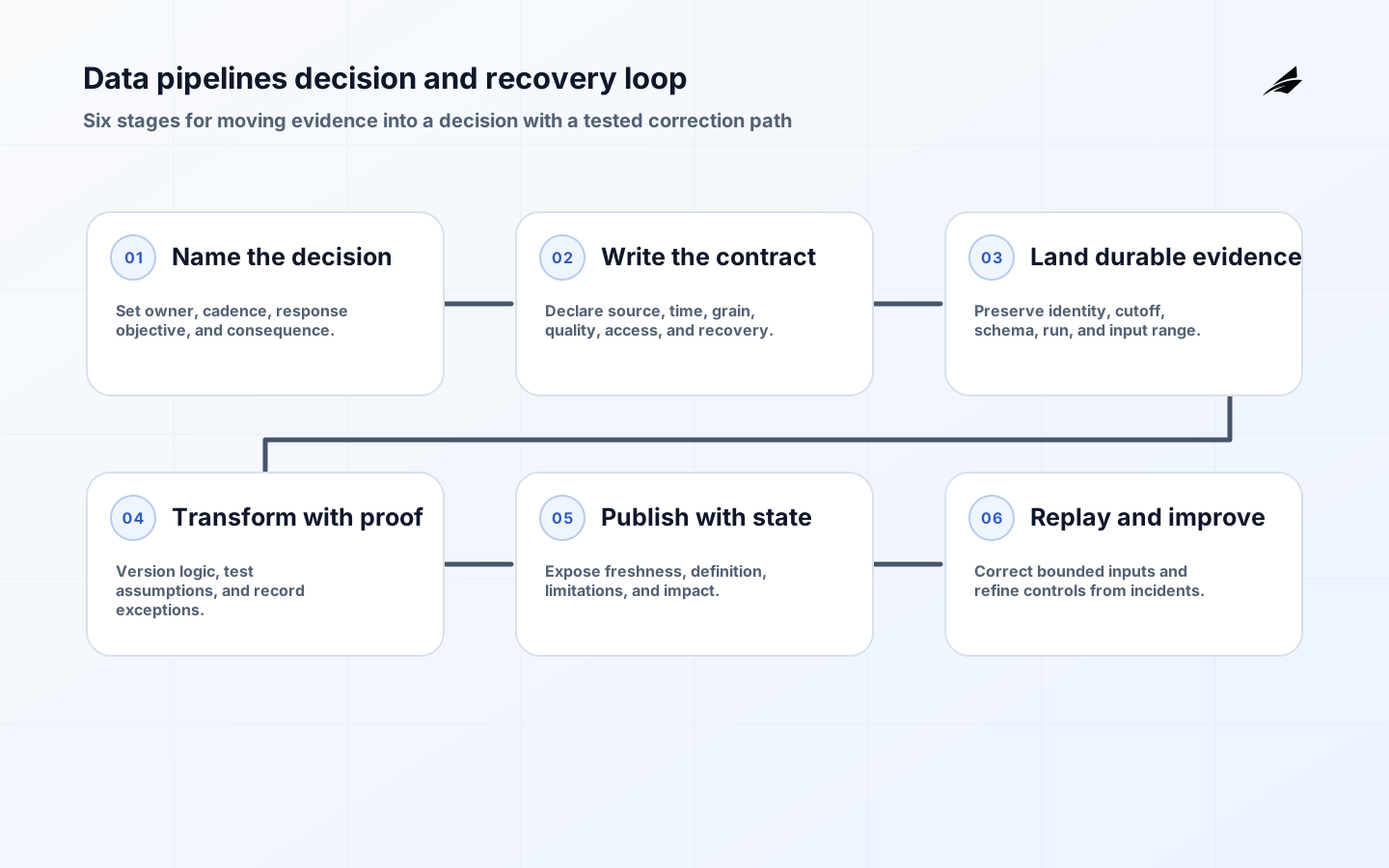
Data Pipelines for Growing Teams: Recovery by Design
A data pipeline is a managed path from source evidence to a destination where someone or something can act. The central question is whether a decision receives the right evidence at a known time, with enough context to explain freshness, quality, provenance, and recovery. A pipeline that completes after loading only part of a billing source is more dangerous than a visible failure when the dashboard looks current. Start with one decision, preserve run evidence, and decide what a late or corrected record means before adding components.
Choose the decision before the pipeline shape
Write the decision in one sentence: at this cadence, this owner chooses this action using these measures. Then name source owners, keys, event time, cutoff, transformation rules, destination, access, freshness expectation, and response when evidence is incomplete. A planning pipeline may preserve yesterday's certified state when today's source is late; a fraud pipeline may need a lower-latency path and a bounded fallback. Do not promise real time when the business only needs a daily answer, and do not accept a daily batch when a missed event creates immediate harm. Dataflow documentation covers both batch and streaming patterns; use the processing mode to serve the business timing, not to signal technical ambition.
| Contract element | Decision | Operational evidence |
|---|---|---|
| Source | Which system and owner is authoritative? | Source ID, schema, expected volume, and contact. |
| Time | Which timestamp and cutoff define the result? | Event time, ingest time, watermark, and published cutoff. |
| Quality | What must be true before publication? | Assertions, reconciliation, and exception state. |
| Recovery | How can the result be replayed or corrected? | Run ID, input range, version, and replay procedure. |
Separate evidence, computation, meaning, and publication
Separate ingestion, durable landing, transformation, publication, and observation enough that a failure can be localized. Preserve source identifiers, input ranges, schema versions, run IDs, and transformation versions. Make loads idempotent where possible so retry does not duplicate business records. A Kafka topic or similar durable stream can preserve event order within a partition and support replay, but partition keys and retention become part of the contract. W3C PROV describes entities, activities, derivations, and agents; those concepts translate into source records, pipeline runs, output datasets, and accountable owners. A pipeline should let an operator answer which input produced an output and which code or configuration was responsible.

Quality needs context. W3C's Data Quality Vocabulary provides a way to describe dimensions and measurements, but a completeness score has meaning only relative to a population and decision. Track missing keys, duplicate records, late arrivals, invalid values, reconciliation gaps, and distribution shifts; classify whether each blocks publication, qualifies it, or waits for the next run. Keep raw or source-shaped evidence when policy permits so a correction can be replayed without inventing a second source of truth. The analytics documentation guide helps surface the definitions, cutoff, and limitation that users need at the destination.
| Layer | Responsibility | Failure signal |
|---|---|---|
| Landing | Preserve source shape, identity, time, and access context. | Missing file, schema drift, volume anomaly, or late arrival. |
| Transform | Apply versioned logic, deduplication, and business rules. | Test failure, duplicate key, or unexpected join growth. |
| Publish | Expose definition, status, freshness, and permitted detail. | Stale output, unexplained shift, or access mismatch. |
| Operate | Alert, communicate, repair, replay, and learn. | Unowned incident, repeated workaround, or slow recovery. |
Give late data a visible correction route
Use representative data and real users to test a pipeline. Include a source delay, schema addition, duplicate event, malformed record, permission failure, partial write, and backfill. The release is ready when the decision owner can see what was published, what is missing, and how to respond. A technical job status is not enough. Build a run view that shows start and end time, source cutoff, records accepted and rejected, quality checks, output version, and downstream impact. If a dashboard or semantic model consumes the result, link the release to that exposure and document the state that readers should see during an incident. ELT workflow guidance can help when the pipeline combines raw landing with warehouse transformation.
Choose batch or streaming from response need and correction behavior. Batch can be simpler to reconcile and replay; streaming can reduce latency but must handle ordering, duplicate delivery, late events, state, and retention. Kafka's operational model makes partitions, consumer progress, and retention observable concerns, while Dataflow highlights managed processing patterns and windowing choices. In either mode, name the unit of progress. A stream job should expose offsets or watermarks; a batch job should expose input range and output version. Without that evidence, an operator cannot tell whether a restart is safe or whether a replay will duplicate effects.
Use pipeline signals to protect the decision
Measure freshness against the decision promise, not against a generic target. Track source-to-target reconciliation, accepted and rejected records, lag, throughput, retry rate, failed-run recovery time, backfill duration, cost per useful output, and unresolved exceptions. Segment signals by source, release version, business unit, and partition to find concentrated failures. Review a normal run, an exception, a change request, and a user question. Ask whether anyone acted on a qualified result, whether a manual correction was needed, and whether the pipeline preserved enough evidence to explain it. Retire checks that create noise, but add controls after a meaningful incident or source change. Reliability is the ability to make safe decisions repeatedly, not a dashboard of green jobs.
Recovery objectives should reflect downstream harm. Keep the last certified output when a daily report can tolerate delay; freeze and visibly qualify a result when a compliance export is incomplete; route an emergency decision to a human when automation cannot establish evidence. A replay needs a boundary: input events, transformation version, target state, deduplication key, and side effects. Test an upstream correction and partial replay, not just a failed-job retry. Preserve audit evidence around the original and corrected outputs so a reviewer can explain why a number changed. A small recovery exercise often reveals missing ownership faster than a large architecture review.
Trace one correction from source to decision
A practical pipeline review follows a completed run rather than a diagram. Pick a normal run and record the source cutoff, input identifiers, accepted and rejected records, transformation version, quality results, output state, and the decision that used the result. Then pick a troublesome run with a late source or correction and compare the evidence. Can the operator tell which output was certified? Can the decision owner see what is missing? Can the team replay only the affected range without duplicating records or triggering an external side effect? These questions reveal whether the architecture is observable in the way users actually need.
Use the review to tune the service level. If the source is frequently late but the decision can wait, change the cutoff or publish a qualified prior state rather than paging on every delay. If the output is used before reconciliation, move the control earlier or make draft status unavoidable. If a backfill requires a specialist, document the boundaries and rehearse it with a second operator. The goal is not to remove every exception; it is to ensure exceptions have a predictable state, owner, communication path, and recovery action.
Related Edilec reading: metric layers, ELT workflows, and BI dashboard reliability connect pipeline evidence to analytics decisions.
Source context: Google Cloud Dataflow explains managed batch and streaming processing; Apache Kafka 4.3 Design covers durable event-stream concepts; the W3C Data Quality Vocabulary provides quality dimensions; and W3C PROV supplies provenance concepts for evidence and responsibility.
Key takeaways
- Start with a decision, owner, cadence, cutoff, and response to incomplete evidence.
- Preserve source identity, run state, transformation version, quality results, and downstream impact.
- Choose batch or streaming from latency, ordering, correction, and replay requirements.
- Make unhappy paths visible and test delay, drift, duplicates, permission failures, and partial replay.
- Measure safe decision support, recovery, and useful cost rather than job completion alone.
Frequently asked questions
Do growing teams need a streaming platform?
Only when the decision needs lower latency or continuous event handling and the team can operate ordering, state, retention, replay, and correction. A well-controlled batch pipeline may be more dependable and cheaper for daily planning or finance reporting. Start with the response objective.
What quality checks belong in a pipeline?
Check the assumptions that change the decision: presence, uniqueness, validity, relationships, completeness, freshness, reconciliation, and distribution. Give every check an owner and response state so failures do not become unexplained alerts.
What makes a replay safe?
A bounded input range, stable identity or deduplication key, versioned logic, isolated target or merge strategy, and a plan for downstream side effects. Record original and corrected outputs so the change remains explainable.
Use a daily billing report to test the design. Capture the source cutoff, accepted and rejected records, transformation version, quality results, publication state, and decision that used the output. Then introduce a late file and a corrected record. The team should be able to qualify the current result, replay only the affected range, prevent duplicate side effects, and tell the report owner when the certified state changes. If one specialist must reconstruct the run from memory, the pipeline still has an operational gap.
Data Pipelines for Growing Teams: a decision you can operate
A growing team does not need a large platform before it needs a clear response contract. Define what the decision requires, preserve reconstructable run evidence, separate computation from publication, and expose late or qualified states. Exercise correction and replay while the path is small, then let observed latency, recovery effort, volume, access needs, and failure patterns determine the next component.
For a growing team, make the first pipeline contract concrete with a daily order-fulfillment file. The source owner promises one file per warehouse by 05:30 UTC; the pipeline records file hash, arrival time, warehouse key, event date, row count, and schema version. Validation rejects duplicate order IDs, negative shipped quantities, unknown warehouse codes, and files that mix reporting dates. The decision owner can use the last certified output when the file is late, but a missing warehouse must be shown as a qualification rather than silently omitted. A run record links accepted and rejected rows to the transformation version and downstream dashboard. This contract gives engineers a bounded replay range and gives operations a clear choice at 08:00. It also creates a practical boundary for future streaming: the team can ask whether lower latency changes fulfillment action, or whether continuous processing would only add state, ordering, and correction cost.
The architecture earns trust when a changed source produces an explainable result and a bounded repair rather than a silent rewrite of yesterday's answer.