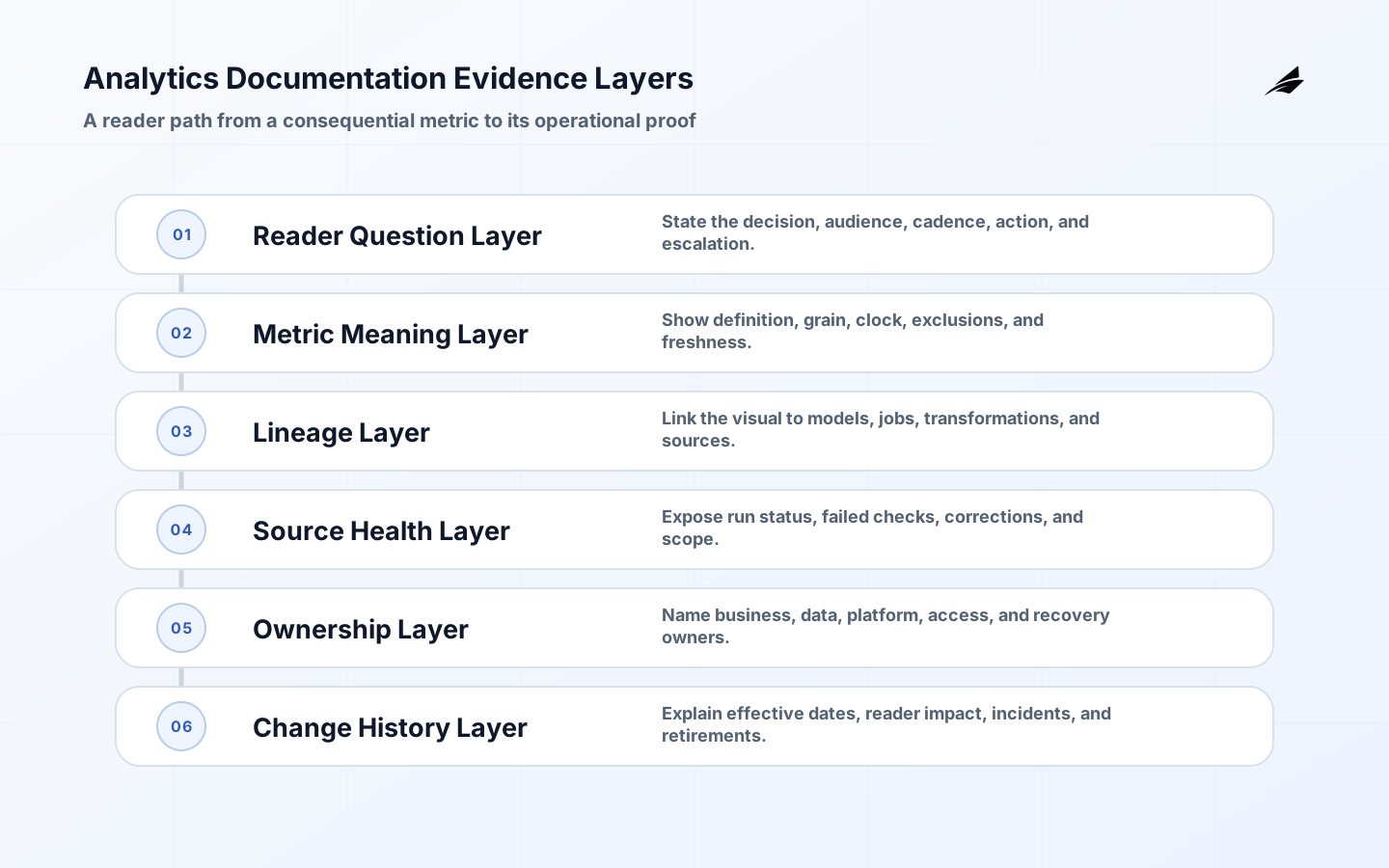
Analytics documentation is useful when it answers the question someone has while deciding, investigating, approving, or changing something. It is not a collection of definitions written once for a governance review. An operations leader needs to know what a backlog measure includes, when it was refreshed, who owns a mismatch, and which records explain the total. An analyst needs the source and transformation path. A new manager needs the threshold and intended action. Design documentation around those moments so it reduces interruption and unsafe assumptions instead of becoming a separate library that nobody opens.
Document the decision before the artifact
Analytics documentation should answer the question a reader has at the moment a number matters: what does this measure mean, where did it come from, how current is it, who can correct it, and what changed since last time? A catalog full of table descriptions cannot do that by itself. Start at a decision or report, then connect the definition to source records, transformation logic, freshness status, owner, access conditions, and a change history. OpenLineage documentation is useful because it treats jobs, datasets, and runs as connected operational facts rather than prose fragments. The NIST data governance profile reinforces the need to assign responsibility for data activities. Keep the first scope small: a high-use dashboard, its core metrics, and one investigation route. When an incident or a release teaches the team something new, update the same record that readers consult; that is how documentation becomes evidence instead of a stale archive.
Begin with the operational question a report or dashboard supports. For example, “Which cases must be reassigned before the service-level commitment expires?” is more useful than “operations dashboard.” Record the reader, frequency, action, population, timing, source precedence, and escalation route. That creates a short decision record that links naturally to metrics, models, and controls. It also reveals where documentation is missing: a number cannot be operationally clear if nobody owns its exceptions. Executive dashboards operations guidance provides a useful example of turning a high-level view into a decision tool rather than a presentation.
| Documentation item | Reader's question | Keep it current by |
|---|---|---|
| Metric record | What does this number count and exclude? | Reviewing with metric changes |
| Dataset record | Where does this data come from and how fresh is it? | Generating from pipeline metadata where possible |
| Dashboard brief | What action is this page meant to support? | Reviewing with the decision owner |
| Incident note | What failed, who was affected, and what changed? | Completing during resolution |
Make evidence navigable
Readers should be able to move from a visual to a metric definition, source status, contributing records, and an owner without searching several systems. That does not require putting every technical detail on a dashboard. It requires stable links and a sensible hierarchy: a short reader-facing explanation, a deeper model or lineage view for investigators, and an incident or change history for operators. Use the same names across these layers. If a report calls a measure “fulfilled orders” while the model calls it “completed shipments,” the documentation has already introduced a translation burden that will return during an incident.
- Keep a concise definition, owner, grain, time rule, and material exclusions beside every consequential metric.
- Link dashboards to data status and a correction path instead of embedding stale explanatory text in screenshots.
- Record sources of truth and matching or precedence rules when several systems can disagree.
- Use generated lineage and run metadata where available, then add human explanations for business choices.
- Write change notes in terms of reader impact, not only implementation details.
Run documentation as an operating practice
Documentation stays alive when it is part of normal delivery. Add a small review to new metrics, changed sources, dashboard releases, and incident closure. Make ownership explicit: business owners approve meaning and thresholds; data or engineering owners explain implementation, freshness, and recovery; platform owners explain access and retention. Automated extraction can maintain table, column, and job metadata, but it cannot decide whether a cancelled appointment belongs in a service KPI. Protect time for that human decision, then capture it where the next reader can find it. The goal is a maintained operating memory, not a perfect encyclopedia.

| Trigger | Documentation update | Evidence of completion |
|---|---|---|
| New metric | Definition, owner, grain, and first reconciliation | Review record and linked test |
| Source migration | Precedence, lineage, freshness expectation, rollback | Consumer impact note |
| Dashboard release | Decision brief, audience, access, and support route | Pilot feedback and release note |
| Data incident | Scope, temporary workaround, root cause, preventive change | Resolved incident record |
Avoid common documentation failures
The common failure is documentation that describes components but not consequences. A table catalog without grain, freshness, or ownership still leaves an operations lead unable to decide whether to trust a result. Another failure is writing only for specialists: technical lineage matters, but it does not replace a plain-language statement of what a metric means. Finally, avoid assigning a single documentation owner for every domain. Central teams can set standards and maintain tooling, while the people closest to a decision must own its business rules. That balance is what allows material detail to remain current.
Work through a practical case
A support organization tracks first-response compliance. The documentation starts with the service commitment, the clock used to calculate it, the ticket states that pause the clock, and the teams responsible for correcting a misclassified ticket. The dashboard shows the current percentage and freshness. A linked metric record explains that reopened tickets are measured against their original creation time, while a linked model view shows the source fields. When a helpdesk migration changes status codes, the change note explains which historical comparison is affected and which validation sample was reviewed. A manager can now defend the number without knowing the transformation code.
Plan the next review
Treat documentation review as a field exercise. Ask a manager who did not help build the report to answer a recent operational question, trace a surprising number to its evidence, and find the owner of a defect. Time the journey and note where terminology, links, permissions, or missing history block progress. Then ask an engineer to follow the same route from the source change back to the affected reader. The difference between those two experiences reveals whether the documentation connects business meaning and technical evidence. Use release notes and incident records as input, because they often contain the missing context that a static glossary never captures. Small, repeated review is more sustainable than an annual documentation campaign.
- Choose one decision-critical metric each month and verify its definition, owner, links, and exception path.
- Audit broken links and inaccessible records before readers have to rely on memory or chat messages.
- Turn a repeated support question into a scoped documentation improvement with a named maintainer.
- Review whether source and model names still map cleanly to the language used by operators.
- Archive obsolete guidance with a replacement pointer so historic decisions remain explainable without confusing current work.
Access is part of documentation quality. A definition that links to an unreadable model, incident, or source record fails the person trying to verify a result. Design the documentation path for the permissions readers actually have, with a safe escalation route when deeper technical or restricted evidence is needed. Review language as well as links during releases: a renamed workflow, team, or system can quietly make a once-clear explanation misleading. These small maintenance actions prevent documentation from decaying between formal governance reviews. The review itself should verify both normal and restricted roles, because a secure but inaccessible evidence path still leaves operations without a dependable answer.
Connect the practice to the wider data system
Useful documentation connects the work that otherwise becomes disconnected during a dispute. Analytics documentation decisions offers a starting scope, event analytics shows why event context matters, and data lineage supplies the dependency view needed before changing a source or metric.
Key takeaways
- Write documentation for decisions, investigations, and changes, not for passive inventory.
- Give consequential metrics a visible definition, owner, freshness expectation, and exception route.
- Connect reader-facing explanations to lineage, source status, and supporting records.
- Update documentation as part of release and incident work, with owners close to the domain.
- Explain change in terms of decision impact so consumers can compare results responsibly.
FAQ
Should documentation be generated automatically? Generate technical metadata and lineage whenever reliable tooling can do it, but retain human review for business meaning, source precedence, and operational action. How much documentation is enough? Enough for the intended reader to understand what a result means, assess its freshness and limits, find an owner, and investigate a meaningful discrepancy. Start with decision-critical assets, then use support questions and incidents to decide what detail to add.
Conclusion
Strong analytics documentation is an operating aid. It connects a number to its purpose, definitions, evidence, owner, and change history at the moment someone needs to act. Build it into delivery and incident habits, automate what is mechanical, and keep business choices visible. The result is not more documentation for its own sake; it is faster, more defensible operations when data is questioned or changed. Prioritize discoverability over exhaustive prose: a short, current explanation linked to its supporting evidence is more valuable than a perfect description hidden in a separate repository. Use the language of the people doing the work, then link to the technical identifiers maintainers need. That small translation layer reduces the risk that different teams build parallel definitions. Over time, documentation quality should be judged by whether it shortens onboarding, resolves disputes, and improves incident recovery, not by page count or field coverage alone.