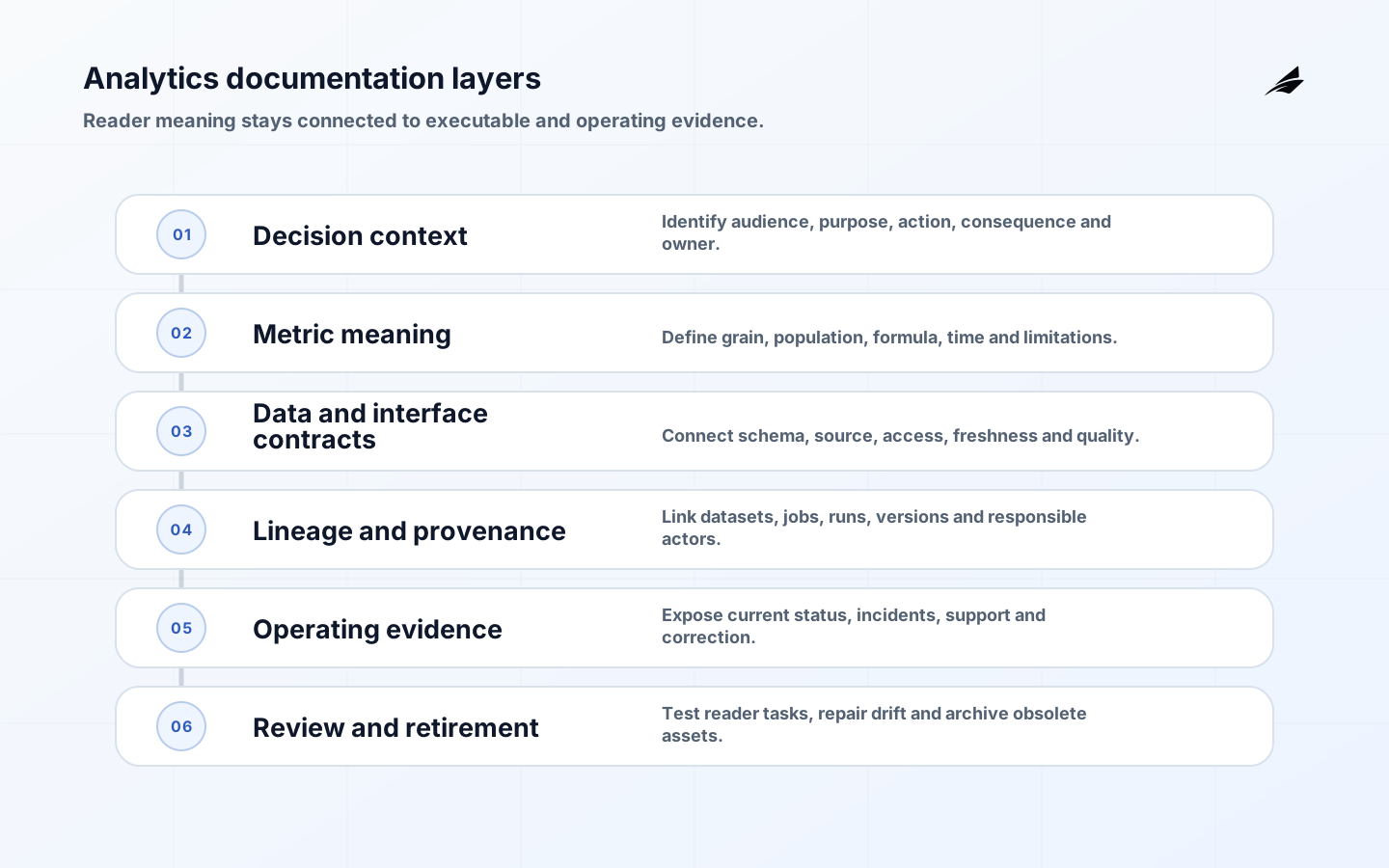
Analytics documentation for operations leaders is the evidence that lets a person interpret a number, trace a surprise, make a decision and change the system safely. A catalog entry or dashboard description is only one layer. Useful documentation connects business meaning to source contracts, transformations, quality, lineage, access, operating status, ownership and change. It should answer common questions without oral history while preserving links to executable truth.
Pair this operating model with Edilec's analytics documentation operations playbook, data lineage architecture guide and semantic-layer guide. Those resources go deeper on stewardship, provenance and governed metric execution.
Document the decision before the artifact
Start with audience, purpose, decision, cadence, consequence and owner. A warehouse table, semantic metric, dashboard, alert and exported file may all support the same decision but require different technical records. Describe what a user should conclude, what actions are available and what limitations matter. This prevents documentation from becoming a list of column names that never explains why the asset exists.
For each metric, record name, plain-language meaning, grain, population, formula, units, time zone, event-time rule, dimensions, exclusions, source, owner, freshness, quality thresholds and change policy. Include examples and counterexamples. Link the human definition to semantic code or query tests. Operations leaders should be able to distinguish a business-definition dispute from stale data or a pipeline failure before escalating.
| Question | Documentation layer | Authoritative evidence | Owner |
|---|---|---|---|
| What does this number mean? | Metric definition | Approved semantic logic | Business owner |
| Where did it come from? | Lineage and source contract | Run and transformation metadata | Data owner |
| Is it current and healthy? | Operating status | Freshness and quality results | Service owner |
| Who may use it? | Access and classification | Policy and entitlement record | Data steward |
| What changed? | Version and decision history | Release, diff and approval | Product owner |
Build a linked documentation model
Give assets stable identifiers and represent relationships among datasets, distributions, services, owners and themes. The W3C Data Catalog Vocabulary 3 provides a web standard for catalog interoperability and dataset or data-service descriptions. An organization need not implement RDF to benefit from its concepts. Separate a dataset from a file or API distribution, state access and update characteristics, and make relationships machine-readable enough to prevent disconnected inventories.
Document interfaces close to their implementation. The current OpenAPI Specification defines a language-agnostic description for HTTP APIs that tools and people can interpret. Use structured specifications for schemas, required fields, errors and examples; add business purpose, data classification, service commitments and change governance around them. Generate reference material from code where possible, but review generated output for usefulness and sensitive detail.
Connect provenance, lineage and run evidence
Lineage should help answer impact and investigation questions, not merely draw a large graph. Record source, transformation, output, job, run, version and ownership at useful granularity. The W3C PROV-O recommendation supplies general concepts for entities, activities, agents and derivation. Use those ideas to distinguish what data was produced, by which process and under whose responsibility.
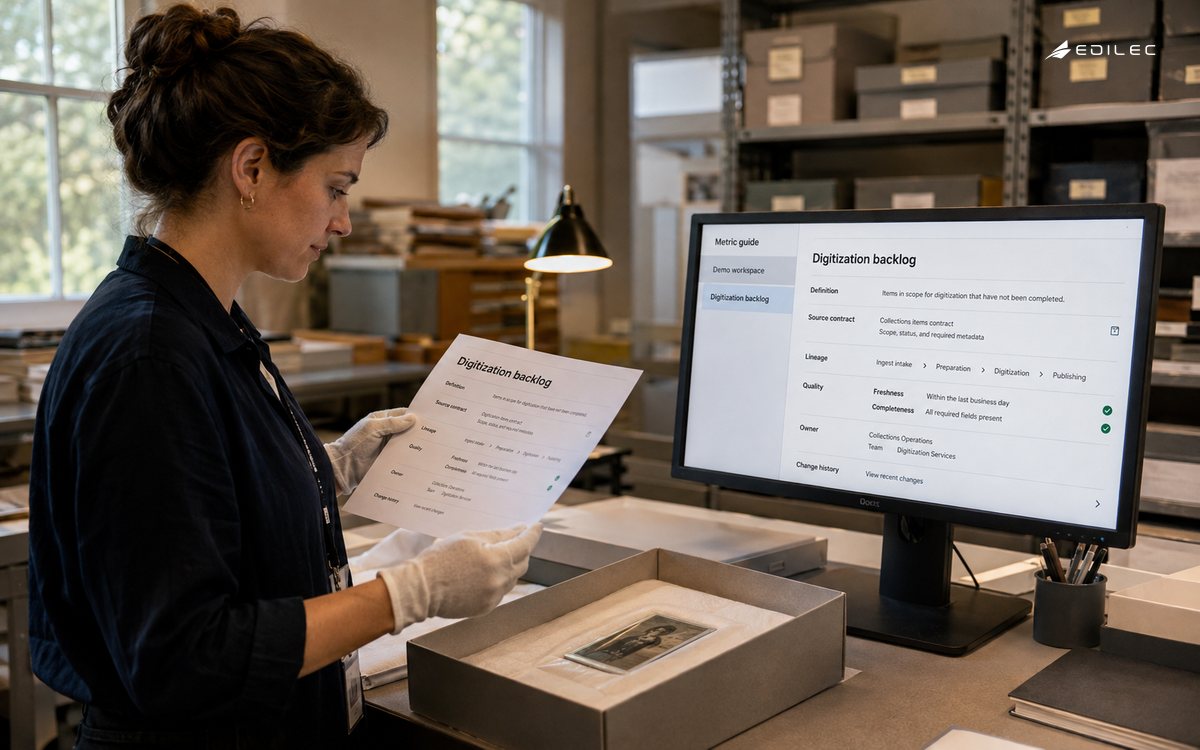
For operational capture, the OpenLineage API specification defines events and facets for jobs, runs and datasets. Instrument orchestration and transformation platforms where it materially improves impact analysis and incident diagnosis. Automated lineage still needs interpretation: dynamic SQL, external files, manual adjustments and business rules may be incomplete. Display confidence and gaps rather than implying a complete graph.
Run documentation as an operating practice
Create documentation in the delivery definition of done, with named review for decision-critical assets. Validate required metadata, broken links, schema drift and owner status in CI or scheduled checks. Show current freshness, quality incidents and support route beside static definitions. A perfect page from six months ago can be more dangerous than an obvious gap because readers assume it describes the current release.
Set lifecycle states such as draft, reviewed, certified, deprecated and retired with clear meaning. Require owners to review at a risk-based cadence and after material source, logic or policy changes. Notify consumers before breaking change, provide migration guidance and retain superseded definitions long enough to explain historical reports. Archive obsolete assets from ordinary search while preserving audit evidence according to retention requirements.
| Trigger | Required update | Verification | Consumer notice |
|---|---|---|---|
| Source schema change | Contract, lineage and quality rules | Compatibility test | Before breaking release |
| Metric logic change | Definition, examples and effective date | Parallel result comparison | Decision owners and report users |
| Ownership change | Owner and support route | Acknowledged handover | Catalog subscribers |
| Incident | Status, impact and correction | Reconciled rerun | Affected consumers |
| Retirement | Replacement and retention | Dependency scan | Deadline and migration path |
Make documentation findable without leaking data
Support search by business term, owner, system, field, dashboard and decision. Provide glossary aliases and show related assets, but rank current governed content above abandoned drafts. Measure successful tasks such as finding an owner or tracing a metric, not page count. Microsoft's analytics adoption maturity guidance includes clear ownership and solution documentation among mature practices, reinforcing that documentation serves effective use rather than publication volume.
Classify documentation itself. Schemas, samples, query text, incident notes and lineage can reveal personal data, commercial logic or security architecture. Apply role-based access and redact examples while keeping definitions broadly available where possible. Do not copy credentials or live customer records into examples. Record access requests and provide a route for legitimate users to obtain deeper technical evidence.
Review quality through reader tasks
Sample a metric and ask a new analyst to explain its population, trace one output to source and run, identify the current owner, determine freshness and find the last material change. Ask an operator to assess impact from a proposed schema change. Time the tasks and record ambiguity. This exposes broken relationships that metadata completeness scores miss.
Track search success, unresolved questions, stale ownership, broken links, undocumented critical assets, incident investigation time and change defects. Review recurring questions for missing structure or vocabulary. Avoid targets that reward empty descriptions. A smaller catalog that supports decisions and incidents is better than a complete inventory nobody trusts. Fund documentation repair as product work when it repeatedly delays operations.
Implement the documentation model in risk-based increments
Start with a critical decision journey rather than an enterprise catalog rollout. Select one dashboard or operational report, its semantic metrics, transformations, sources and owners. Create stable identifiers, minimum metadata, lineage and current status. Ask readers to complete interpretation and investigation tasks, then improve the model before adding another domain. This exposes vocabulary and ownership problems while the scope is still manageable.
Define a minimum record by asset type. A metric needs formula and population; a source needs contract and owner; a pipeline needs run, schedule and recovery; a dashboard needs decision, audience and freshness. Make fields required only when they support a known task. Conditional requirements produce better records than one universal form that invites placeholders. Publish examples of good entries and reasons behind each field.
Integrate capture with tools teams already use: schema repositories, transformation projects, orchestrators, catalogs, BI platforms, issue trackers and service management. Prefer APIs and events over repeated manual copying. Establish an authoritative location for each fact and link to it elsewhere. Synchronization must preserve version and source; otherwise automation spreads stale ownership faster than people can correct it.
Fund stewardship and maintenance explicitly. Domain owners need time to approve definitions and resolve conflicts, while platform teams operate search, metadata ingestion, permissions and quality checks. Track the backlog of missing high-risk evidence and review it with incidents and planned changes. Documentation debt is most expensive when a service fails or a producer changes, so prioritize records that reduce those consequences.
Establish vocabulary governance for terms that cross domains. Record preferred term, aliases, definition, steward, scope and relationships; do not erase legitimate domain differences behind one forced label. When sales and finance use revenue differently, show both qualified concepts and the reconciliation between them. Search should recognize aliases while dashboards and contracts reference the precise term. Review disputes through decision use, source authority and consequence, then publish the resolution and effective date.
Design disaster recovery for the documentation service itself. Export critical definitions, ownership, contracts and lineage in an accessible format; back up configuration and test restore. During a catalog outage, operators still need runbooks, source contacts and metric meaning. Avoid making one proprietary interface the only copy of evidence required to operate or migrate data products. Recovery and export tests are also practical checks on metadata portability. Include the documentation platform in continuity exercises and verify that restored identifiers still resolve from dashboards, alerts and transformation repositories. Record recovery time and any links that require manual repair during real operational pressure.
Key takeaways
- Begin with the decision, audience and consequence.
- Link plain-language definitions to executable logic and tests.
- Represent data, interfaces, provenance and runs as connected evidence.
- Update documentation through delivery and incident workflows.
- Protect sensitive technical detail while keeping meaning discoverable.
- Test documentation by real investigation and change tasks.
Analytics documentation FAQ
Who owns analytics documentation?
Ownership is distributed. Business owners approve meaning, data owners govern sources, engineers maintain executable contracts and service owners maintain operating status. One product owner should coordinate the reader experience.
Can documentation be fully generated?
Technical reference and lineage can be generated, but purpose, decision context, limitations and approved meaning require accountable human input. Generated documentation should remain linked to versions and tests.
How much documentation is enough?
Enough for intended readers to interpret, operate, investigate and change the asset safely. Prioritize consequential and widely reused products, then use task failures to identify the next gap.
Conclusion
Analytics documentation is part of the operating system for trustworthy decisions. Connect meaning to contracts, lineage, current health and change; keep ownership visible; and test whether readers can complete real tasks. Documentation then reduces uncertainty instead of merely recording inventory.