Data Lineage for Growing Teams: Evidence and Impact
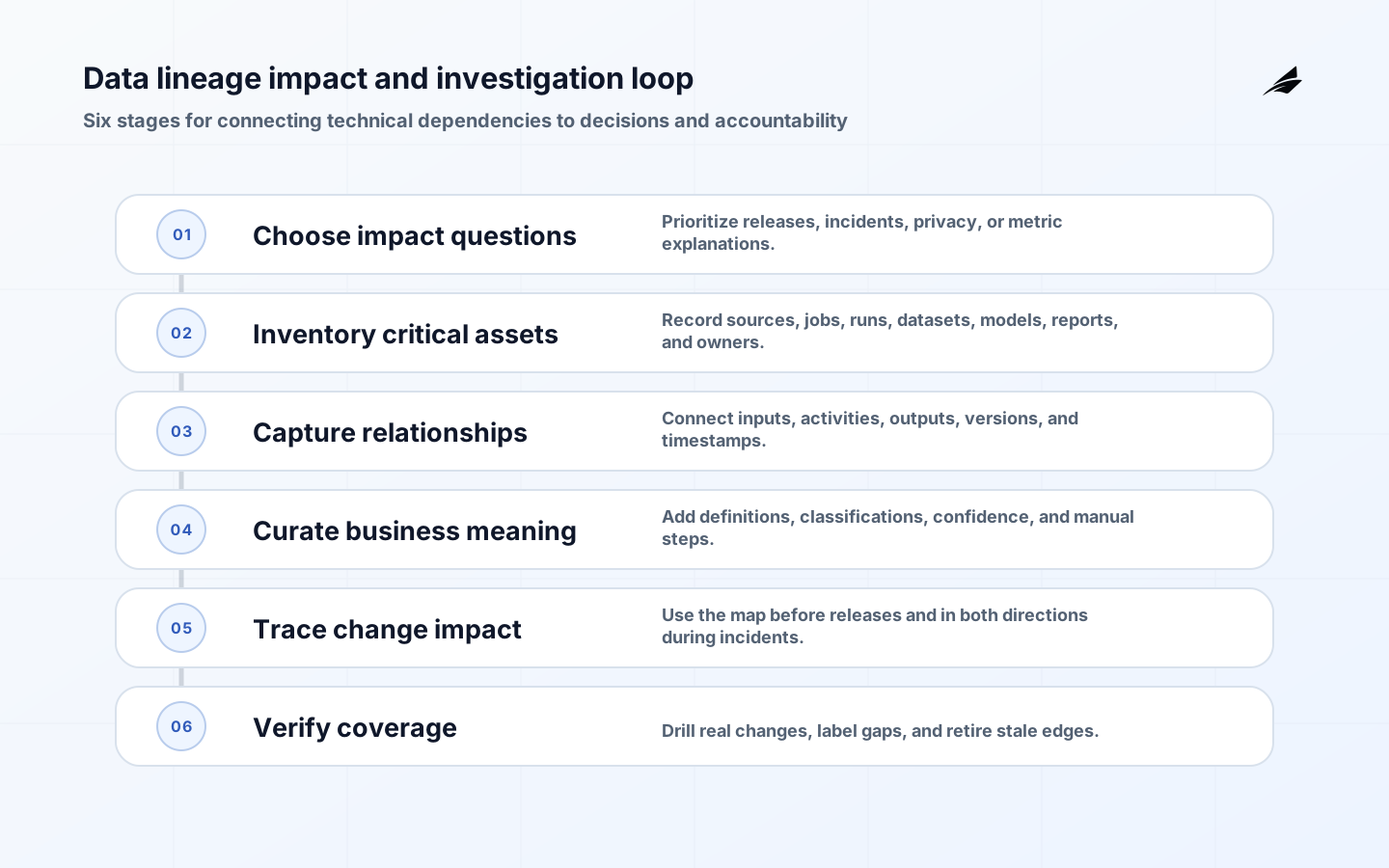
Data lineage earns its place when it answers an operational question: which reports depend on this source, what changed before a number moved, who owns the failing step, or which consumers are affected by a release? A table-and-arrow inventory is not enough if it is stale or disconnected from business meaning. Start from impact and investigation questions, then capture the relationships and evidence needed to answer them. Provenance is a record of what happened, when, under which activity, and with whose accountability.
Begin lineage with an impact question
Prioritize consequential outputs: regulatory reports, executive metrics, customer statements, operational queues, and models that drive action. For each, ask where the source begins, which transformation creates meaning, which human or system owns each boundary, how current the map must be, and what evidence is required during an incident. A CTO may need release impact before changing a customer dimension; a data steward may need a field-level path to resolve a classification issue; an analyst may need a source link to explain a metric. These are related but not identical products. Define the minimum granularity and confidence each question needs before buying a catalog or instrumenting every job.
| Question | Minimum lineage evidence | Decision it enables |
|---|---|---|
| What will this source change affect? | Source-to-model-to-report dependencies and owners. | Sequence release, notify consumers, or block change. |
| Why did this value move? | Run, version, input range, transformation, and quality state. | Investigate logic, source, late data, or legitimate change. |
| Who can fix it? | Technical and business ownership at each boundary. | Route incident and approve definition or access change. |
| Can we trust the map? | Collection time, coverage, tests, and manual links. | Use lineage with known confidence or gather evidence. |
Capture runtime facts before drawing relationships
Technical lineage can come from query parsing, orchestration metadata, warehouse catalogs, transformation manifests, and runtime events. OpenLineage provides an open framework for collecting lineage events around jobs, runs, and datasets; use that kind of event evidence to avoid relying on one static scan. Capture source and target identifiers, job or activity, run ID, version, timestamps, inputs, outputs, and failure state. Then add business context: owner, definition, classification, criticality, service level, manual step, and approved audience. A table name does not tell a reviewer whether it represents orders, invoices, or a customer support case; names and descriptions need to travel together.
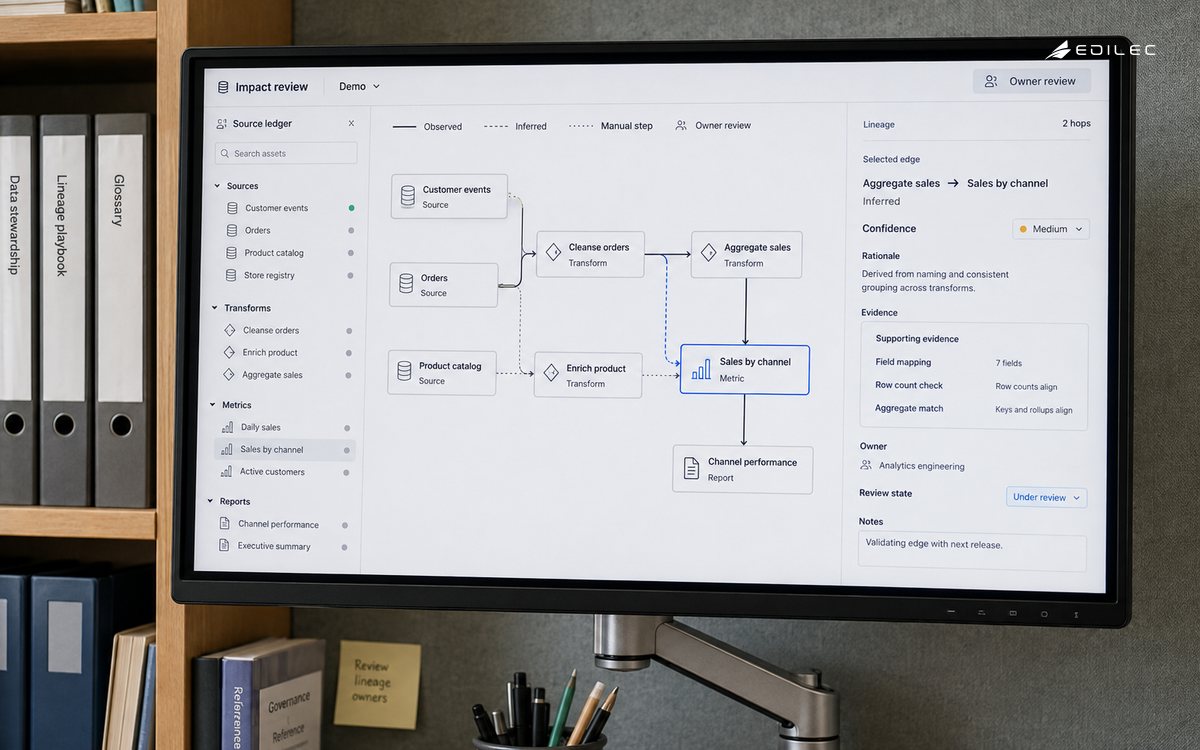
Lineage is not automatically truth. Dynamic SQL, stored procedures, manual uploads, external APIs, row-level filters, and semantic calculations can create gaps. Mark inferred, observed, curated, and manually confirmed relationships differently. Link tests and quality measurements so a user can see whether a dependency was healthy when the output was produced. The data quality guide can help teams connect lineage coverage to the quality conditions that make a trace useful.
| Lineage layer | Capture | Known limitation |
|---|---|---|
| Source and ingestion | System, object, owner, schema, arrival, and access boundary. | External or manual sources may be invisible to scanners. |
| Transformation and runs | Job, query, code version, run ID, inputs, outputs, and status. | Dynamic SQL and uninstrumented tools can hide edges. |
| Business and semantic | Definition, metric, field meaning, classification, and consumer. | Meaning can change without a code change. |
| Confidence and review | Collection time, test state, manual confirmation, and coverage. | A complete-looking graph can still be stale. |
Attach business meaning and confidence to provenance
Before changing a source column, model rule, metric definition, or access policy, search downstream dependencies and contact owners of consequential consumers. Classify the change as additive, breaking, semantic, access-related, or operational. A field rename may break a model; a datatype change may silently alter a join; a metric definition may preserve schemas while changing incentives. Record the impact decision and effective date. During an incident, move in both directions: from a failed output back to source and from a changed source forward to reports, APIs, or exports. Preserve the run and version that produced the affected output so investigators can separate new bad data from a previously published state.
Use lineage to shorten coordination, not to replace judgment. An automatically discovered edge can show a likely consumer, but the owner must decide whether the consumer is material and what communication is required. For dashboard and semantic-layer consumers, use the analytics documentation guide to connect technical paths to definitions and permitted use. For dbt models, data tests can provide evidence that a relationship or key assumption held at a point in time, but a passing test does not prove every downstream dependency was captured.
Use lineage during releases and incidents
Treat lineage emission and curation as delivery requirements. A new pipeline should publish dataset and run metadata; a new semantic metric should identify its model and owner; a manual spreadsheet should be registered if it materially affects a decision. Monitor stale edges, unowned assets, unexplained orphan nodes, missing runs, coverage by critical output, and impact queries that return incomplete results. Review a normal release, a breaking change, a manual step, and an incident. Ask whether the map helped a person act faster and whether any inferred relationship misled them. Retire lineage for decommissioned assets so the graph does not accumulate historical noise that obscures current risk.
Test coverage with a changed metric
Choose a realistic change, such as renaming a source field, changing a status value, or altering a metric's population. Ask the team to use lineage to identify affected models, reports, exports, owners, tests, and documentation. Compare the result with the dependencies observed in a test environment or recent release. Mark each edge as confirmed, inferred, stale, or missing. This drill exposes where parsers cannot see dynamic SQL, where manual work is undocumented, and where a report depends on a semantic definition that is absent from technical metadata.
Run a second exercise from an incident: begin with an incorrect output and trace backward to the first changed or missing input. Preserve the run, code version, input range, and quality state that support the conclusion. If the map cannot answer, record the smallest metadata or ownership change that would make it answerable next time. Over several drills, prioritize high-impact gaps instead of trying to achieve perfect graph coverage. A lineage program earns trust when it shows both what it knows and what it cannot yet prove.
Related Edilec reading: data quality for growing teams, ELT workflows for growing teams, and data lineage architecture provide adjacent practices for trustworthy dependencies.
Source context: W3C PROV-DM defines entities, activities, derivations, and agents; OpenLineage documents runtime metadata events; the W3C Data Quality Vocabulary gives quality measurement context; and dbt data tests provide test evidence that can anchor confidence.
Key takeaways
- Start with impact and investigation questions, not a universal graph of every asset.
- Capture runs, versions, inputs, outputs, owners, definitions, and confidence alongside technical edges.
- Use lineage before semantic, schema, access, and source changes; use it in both directions during incidents.
- Mark inferred and manually curated relationships so reviewers understand evidence strength.
- Measure whether coverage improves release impact analysis and incident response, then retire stale assets.
Frequently asked questions
Do we need a lineage platform?
A platform can collect and query metadata at scale, but it cannot define the questions, fill manual boundaries, or assign ownership by itself. Start with a critical output and prove that the map improves a release or incident decision; use the evidence to choose tooling and coverage priorities.
Should lineage be column-level?
Use the smallest level that answers a consequential question. Dataset-level lineage may be enough for job impact, while field-level lineage can matter for privacy, finance, or breaking schema changes. More detail increases collection and interpretation cost, so prioritize sensitive and decision-critical fields.
How do we know lineage is trustworthy?
Show collection time, source of the relationship, run coverage, test state, manual confirmation, and known gaps. Validate the map with a release drill or incident replay; a graph that has never been used under pressure is only an assumption.
Pick a report whose source changed recently and preserve the before-and-after value, source cutoff, model or query version, run identifier, quality state, affected audience, and owner. Trace backward to the first changed input and forward to the decisions and communications that depended on it. Label the edge that comes from automation, the edge confirmed by a steward, and the gap that still requires a person. This drill tests lineage as an investigation aid instead of rewarding a graph that merely looks complete.
Data Lineage for Growing Teams: a decision you can operate
Lineage becomes an operating capability when it helps a responder decide where to look, whom to call, what changed, and which outputs need qualification. Combine technical relationships with definitions, timestamps, run evidence, confidence, ownership, and known gaps. Validate the map with a release-impact review and a real incident trace.
Choose a high-consequence output and build lineage from the question an operator will actually ask. For a weekly revenue dashboard, record the source ledger table, ingestion run, currency normalization job, order-to-invoice join, semantic metric, dashboard version, finance owner, and last certified cutoff. Mark the ledger-to-landing edge observed from a run event, the manual currency exception curated by finance, and the metric definition approved by the controller. Attach the data-test result and reconciliation status to the published value, not just to the model node. If a source field changes, the impact query should return the dashboard, export, owner, effective date, and test that needs review. This is a useful first slice because it connects technical dependencies with a financial decision and exposes the manual edges that a parser cannot infer.
Run a change drill before expanding coverage. Rename a source status, alter a join key type, or change the revenue metric's population in a test environment. Ask the team to identify every affected model, report, export, definition, owner, and test, then compare the answer with observed query and run metadata. Label each relationship confirmed, inferred, manually curated, stale, or missing. The review should produce one repair at a time: instrument a job, register a spreadsheet, add an owner, or publish a definition. Measure time to find impact and the number of critical assets with no accountable responder. A graph is improving when it shortens a release decision or incident investigation, not when it merely contains more nodes.
Stale edges should be retired or marked historical, not left to mislead the next query. Start with consequential decisions, improve evidence at their boundaries, and expand coverage only when the new path will answer a real question.