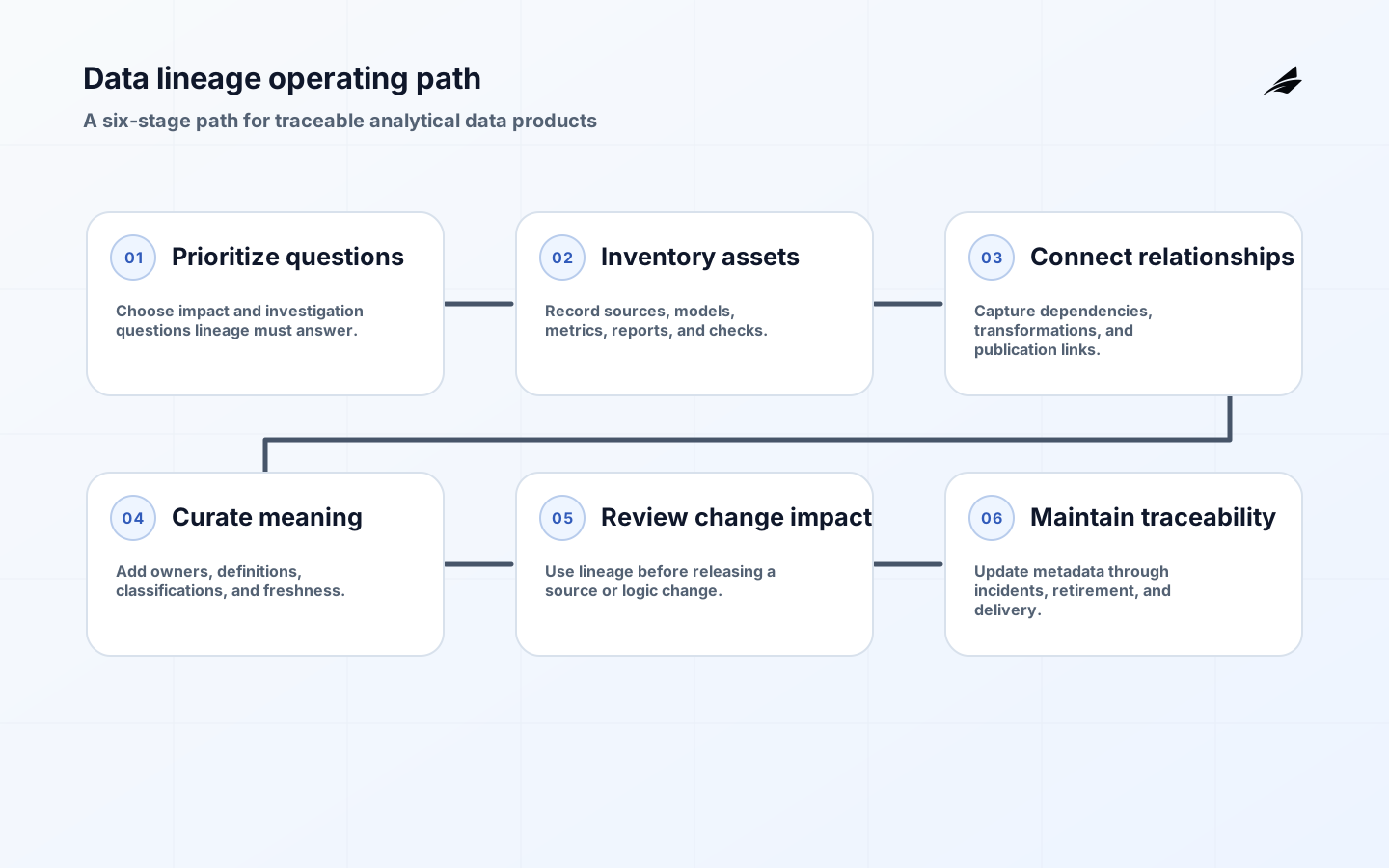
Data lineage architecture makes a result explainable by recording where it came from, how it changed, who owns each step, and what release produced it. It is not satisfied by a static diagram of systems. Useful lineage answers operational questions: Which dashboards depend on a source that is late? Which metrics will change if this transformation is revised? Which source record and rule explain an unexpected customer count? The architecture must connect technical metadata with business meaning, and it must stay current as pipelines and definitions evolve. Google Cloud data architecture guidance is useful context for separating source authority, transformation, and published meaning.
Choose lineage questions before choosing a catalog
Start with the questions people need lineage to answer. Incident responders need downstream impact and freshness context. Analysts need to trace a metric through models to an authoritative source. Governance teams need ownership, classification, and access context. Change reviewers need to see which published assets might be affected. These needs determine the minimum metadata. Trying to capture every execution detail before serving a real question often produces an expensive catalog that users avoid. Instead, choose a critical decision product, map its path end to end, and make that path useful in a review or incident.
- List the investigation, impact, and compliance questions lineage must answer.
- Prioritize business-critical data products and their dependent sources.
- Capture owner, purpose, classification, and freshness alongside technical edges.
- Distinguish observed runtime lineage from designed transformation documentation.
- Set an update path for new assets, changes, and retirements.
Represent the assets that reviewers actually use
An asset inventory should distinguish systems, databases, tables, files, transformations, semantic measures, reports, and data-quality checks. Relationships need direction and context: a model reads from a source, a metric is defined from a model, a dashboard displays a metric, and a test asserts a condition about a model. Preserve identifiers that tools can update automatically where possible, but add human-readable names and descriptions for reviewers. Data model documentation provides a closely related pattern: state grain, keys, history, and ownership so users do not have to reverse-engineer meaning from a technical name.
| Asset type | Lineage metadata needed | Primary user |
|---|---|---|
| Source dataset | System owner, extraction method, classification, and arrival expectation. | Engineers and stewards. |
| Transformation | Inputs, rule version, execution status, and technical owner. | Analytics engineers and incident responders. |
| Published model | Grain, definition, freshness, and accountable owner. | Analysts and product teams. |
| Dashboard metric | Business meaning, supporting model, and decision use. | Leaders and operational readers. |
Separate automated edges from business meaning
Use platform metadata, orchestration records, and transformation declarations to collect technical relationships where practical. Then curate the information automation cannot infer reliably: business definitions, authority boundaries, risk classification, and owner responsibilities. dbt data tests illustrates how transformation assets can carry executable assertions that add valuable lineage context. A catalog should expose the difference between an upstream dependency and an authoritative source; a raw event feed may be upstream of a KPI but not be the place to resolve a commercial dispute. Apache Airflow core concepts helps locate orchestration metadata in the operational path.
- Collect technical dependencies from builds and orchestration rather than drawing them by hand.
- Require owners and definitions for published models and metrics.
- Attach quality checks and freshness expectations to critical lineage paths.
- Review unmatched or stale metadata as an operational backlog.
- Provide links from reports to definitions and from incidents to impact views.
Make lineage part of change and incident work
Lineage becomes dependable when changes update it as part of delivery. A new source or model should register its owner, inputs, classification, tests, and intended consumers before publication. For a breaking change, the delivery review should show downstream impact and the migration plan. The Microsoft guidance on governance reinforces the need for defined ownership and repeatable practices around governed content. Pair that with dbt model security review when lineage includes sensitive transformations, so a dependency analysis also accounts for access and purpose. For wider ownership context, see What IT Managers Should Know About Analytics Governance.
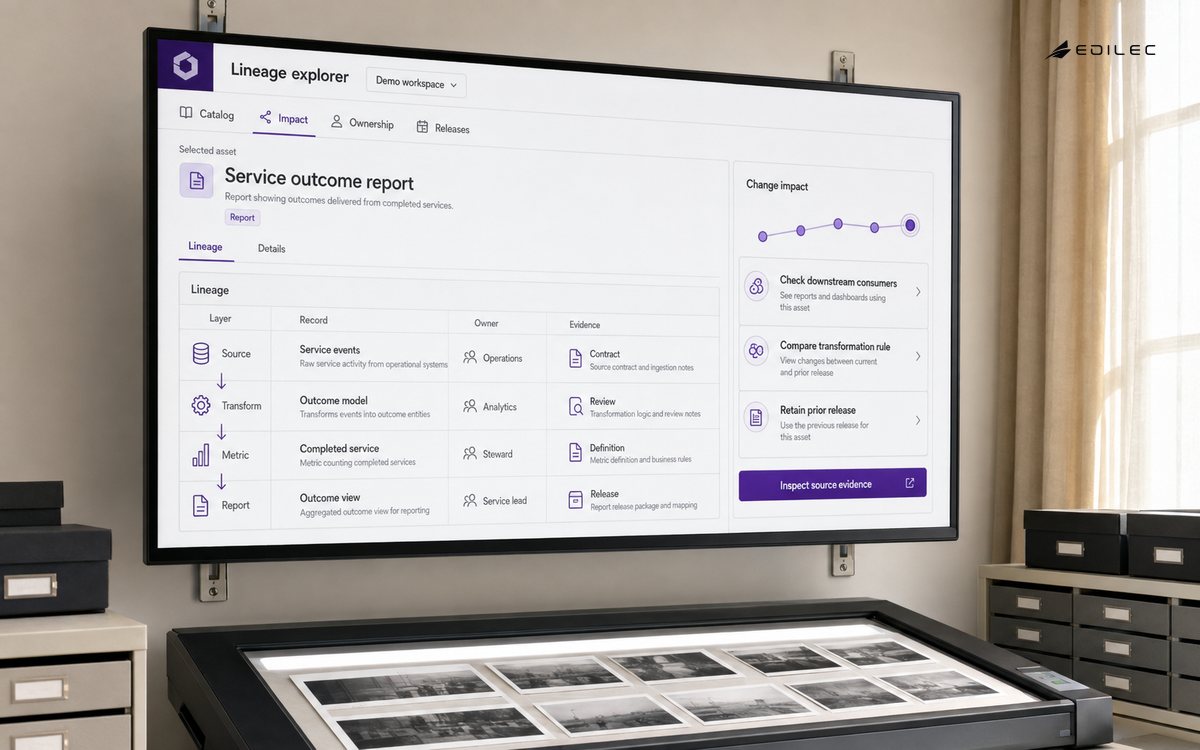
| Lifecycle event | Lineage check | Result |
|---|---|---|
| New source | Is authority, classification, owner, and arrival contract recorded? | Consumers can assess suitability before use. |
| Transformation update | Which published assets depend on the changed logic? | Reviewers can plan tests and communications. |
| Source incident | Which metrics and reports may be stale or incomplete? | Readers receive an accurate scope of impact. |
| Asset retirement | Which consumers still depend on it? | Migration is completed before removal. |
Walk one metric from dashboard to source
Imagine that a leadership dashboard shows active customers and the number drops sharply. The first useful lineage question is not merely which table fed the chart; it is whether the drop came from a source-extraction issue, a change in the active definition, a failed transformation, a delayed publication, or real customer behavior. A usable lineage view can take the reader from the dashboard metric to its semantic definition, supporting model, upstream source datasets, quality checks, latest run status, and accountable owners. That sequence turns a vague concern into a focused investigation.
Now assume a source team plans to rename a status code and retire a field. Before approving the change, the lineage system should identify models, tests, metrics, and reports that depend on that field. Each downstream owner can then decide whether to update logic, preserve compatibility, or retire the asset. The record of this review becomes more valuable than an architecture diagram because it shows how a planned technical change was assessed in business terms. It also prevents a silent breaking change from emerging later as an unexplained reporting discrepancy.
Lineage benefits from a practical service level. Critical assets may require ownership, freshness, definitions, technical dependencies, and downstream impact before publication. Less critical exploratory work may begin with minimal metadata and become more governed when it gains consumers. This proportionate approach keeps the catalog usable and focuses stewardship effort where a failure would affect decisions, customers, or compliance. The architecture succeeds when incident responders and change reviewers reach for it because it answers their questions faster than chat messages or old diagrams. The NIST data governance and management profile adds a governance lens for ownership and stewardship.
- Define the investigation and change-impact questions that each lineage path must answer.
- Register sources, transformations, models, metrics, reports, and quality checks as distinct assets.
- Capture technical dependencies automatically where reliable, then review gaps and ambiguous mappings.
- Require business definitions, owners, classifications, and freshness for critical published assets.
- Link data-quality incidents to affected downstream products and reader communications.
- Review impact before retiring fields, tables, jobs, or semantic measures used by consumers.
- Distinguish raw upstream dependency from the authoritative source for a business dispute.
- Provide direct routes from dashboards to metric definitions and their supporting models.
- Measure stale metadata and unresolved owner assignments as an operating backlog.
- Archive retired assets with enough lineage history to explain past reported results.
Do not wait for a platform-wide inventory to prove value. Choose a report that regularly attracts questions, such as a finance metric, customer-risk view, or operational KPI, and make its path complete enough for a real review. Ask a new analyst to explain the result from the report back to source records, and ask an engineer to estimate the impact of a planned upstream change. Any missing step is a concrete lineage improvement. Repeating this exercise across a small number of critical products creates practical standards that can later scale through automation and stewardship.
Lineage becomes part of the operating model when it is consulted before a change and during an incident, not only displayed during a catalog demonstration. Define a service expectation for critical paths: owner, authoritative source, freshness, quality checks, downstream impact, and a route for correcting stale metadata. Let exploratory assets start with lighter requirements, then increase stewardship as their audience or decision impact grows. This tiered approach protects the catalog from becoming a neglected inventory while giving high-consequence reports the traceability needed for safe change.
Key Takeaways
- Build lineage around real impact and investigation questions.
- Join technical dependencies with definitions, owners, and freshness.
- Automate evidence collection but curate business meaning.
- Make lineage updates part of ordinary change delivery.
Frequently Asked Questions
Is lineage the same as a data catalog? No. A catalog describes assets; lineage describes relationships and flow. They work best together. What is column-level lineage? It traces how particular fields derive from upstream fields. It is valuable for high-risk or complex transformations but may not be necessary everywhere. Can lineage be automated? Technical edges often can; ownership and business definition generally need human stewardship. How do we start? Select one critical metric or report, map it end to end, and use the result in a real change review or incident.
The most useful lineage service is selective and maintained. Give critical assets a stronger publication contract, including an accountable owner, business definition, freshness expectation, classification, quality checks, and downstream impact view. For lower-risk exploratory work, capture enough metadata to identify the source and retire the asset later. Review stale edges and unassigned owners as operational backlog items. That keeps lineage aligned with the decisions it supports instead of rewarding a catalog for accumulating records no one consults.
Conclusion
Data lineage architecture should make a trusted result easier to inspect, not merely satisfy documentation obligations. Start with the questions users need answered, model the relevant assets and relationships, then combine automated technical evidence with accountable human context. When an upstream source changes or a metric is challenged, the organization can see both the path and the meaning of the affected data. That is the practical payoff of lineage maintained as part of normal delivery.
For a critical dashboard metric, the lineage acceptance record should name source authority, transformation version, freshness, quality checks, downstream readers, and owner. Keep those fields close to the delivery change so an incident responder can assess impact without waiting for a catalog specialist.
Test the path with a change-impact review and an incident drill. If a field is renamed, identify dependent models, tests, metrics, and reports; if a source arrives late, show which published results are stale.