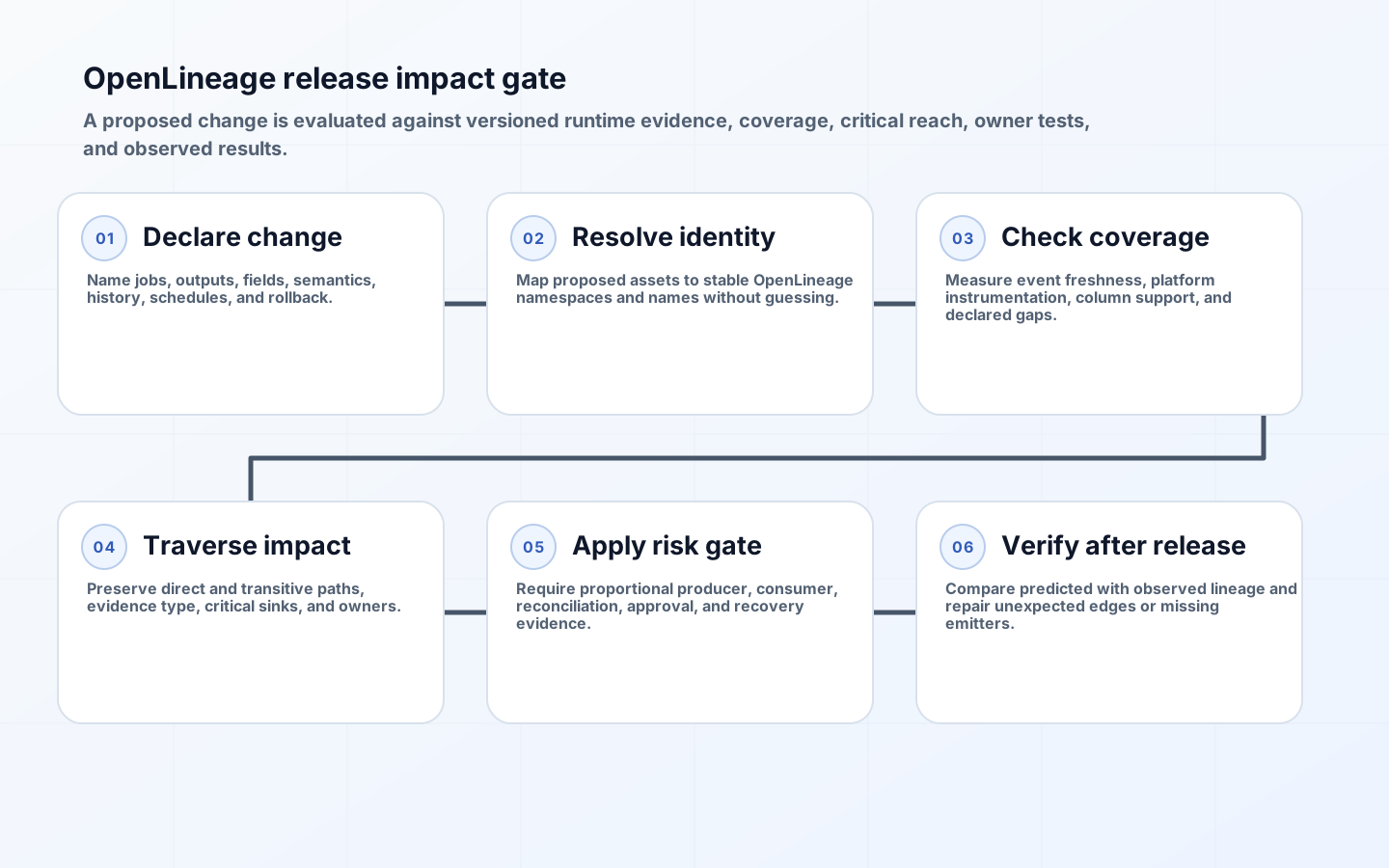
OpenLineage records runtime relationships among jobs, runs, and datasets, with facets that add schema, lifecycle, ownership-adjacent, quality, and column-level context. That evidence can help a release process identify downstream systems likely to be affected by a pipeline change. OpenLineage impact analysis is not a magical preview of code that has never run. It is a graph-assisted risk assessment built from observed history, declared change scope, coverage evidence, and human ownership.
A useful gate answers four questions: what outputs can this release change, which observed paths depend on them, how complete and fresh is the graph, and which owners must review or test? The gate should become stricter as impact and uncertainty increase. Treating every graph edge as certain creates needless approvals; treating missing edges as no impact creates false confidence. Lineage quality is itself a release input.
Define the evidence boundary
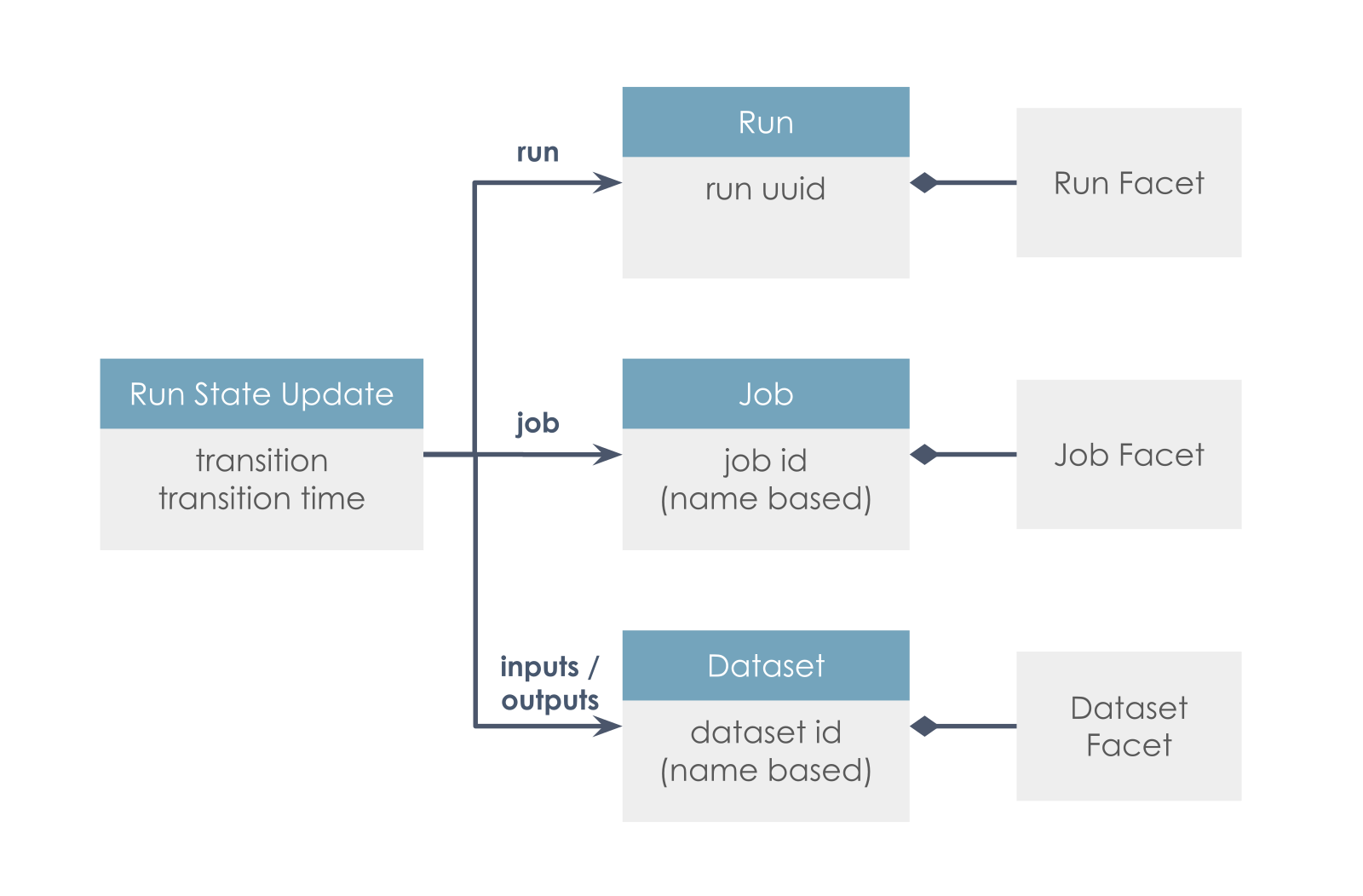
OpenLineage's core model identifies job, run, and dataset entities through namespaces and names, and run events describe inputs and outputs. Facets extend those entities. Decide how your organization maps scheduler tasks, SQL models, Spark applications, tables, files, streams, dashboards, and exports into stable identities. Namespace collisions or environment mixing can connect unrelated assets. Version the identity convention and test changes as migrations because graph continuity depends on it.
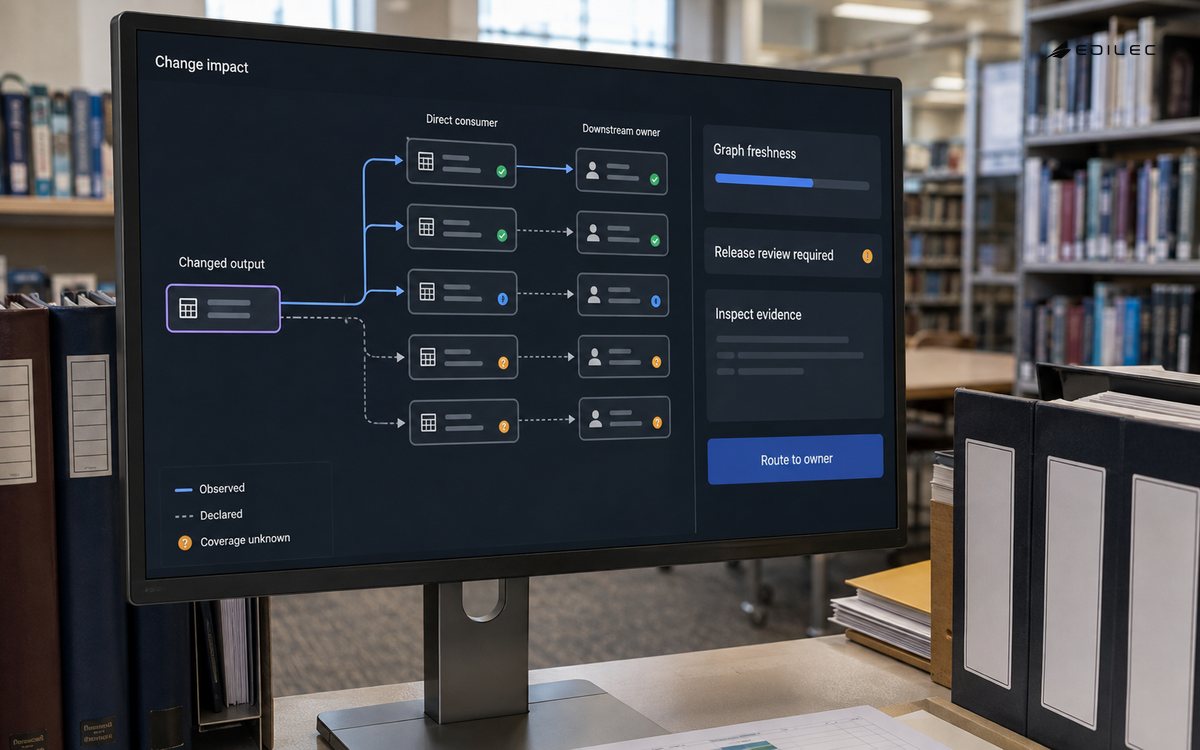
State which execution systems emit events and which downstream systems do not. Runtime lineage usually sees successful or attempted executions that are instrumented; it may miss manual queries, extracts, notebooks, external vendor reads, disabled integrations, or jobs that have not run within retention. Supplement observed edges with declared contracts, catalog subscriptions, access evidence, and critical-consumer registries. Preserve provenance so reviewers know whether an edge is observed, declared, inferred, or manually attested.
| Evidence type | Strength | Typical gap | Gate treatment |
|---|---|---|---|
| Recent run edge | Observed execution relationship | Rare or seasonal jobs | Include with freshness |
| Column lineage facet | Observed field mapping where emitted | Dynamic SQL or unsupported operator | Use only with coverage flag |
| Declared dependency | Owner states intended contract | Can become stale | Require periodic attestation |
| Access or query evidence | Shows actual readers | Does not prove semantic dependence | Use as supplemental reach |
| Static analysis | Can preview unexecuted code | Dynamic behavior and runtime resolution | Label as inferred |
Describe the proposed change independently
The pull request or release manifest should name affected jobs, output datasets, fields, schedules, partitions, semantics, and service levels. Classify additions, removals, type changes, key changes, filters, joins, aggregation, lateness, correction behavior, and historical rewrites. A lineage graph identifies reach, not the meaning of the diff. The release system needs a machine-readable change set plus a concise explanation from the producer.
Map proposed output identities to existing graph nodes before approval. A rename can appear as deletion plus creation and sever history. A new job with no runtime identity needs a declared preview or an isolated run that emits lineage. Verify environment and namespace. If mapping fails, stop automatic low-risk classification and route to an owner; guessing the closest name can notify the wrong consumers while missing the real ones.
Traverse downstream paths with useful limits
Begin from every changed output and traverse downstream dataset-to-job-to-dataset edges. Retain path, depth, most recent observation, environment, and evidence type. Stop at an intentional contract boundary only when the downstream owner accepts responsibility for further propagation; arbitrary depth limits hide long chains. Deduplicate assets while preserving multiple paths because redundancy can affect both risk and test selection.
Distinguish direct consumers from transitive reach. A direct model may need a contract test, while a distant dashboard may need only validation through an intermediate product owner. Identify critical sinks such as regulatory reports, customer exports, machine-learning features, billing, and operational automation. Apply time windows carefully: an annual job absent for eleven months is not irrelevant. Combine recent runtime edges with expected schedules and retention policy.
| Impact signal | Low-risk example | Higher-risk example | Required evidence |
|---|---|---|---|
| Schema | Nullable field addition | Removal or key change | Compatibility and consumer tests |
| Semantics | Documented bug fix | Unit or aggregation change | Before/after business reconciliation |
| Reach | One owned internal model | Many teams or external export | Owner acknowledgements |
| Criticality | Exploratory dashboard | Billing or regulatory output | Domain approval and rollback |
| Graph confidence | Fresh complete instrumentation | Stale or missing integration | Expanded discovery or block |
Use column lineage with explicit limitations
The column lineage facet can describe input fields for output fields and transformation metadata. This enables narrower questions, such as which outputs depend on a column proposed for removal. Coverage varies by integration, operation, and query shape. An absent field edge can mean no dependency or no extraction. Store a coverage status for each job and run, and fall back to dataset-level impact when column evidence is incomplete.
Do not infer semantic safety from a field mapping. Changing dollars to cents, local time to UTC, customer to account grain, or null handling may preserve names and types while changing every downstream result. Conversely, an internal field rename behind a stable view can have no consumer effect. Pair column paths with a data contract and semantic change declaration. Sample transformation descriptions help reviewers, but avoid exposing sensitive SQL or literals in broadly accessible metadata.
Measure freshness and coverage as first-class data
For each execution platform, measure expected jobs, emitting jobs, valid event rate, namespace validity, input/output completeness, column extraction coverage, and event delay. For each graph node, record last successful observation and expected cadence. Reconcile lineage datasets against scheduler inventories, catalogs, and critical-consumer registers. Coverage should be segmented; a single ninety-percent figure can conceal that the uninstrumented ten percent contains the financial reporting estate.
Set stale thresholds from schedule. An hourly job may be suspect after several hours, while a monthly close job remains current longer. Treat an integration outage as uncertainty, not as mass dependency removal. Preserve the last known graph and mark freshness. Alert when event ingestion falls, identity cardinality spikes, or expected edges disappear. Graph quality incidents need an owner and response objective because they directly weaken release decisions.
Assign risk from impact and uncertainty
Calculate a transparent tier from change severity, downstream reach, criticality, external exposure, rollback difficulty, historical rewrite, and graph confidence. Keep the component values visible instead of collapsing everything into an unexplained score. A small schema addition with fresh lineage can pass automatically after contract tests. A semantic key change touching billing should require consumer evidence and owner approval. An apparently small change with poor coverage may be high risk because the unknown reach is material.
Risk tier determines controls: producer tests, impacted consumer tests, shadow execution, reconciliation, owner acknowledgement, maintenance window, canary, and rollback. Avoid asking every downstream team to approve every release. Route only material impacts and let data-product owners represent governed subordinate dependencies. Record nonresponse policy and escalation; silence must not become accidental approval for critical changes.
Implement the release gate
On a proposed release, validate the change manifest, resolve graph identities, query a versioned lineage snapshot, traverse impacts, evaluate graph health, and produce a review artifact. Include changed assets, direct and transitive paths, critical consumers, evidence freshness, missing coverage, required tests, owners, and rollback. Bind approval to the code revision and lineage snapshot. Recompute if either changes materially before deployment.
After release, observe actual run events and compare inputs, outputs, schema, and column paths with the prediction. Run selected reconciliations and watch consumer failures. New unexpected edges should trigger investigation and update the consumer registry. Keep a bounded override path with accountable owner, reason, compensating validation, and expiry. Never make the lineage service a single unavailable dependency for emergency repair; define a controlled degraded mode.
Handle stale or incomplete graphs safely
When coverage is below the tier's threshold, expand discovery: query catalog relationships, scheduler definitions, access logs, repository references, dashboard metadata, and owner attestations. The result may remain incomplete; represent that uncertainty explicitly. Delay a destructive change when critical reach is unknown. For urgent fixes, choose additive or reversible behavior, dual-run where possible, and extend post-release observation.
Create repair work for missing instrumentation instead of permanently normalizing manual review. Test emitters during platform upgrades and verify event schemas at ingestion. Backfill lineage history only when provenance remains clear; synthetic events should not masquerade as observed runs. A trustworthy graph acknowledges where it cannot see. That honesty makes automatic low-risk releases safer and concentrates human attention where uncertainty is real.
Key takeaways
- OpenLineage provides runtime evidence; proposed change meaning still needs a separate manifest.
- Preserve whether dependencies are observed, declared, inferred, or manually attested.
- Treat missing column lineage as unknown unless integration coverage is proven.
- Combine impact, criticality, rollback, and graph confidence in transparent risk tiers.
- Compare predicted and observed lineage after release so both the graph and gate improve.
Frequently asked questions
Can OpenLineage predict a brand-new pipeline?
Not from runtime history alone. Use a declared manifest, static analysis, or isolated execution, label that evidence appropriately, and verify actual lineage after the first run.
Is column lineage enough for field removal?
Only when extraction coverage is proven for every relevant path and semantic contracts agree. Otherwise use dataset-level reach, access evidence, and consumer attestation.
Should a lineage outage block every release?
No. Define degraded modes by risk. Low-risk additive work may proceed with cached evidence, while destructive or critical changes may pause or require expanded manual discovery and approval.
Conclusion
OpenLineage can turn dependency visibility into practical release evidence when teams measure what the graph actually covers. A change manifest, identity discipline, freshness-aware traversal, column-level caution, risk tiers, owner routing, and post-release comparison create an effective impact gate. The graph accelerates judgment; it does not replace contracts or responsible owners.