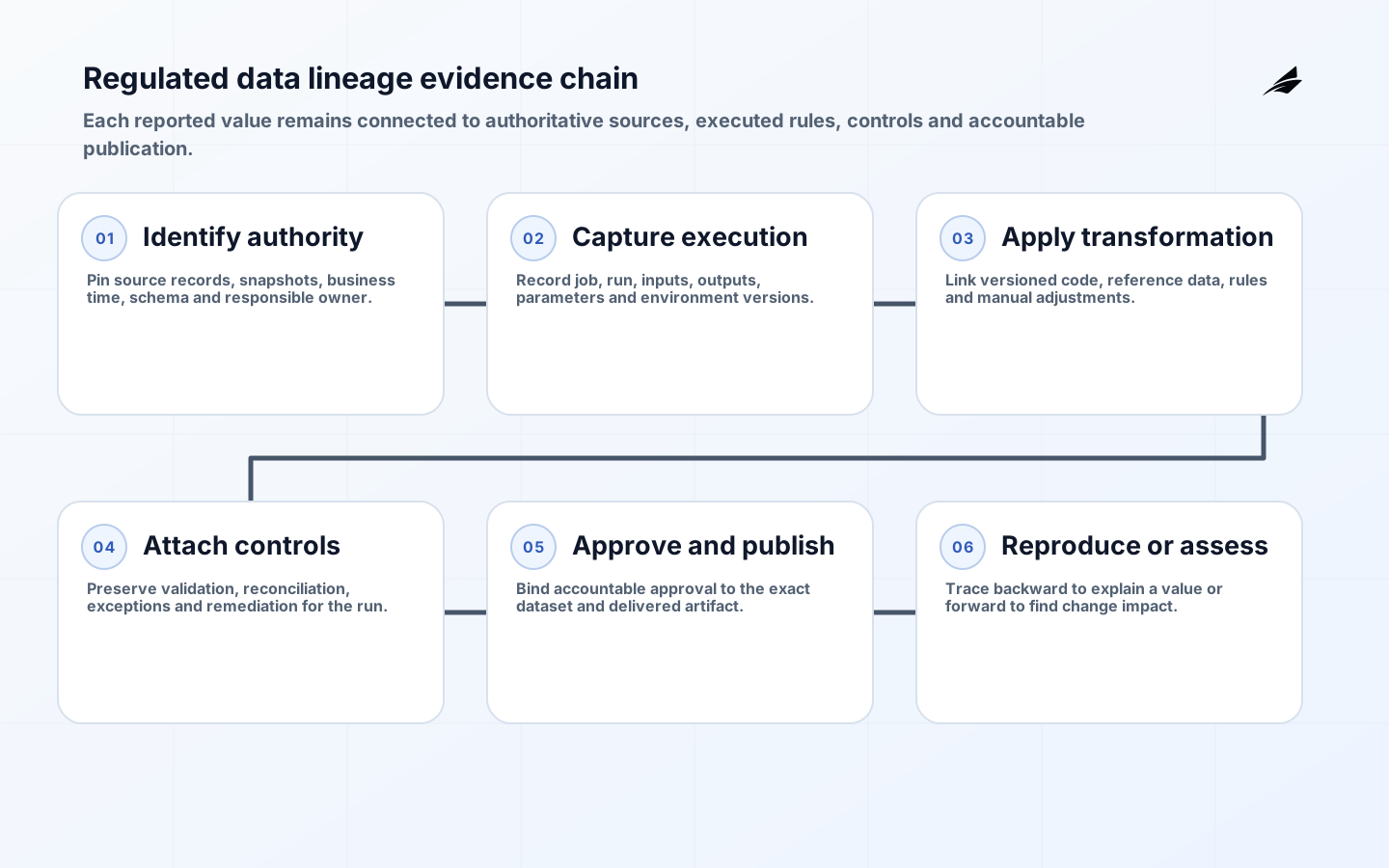
Data lineage for regulated workflows is the ability to explain how a material data item moved from its origin to a decision, disclosure or report. A defensible explanation identifies the source, transformations, controls, responsible systems, execution instances, approvals and final use. It must also survive change: when a source field, rule or job changes, owners should know which downstream obligations may be affected before release.
Lineage is not a screenshot of a pipeline graph and not a substitute for data quality. It is an evidence system connecting technical provenance to business meaning. This guide complements data quality checks for SaaS products, semantic layers for growing data teams and dashboard adoption plans. Legal and supervisory scope varies, so regulated organizations should confirm specific duties with qualified compliance and legal owners.
Scope lineage from obligations and material decisions
Begin with the outputs that must be trusted: regulatory returns, risk reports, financial disclosures, customer decisions, compliance monitoring and safety records. For each output, identify the accountable owner, submission or decision frequency, material data elements, tolerance for correction and evidence expected by reviewers. This creates a risk-based boundary. Attempting column-level lineage for every experimental dataset at once consumes effort without ensuring the most consequential paths are complete.
Translate obligations into traceability questions. Can the team reproduce the reported value for a specific period? Can it identify every source and adjustment? Can it distinguish business-time corrections from late-arriving data? Can it show who approved a manual override? Can it assess the effect of a changed definition? BIS guidance for risk data aggregation emphasizes accuracy, completeness, timeliness and adaptability; its January 2026 implementation update again identifies data lineage across legacy and distributed estates as a continuing challenge.
| Lineage scope | Minimum evidence | Owner question | Acceptance test |
|---|---|---|---|
| Reported measure | Definition, period, unit and final dataset | What exactly is asserted? | Recalculate a sampled value |
| Source data | System, record key, extraction and business time | Which record was authoritative? | Trace sample to retained source |
| Transformation | Versioned rule, code, parameters and run | How did inputs become output? | Replay with pinned artifacts |
| Manual change | Reason, approver, before/after and ticket | Was judgment authorized? | Review exception evidence |
| Delivery | Report version, recipient and submission status | Which result left the boundary? | Match filing to approved dataset |
Model entities, activities and accountable agents
A portable provenance model separates entities, activities and agents. An entity may be a source snapshot, table version, model artifact or report. An activity is an extraction, transformation, approval or publication. An agent is the person, service or organization responsible for an activity. W3C PROV formalizes these relationships, while OpenLineage events describe jobs, runs, datasets and extensible facets. A team can adopt the concepts without implementing either specification wholesale.
Use stable identifiers and time semantics. Dataset names alone are ambiguous when environments, schemas and partitions change. Record namespace, platform, object, version or snapshot, schema, business period and processing run. Distinguish event time, effective time, ingestion time and correction time where the workflow needs them. Every transformation should point to immutable code or configuration and the exact input versions. A current SQL definition cannot explain a report created under last quarter's rule.
Capture lineage at the strongest available boundary
Prefer automatic capture from orchestrators, query engines, transformation tools and data contracts because it follows actual execution. Parse structured query plans or framework metadata instead of scraping logs when supported. Emit run identifiers and input/output references at execution time. For packaged systems that expose limited internals, capture interface-level lineage: exported file, report parameter, checksum, transfer event and importing job. Manual documentation remains necessary for judgment, spreadsheet steps and external submissions.
Column-level lineage is valuable for material elements but difficult around dynamic SQL, stored procedures, user-defined functions, unstructured data and generated code. State confidence and granularity rather than presenting inferred relationships as observed fact. Label an edge as executed, declared, parsed or manually attested. Retain extraction failures and coverage gaps. Reviewers need to know where evidence stops; an attractive graph that silently guesses is more dangerous than an explicit unknown.
Connect lineage to data-quality and reconciliation controls
Lineage shows a path; controls test whether the path produced an acceptable result. Attach schema validation, completeness checks, reconciliations, threshold tests and approvals to the run they evaluated. Reconcile independent control totals across boundaries such as source-to-ingestion, ledger-to-warehouse and approved dataset-to-filed report. A successful job is not evidence of correct data. Preserve failing results and remediation instead of overwriting them after a rerun.
Define treatment for late, corrected and missing records. Regulated reports often need an as-of view that cannot be recreated from current source state. Keep snapshots or reconstruction inputs according to retention policy. Record adjustments as separate events with reason and authority, never as invisible edits to history. If a transformation is nondeterministic, uses an external model or depends on mutable reference data, retain the seed, model version, prompt or policy and reference-data version needed to explain the outcome.
| Control point | Failure detected | Evidence linked to lineage | Response |
|---|---|---|---|
| Source intake | Missing or duplicate records | Manifest, count, checksum and rejection set | Quarantine or obtain corrected extract |
| Transformation | Rule or schema mismatch | Code version, test result and run log | Stop affected branch |
| Aggregation | Totals do not reconcile | Independent totals and variance detail | Investigate before approval |
| Approval | Unauthorized override | Actor, role, reason and policy result | Reject and escalate |
| Publication | Wrong version or recipient | Approved hash and delivery receipt | Contain, correct and notify |
Build a reproducible evidence chain
For a sampled report cell, the evidence chain should move backward from published artifact to approved dataset, aggregation, transformations, source extracts and authoritative records. Moving forward from a changed source should reveal affected datasets, controls, reports and owners. Both directions matter. Backward trace supports explanation and reproduction; forward impact analysis supports safe change and incident containment. Verify both with representative scenarios rather than assuming graph connectivity proves usable evidence.

Package evidence for the audience. An auditor may need definitions, approvals, exceptions and retained artifacts; an engineer needs run and code identifiers; a business owner needs impact and reconciliation status. Provide a concise summary with links to controlled records rather than exporting the entire metadata store. Apply least privilege because lineage can reveal sensitive fields, system topology and processing purposes. NIST's Privacy Framework treats data processing across interconnected entities as a lifecycle concern, and accountability requires documentation without unnecessary disclosure.
Use lineage for change control and incident response
Integrate impact analysis into schema, pipeline, model and business-definition changes. A proposed change should list downstream material elements, reports, controls and owners; unknown impact should block a high-risk release. Version contracts and permit compatible transitions where producers and consumers cannot change together. After release, compare lineage coverage and control results. Retire old edges only when delayed jobs, backfills and historical reproductions no longer depend on them.
During an incident, freeze affected evidence, identify the earliest suspect activity and traverse forward to every output that consumed it. Distinguish incorrect values from unavailable or late values, and identify reports already delivered. Record containment, corrected runs, approvals and external communication. Afterward, add the missing detection or ownership control. Measuring time to assess impact is often more meaningful than counting cataloged tables because it tests whether lineage works under real decision pressure.
Implement lineage in six practical stages
- Prioritize regulated outputs and define material elements, owners and evidence expectations.
- Map sources, transformations, controls, manual decisions and publication boundaries.
- Choose identifiers and capture methods; label observed, inferred and attested relationships.
- Instrument actual runs and attach code, schema, quality and approval evidence.
- Test backward reproduction and forward impact with sampled values and changes.
- Operate coverage, exceptions, access, retention and ownership as ongoing controls.
Assign ownership at three levels: business owners approve definitions and materiality; data owners are accountable for quality and permitted use; technical owners maintain capture and recovery. Establish a review cadence for uncovered paths, orphaned datasets, stale attestations and failed reconciliations. Avoid a central team becoming the only party who can interpret lineage. Producers should publish trustworthy metadata and consumers should verify the critical paths they rely on.
Key takeaways
- Scope lineage from material outputs and regulatory questions, not catalog ambition.
- Represent source versions, activities, agents and execution evidence explicitly.
- Pair every important path with quality, reconciliation and approval controls.
- Label inferred or manual lineage honestly and protect metadata as sensitive information.
- Test reproducibility and forward impact analysis under change and incident scenarios.
Frequently asked questions
Is a data catalog the same as data lineage?
No. A catalog organizes data assets, definitions and ownership. It may display lineage, but defensible traceability also needs execution history, versions, controls, approvals and retained evidence. Evaluate the workflow, not the product label.
Does every dataset need column-level lineage?
Not necessarily. Use the granularity required to explain material elements and assess risk. Dataset-level lineage may suffice for low-risk transfers; regulated calculations often need field-level rules and adjustment evidence. Document deliberate exclusions.
How should spreadsheets be handled?
Treat a controlled workbook as a versioned transformation artifact. Record inputs, formulas or macros, owner, review, checksum and output. Reduce material spreadsheet steps over time, but do not omit them from lineage while they remain part of the actual process.
Conclusion
Useful lineage turns a number into an explainable chain of custody. Start from regulated decisions, capture actual runs and versions, attach controls and preserve human judgment. When teams can reproduce a result and identify the impact of change quickly, lineage becomes operational assurance rather than a decorative map of the data estate.