A data pipeline is an operational system that moves, transforms, and publishes information for a decision. Its quality is not defined by how many tools it contains. A useful pipeline reliably delivers a known population at an agreed time, preserves enough evidence to investigate a problem, and handles change without silently rewriting business history. Teams often see a pipeline as finished when a dashboard loads once. The harder work begins when a source misses a delivery, a field changes, a backfill is needed, or a downstream result is questioned. Design those conditions from the beginning and the pipeline becomes an asset rather than a source of recurring manual repair.
Begin with a delivery contract
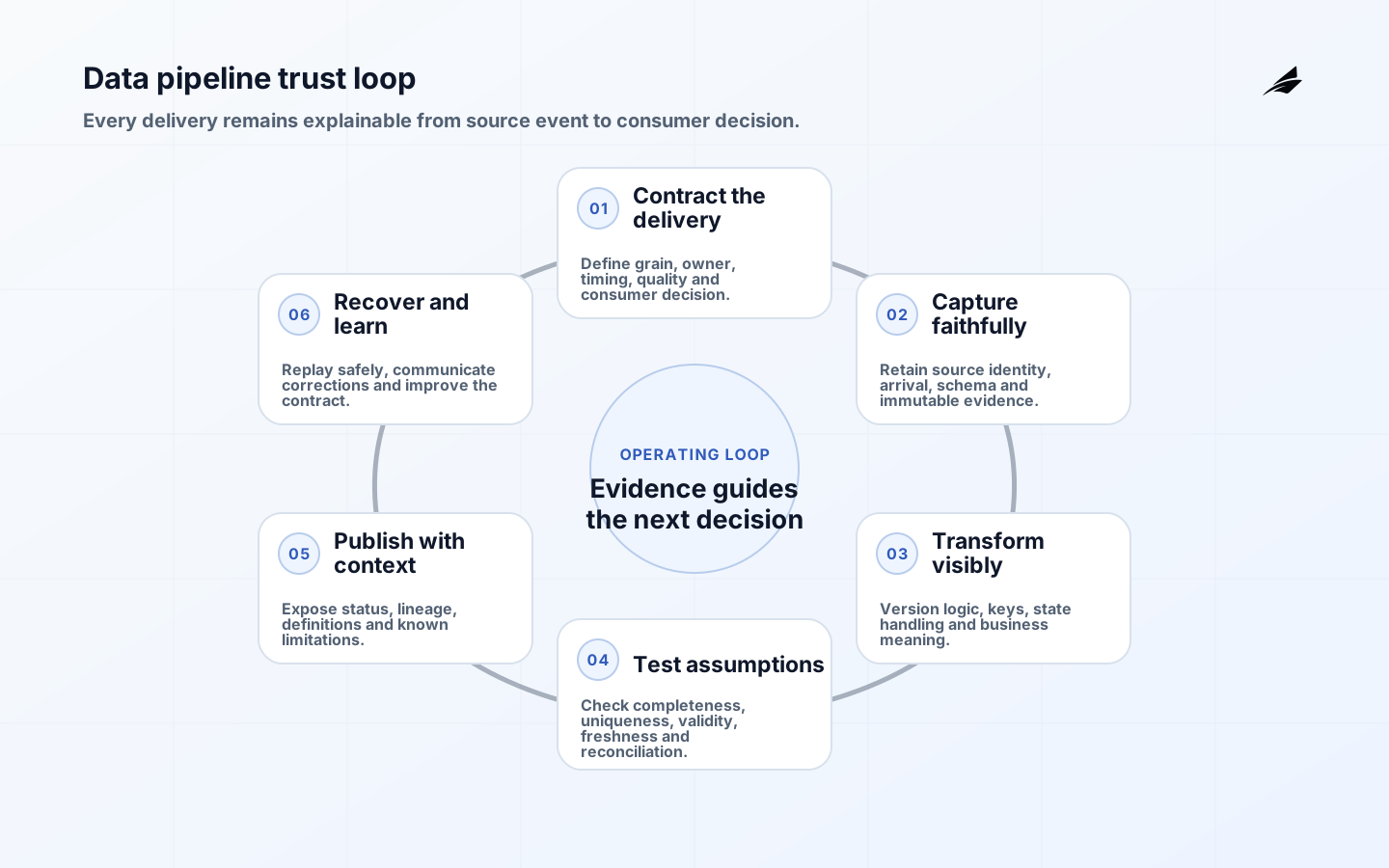
Define the consumer outcome before choosing orchestration or storage. State the source owner, record grain, key, expected arrival, freshness objective, classification, and known corrections or late changes. A daily finance report may need complete data by a specified morning; a product dashboard may accept hourly updates with a visible delay. Identify the authoritative source when systems disagree and the fallback if delivery fails. This makes it possible to configure meaningful checks and alerts. It also keeps the team from optimizing a job duration while missing the more important question: whether the published result is fit for the decision it supports.
Use Edilec's data pipeline planning guide to frame ownership and delivery, the data quality checks guide to turn business assumptions into tests, and the enterprise reporting architecture guide to connect curated datasets to governed consumption. These are distinct concerns: orchestration can succeed while data quality fails, and a correct dataset can still be published through a confusing reporting model.
Treat every pipeline run as a state transition with an identity, input interval, code version, environment and output disposition. Apache Airflow models workflows as DAGs with tasks, dependencies, schedules, retries and timeouts. dbt data tests express assertions that return failing records, including uniqueness, non-null, accepted-value and relationship checks. OpenLineage supplies a shared vocabulary for jobs, runs and datasets, while the BigQuery documentation illustrates a managed analytical store that separates compute and storage concerns. Together these mechanisms help responders explain what ran, changed or failed; none replaces a business contract.
Define recovery at dataset level as well as job level. A retry may complete the task while leaving duplicate rows, a partial partition or inconsistent downstream aggregates. Record the replay interval, idempotency rule, correction method and reconciliation query before an incident. When a backfill changes a published result, notify affected consumers with the impacted period and the time at which corrected data became available. This turns recovery into a controlled data change rather than an invisible rerun.
| Pipeline layer | Responsibility | Evidence to retain |
|---|---|---|
| Ingestion | Capture source data and delivery metadata | Source file or event identifiers, arrival time, checksum or count |
| Raw storage | Preserve an inspectable input record | Partition, retention rule, access classification |
| Transformation | Apply documented business logic | Code version, test results, run identifiers |
| Publication | Expose a consumer-ready model or extract | Freshness status, lineage, owner, and change note |
Preserve and model deliberately
Keep an immutable or otherwise recoverable representation of the input where legal and practical. It gives investigators a way to distinguish a source issue from a transformation defect and lets the team replay after fixing a model. Then transform through explicit layers: raw intake, cleaned or conformed data, and consumer-ready models. Do not use those names as a ritual; use them to make responsibilities and retention clear. Handle late updates, deletions, and backfills as first-class behaviours. A pipeline that only works for a perfect chronological feed will eventually force someone to patch results by hand, which destroys confidence in its history.

- Assign durable keys and deduplication rules before aggregating or joining incoming records.
- Record run identifiers, source versions, row counts, and meaningful timings for each material load.
- Test critical assumptions such as uniqueness, accepted values, referential relationships, and freshness.
- Quarantine malformed or unexpected input with enough context for the producer and operator to diagnose it.
- Make backfills repeatable, scoped, reviewed, and visible to consumers whose results may change.
Operate the pipeline as a product
Pipelines need clear on-call and ownership boundaries. A failed source extraction belongs with the source owner and pipeline operator; a model rule dispute belongs with the data steward and decision owner. Alert on conditions that threaten a consumer promise, such as missing partitions, freshness breaches, unexpected volume changes, or failed tests. Avoid alerting every retry or transient warning to a human. Provide a runbook that says how to assess impact, communicate a delayed result, retry safely, and decide whether a partial publish is acceptable. That is the operational substance behind a reliable pipeline, more important than any single scheduler or framework.
| Incident type | Safe immediate action | Consumer communication |
|---|---|---|
| Source absent | Hold publication or mark last good result as stale | State affected datasets and expected next update |
| Transformation test fails | Stop the dependent release and retain failure rows | Explain whether prior results remain usable |
| Duplicate load | Rollback or rebuild from identifiable input | Identify impacted periods and corrected outputs |
| Backfill changes history | Validate reconciliation and approve release | Publish what changed, why, and affected comparisons |
Design for change
Most pipeline risk arrives through normal change: a new source version, revised business policy, new timezone, or acquired system. Treat these as releases with contracts, impact analysis, and rollback plans. Data lineage helps identify dependent models and dashboards, but it should be complemented by a review of semantic impact. A renamed field can be technically compatible while changing a metric's meaning. For broader transformation practice, ELT workflow planning offers a useful pattern for reviewing models and backfills. The key is to communicate changes before consumers discover unexplained movement in a report.
Work through a practical case
A retailer receives daily inventory files from several warehouses. The pipeline records file arrival and counts, stores the received file, validates SKU and location keys, and produces a conformed inventory model. One warehouse begins sending a new status code. The validation step quarantines those rows and prevents the availability dashboard from treating them as zero stock. The operator notifies the warehouse owner and marks the relevant regions as incomplete. Once the source mapping is approved, the team reruns only the affected partitions, reconciles stock totals, and publishes a release note. The pipeline preserved the evidence and prevented a source change from becoming a false operational signal.
Plan the next review
Establish a pipeline service review that looks beyond job success. For a selected consumer output, compare the promised arrival and freshness with actual delivery, inspect data-quality failures, and review any manual intervention or backfill. Trace one published result from its model to a source input and one incident from alert to consumer communication. This reveals whether orchestration, storage, and transformation controls work as a coherent service. Use the review to remove noisy alerts, strengthen a material test, refine a runbook, or agree a source-level change. Pipeline monitoring is useful only when it helps the team protect a consumer decision, so choose measures such as late publication, affected records, and time to recovery rather than a long generic list of job metrics.
- Compare actual delivery against the freshness requirement for each decision-critical output.
- Review retried and manually rerun jobs to ensure their effects and communications are traceable.
- Test a scoped backfill in a nonproduction or controlled path before using it to repair history.
- Verify that alerts identify the owning team, affected output, consumer impact, and first safe action.
- Use recurring source failures to negotiate a clearer contract instead of repeatedly patching downstream models.
Security and privacy should travel with the data path. Classify inputs, restrict raw evidence and temporary failure stores appropriately, and make sure test fixtures and logs do not become an ungoverned copy of sensitive data. Pipeline developers also need a retention decision that balances recovery with minimization. Review access when a new consumer is added, because a useful published model can become a broader exposure than the source system intended. Reliable delivery includes knowing who can see, alter, and recover the information at each stage.
Key takeaways
- Define a pipeline by the consumer promise it must meet, not by the toolchain it uses.
- Preserve inspectable inputs and run metadata so material results can be reconstructed.
- Test keys, relationships, freshness, and business rules at points where failures can be contained.
- Make retries, backfills, and partial publication explicit operating procedures.
- Treat source and semantic changes as reviewed releases with consumer impact communication.
FAQ
Should every pipeline keep raw data forever? No. Retention must reflect legal, privacy, security, cost, and recovery needs. Keep enough governed evidence for the required investigation and replay window, then apply approved deletion or minimization policies. Is ELT better than ETL? The labels matter less than the design. Choose where to transform based on source constraints, governance, performance, and the ability to test, recover, and explain the resulting data.
Conclusion
Dependable data pipelines protect analytics from normal operational reality: late files, imperfect sources, changing rules, and necessary corrections. Define clear delivery promises, retain evidence, build testable transformations, and make recovery and communication part of the service. That gives consumers a result they can use with appropriate confidence, even when the path behind it needs attention. Treat pipeline cost as an operating cost, not just a cloud bill. Complexity appears in source support, alert triage, retention, backfill duration, and the number of consumers exposed to a delay. Make those costs visible when deciding whether to add a new feed or transform. A smaller pipeline with a clear promise, good observability, and a practiced recovery path is often more valuable than a broad integration that cannot be explained when it fails. This perspective helps teams make architecture choices that remain workable after the initial delivery phase.