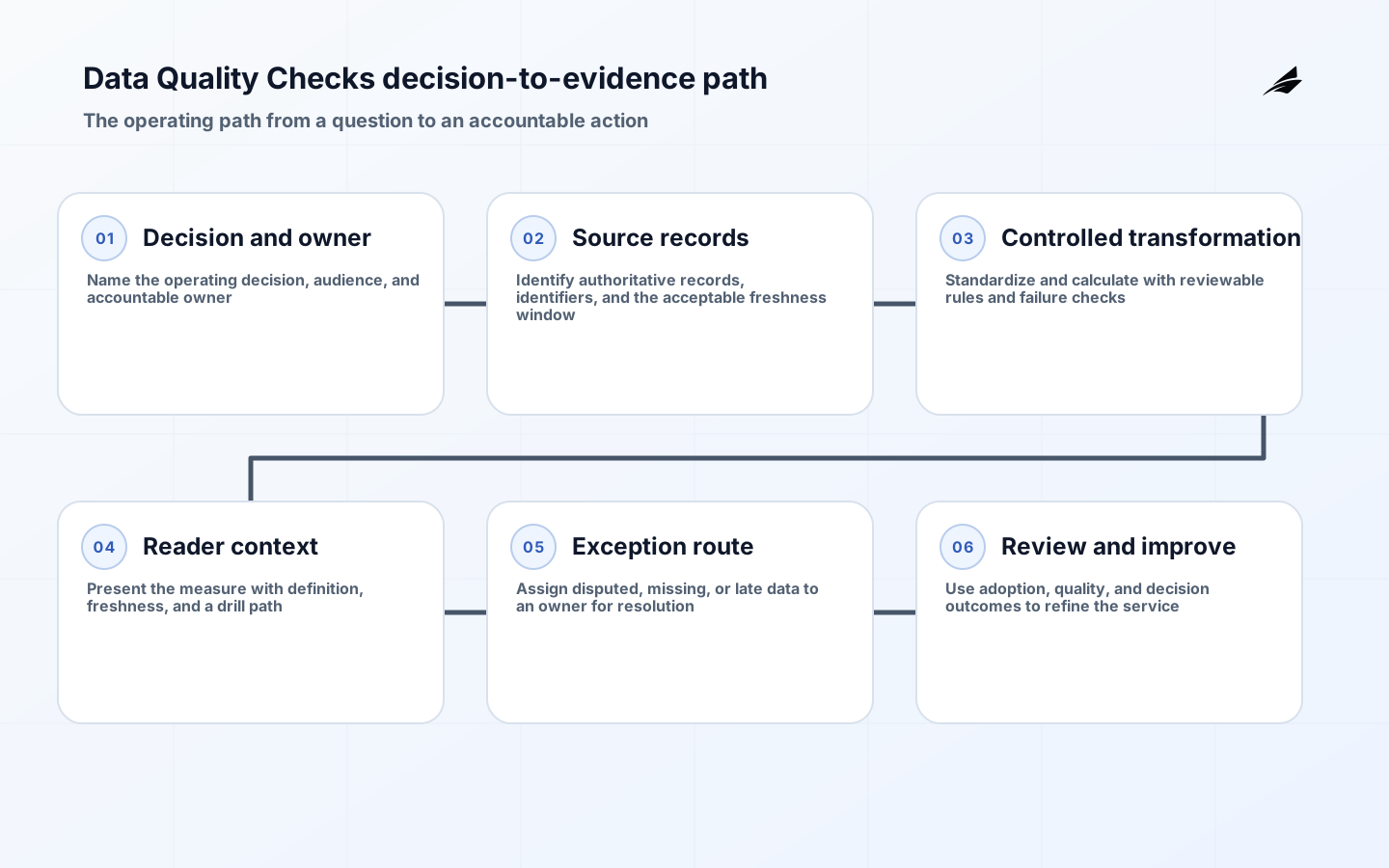
Data quality checks form a decision system, not a collection of charts. This guide explains how a founder-led business can move from a vague request for visibility to an operating surface that supports confidence in the numbers used to act. The starting point is not a preferred platform. It is a bounded decision, the people accountable for it, and the records that make the decision defensible. When those are explicit, the team can design validity, completeness, timeliness and reconciliation checks around a useful outcome: an early warning before decisions depend on bad data. A founder-led business should keep validity, completeness, timeliness and reconciliation checks connected to confidence in the numbers used to act, rather than treating the guidance as a generic reporting exercise.
Start with the decision Data Quality Checks must support
Teams often begin data quality checks by asking which visuals or tools to use. That reverses the useful order. First name the decision that will change when the information changes. A dashboard for a weekly operating meeting, a scheduled report for a customer, and a pipeline that feeds a regulatory calculation have different tolerance for delay, different readers, and different controls. A decision statement makes the scope testable: who reads it, what action is expected, what information is sufficient, and what happens when confidence is low. For this data handoff, name the accountable owner, supporting evidence, exception route, and next measurable check.
- Write one sentence describing the decision and its accountable owner.
- List the records required for that decision, including the system that owns each record.
- Define the expected refresh or delivery window in business terms rather than a vague request for real time.
- Name the action to take when a number is missing, stale, disputed, or outside an agreed range.
- Keep detail available for investigation, while keeping the primary view focused on the decision.
Define the operating contract before building
An operating contract turns a reporting request into an implementable service. For data quality checks, it should describe the audience, data boundary, definitions, owners, access rules, delivery rhythm, and exception process. This is also the right place to distinguish a working measure from a formally governed one. A provisional measure can be useful for discovery, but it should not quietly become the basis for compensation, financial reporting, or customer commitments without a named owner and review path. Within this part of the system, name the accountable owner, supporting evidence, exception route, and next measurable check.
| Contract element | Question to resolve | Evidence of a workable answer |
|---|---|---|
| Decision boundary | What decision does data quality checks influence? | Named owner, meeting or workflow, and the action expected |
| Record authority | Which system and fields are authoritative? | Source register, field definitions, and a reconciliation rule |
| Freshness | How late can the information be before it becomes unsafe to use? | Published refresh target and stale-data indicator |
| Access | Who can see, export, or change the content? | Role map, sharing rule, and approval path |
Design the data path and semantic layer
The most expensive problems in data quality checks usually appear between systems: a customer is matched differently in two tools, an event arrives twice, a late correction silently changes a total, or a report applies business logic that exists nowhere else. Treat these as design questions. Preserve a stable identifier where possible, record when data was observed and when it became effective, and make transformations inspectable. A semantic definition should say what is included, excluded, and grouped; it should not rely on a person remembering how a spreadsheet was built. When implementing this data handoff, name the accountable owner, supporting evidence, exception route, and next measurable check.
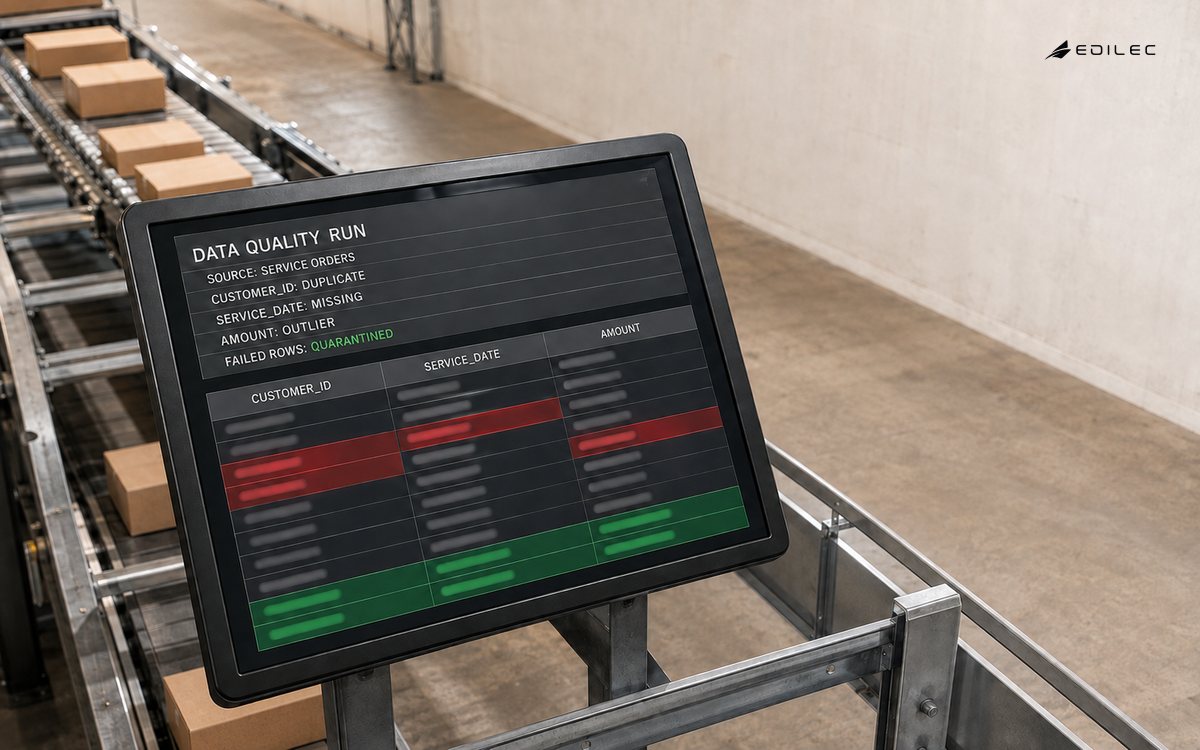
A useful delivery path separates raw inputs, controlled transformations, and reader-facing measures. That separation does not require a large platform on day one. It requires enough structure that an operator can answer: where did this number come from, when was it last refreshed, and what rule produced it? Those answers make corrections safer and reduce the temptation to patch a finished report by hand. Before releasing this data handoff, name the accountable owner, supporting evidence, exception route, and next measurable check.
| Layer | Purpose | Control to include |
|---|---|---|
| Source intake | Collect validity, completeness, timeliness and reconciliation checks without inventing a second system of record | Schema checks, timestamps, source identifier, and failure alert |
| Transformation | Standardize, join, and calculate with reviewable logic | Versioned rule, test case, and rejection route |
| Semantic measure | Express a reusable business definition | Owner, definition, inclusion rules, and change history |
| Reader experience | Present the right level of detail to the intended audience | Freshness label, drill path, and access enforcement |
Make governance part of the workflow
Governance is not a separate approval ceremony after delivery. It is the practical answer to who may define a measure, approve a change, grant access, or accept an exception. NIST describes data governance as establishing authority and decision-making parameters for enterprise data. For data quality checks, that principle becomes concrete through accountable owners, documented definitions, access boundaries, and a lightweight process for proposing changes. The aim is to make the trusted route easier than creating a parallel file outside the service. While operating this workflow step, name the accountable owner, supporting evidence, exception route, and next measurable check.
Release in a way people can adopt
A polished interface does not guarantee adoption. Release data quality checks with a real group of readers and a defined operating rhythm. Observe whether people can find the answer, explain the definition, and follow the drill path without a separate analyst translating the screen. If they cannot, the issue may be the model, language, access design, or decision process rather than the visual layer. Keep early releases narrow enough to correct quickly, then expand only when the team uses the result in real work. When changing this operating step, name the accountable owner, supporting evidence, exception route, and next measurable check.
- Test data quality checks with the people who will act on it, not only project reviewers.
- Run a parallel comparison where a prior process exists and investigate meaningful differences.
- Expose a clear freshness state and a named route for questions or corrections.
- Document how readers request a definition change, access change, or new measure.
- Review usage and exception patterns after launch before adding more pages or metrics.
Measure quality, usefulness, and trust
Success for data quality checks is not the number of charts produced. Look for evidence that the intended decision is faster, clearer, and easier to revisit. Track the age of data, the number of unresolved quality exceptions, whether readers leave the product for manual workarounds, and whether a material question can be traced to a source record. The right measures vary by context, but every release should have a baseline and an owner who can explain what changed. During support for this evaluation, name the accountable owner, supporting evidence, exception route, and next measurable check.
| Signal | What it reveals | Review question |
|---|---|---|
| Freshness exceptions | Whether the delivery window is dependable | Did readers know the information was stale before acting? |
| Definition disputes | Whether the semantic model is clear enough | Is the disagreement about data, business policy, or presentation? |
| Manual workarounds | Whether the service fits the operating workflow | What task still forces people into private spreadsheets or messages? |
| Decision follow-through | Whether insight leads to accountable action | Did the review produce an owner, due date, or documented choice? |
Implementation checklist
- Choose one high-value decision for the first data quality checks release.
- Name the business owner, technical owner, and support route.
- Document source records, identifiers, calculation rules, and expected freshness.
- Agree on access and export rules before sharing broadly.
- Test normal, late, duplicate, missing, and corrected data scenarios.
- Publish concise guidance for readers and a clear request path for changes.
- Review adoption and data exceptions on a fixed cadence.
Key takeaways
- Data Quality Checks should start with a decision and accountable owner, not a tool shortlist.
- Trusted data quality checks depends on visible source authority, definitions, freshness, and exception handling.
- Governance works best when access, ownership, and change routes are part of normal work.
- A smaller release that readers use and challenge is more valuable than an impressive but unowned reporting estate.
Frequently asked questions
What belongs in the first data quality checks release?
Include only the measures, records, and drill paths required for one recurring decision. Make source ownership and freshness visible. Leave adjacent requests for a later release unless they are necessary to interpret the core decision safely. To validate this data handoff, name the accountable owner, supporting evidence, exception route, and next measurable check.
How much governance is enough?
Use the lightest model that protects the decision. At minimum, name an owner, document the definition and source, enforce appropriate access, and provide a route for exceptions. Increase review for sensitive, executive, financial, or externally shared information. To govern this part of the system, name the accountable owner, supporting evidence, exception route, and next measurable check.
Conclusion
Data Quality Checks earns trust when it helps operators, analysts and product teams make a specific decision from records they can understand and challenge. Build the first release around that decision, make definitions and ownership visible, and use real adoption and exception data to guide the next improvement. That approach creates an early warning before decisions depend on bad data rather than another isolated reporting surface. When explaining this part of the system, name the accountable owner, supporting evidence, exception route, and next measurable check.