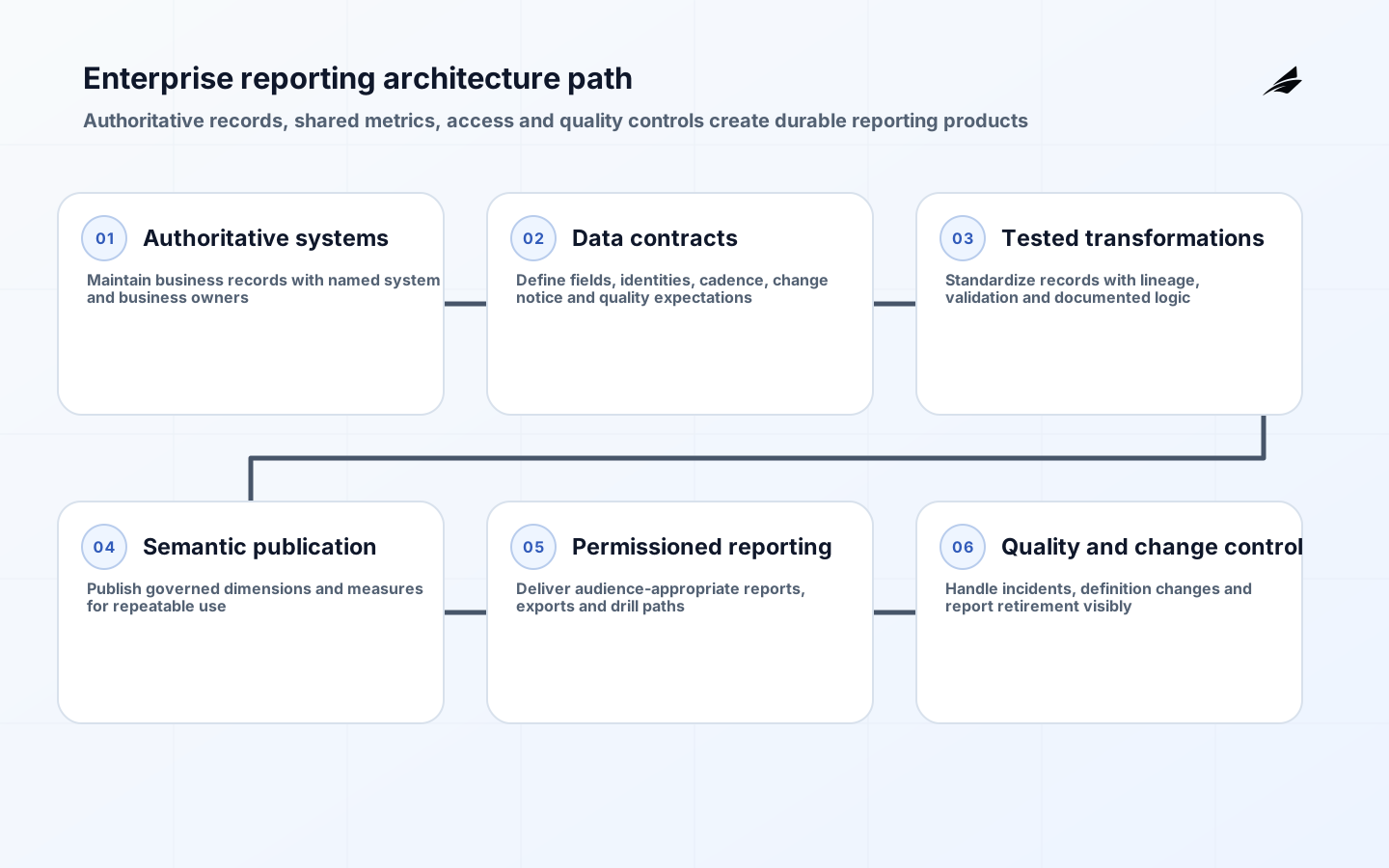
Enterprise reporting architecture is the set of decisions that turns operational records into governed information for people who need to run the business. It includes more than a reporting tool or a warehouse. Product leaders need to decide which questions reports must answer, who owns the meaning of a measure, where records are authoritative, how data moves, what access is permitted and how changes reach users without breaking their trust. The architecture is successful when it allows a reviewer to understand a number's scope, time, calculation and source, then act on it with the right level of confidence. It fails when different teams publish plausible but incompatible versions of the same business fact.
Define reporting products and users
Treat a report as a product with a specific user, decision and service expectation. An operations manager may need a daily exception queue, a finance team may need a controlled close process, and a product leader may need a trend that helps prioritize investment. Those needs should not be compressed into one universal report merely because the data overlaps. Describe the audience, decision, required dimensions, cadence, tolerance for late data, access class and owner for each reporting product. This makes scope testable and gives teams a way to retire reports that no longer support a real workflow. It also reveals whether a request is actually for a new metric, a new data integration or a different permission boundary.
| Reporting product | Primary user question | Architecture consequence |
|---|---|---|
| Operational exception view | What needs intervention now? | Freshness, routing and clear ownership matter |
| Management performance report | Are commitments and trends moving? | Stable definitions and comparison periods matter |
| Financial or compliance report | What must be formally reconciled? | Controlled close, lineage and retention matter |
| Product insight view | Where should investment change? | Cohort, event and segmentation semantics matter |
| Self-service exploration | What can analysts investigate safely? | Catalog, governed dimensions and access policy matter |
Establish record and metric ownership
Begin with record ownership. A CRM may be authoritative for a commercial interaction, an ERP for posted financial records, an identity platform for account status and a product service for event activity. Reporting can combine them, but it should not quietly replace their stewardship. For each key entity, record the system owner, business owner, identifier, lifecycle, quality expectations and permitted consumers. Then define metric ownership separately. A metric steward maintains meaning and calculation; a data team maintains the implementation; a business sponsor decides whether the measure remains relevant. Confusing these roles is how formula changes become unreviewed business policy changes.
A semantic model is useful when it publishes approved entities, relationships, dimensions and measures for repeated use. It should expose definitions and versioning, not become a mysterious layer that hides every transformation. Decide which calculations belong in the semantic model and which remain in a report because they are audience-specific. Centralize logic that represents shared business meaning; keep local presentation calculations limited and visible. When a definition changes, communicate the date, affected reports, expected trend break and owner. Historical restatement is a business decision, not merely a data engineering task.
| Ownership layer | Accountable role | Question to answer |
|---|---|---|
| Business record | System and business owner | Where is the authoritative lifecycle maintained? |
| Data contract | Source and platform owner | What fields, cadence and change notice are supplied? |
| Metric definition | Metric steward | What does the measure mean and exclude? |
| Transformation | Data product owner | How is source data standardized and tested? |
| Report experience | Reporting product owner | Which decision and audience does this presentation serve? |
Design the data and semantic path
Map the path from source change to report use. A robust path usually includes extraction or event capture, durable storage where appropriate, transformation, validation, governed publication, semantic modeling and report delivery. The exact technology can vary; the responsibilities should not. Define data contracts for important sources, including field meaning, identity, cadence, change notice and owner. Preserve enough lineage to connect a published measure to its transformation and source records. Tests should be chosen for actual risks: unique keys, accepted values, referential relationships, balancing totals, freshness and reconciliation are useful only when they reflect a known failure mode or commitment.

Model time and history deliberately. Reports may need event time, effective time, processing time or financial posting time, and the correct answer can differ by use case. Slowly changing dimensions, late-arriving records and corrections require stated treatment; otherwise the same historical view shifts unexpectedly after every run. Where a report needs a controlled snapshot, produce it as an explicit artifact with its as-of date and source state. This preserves the ability to explain a past decision without freezing the entire operational data platform.
| Architecture stage | Control objective | Useful evidence |
|---|---|---|
| Source contract | Detect incompatible upstream changes | Versioned schema and owner notification |
| Transformation | Make business logic reviewable | Versioned model, tests and documentation |
| Quality gate | Stop or qualify unreliable publication | Freshness and reconciliation results |
| Semantic publication | Reuse approved meaning consistently | Versioned measures and dimensions |
| Report delivery | Expose the right view to the right audience | Access test and release record |
Govern access, distribution and retention
Reporting often joins information that was separately protected in operational systems. Design access from the audience and data classification rather than treating a dashboard workspace as a public notice board. Determine whether access is report-level, row-level, column-level or based on a governed aggregate. Test exports, subscriptions, embedded reports, cached extracts and drill-through paths because each can create a different distribution route. A user who may view a summary does not automatically need the underlying customer or employee record. Keep permission assignment reviewable and remove access when team membership or reporting purpose changes.
Retention also affects architecture. Some reports need reproducible historical evidence; others should not preserve detailed data longer than necessary. Coordinate report requirements with record policy, privacy obligations and operational recovery. Do not build a separate, undocumented historical archive inside exports or analyst workspaces. A catalog and clear metadata can help users discover approved products, but discoverability must be matched with a request path for data that is restricted or not yet fit for reuse.
Run quality, change and incident processes
Operate data quality as a service concern. Define what happens when a critical source is late, a model test fails, a metric is restated or a report is published with known limitations. The response should name affected products, business impact, temporary status, owner, communication route and correction decision. A report can stay available with a clear quality notice in some cases; in others, publication should pause. The choice belongs to the reporting product owner and affected business owner, not solely to a pipeline alert. Keep a history of material incidents and their causes so recurring source and contract failures receive structural fixes rather than repeated manual patches.
| Change or incident | Required decision | Communication to users |
|---|---|---|
| Source schema change | Can the model continue safely? | Affected report and expected timing |
| Metric definition change | Restate history or start a new series? | Meaning, effective date and trend impact |
| Late critical data | Publish provisional result or wait? | Data-as-of time and limitation |
| Access policy change | Which audiences lose or gain visibility? | Purpose and request route |
| Report retirement | What replaces the workflow? | Migration date and retained history |
Use a release path for reporting products. Peer review transformation and metric changes, test representative access rules, validate important comparisons and let business stewards approve meaning where needed. Measure adoption by the quality of the workflow, not just page views: are teams using the product in the intended meeting or decision, and do they still rebuild the same analysis elsewhere? Product leaders should periodically prune duplicate reports, undocumented extracts and abandoned metrics. Simplifying the estate is a reliability improvement because it concentrates support and definition ownership where it is actually needed.
Stage the delivery plan
Deliver in slices that connect a reporting question to a complete, governed data path. Start with one high-value product, its authoritative sources, minimum viable metric set, access policy and review rhythm. Prove that users can trace the result, handle a data exception and request a definition change. Then extend shared dimensions and semantic logic to adjacent products. This sequencing exposes dependencies early and avoids a long program that builds infrastructure without a usable reporting service. Keep an architecture decision record for important choices, especially identifier strategy, history treatment, metric publication and access enforcement.
Key takeaways
- Design reporting products around users and decisions, not around a generic request for dashboards.
- Separate stewardship of operational records from ownership of shared metric meaning.
- Use contracts, lineage, tests and a governed semantic layer to make information reusable and explainable.
- Treat access, export routes and retention as architectural requirements.
- Operate reporting with clear quality notices, release controls and retirement decisions as the estate evolves.
Frequently asked questions
Does every enterprise need one semantic layer?
Shared business definitions benefit from governed reuse, but the implementation can be incremental. Start with the entities and measures used by multiple reporting products, then expand when ownership and change control are ready.
Is a warehouse enough to solve reporting inconsistency?
No. Storage and query capability do not define business meaning, ownership, access or a release process. Those operating decisions are required even when all reports use the same platform.
How can teams enable self-service without losing control?
Publish documented, permissioned data products and shared metrics, then give analysts a route to request new definitions or access. Self-service works best when it reduces repeated extraction while preserving traceability and stewardship.
Conclusion
Enterprise reporting architecture is a product and governance discipline, not a diagram of tools. Give reports a clear purpose, preserve ownership from source to metric, make quality visible and control how information reaches people. With those foundations, product leaders can build an estate that grows through reuse instead of multiplying conflicting versions of the business.