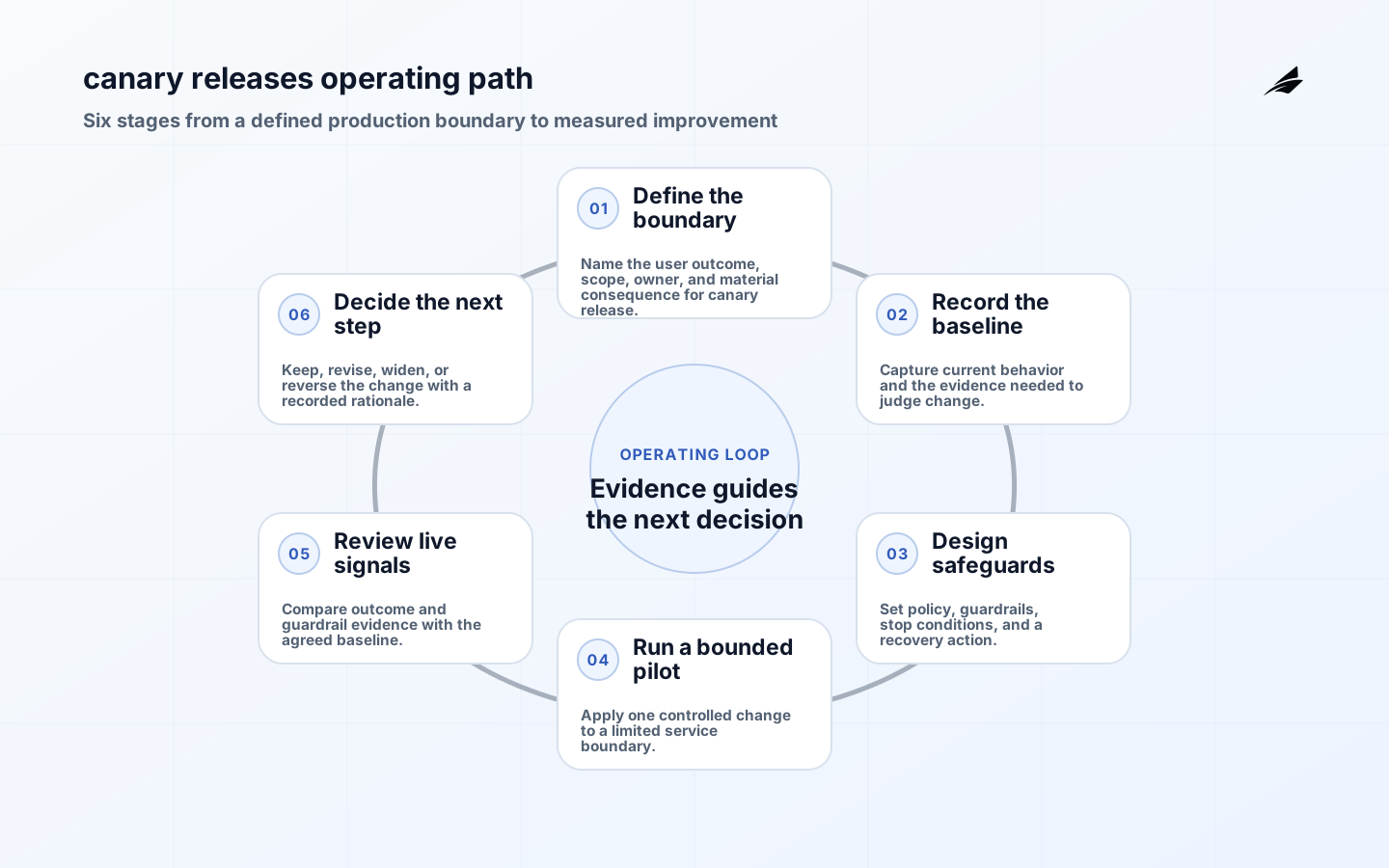
Canary releases let a team expose a new revision to a deliberately limited portion of traffic before making it the default. The word “limited” is doing serious work: a percentage is not automatically a useful cohort, and a green CPU graph is not proof that a checkout or workflow succeeds. Google Cloud Deploy’s canary strategy models separate rollout phases and a stable phase; Argo Rollouts analysis shows how measurements can gate progress. The production discipline is choosing signals that reveal customer harm early enough to stop.
Set the cohort and promotion evidence before rollout
The first production artifact is a staged exposure policy that defines the cohort, percentage or region, observation window, promotion thresholds, and automatic or human stop action. It turns an abstract initiative into a boundary that someone can operate — For a production canary, apply the test at the cohort, guardrail, and recovery checkpoint. Write the user outcome, the systems included, the named owner, the decision cadence, and the condition that stops the change For canary release, the important risk is exposing a harmful change to more users because the team measured only infrastructure health or advanced stages faster than the evidence allowed. A boundary is useful only when it makes that risk visible before customers discover it — For a production canary, apply the test at the cohort, guardrail, and recovery checkpoint.
Start by deciding what is safe to learn from. A canary can target a region, tenant class, employee group, request header, or small percentage, but the selection must not unfairly concentrate a high-consequence workflow. State the expected improvement or equivalence and the adverse condition that halts the release. A short observation window detects immediate errors; a longer window may be needed for batch work, caching, seasonal demand, or customer behavior. Do not promote merely because nothing crashed in the first five minutes.
| Decision element | Question to settle | Evidence to retain |
|---|---|---|
| Outcome | What user or operator result should canary release improve or protect? | A baseline, target, and named service owner. |
| Scope | Which services, environments, and actors are included? | A current inventory and explicit exclusions. |
| Guardrail | What harm must stop the work? | Thresholds, alert query, and stop authority. |
| Recovery | How is normal behavior restored? | A tested runbook and decision record. |
Trace each request through the candidate path
The routing layer needs a clear source of truth for which revision receives which request. Preserve correlation between request, release version, cohort, and downstream effects so a metric can be segmented without guesswork. Feature flags may complement traffic splitting, but they introduce their own state and rollback path. Keep the baseline revision available while the canary is active, and make sure retries, queues, and sticky sessions do not accidentally move an experiment across cohorts.
For canary releases, keep the architecture legible to the person on call. Show the entry point, authoritative records, identities, policy or control points, telemetry, and the path to a safe state Google Cloud rollout management is a useful reference for the underlying mechanisms. In local design reviews, ask a practical question: when the expected result is absent, which component, owner, and record will establish what happened That question usually exposes missing dependencies sooner than an elaborate diagram does — For a production canary, apply the test at the cohort, guardrail, and recovery checkpoint.
Advance stages only when the evidence earns it
Use few, meaningful stages. For each one, record the entrance condition, minimum observation period, health queries, owner, and next action. A release controller can automate the percentages, but a human still needs authority to pause when context changes, such as an incident or marketing event. Google’s rollout-management documentation is a useful reminder that a rollout consists of jobs and phases, not a single instantaneous deploy. Rehearse the halt while traffic is low.

For canary releases, make the release record specific enough for another operator to continue the work: baseline, exact configuration or revision, expected effect, affected cohort, observation window, guardrail queries, and recovery action. Use the related delivery guide to keep the surrounding change process clear A small pilot is not a ceremonial prelude; it is how the team learns whether its measurement and response assumptions survive production conditions — For a production canary, apply the test at the cohort, guardrail, and recovery checkpoint.
| Stage | Minimum output | Decision gate |
|---|---|---|
| Discover | Current boundary, baseline, owner, and known constraints. | The problem can be measured without guessing. |
| Design | Controls, evidence path, and recovery action. | The main consequence has a practical safeguard. |
| Pilot | A limited change with explicit stop conditions. | Observed behavior supports a wider use. |
| Operate | Runbook, alert owner, and review cadence. | Normal turnover will not erase knowledge. |
| Improve | A recorded lesson and next hypothesis. | Evidence, rather than urgency, selects the next change. |
Pair customer outcomes with release guardrails
Use cohort-specific successful-journey rate, error budget burn, latency, support signals, and the time from regression to halted exposure. Pair a direct outcome measure with a guardrail so a local improvement cannot hide a broader regression Segment by the boundary that matters, such as revision, region, workload, cohort, or service route — For a production canary, apply the test at the cohort, guardrail, and recovery checkpoint. Each query should have an owner who understands its limitations and a written action for breach — For a production canary, apply the test at the cohort, guardrail, and recovery checkpoint. Argo Rollouts analysis provides authoritative context, but the threshold must reflect the consequence and operating capacity of this service.
The canary dashboard should compare the candidate with a baseline over the same cohort or an equivalent control. Put user-facing success first, then supporting infrastructure signals. Alerting needs to be sensitive enough to stop a dangerous change but resistant to ordinary noise; otherwise teams learn to bypass it. Record why a release advanced, paused, or reverted. That history improves threshold design and lets the team identify whether a recurring regression belongs to code, data, release process, or observability.
Plan for shared dependencies and side effects
A canary becomes theater when it uses fixed percentages with no decision criteria. It also fails when a shared dependency makes the candidate’s effect visible to everyone, or when asynchronous work continues after the route is reverted. Include side effects in the blast-radius estimate. The recovery decision should prioritize users already affected: stop further exposure, restore the known-good behavior, and reconcile any incomplete work before debating the next percentage.
A sound canary review separates evidence from explanation. Compare the release timeline, cohort scope, and customer effect, then identify the failed assumption, control, or handoff. Use observability and incident context to trace the investigation without adding vague monitoring. Close with one owned correction, a due date, and a recorded decision about whether the operating boundary can widen — For a production canary, apply the test at the cohort, guardrail, and recovery checkpoint.
Keep the comparison record stable
Choose cohort boundaries that support diagnosis as well as safety. A small percentage mixed across all traffic may be appropriate for a stateless endpoint; a region or employee cohort may produce clearer evidence for a workflow with long-lived state. Keep the assignment rule stable through the observation window. Changing both the code and the experiment population prevents a fair comparison and weakens the promotion decision.
For canary releases, record the comparison cohort and decision timestamp at each stage. That evidence lets the next release owner understand why a percentage advanced or stopped instead of repeating the same uncertain experiment.
The hardest canary decisions concern effects that outlive routing. Queued work, cache writes, notifications, and partially completed transactions may continue after the candidate stops receiving new requests. Include those effects in the release boundary and give the responder a reconciliation step. Also keep the comparison cohort stable: changing the population while changing the revision makes a result difficult to interpret even when the dashboard looks healthy. A short decision record should capture the cohort rule, stage, evidence window, threshold, side-effect status, and owner at every promotion or halt.
Key Takeaways
- Canary releases should begin with a defined user outcome and a named operating boundary.
- Keep the first production change small enough to observe, stop, and reverse — For a production canary, apply the test at the cohort, guardrail, and recovery checkpoint.
- Use an outcome signal with guardrails so apparent improvement does not conceal harm — For a production canary, apply the test at the cohort, guardrail, and recovery checkpoint.
- Treat ownership, evidence, and recovery as implementation requirements, not documentation afterthoughts
- Expand only when the team can explain the result and sustain the operating work — For a production canary, apply the test at the cohort, guardrail, and recovery checkpoint.
Frequently Asked Questions
These answers focus on production canary boundaries: choosing a diagnostic cohort, setting stop conditions, preserving side effects, and recording why routing advanced or stopped. Apply them alongside the release record and recovery runbook.
Promotion policy should reflect the consequence of the workflow, not a fashionable percentage. A low-risk stateless endpoint may tolerate a small traffic share, while a stateful checkout or notification path may need a region, tenant class, or employee cohort that makes side effects diagnosable. Define what remains outside the experiment, how retries and sticky sessions are handled, and which team owns communication when the candidate is stopped. Those details are what turn a rollout controller into a safe production practice. For a different traffic-boundary pattern, Azure Front Door blue/green deployment guidance shows how routing and verification can be coordinated.
Conclusion
The durable version of canary releases is an operating promise: what the team is improving or protecting, who can decide, which evidence matters, and how harm is contained. Start with the smallest decision that matters, keep the path reversible, and let measured production behavior determine the next investment That approach produces a capability the team can explain, operate, and improve under real pressure — For a production canary, apply the test at the cohort, guardrail, and recovery checkpoint.
A production canary needs an evidence record tying each stage to a cohort, comparison, threshold, decision time, and named authority. Preserve the stable revision and asynchronous side effects so reversal does not erase diagnosis facts. See distributed tracing for Cloud and DevOps for adjacent investigation practice.
Use a customer journey as the test case: compare the candidate with a stable cohort, stop on a guardrail breach, restore routing, reconcile continued work, and decide whether to widen, revise, or retire the rollout policy.