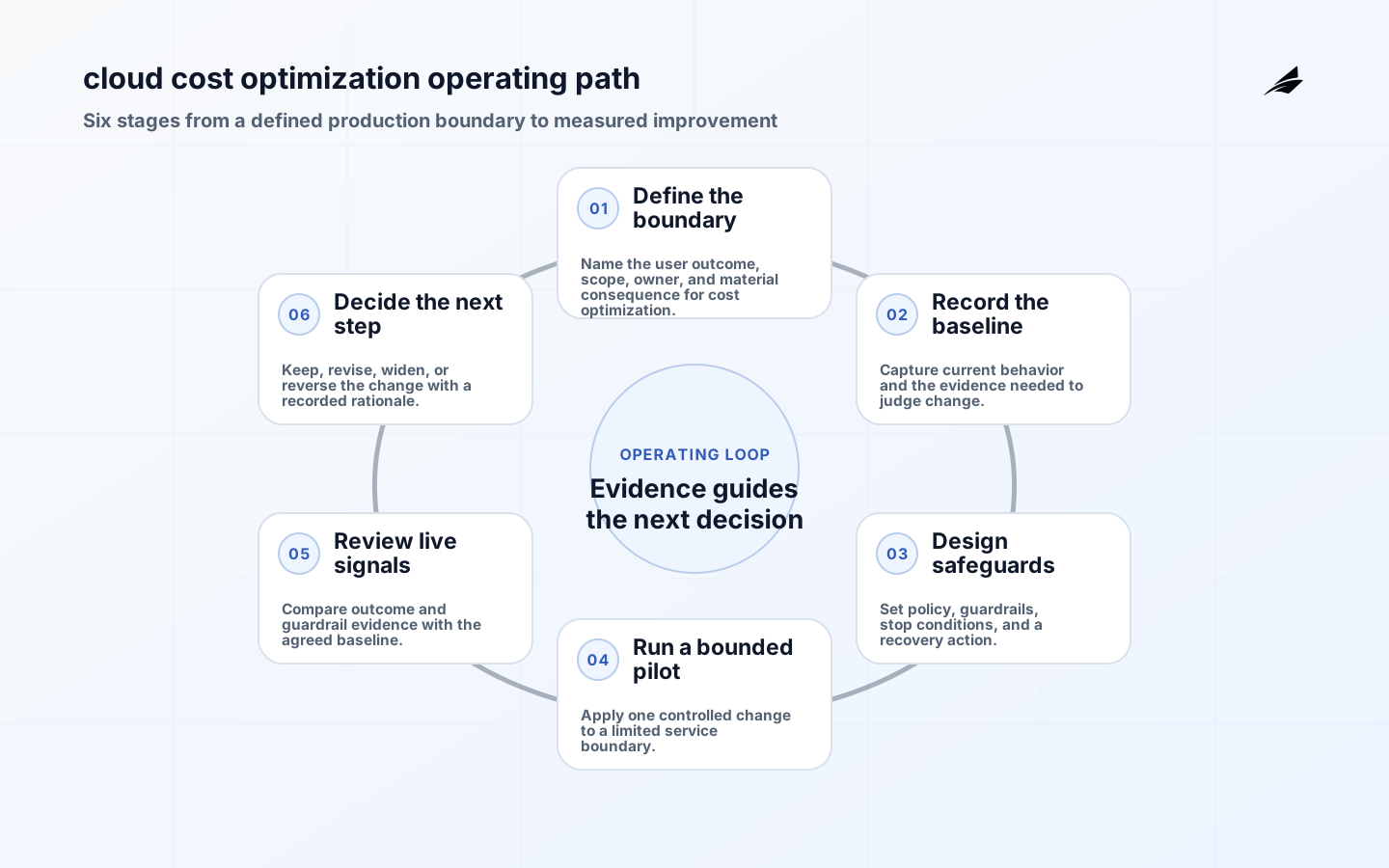
Cloud cost optimization becomes a production concern when savings change the service a customer actually receives. Turning off idle development capacity is usually straightforward; changing database capacity, storage retention, or network paths can alter recovery and latency. Treat the work as a sequence of testable decisions rather than a monthly scavenger hunt. The AWS Well-Architected Cost Optimization Pillar and FinOps Framework capabilities both stress ownership, allocation, and recurring review. In a product team, that means a service owner and finance partner agree on the unit of value before anyone changes a reservation, schedule, or resource size.
Draw the Production Cost Boundary
The first production artifact is a workload inventory that joins owner, environment, allocation tag, and a business unit such as a completed order or active tenant. It turns an abstract initiative into a boundary that someone can operate in the cost governance. Write the user outcome, the systems included, the named owner, the decision cadence, and the condition that stops the change in the cost governance. For cost optimization, the important risk is a lower bill achieved by silently reducing availability, performance headroom, backup coverage, or developer capacity. A boundary is useful only when it makes that risk visible before customers discover it in the cost governance.
Start by separating useful demand from accidental consumption. A cost report without resource ownership produces arguments; a report connected to a customer journey produces choices. Map compute, storage, egress, managed service fees, and support costs to the workload boundary. Then state which costs cannot be reduced because they protect a recovery objective or a contractual commitment. This makes the first hypothesis modest and inspectable: for example, schedule a non-production environment, right-size one worker pool, or remove an unused snapshot policy after confirming retention needs.
| Decision element | Question to settle | Evidence to retain |
|---|---|---|
| Outcome | What user or operator result should cost optimization improve or protect? | A baseline, target, and named service owner. |
| Scope | Which services, environments, and actors are included? | A current inventory and explicit exclusions. |
| Guardrail | What harm must stop the work? | Thresholds, alert query, and stop authority. |
| Recovery | How is normal behavior restored? | A tested runbook and decision record. |
Make Allocation Explain the Architecture
The useful architecture is a joined evidence path, not merely a billing dashboard. Billing exports provide the spend and usage record; tags and account structure provide attribution; application telemetry provides demand and reliability context; deployment history explains discontinuities. Set a freshness expectation for each feed. An owner should be able to distinguish a true increase in customer activity from a tag gap, a new region, a load test, or a pricing change. Google Cloud guidance is particularly useful here: measure a workload in a way that connects efficiency to its business purpose.
For cloud cost optimization, keep the architecture legible to the person on call. Show the entry point, authoritative records, identities, policy or control points, telemetry, and the path to a safe state FinOps Framework capabilities is a useful reference for the underlying mechanisms. In local design reviews, ask a practical question: when the expected result is absent, which component, owner, and record will establish what happened in the cost governance. That question usually exposes missing dependencies sooner than an elaborate diagram does during the cost governance review 1.
Record the Configuration. Before Touching. It
Make proposed changes reversible and narrow. Capture the prior configuration, the expected saving, the guardrail thresholds, a stop condition, and the person who may approve a rollback. Start with a window where demand is understood, then compare like-for-like periods rather than declaring success from a single quiet day. Capacity reductions should have automated scaling or a documented restoration path. Storage lifecycle changes need a restore test, because a cheaper retained object is not useful if its recovery process fails.

For cloud cost optimization, make the release record specific enough for another operator to continue the work: baseline, exact configuration or revision, expected effect, affected cohort, observation window, guardrail queries, and recovery action. Use the related delivery guide to keep the surrounding change process clear in the cost governance. In the cost governance: A small pilot is not a ceremonial prelude; it is how the team learns whether its measurement and response assumptions survive production conditions
| Stage | Minimum output | Decision gate |
|---|---|---|
| Discover | Current boundary, baseline, owner, and known constraints. | The problem can be measured without guessing. |
| Design | Controls, evidence path, and recovery action. | The main consequence has a practical safeguard. |
| Pilot | A limited change with explicit stop conditions. | Observed behavior supports a wider use. |
| Operate | Runbook, alert owner, and review cadence. | Normal turnover will not erase knowledge. |
| Improve | A recorded lesson and next hypothesis. | Evidence, rather than urgency, selects the next change. |
Review Savings Against Service Consequences
Use cost per successful business unit, with latency, error rate, and capacity headroom as guardrails. Pair a direct outcome measure with a guardrail so a local improvement cannot hide a broader regression in the cost governance. Segment by the boundary that matters, such as revision, region, workload, cohort, or service route during the cost governance review 1. Each query should have an owner who understands its limitations and a written action for breach in the cost governance. Google Cloud cost optimization framework provides authoritative context, but the threshold must reflect the consequence and operating capacity of this service.
Put the review in the operational calendar, not in a special project folder. A weekly service-level review can examine anomalies and expiring exceptions; a monthly cost review can examine unit economics and pricing commitments. The decision record should say whether a saving was retained, reversed, or deferred, and why. This preserves the context that is otherwise lost when the person who resized a workload changes teams. Azure Well-Architected guidance reinforces the need to balance cost with reliability and performance rather than optimizing a single invoice line.
Failure Stories Worth Catching Early
The common failure is treating spend as the only signal. A team can cut database capacity, see a short-term saving, and push queuing or failed requests onto customers. Another is buying a long commitment before usage is stable. Avoid both by pairing every cost measure with a service guardrail and by recording demand assumptions. A cost anomaly also deserves investigation before correction: it may reveal an attack, a retry storm, a release defect, or a missing tag rather than ordinary waste.
A sound cloud cost optimization review separates evidence from explanation. Confirm the timeline, scope, and customer effect; then identify the assumption, control, or handoff that failed in the cost governance. Use observability and incident context to improve the investigation path rather than adding vague monitoring during the cost governance review. In the cost governance: Close the review with one owned correction, a due date, and an explicit decision about whether the operating boundary can widen
Use a concrete comparison when the team debates whether a saving is real. For a worker-pool change, compare cost per completed job, queue wait, error rate, and recovery time for the same demand window before and after the change. Exclude a known load test or promotion event, and record why the comparison is still representative. If the cost falls while queue wait rises only for one tenant or region, the average has hidden the decision that matters. Segment first, then decide whether to keep the change, narrow its scope, or restore the prior capacity. This turns a production cost review into an operational decision with evidence rather than a debate over a single invoice chart.
Leave a Decision. Record Another Engineer Can Replay
Before approving a saving, record the demand assumption that makes it safe. A weekday schedule may be sound for a training environment and dangerous for a customer-facing regional service. Keep the forecast, business calendar, autoscaling limit, and restoration command together. When costs rise, compare the change in cost per successful unit with demand and reliability first; a larger bill can be a healthy result when a growing workload is delivering proportionally more value.
Key takeaways
- Cloud cost optimization should begin with a defined user outcome and a named operating boundary.
- Keep the first production change small enough to observe, stop, and reverse in the cost governance.
- Use an outcome signal with guardrails so apparent improvement does not conceal harm in the cost governance.
- Treat ownership, evidence, and recovery as implementation requirements, not documentation afterthoughts
- Expand only when the team can explain the result and sustain the operating work in the cost governance.
Frequently asked questions
When is cost optimization ready for production? When the scope, accountable owner, evidence, control, and recovery action are explicit and have been exercised for a bounded use in the cost governance. What should a small team do first for cloud cost optimization? Pick one meaningful journey, record a baseline, and make one reversible change; broad programs create evidence gaps in the cost governance. How often should it be reviewed? In cost governance: Review after a material change or incident and on a cadence proportionate to the consequence What if the data is incomplete? In cost governance: In cost governance: Make the uncertainty visible, narrow the action, and improve the measurement before making an irreversible decision This related operations guide can help establish the surrounding reliability practice
Conclusion
The durable version of cloud cost optimization is an operating promise: what the team is improving or protecting, who can decide, which evidence matters, and how harm is contained. Start with the smallest decision that matters, keep the path reversible, and let measured production behavior determine the next investment in the cost governance. That approach produces a capability the team can explain, operate, and improve under real pressure during the cost governance review 1.
A production cost change earns trust when another engineer can reconstruct its premise from the record. Keep the affected service, demand assumption, baseline, exact setting, expected saving, observation window, guardrail queries, approver, and restoration action together. Review the saving with the user-visible result rather than treating a billing delta as a verdict. If the bill improves but recovery, latency, or queue behavior worsens, the correct decision is to narrow or reverse the change. If the service remains healthy, record why the evidence is sufficient to widen it and which assumption will be checked next.
A production decision about cloud cost optimization should be tested against a concrete operating scenario, not only a design diagram. Use the production scenario to name the input, the responsible owner, the expected signal, and the point at which the team stops or reverses the change in the cost governance. Evidence should include both the normal path and the first credible exception: late data, an unavailable dependency, an unexpected permission, a changed schema, a noisy alert, or a customer-visible delay in the cost governance. Record the observed condition and the decision made so a later reviewer can tell whether the control worked or merely appeared to work in the cost governance. This record is specific to this article, so its acceptance evidence should remain tied to the article's named workflow rather than a generic checklist in the cost governance.
Authoritative context for cost governance: AWS Well-Architected Cost Optimization Pillar; FinOps Framework; Google Cloud cost optimization framework; Azure Well-Architected cost optimization. These references anchor the article-specific guidance in current technical and operating practice, while the local owner remains responsible for applying the evidence to the cost governance decision.