Serverless architecture shifts important operational choices; it does not remove them. The provider operates servers and much of the scaling machinery, while the application team still owns event contracts, identity, concurrency limits, dependencies, data consistency, and customer outcomes. Many failures come from applying synchronous request assumptions to asynchronous work: an event is delivered more than once, a downstream service throttles, a retry repeats a side effect, or a function scales faster than the database it calls. The remedy is to design the workload around its delivery semantics and recovery obligations.
Key takeaways
- Treat serverless architecture as an operating decision with a named owner and explicit evidence.
- Separate the normal delivery path from the exception or recovery path before production pressure arrives.
- Use customer, service, and operational signals together so a technically green result does not hide a failed outcome.
- Improve the supported pattern from incidents, exercises, and recurring exceptions rather than relying on informal memory.
Choose serverless for a workload, not as a default identity
Serverless functions suit discrete, event-driven tasks with clear boundaries, variable demand, and manageable execution limits. They are less attractive when a workload needs long-lived connections, highly predictable sustained capacity, specialized runtime control, or complex local coordination. Evaluate the transaction shape, latency tolerance, state model, dependency throughput, security boundary, and operational skills before choosing the platform. A decision that says no to a function is not a failure of modernization; it can be the best way to reduce the operational surface for a service.
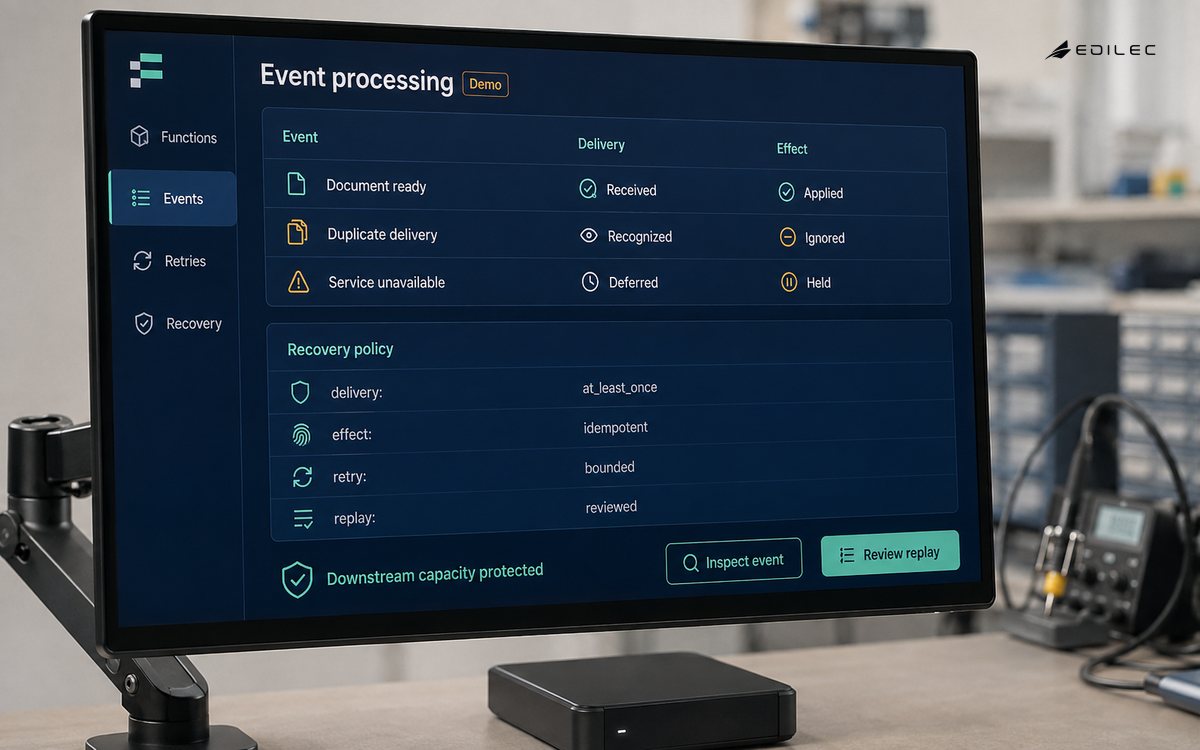
Define the event contract as carefully as an API. Specify identifier, schema version, producer, consumer behavior, retry and ordering assumptions, duplicate handling, retention, and dead-letter or failure destination. Producers and consumers evolve independently in an event system, so compatibility and observability are delivery architecture concerns. Include a correlation identifier that survives queues and function invocations, and record enough business context to route a failed item without logging sensitive payloads unnecessarily.
| Design concern | Failure mode | Practical control |
|---|---|---|
| At-least-once delivery | Duplicate payment, email, or state change | Use idempotency keys and durable completion records. |
| Burst scaling | Database or partner service overload | Set concurrency limits and absorb work in a queue. |
| Retry behavior | Poison event repeats until expiry | Set retry, age, and failure destination deliberately. |
| Event schema change | Old consumer rejects new producer | Version contract and test compatibility before release. |
Design retries, timeouts, and concurrency as one system
A retry policy is a statement about which failures are likely transient and how much duplicate work the business can tolerate. Configure timeout, retry count, maximum event age, and failure destination together. For asynchronous Lambda invocation, the platform has documented retry behavior and can deliver the same event more than once; application logic must therefore be idempotent. A dead-letter queue is not a place to forget failed work. Name an owner, alert on depth and age, and provide a safe reprocessing procedure with the same deduplication controls.
Set concurrency in relation to the narrowest downstream dependency, not the theoretical scale of the function service. A function that successfully opens thousands of concurrent database connections can create an outage while every individual invocation is healthy. Use queues to smooth bursts, backoff with jitter for transient dependency failures, and circuit or admission controls where applicable. Then test the behavior at a controlled load. The architecture is complete only when overload produces a known degraded mode rather than uncontrolled retries and cost growth.
Design the serverless architecture decision path
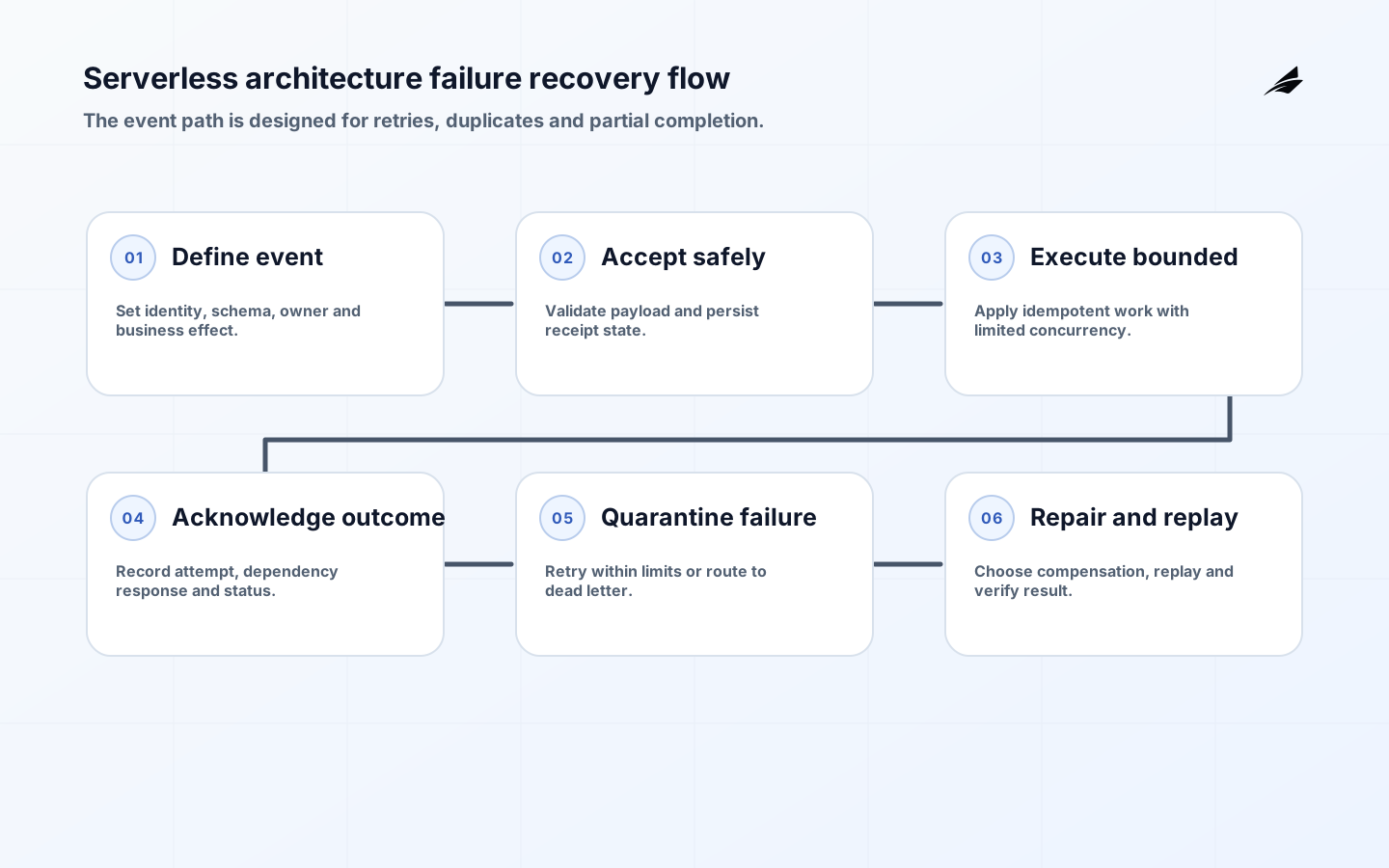
The serverless operating path moves from a defined event contract through bounded invocation, idempotent processing, controlled retry and failure capture, business reconciliation, and feedback into capacity and schema design. It makes the recovery path explicit instead of treating retries as magic.
| Operational signal | Question to ask | Corrective action |
|---|---|---|
| Function errors rise | Is failure in code, configuration, or dependency? | Contain producer rate or route failures while investigating. |
| DLQ depth grows | Can these events be safely replayed and by whom? | Classify, repair cause, and reprocess with audit trail. |
| Duration approaches timeout | Is work too large or dependency too slow? | Split work, adjust timeout, or fix the downstream bottleneck. |
| Cost spikes with invocation count | Did demand change or is there a retry loop? | Trace correlation IDs; throttle recursive or runaway paths. |
Keep identity and data boundaries small
Give each function the narrowest practical access to its data stores, queues, and secrets. Separate ingestion, transformation, and privileged action when that makes authority easier to reason about. Environment variables are configuration inputs, not a secure place for long-lived secrets; use the provider's secret or identity facilities and restrict who can change the function configuration. Review event sources too: a function can be well scoped yet still be triggered by an overly broad bucket, topic, or cross-account permission.
Avoid recursive invocation paths unless they are intentional, bounded, and observable. Provider guidance specifically warns that recursive patterns can create unintended invocation volume and escalating cost. Add rate limits, concurrency controls, and alarms that identify the producer and function before a loop becomes a bill or an outage. This is a good example of why cost, reliability, and security cannot be separated cleanly in serverless design: the same unbounded permission or retry path affects all three.
Operate on business outcomes, not provider success codes
A successful function invocation may still represent a failed customer outcome if a downstream write was rejected, a message was routed to a failure queue, or a later step timed out. Instrument business completion and durable state transitions alongside invocation, duration, error, and throttle metrics. Correlate the event identifier through the workflow so support can answer where an order or request stopped. This turns distributed debugging from log searching into an evidence trail aligned with the service promise.
Review the oldest failed messages, concurrency saturation, retry volume, dependency latency, and cost per completed unit at a regular cadence. These measures reveal whether a function is carrying a workload it should not own or whether an event contract needs redesign. Fixes may include a queue boundary, batch behavior, a durable orchestrator, a different compute model, or a clearer ownership handoff. The right architecture is the one whose normal and failure paths the team can explain.
Worked serverless decision
An order-import function receives object-created events and writes rows to a database before notifying another service. One afternoon the downstream service throttles, the function times out, and the event source retries. Without an idempotency key, the retry creates duplicate rows and duplicate notifications even though the provider is behaving as designed. A safer design stores a durable import identifier before the side effect, uses the identifier to return the previous outcome on a duplicate, and sends permanently failing events to a monitored failure destination. Concurrency is capped so the database and downstream service receive work at a rate they can tolerate. Queue age then becomes an operational signal rather than a hidden backlog.
The recovery procedure should distinguish an event that never completed from one that completed but whose acknowledgement was lost. A replay tool that ignores that distinction can cause more harm than the original failure. By keeping correlation identifiers, durable completion state, and a named owner for failed events, the team can repair the order path with evidence rather than attempting a blind bulk replay.
Before accepting the design, run a small failure exercise that deliberately sends a duplicate event, slows the downstream dependency, and creates one permanently invalid message. Confirm that the duplicate has no extra business effect, that bounded concurrency protects the dependency, and that the invalid item reaches a place where a human can inspect it with the necessary context. Also check the customer-facing result: an order should not look completed merely because the first function returned successfully. The exercise connects function-level metrics to the actual workflow and often reveals a missing status transition or notification. It is a compact way to prove that retry behavior and reconciliation are architecture choices, not just provider settings.
Frequently asked questions about serverless architecture
Question: When is serverless a good fit? Answer: It fits event-driven or variable workloads when managed scaling is valuable and state, startup latency, execution limits, and operational ownership can be bounded.
Question: How should duplicate events be handled? Answer: Use idempotency keys, durable state, retry and dead-letter behavior, and reconciliation so a repeated delivery cannot silently create a second business outcome.
Are serverless functions exactly-once?
Usually not. Event sources and retries commonly have at-least-once behavior, so application logic must safely tolerate duplicates through idempotency and durable state design.
Should a dead-letter queue automatically replay messages?
Only after the failure cause and replay safety are understood. Automatic replay can repeat an external side effect or flood a still-unhealthy dependency.
Conclusion
Serverless architecture is strongest when event delivery, dependency limits, failure handling, and business reconciliation are first-class design choices. Let the platform handle commodity operations, while keeping ownership of the outcomes customers actually experience.
Review the failure path, not only the function
A serverless architecture review should follow one event through producer, trigger, function, state store, downstream effect, acknowledgement, retry and dead-letter route. AWS Lambda design guidance emphasizes statelessness, decoupling, orchestration and idempotency. Azure Functions reliability guidance similarly treats retries, durable state, monitoring and idempotent effects as architecture decisions rather than code details.
Test a timeout after a downstream system accepted a request, a poison message, a quota limit, a duplicate delivery and a cold-start or dependency delay. Record event identity, attempt, state transition and external response. Decide whether the operator retries, quarantines, compensates or asks for a business decision. Cost should be reviewed with reliability: uncontrolled fan-out, oversized payloads and repeated retries can turn a partial failure into a bill or backlog. Related reading includes serverless in production, CI/CD in production, and backup and restore.
Further Edilec context: Serverless production guide, CI/CD production guide, Backup and restore guide. The operating decision applies those references specifically to serverless architecture: mistakes, fixes and operating boundaries.
Source trail: AWS Lambda application design covers statelessness and idempotency; AWS event-driven architecture explains event sources and asynchronous trade-offs; Azure Functions architecture guidance maps reliability and security choices; and reliable Azure event processing documents at-least-once delivery. Use the four views to test the whole path.