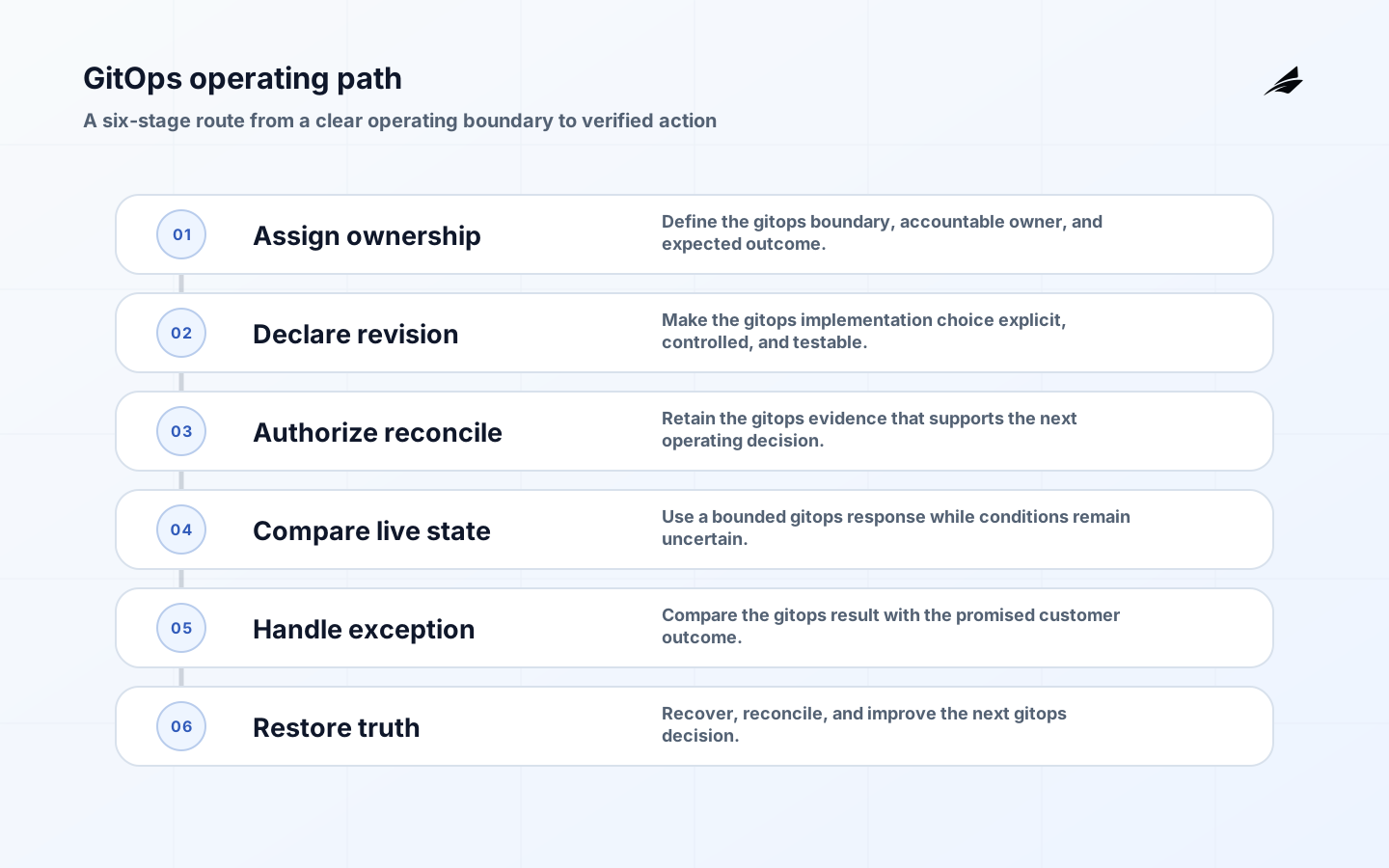
GitOps becomes valuable when a growing team can explain what it changes in daily work and how it protects customers when conditions are imperfect. The useful question is not whether the toolset looks mature; it is whether a developer, operator, or product owner can make a safe decision without reconstructing hidden assumptions. This field guide treats gitops as an operating capability: it has an owned boundary, evidence of normal behavior, a deliberate exception path, and a way to learn after a surprise. Start with one consequential workflow, make its constraints visible, and improve the routine through use.
Key takeaways
- Align repositories and environments with real decision rights, not an arbitrary folder structure.
- Use a scoped reconciliation identity instead of broad human credentials in automation.
- Make sync status actionable by pairing it with revision, target, and error evidence.
- Support emergency intervention, then require a path back to a reviewed declaration.
Set a desired-state boundary that maps to ownership
GitOps should begin with a compact contract that a team can review in ordinary language. Name the outcome being protected, the boundary where responsibility changes, the person who can decide, and the evidence that says the work is acceptable. That contract prevents an implementation detail from becoming a substitute for judgment. It also exposes the uncomfortable cases early: a dependency is slow, a permission is missing, an update is only partly applied, or a customer has already observed the effect. The right first design is the one a new on-call engineer can understand under time pressure.

| Contract element | Record to keep | Operational value |
|---|---|---|
| Repository boundary | Team, environment, and state it may declare | Makes review and ownership legible |
| Controller identity | Target namespaces and permitted actions | Limits blast radius of automated reconciliation |
| Revision policy | Reviewed commit and promotion rule | Creates a durable deployment record |
| Exception path | Emergency action, expiry, reconciliation owner | Prevents direct changes becoming permanent drift |
Grant controllers only the access they need
Growing teams do not need identical controls for every gitops decision. They do need a shared way to recognize when consequence rises. Reversible work with a narrow audience can move with automated checks and a short observation period. Changes that affect durable records, permissions, money, or a cross-service dependency deserve stronger compatibility evidence and an explicit recovery owner. Avoid measuring maturity by the number of gates. A useful control removes uncertainty for a real decision; a noisy control teaches people to route around it. Keep the exception path narrow, recorded, and time-limited so speed does not become invisible risk.
| Situation | Evidence and control | Decision rule |
|---|---|---|
| Out-of-sync resource | Compare declared and live state | Investigate intent before force-applying |
| Failed reconcile | Surface error with target and revision | Fix the declaration or access condition |
| Urgent live change | Record action and time limit | Codify or reverse after stabilization |
| Repository compromise | Revoke credentials and review controller scope | Restore trusted desired state from an audited revision |
Treat reconciliation and drift as operational signals
A green control-plane status is necessary evidence, but it is not a complete outcome. Pair technical signals with the customer or business result that the system exists to provide. Choose a comparison window and baseline before a change or incident creates pressure to interpret every fluctuation as meaningful. The signal owner should be able to state what will cause expansion, a pause, containment, or a repair. That discipline keeps gitops connected to service responsibility rather than a separate reporting exercise. It also makes handoffs kinder: the next person sees the change, the current state, and the decision already taken.
Keep an emergency route that returns to declared state
Begin with a production-adjacent path that has a real owner and enough existing evidence to compare before and after. Make the normal route simple enough that people choose it during a busy week, then exercise one adverse condition without depending on the original implementer. Document what was difficult to find: an unclear permission, a missing identifier, a fragile dependency, or a decision nobody was authorized to make. Those findings are the implementation backlog. Standardize only after the first path works, because a generic platform cannot answer questions that an accountable service team has not yet learned to ask. GitOps: Cost, Scaling and the Architecture of Reconciled Delivery offers a complementary deep dive for teams ready to extend this operating model.
A field scenario
An engineer changes a production service setting directly to restore traffic. That may be the right containment action, but the state will drift from the repository. The incident record names the expiry, and the team either codifies the justified setting in Git or restores the prior declared value. The controller is not blamed; it is used to reveal the unresolved decision.
Review checklist
- Name the accountable owner, operational responder, and decision authority for gitops.
- Keep enough evidence to reconstruct one important event without relying on a mutable label or a person's memory.
- Test one failure mode that crosses the boundary most likely to surprise the team.
- Confirm the first containment action is reversible, scoped, and available to the on-call role.
- Check a customer-facing outcome alongside the technical evidence before declaring normal operation.
- Assign an expiry and owner to every exception, temporary permission, or manual workaround.
Run a GitOps design review that produces decisions
Bring the people who build, operate, support, and approve the affected workflow into the same gitops review. Walk a representative request or change from its first input to the customer-visible result, including the handoffs that occur outside the primary code path. Ask where declarative delivery is recorded, which assumption would be hardest to verify during an incident, and who can make the first containment decision. Leave with named owners and a short list of evidence gaps, not a broad action to “improve reliability.” This keeps the design review anchored to a real operating choice.
Next, run a low-risk rehearsal that deliberately removes one assumption. The team might restrict a permission, delay a dependency, introduce an invalid input, or make a normal lookup unavailable. Observe how gitops behaves, what signal appears first, and whether the response path still works for someone who did not implement it. Rehearsal is valuable because it reveals the distance between a design diagram and the access, records, and communication available during an ordinary shift. Turn the result into a small, owned improvement while the context is fresh.
Make configuration drift evidence useful under pressure
Evidence for gitops should answer a sequence of practical questions: what changed, where did it take effect, which customer path is affected, and what action remains available. Favor stable identifiers, timestamps, and concise decisions over a pile of uncorrelated status messages. Protect sensitive data and avoid collecting fields that no responder can use. A responder needs enough context to distinguish a local symptom from a broken contract, then enough authority to contain the problem. When evidence cannot support either step, improve the instrument or record rather than adding another passive dashboard.
Finally, review whether the operating model remains proportionate as the team grows. GitOps may need stronger separation of duties, clearer reconciliation, or a documented escalation route when more systems and customers depend on it. Those changes should follow observed friction: repeated manual reconciliation, slow decisions, unclear ownership, or incidents that take too long to explain. The goal is not to preserve a simple implementation at all costs. It is to keep the routine understandable while deliberately adding control where the consequence now warrants it.
A right-sized next step for GitOps
Choose one improvement that can be demonstrated within a normal delivery cycle: remove an unclear handoff, add a missing GitOps access control, rehearse a recovery action, or make a decision record easier to find. Give that improvement an owner and a date to review its effect. A small, verified step is more durable than a broad gitops initiative because it teaches the team how this capability behaves in its own systems. Once the first path is dependable, reuse the decision pattern where the same risks and responsibilities genuinely apply.
Frequently asked questions
What is the first useful GitOps investment?
Start with the smallest change that makes one important workflow understandable and recoverable. For gitops, that means identifying the owner, the expected outcome, the evidence to retain, and the next action when the outcome is not normal. A precise first path produces better priorities than a broad adoption program.
How much of gitops should be automated?
Automate the repeatable parts of gitops: routine checks, durable records, and bounded actions with a known result. Preserve judgment for ambiguous customer impact, policy exceptions, irreversible data work, and trade-offs that only an accountable person can make. The best automation makes the safe gitops routine easier to follow while keeping its limits visible.
How should a team measure success with gitops?
Measure whether gitops makes the intended service outcome easier to deliver and recover, not whether a dashboard or tool shows more activity. Useful measures include time to make a safe decision, time to contain a failed change, successful workflow completion, and the number of recurring manual handoffs removed from this specific path.
Conclusion
GitOps is dependable when its decisions are explicit before the stressful moment arrives. Define the operating contract, retain the evidence that supports it, match controls to consequence, and practice the action that contains harm. That combination gives a growing team speed with memory: people can move a routine change quickly and still understand what happened when the unusual case appears. Continue with GitOps: Cost, Scaling and the Architecture of Reconciled Delivery and the related production guidance already available in the knowledge base.