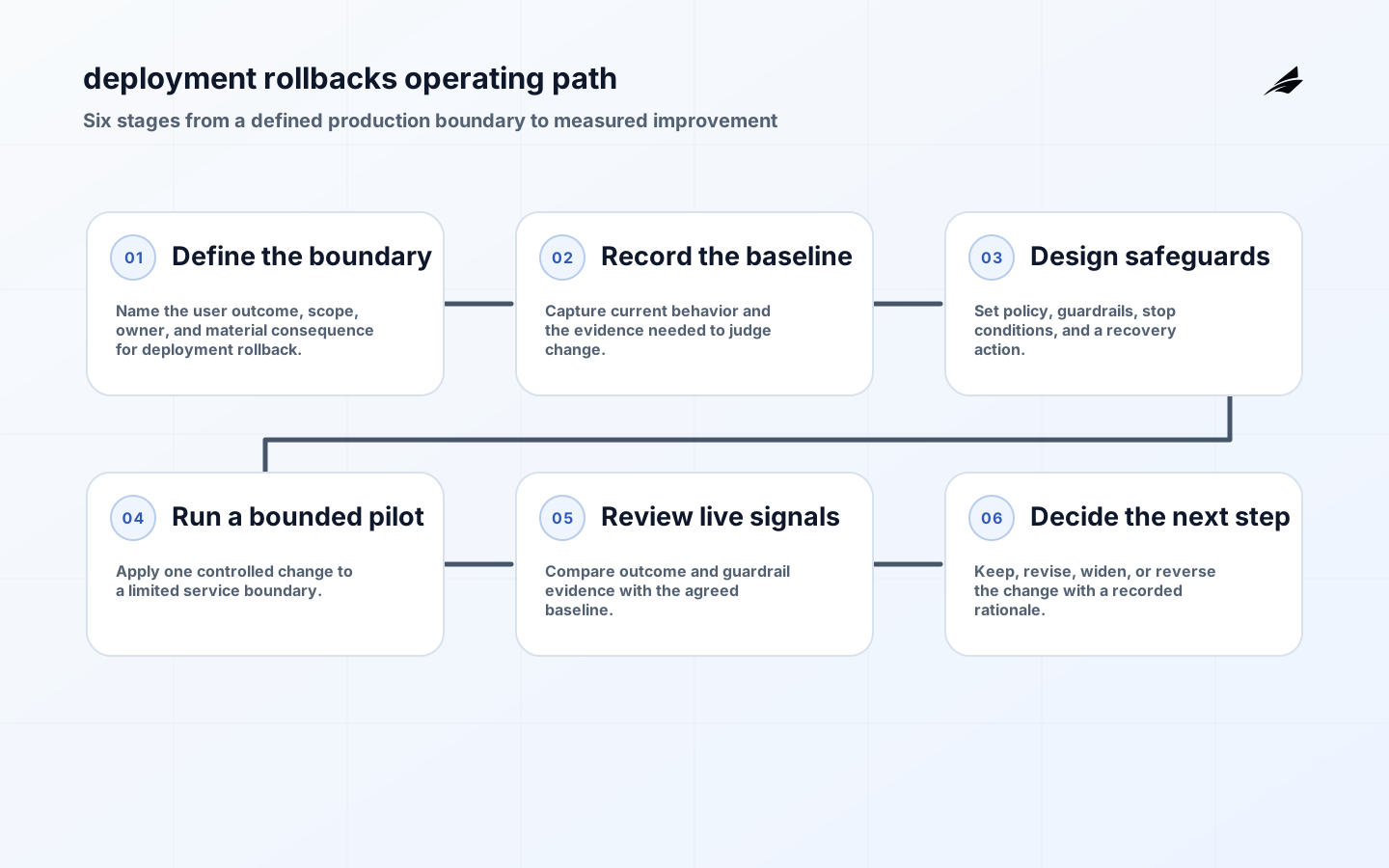
Deployment rollbacks are not the same as pressing a previous-version button. In production, a release changes code, configuration, feature flags, data contracts, background work, and sometimes infrastructure. A credible recovery plan must say which of those can move backward independently and which require a forward fix. Kubernetes Deployments documents revision history and rollout control, while AWS CodeDeploy guidance distinguishes automatic and manual rollback behavior. Those mechanics matter only after the team has defined what “service restored” means for its own customer journey.
Name what the production rollback must restore
The first production artifact is a release record containing the immutable build identity, configuration version, database compatibility state, traffic state, and the approving owner. It turns an abstract initiative into a boundary that someone can operate specifically for migration compatibility during rollback. Write the user outcome, the systems included, the named owner, the decision cadence, and the condition that stops the change, in the migration compatibility during rollback context. For deployment rollback, the important risk is restoring code while leaving incompatible schema, configuration, queued jobs, or externally visible side effects behind. A boundary is useful only when it makes that risk visible before customers discover it specifically for migration compatibility during rollback.
Classify releases by reversibility before approval. Stateless presentation code with a compatible API is often quickly reversible. A migration that deletes, transforms, or exposes data may not be. For each category, define the safe response: roll back traffic, disable a feature, stop consumers, run a compensating migration, or deploy a corrective version. The release owner needs access to those actions without waiting for a separate incident just to discover which build is currently serving a region.
| Decision element | Question to settle | Evidence to retain |
|---|---|---|
| Outcome | What user or operator result should deployment rollback improve or protect? | A baseline, target, and named service owner. |
| Scope | Which services, environments, and actors are included? | A current inventory and explicit exclusions. |
| Guardrail | What harm must stop the work? | Thresholds, alert query, and stop authority. |
| Recovery | How is normal behavior restored? | A tested runbook and decision record. |
Map code, configuration, data, and side effects
A rollback-ready delivery path preserves identity. Build artifacts should be immutable, configuration should be versioned, and the deployment system should record the target, health result, and traffic shift. Database changes deserve special treatment: use expand-contract patterns where possible, deploy readers that tolerate both shapes, and delay destructive work until the older application version is no longer needed. A release that cannot explain its schema compatibility is not ready to claim a fast rollback.
For deployment rollbacks, keep the architecture legible to the person on call. Show the entry point, authoritative records, identities, policy or control points, telemetry, and the path to a safe state, in the migration compatibility during rollback context. Argo Rollouts rollback is a useful reference for the underlying mechanisms. In local design reviews, ask a practical question: when the expected result is absent, which component, owner, and record will establish what happened, in the migration compatibility during rollback context. That question usually exposes missing dependencies sooner than an elaborate diagram does specifically for migration compatibility during rollback.
Put compatibility gates before recovery
Practice recovery with an intentionally small release. Set the trigger thresholds in advance, assign a release commander, and establish whether automation may stop or reverse the rollout. Test a failure that is realistic for the component: a dependency timeout, elevated checkout errors, a broken worker, or a malformed configuration. Argo Rollouts rollback documentation is useful implementation context, but do not assume every platform has identical behavior around paused or superseded revisions.
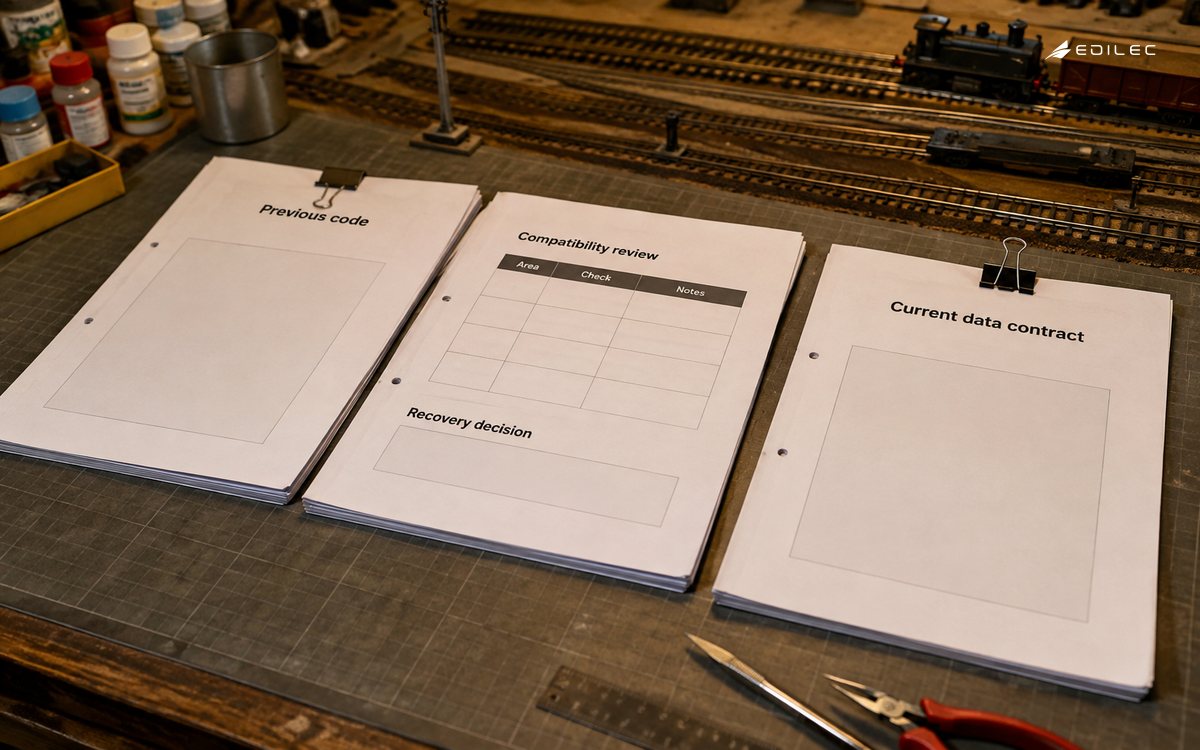
For deployment rollbacks, make the release record specific enough for another operator to continue the work: baseline, exact configuration or revision, expected effect, affected cohort, observation window, guardrail queries, and recovery action. Use the CI/CD pipeline release context to keep the surrounding change process clear. A small pilot is not a ceremonial prelude; it is how the team learns whether its measurement and response assumptions survive production conditions, in the migration compatibility during rollback context.
| Stage | Minimum output | Decision gate |
|---|---|---|
| Discover | Current boundary, baseline, owner, and known constraints. | The problem can be measured without guessing. |
| Design | Controls, evidence path, and recovery action. | The main consequence has a practical safeguard. |
| Pilot | A limited change with explicit stop conditions. | Observed behavior supports a wider use. |
| Operate | Runbook, alert owner, and review cadence. | Normal turnover will not erase knowledge. |
| Improve | A recorded lesson and next hypothesis. | Evidence, rather than urgency, selects the next change. |
Practice the decision with a bounded cohort
Use time to make a rollback decision, time to restore the customer journey, and the error and latency signals that triggered it. Pair a direct outcome measure with a guardrail so a local improvement cannot hide a broader regression, in the migration compatibility during rollback context. Segment by the boundary that matters, such as revision, region, workload, cohort, or service route specifically for migration compatibility during rollback. Each query should have an owner who understands its limitations and a written action for breach specifically for migration compatibility during rollback. AWS CodeDeploy rollbacks provides authoritative context, but the threshold must reflect the consequence and operating capacity of this service.
During an incident, the decision needs less debate than the diagnosis. The on-call view should show the last known good revision, the current exposure, affected regions or cohorts, relevant feature flags, and a direct link to the runbook. Preserve a timestamped decision record: it helps distinguish recovery delay from detection delay later. Follow the restoration with a customer-impact check, because healthy pods do not prove that a transaction, webhook, or queued action completed correctly.
Track recovery time and customer impact
Rollback plans fail when they are written only for code. Configuration drift, one-way data changes, caches, third-party effects, and infrastructure updates can all survive a version reversal. Another failure is rolling back based on noisy alerts without checking the control group or a known baseline. Use a short stabilization period after recovery, then decide whether the next move is a fixed forward release, a data repair, or a longer investigation. The goal is controlled restoration, not reflexive motion.
A sound deployment rollbacks review separates evidence from explanation. Confirm the timeline, scope, and customer effect; then identify the assumption, control, or handoff that failed, in the migration compatibility during rollback context. Use observability and incident context to improve the investigation path rather than adding vague monitoring, in the migration compatibility during rollback context. Close the review with one owned correction, a due date, and an explicit decision about whether the operating boundary can widen, in the migration compatibility during rollback context.
Keep a decision record that survives the incident
The decision record should state whether recovery means moving traffic, disabling behavior, or repairing data. These actions have different owners and time horizons. A rollback that restores HTTP success but leaves a failed fulfillment job is only partial recovery. Make the aftercare owner explicit, preserve the relevant correlation IDs, and schedule the forward repair before the incident timeline fades from memory.
For deployment rollbacks, confirm that build history, configuration history, and database compatibility are all available from the same incident view. A release cannot be safely recovered by a team that must search several systems for the current truth.
Keep an access-tested recovery command in the runbook, including the target region and revision. Documentation that omits permissions or target scope can delay restoration at the moment it matters most.
Scenario: an incompatible migration reaches production
A useful production decision record classifies the failure before it names the command. If the new binary is serving incompatible responses but has not changed durable state, shift traffic or restore the prior revision. If a feature flag caused the harm, disable the flag and leave the artifact available for diagnosis. If a migration wrote data that the old version cannot interpret, stop the affected consumer and use a forward-compatible repair. If an external payment, email, or fulfillment call already happened, do not retry blindly; reconcile the side effect first. This classification prevents the team from treating all recovery work as the same kind of rollback.
For each class, record the evidence that authorizes the next action and the person who may approve it. A traffic reversal needs a known-good target and a health check; a flag disable needs a tested default; a data repair needs an owner for reconciliation; an external side effect needs an idempotency or compensation check. The review should also state what remains unresolved after service health returns. A production system is recovered only when the customer journey, durable state, and operational record agree that the harmful change is contained.
Key Takeaways
- Deployment rollbacks should begin with a defined user outcome and a named operating boundary.
- Keep the first production change small enough to observe, stop, and reverse specifically for migration compatibility during rollback.
- Use an outcome signal with guardrails so apparent improvement does not conceal harm specifically for migration compatibility during rollback.
- Treat ownership, evidence, and recovery as implementation requirements, not documentation afterthoughts.
- Expand only when the team can explain the result and sustain the operating work specifically for migration compatibility during rollback.
Reference checkpoints for migration compatibility during rollback: Use Kubernetes Deployments to check migration compatibility during rollback at definition time. Use Argo Rollouts rollback to check migration compatibility during rollback at release time. Use AWS CodeDeploy rollbacks to check migration compatibility during rollback at review time. Use Google Cloud Deploy rollout management to check migration compatibility during rollback at exception time.
For the surrounding response practice, compare the incident response planning guide with this rollback-specific compatibility path.
Frequently Asked Questions
Use these questions to separate safe artifact reversal from forward repair when production state has already changed.
Conclusion
The durable version of deployment rollbacks is an operating promise: what the team is improving or protecting, who can decide, which evidence matters, and how harm is contained. Start with the smallest decision that matters, keep the path reversible, and let measured production behavior determine the next investment, in the migration compatibility during rollback context. That approach produces a capability the team can explain, operate, and improve under real pressure specifically for migration compatibility during rollback.
For production deployment rollbacks, the useful standard is recoverability with boundaries. The team should know what can be restored, what must be repaired forward, who can authorize the action, and which customer signal proves that the service is usable again.
Exercise a rollback after a migration has added a field and a background worker has begun writing it. Decide whether the prior reader can tolerate the expanded schema; if not, disable the writer, preserve affected records, and choose a forward repair. The review succeeds when the customer outcome and unresolved state are both visible.