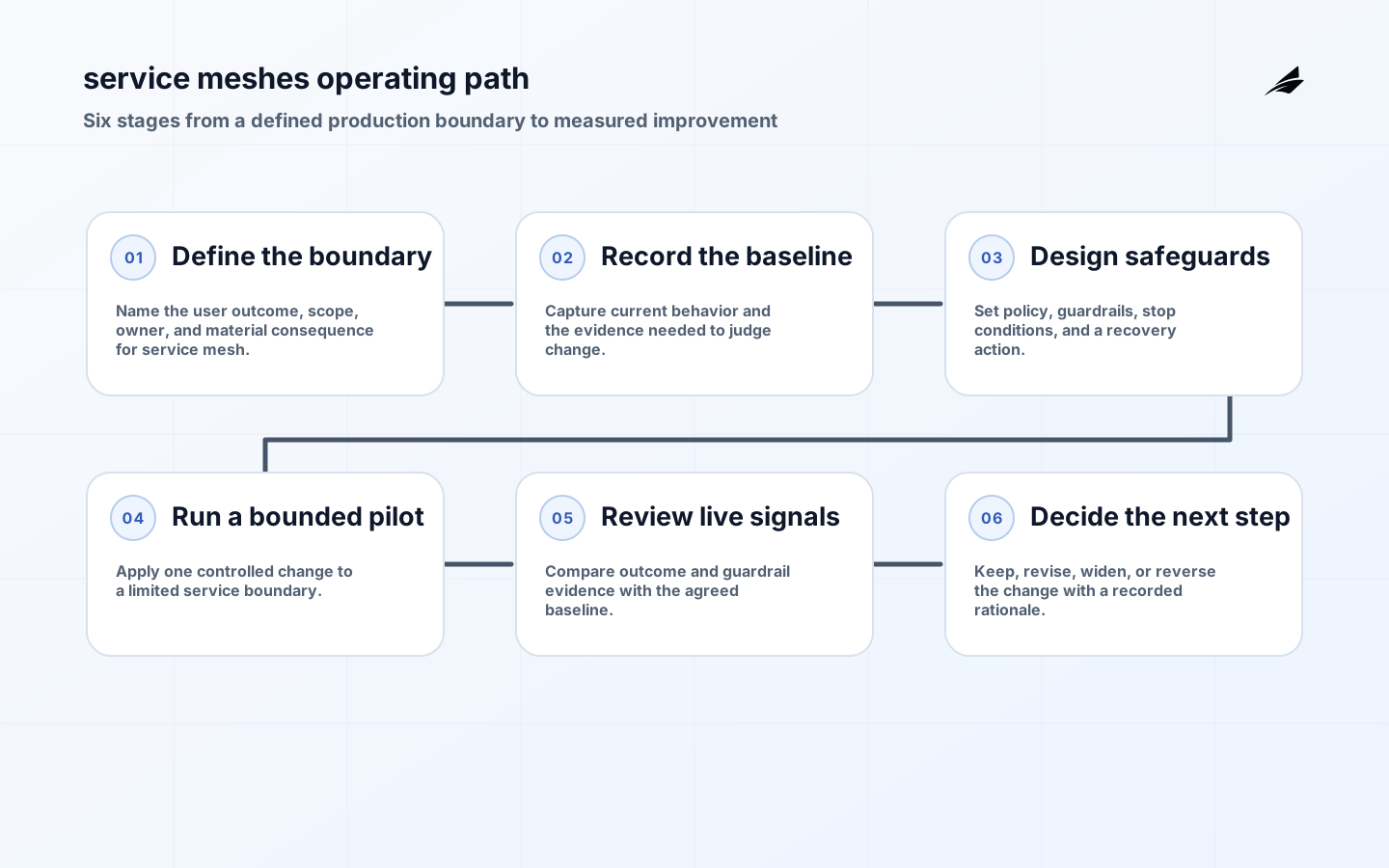
Service meshes move network policy, service identity, telemetry, and traffic behavior closer to the application path (inside the production mesh path). That can simplify repeated controls, but it also inserts a new distributed system into every request (at the sidecar enforcement point). Istio traffic management explains the routing primitives, while Istio security describes identity and mutual TLS concepts (inside the production mesh path). Production readiness depends on knowing which problems the mesh will solve for your services and which problems it will make more visible (inside the production mesh path).
Map policy consequences before enabling sidecars
The first production artifact is a service communication map that identifies workload identity, traffic policy owner, retry and timeout behavior, certificate trust domain, and the telemetry used to validate a change (for the mesh owner). It turns an abstract initiative into a boundary that someone can operate (at the policy boundary). Write the user outcome, the systems included, the named owner, the decision cadence, and the condition that stops the change (for the mesh owner). For service mesh, the important risk is adding a transparent network layer that changes latency, failure behavior, security posture, and debugging complexity without clear ownership (for the mesh owner). A boundary is useful only when it makes that risk visible before customers discover it (at the policy boundary).
Choose a limited first use case. Common candidates include workload identity, encrypted service-to-service traffic, a controlled retry policy, or progressive routing for one service (at the sidecar enforcement point). Avoid starting with every feature at once. Inventory the current client timeouts, retries, circuit breaking, load balancing, and certificates; the mesh can duplicate or conflict with existing libraries (inside the production mesh path). Define the owner for each policy layer so application teams and platform operators do not make contradictory changes during an incident (for the mesh owner).
| Decision element | Question to settle | Evidence to retain |
|---|---|---|
| Outcome | What user or operator result should service mesh improve or protect? | A baseline, target, and named service owner. |
| Scope | Which services, environments, and actors are included? | A current inventory and explicit exclusions. |
| Guardrail | What harm must stop the work? | Thresholds, alert query, and stop authority. |
| Recovery | How is normal behavior restored? | A tested runbook and decision record. |
Separate shared controls from application responsibility
Identity and traffic policy are central contracts. Establish a trust domain, document who may call whom, and decide where authorization is evaluated (inside the production mesh path). Configure timeouts deliberately, because a default retry can amplify overload or repeat a non-idempotent request (inside the production mesh path). Preserve correlation headers and expose request metrics with route and destination labels that remain useful after sidecar or ambient interception (inside the production mesh path). SPIFFE’s overview provides helpful vocabulary for workload identity across infrastructure boundaries (inside the production mesh path).
For service meshes, keep the architecture legible to the person on call (inside the production mesh path). Show the entry point, authoritative records, identities, policy or control points, telemetry, and the path to a safe state Istio security is a useful reference for the underlying mechanisms (at the sidecar enforcement point). In local design reviews, ask a practical question: when the expected result is absent, which component, owner, and record will establish what happened (for the mesh owner). That question usually exposes missing dependencies sooner than an elaborate diagram does (inside the production mesh path).
Canary one route with a tested escape
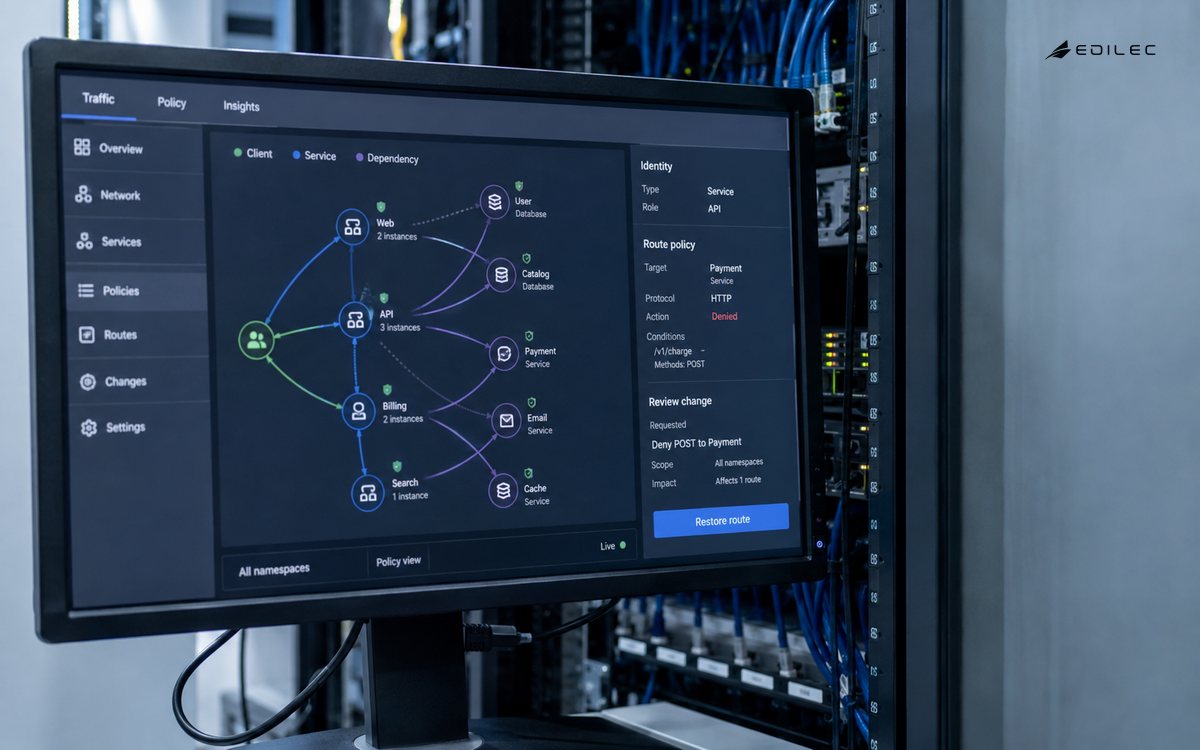
Roll out by namespace, service, or path, and compare behavior before and after injection or policy enforcement (inside the production mesh path). Validate that probes, DNS, egress, and opaque protocols behave as expected. Start mutual TLS in permissive modes only long enough to discover legacy traffic, then plan a verified move to enforcement (inside the production mesh path). A traffic-routing feature should have the same release gates as application routing: a clear baseline, limited scope, and direct reversal (within the canary route). Do not retrofit policies during an unrelated outage.
For service meshes, make the release record specific enough for another operator to continue the work: baseline, exact configuration or revision, expected effect, affected cohort, observation window, guardrail queries, and recovery action (through the tested escape). Use the related delivery guide to keep the surrounding change process clear A small pilot is not a ceremonial prelude; it is how the team learns whether its measurement and response assumptions survive production conditions (before a traffic-policy change).
| Stage | Minimum output | Decision gate |
|---|---|---|
| Discover | Current boundary, baseline, owner, and known constraints. | The problem can be measured without guessing. |
| Design | Controls, evidence path, and recovery action. | The main consequence has a practical safeguard. |
| Pilot | A limited change with explicit stop conditions. | Observed behavior supports a wider use. |
| Operate | Runbook, alert owner, and review cadence. | Normal turnover will not erase knowledge. |
| Improve | A recorded lesson and next hypothesis. | Evidence, rather than urgency, selects the next change. |
Read policy health at the request boundary
Use request success and tail latency by route, proxy resource use, mTLS coverage, policy-change error rate, and time to diagnose cross-service failures (before a traffic-policy change). Pair a direct outcome measure with a guardrail so a local improvement cannot hide a broader regression (inside the production mesh path). Segment by the boundary that matters, such as revision, region, workload, cohort, or service route (at the policy boundary). Each query should have an owner who understands its limitations and a written action for breach (for the mesh owner). Linkerd reliability guide provides authoritative context, but the threshold must reflect the consequence and operating capacity of this service (inside the production mesh path).
The operating view must make the added hop legible. Operators need to see whether a failure came from the client, proxy, policy, destination, certificate, or upstream dependency (inside the production mesh path). Monitor proxy saturation and control-plane health alongside application service-level signals; a mesh-wide issue can look like many unrelated service failures (at the sidecar enforcement point). Linkerd reliability guidance illustrates the importance of observability and failure isolation in the data plane (inside the production mesh path).
Exercise the denied, delayed, and expired paths
A mesh is often over-applied to services that do not need its controls or cannot afford its operational overhead (at the sidecar enforcement point). Another failure is allowing retries and timeouts to be configured independently in application code, gateways, and mesh policy (inside the production mesh path). Keep one documented source of intent for each behavior. Adoption should proceed when the team can explain a request path during an incident, not merely when sidecars are present across the cluster (inside the production mesh path).
A sound service meshes review separates evidence from explanation. Confirm the timeline, scope, and customer effect; then identify the assumption, control, or handoff that failed (at the sidecar enforcement point). Use observability and incident context to improve the investigation path rather than adding vague monitoring (inside the production mesh path). Close the review with one owned correction, a due date, and an explicit decision about whether the operating boundary can widen (at the policy boundary).
Leave an evidence trail for every policy change
Mesh policy changes need a blast-radius assessment before they are applied (before a traffic-policy change). A seemingly local timeout, authorization rule, or certificate setting can affect retries, ingress, egress, or many services that share a namespace (inside the production mesh path). Use dry-run or observe modes where available, inspect denied or altered traffic, and stage enforcement (inside the production mesh path). The safest policy is one with a clear owner and an observable reason for every allowed or rejected request (for the mesh owner).
For service meshes, include proxy resource budgets and control-plane failure scenarios in capacity testing (at the sidecar enforcement point). The layer earns production trust when its own limits and recovery behavior are measured with the applications it carries (through the tested escape).
Version traffic policies with the service changes they affect and review them during incident follow-up (before a traffic-policy change). This keeps network behavior from drifting away from the application assumptions it must support during recovery (through the tested escape).
Key Takeaways
- Service meshes should begin with a defined user outcome and a named operating boundary (at the policy boundary).
- Keep the first production change small enough to observe, stop, and reverse (before a traffic-policy change).
- Use an outcome signal with guardrails so apparent improvement does not conceal harm (by route and workload).
- Treat ownership, evidence, and recovery as implementation requirements, not documentation afterthoughts.
- Expand only when the team can explain the result and sustain the operating work (inside the production mesh path).
Frequently Asked Questions
What evidence should precede mesh expansion? The team should connect a policy change to a service outcome, name the accountable owner, and demonstrate a tested recovery action on a bounded route. Where should a small team begin? Choose one workload and one traffic or identity concern, retain the baseline, and make the reversal path usable before adding features. Which events trigger review? Revisit the mesh after a material policy change, a production incident, or a scheduled review proportional to blast radius. What should operators do when telemetry is incomplete? Narrow the decision, expose what remains unknown, and improve the measurement before accepting irreversible risk. The related operations guide provides adjacent reliability context.
Conclusion
The durable version of a service mesh is a traffic-policy capability that operators can explain under pressure (inside the production mesh path). Before enabling it, map the workloads, routes, identities, dependencies, and owners that make a request meaningful (for the mesh owner). During rollout, keep one route or workload small enough that a policy mistake can be isolated and reversed (inside the production mesh path). After rollout, review the signals that connect policy to consequence: denied requests, retries, latency, certificate health, dependency saturation, and customer-visible errors (by route and workload). A mesh should make these relationships clearer, not hide them behind a platform abstraction (inside the production mesh path). Treat every material policy change as a change to the service’s failure behavior (before a traffic-policy change). Record why it was made, which evidence supported it, who can reverse it, and when the result will be reviewed (against the service baseline). That discipline lets a team gain consistent controls without pretending that the mesh removes the need for application ownership (for the mesh owner).
A production mesh is ready to expand when the team can connect a policy change to a service outcome and can recover without relying on a specialist who is unavailable (before a traffic-policy change). That means testing more than the successful request. Exercise an expired certificate, an unreachable dependency, a route with unexpected retry behavior, and a policy that denies a legitimate call (inside the production mesh path). Confirm that alerts identify the affected boundary and that the runbook points to a safe action rather than a dashboard hunt (at the policy boundary). Keep application teams accountable for their timeouts, error handling, and customer behavior; the mesh can enforce shared rules, but it cannot own every consequence (inside the production mesh path). Review the decision record after incidents and after major upgrades. If the evidence is mixed, narrow the scope and gather a better signal instead of widening exposure on confidence alone (against the service baseline).