Growing teams usually encounter service level objectives after a painful surprise: a bill that cannot be explained, a release that cannot be recovered, an access path nobody can name, or an incident that produces more guesses than evidence. The remedy is not a larger toolchain. For SLO design, it is a small operating boundary with an accountable owner, an explicit decision, and signals that arrive in time to change that decision. This field guide treats service level objectives as engineering work that must be usable during ordinary delivery as well as under pressure. For SLO design, the practical test is simple: can a team describe the intended state, make a bounded change, observe the result, and recover without inventing a procedure in the moment?
Choose a user journey, not a convenient metric
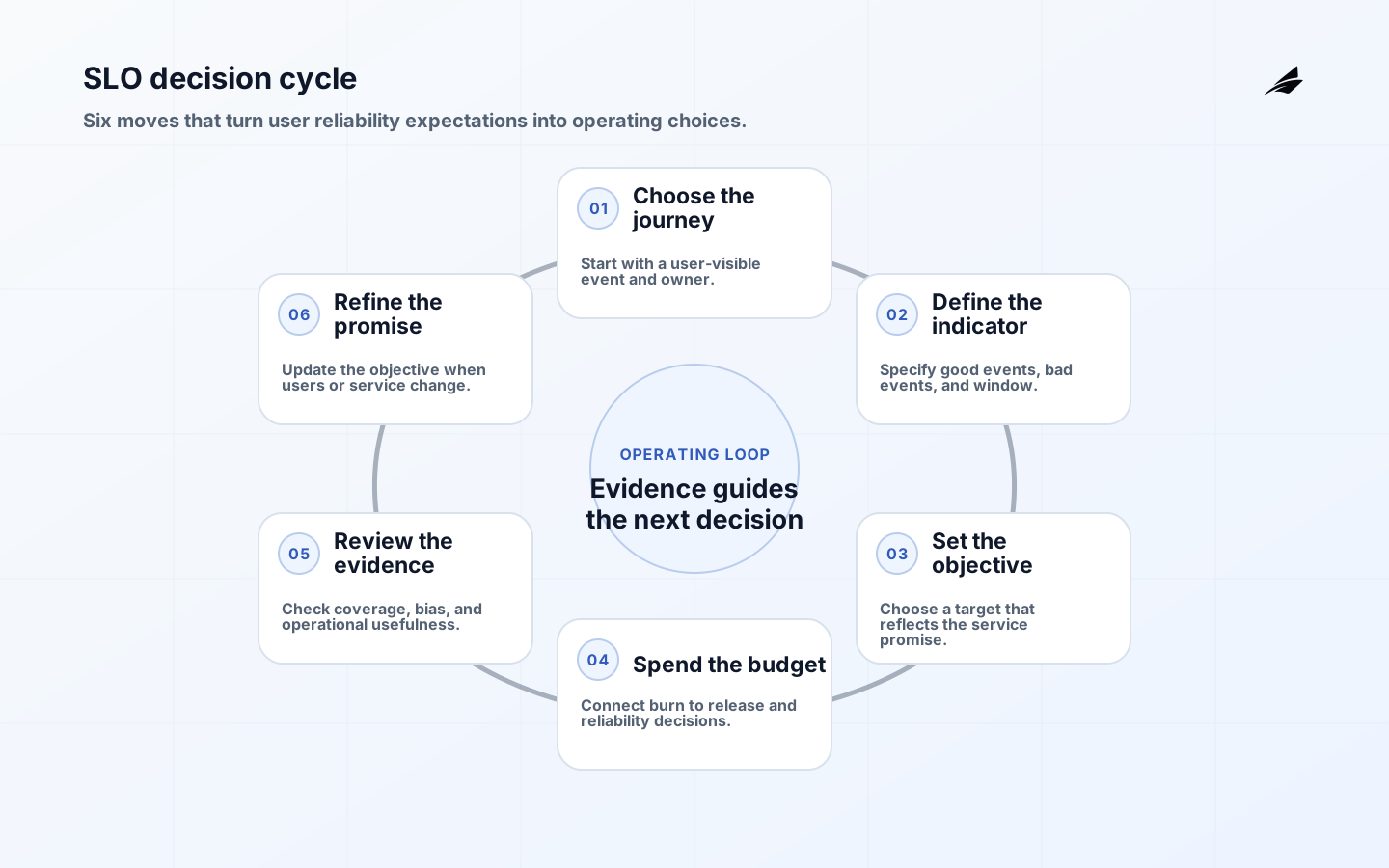
Select a user-visible journey where availability, latency, or correctness changes the product promise. For SLO design, begin with a short written boundary: the service or business outcome in scope, the owner who can approve change, the dependencies that can invalidate an assumption, and the customer impact that must be protected. This is deliberately narrower than a programme plan. For SLO design, a bounded first scope makes data quality issues visible and creates a useful baseline. For SLO design, it also prevents a central team from publishing a standard that local operators cannot apply. The service level objectives work should have a named review rhythm and an exception path; otherwise the first unusual case will become an undocumented workaround.
| Decision | Useful evidence | Owner |
|---|---|---|
| What is in scope? | A named workload, user journey, or business boundary. | Service owner |
| What change is allowed? | A reversible action and a recovery condition. | Change owner |
| What could mislead us? | Known data gaps, dependencies, and timing limits. | Reviewer |
| When is it complete? | Post-change evidence and an explicit close-out. | Accountable lead |
Write a precise service level indicator
Specify good and total events, exclusions, data source, window, and ownership so two people calculate the same indicator. Design the path before selecting a product feature. For SLO design, identify the authoritative input, the identity making the request, the policy that permits it, and the observable output. For SLO design, keep configuration and policy in version control where that is appropriate, with review records that explain intent rather than merely recording a diff. The Google SRE Workbook: Implementing SLOs is a useful primary reference for the mechanics, but the local design still needs a failure mode: what happens when the source is stale, a dependency is unavailable, or a new version has only partial evidence? For SLO design, a dependable default makes those conditions visible and gives an operator a safe next action.
- Write the decision and its guardrail before automating service level objectives.
- Pilot one representative service before applying the policy to every workload.
- Record ownership for configuration, service health, and user communication separately.
- Use versioned journey and indicator identifiers instead of labels that can silently change meaning.
- Make exceptions time-bound, reviewable, and measurable.
- Keep the previous SLO decision path available until the new behavior has been observed.
Use error budgets in delivery decisions
Turn the remaining error budget into a discussion about release risk, reliability work, and the customer impact of waiting. For SLO design, an operating review should distinguish a change in the system from a change in the measurement. For SLO design, compare a baseline with a defined observation window, then look for the conditions that would make the comparison unfair: traffic mix, retries, scheduled work, missing telemetry, provider timing, or a concurrent incident. The Google SRE Book: Service Level Objectives provides useful guidance, but teams still need a plain decision record with the hypothesis, owner, threshold, timestamp, and recovery choice. That record reduces handoff cost. For SLO design, it lets an on-call engineer explain why the state changed without re-deriving intent from dashboards and chat history.
| Signal | Question it answers | Common mistake |
|---|---|---|
| Outcome signal | Did the user-facing result stay acceptable? | Using only host or process health. |
| Control signal | Did the intended policy or change take effect? | Assuming a successful deployment proves behavior. |
| Safety signal | Is a guardrail moving toward breach? | Watching an average that hides a small affected cohort. |
| Evidence freshness | Can the team still trust the comparison? | Acting on delayed or incomplete data. |
Review objectives as the product changes
Inspect misses, burn patterns, and changes in product behavior; an objective is a decision instrument, not a permanent score. This is where service level objectives become a trade-off rather than a slogan. For SLO design, start with the least irreversible option and state what would cause the team to stop. For SLO design, a change can be technically correct yet operationally unsafe when the people responsible for response cannot interpret the signal or reverse the path. Use the OpenSLO specification to challenge assumptions, especially around identity, dependencies, and compatibility. For SLO design, for material changes, include the rollback target, any data transformation constraint, and the communication trigger in the same work item. For SLO design, a fast action without a recovery narrative is only fast until the first surprise.
Introduce SLOs without theater
Start with one service and one decision that will actually change when the objective is healthy or exhausted. For SLO design, in the first two weeks, map the current path and collect enough evidence to establish a baseline. For SLO design, in the next two, make one controlled change and compare the expected and actual result. For SLO design, in the following month, turn the result into a maintained control: document ownership, automate only the repeatable collection, and schedule a review for the exceptions. This pacing lets service level objectives earn trust through observed behavior. For SLO design, it also creates the evidence needed to decide whether broader adoption is justified. The Google Cloud SLO concepts can inform the implementation details, while the local runbook should stay specific to the team’s architecture and escalation model.
Work through an SLO budget case
For an order submission journey, a service level objective could count an event as good only when the customer receives a durable confirmation within the promised time. That forces the team to decide whether validation errors, planned maintenance, asynchronous delays, and third-party failures belong in the denominator. The answer is a product decision with technical evidence, not a percentage selected by convention. Connect the error budget to a real action, such as requiring an incident review before a risky release when rapid burn is occurring. Without that action, an objective becomes another dashboard number rather than a reliability tool.
Implementation details that keep SLOs honest
Implementation quality shows up in the awkward cases. For SLO design, ask what happens when an owner is unavailable, a dependency produces a partial result, a policy exception expires, or evidence arrives after the relevant decision window. For service level objectives, keep the response proportionate: capture the current state, reduce further impact, and preserve the context needed for a deliberate follow-up. For SLO design, a small change log should link the relevant configuration version, service or workload identity, timestamp, expected outcome, observed outcome, and recovery action. For SLO design, this is more useful than a long generic runbook because it lets the next engineer distinguish a known exception from a new fault. Review these records periodically. For SLO design, repeated exceptions are design feedback: they may indicate an incomplete boundary, a missing control, an unrealistic default, or a support responsibility that has not been funded.
Key takeaways
- Treat service level objectives as a decision system, not a one-time configuration task.
- Anchor the SLO to one user-visible request whose availability, latency, or correctness users can feel.
- Use budget burn to frame release risk, reliability work, and the customer impact of waiting.
- Review missed events, burn patterns, and product changes as evidence for the next SLO decision.
- Keep the initial SLO scope to a journey that owners can observe end to end.
An SLO is valuable when it changes a decision, not when it merely appears on a dashboard. The Google SRE book chapter on service level objectives connects objectives to user-visible reliability and error budgets; the SRE Workbook implementation guidance shows how teams can introduce them through a concrete service and review loop. OpenSLO provides a vendor-neutral specification vocabulary, while Google Cloud SLO concepts explains how SLIs, targets, and compliance windows relate in monitoring. The practical boundary is clear: define the user event, eligible population, measurement window, target, and response when the budget is spent. A percentile without those choices is only a number.
Start with one journey that matters to users and one owner who can change the service. Review the objective with product, support, and engineering; compare good and bad events; and decide what the error budget permits or pauses. Then connect it to observability foundations, incident response, and reliability reviews. This makes the SLO a shared operating agreement rather than a reporting exercise. These companion articles are SLOs Decisions That Matter before the First Build, Deployment Rollbacks Decisions That Matter before the First Build, Canary Releases Decisions That Matter before the First Build.
Frequently asked questions
Question: Is an SLO a promise of perfect reliability? Answer: No; it is an explicit target that makes trade-offs and error-budget use visible. Question: What makes an SLO useful? Answer: A user journey, trustworthy indicator, honest window, policy for budget burn, and a review cadence connected to product change.
What is a good first SLO?
Answer: Choose a user journey and an indicator that measures successful service from the user's perspective, with a target and window the team can act on.
How should an error budget affect delivery?
Answer: Use it as a policy signal: protect reliability when budget is low and allow measured change when the service has earned room.
When should an SLO change?
Answer: Change it when the user journey, service architecture, measurement quality, or business consequence changes, and record the new rationale.
Do we need a specialist tool first? For service level objectives, usually not. For SLO design, start with a clear boundary, trustworthy inputs, ownership, and a repeatable review; add tooling when it removes a demonstrated manual burden. For SLO design, How much evidence is enough? Enough to compare one SLO change against a fair baseline and document the uncertainty that could alter the decision. For SLO design, Who owns the decision? The service owner accountable for the affected journey, with platform, security, finance, or product partners supplying the relevant constraints. For SLO design, When should we stop? Stop when telemetry is incomplete, a guardrail shifts unexpectedly, or recovery is unclear.
Conclusion
Good service level objectives practice makes important change easier to explain and safer to repeat. For SLO design, define the boundary, design the evidence, make a reversible first move, and turn what you learn into a maintained operating habit. Keep the decision record close to the work so future service level objectives changes begin with evidence rather than rediscovery.