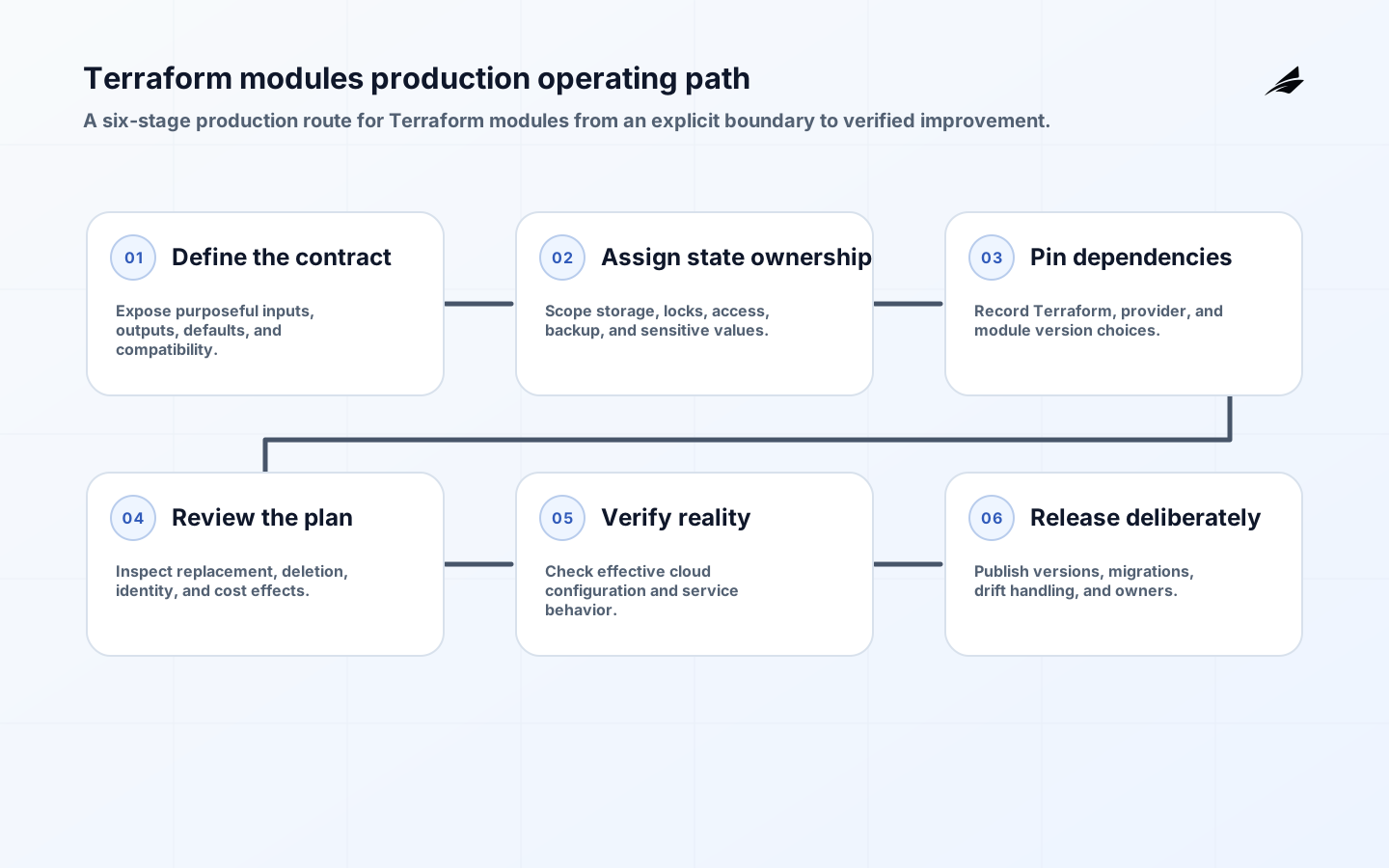
Terraform modules become production interfaces when multiple teams rely on their inputs, outputs, defaults, and state behavior to change real infrastructure. Reuse is valuable only when the module makes a narrow, supportable promise. HashiCorp's module and state documentation is particularly relevant: modules declare provider requirements, state maps configuration to remote objects, and the dependency lock file records provider selections. In production, those mechanics become a change-control problem as much as a code-organization problem. See Terraform modules documentation for the language-level module boundary.
A module’s production boundary should be legible to both its caller and its maintainer. Record which inputs are contractual, which defaults are safe opinions, and which outputs may change only through a versioned migration. Tie each material plan effect to a service owner who can explain the resource’s purpose, not just the Terraform address. During review, compare the planned change with effective cloud state after apply and note any provider behavior that was not visible in the plan. This habit prevents a reusable module from becoming a hidden platform dependency whose risks surface only when a team needs to recover quickly.
Key Takeaways
- Treat Terraform modules as an accountable production capability with an explicit owner and boundary.
- Use evidence that connects the declared change or event to the effective runtime result — For a Terraform module, apply the test at the contract, state, and provider boundary.
- Match controls to consequence: protect irreversible, customer-impacting, or security-sensitive actions most strongly — For a Terraform module, apply the test at the contract, state, and provider boundary.
- Test an unhappy path and a recovery path before expanding exposure.
- Review the operating signals after routine work, not only after a visible failure — For a Terraform module, apply the test at the contract, state, and provider boundary.
Define the module contract callers can safely depend on
Define the module's contract in terms of a specific infrastructure capability. State what it creates, which inputs are required or intentionally defaulted, which outputs consumers may depend on, and which choices remain owned by the root configuration. Do not expose every provider argument as a variable; that transfers complexity to callers and makes future changes harder to reason about. A module version should describe compatibility, deprecations, and migration expectations. Treat an output as public once another configuration consumes it, and avoid changing its meaning silently.
| Decision area | Question to settle | Evidence to retain |
|---|---|---|
| Contract | What may callers rely on? | Inputs, outputs, defaults, and version notes. |
| State | Who can change managed objects? | Scoped remote backend access and lock. |
| Dependencies | Which tools and providers run? | Committed version constraints and lock file. |
| Verification | What proves apply was useful? | Effective cloud state and service check. |
Protect state and dependency selection as production assets
Place state behind an ownership and access boundary that matches the resources it controls. Remote state needs locking, encryption, backup, and tightly scoped read and write identities; it can contain sensitive values even when configuration does not. Split state where ownership, blast radius, or change cadence differs, but do not fragment it so far that a simple service change requires an orchestration puzzle. Pin Terraform, providers, and shared module versions deliberately. Commit the dependency lock file so automated and local runs select the same provider packages. The Terraform state documentation explains the managed-object record and its operational limits. The dependency lock file documentation explains how to keep provider selections reproducible.
Make plan review a technical and operational checkpoint. A useful plan review identifies resource creates, updates, replacements, and destroys; calls out changes to identity, networking, encryption, data retention, cost, and shared dependencies; and confirms the expected workspace and credentials. Do not use targeted applies as a standard workflow because they can obscure dependent changes. Policy checks can guard known organizational rules, but reviewers still need context about a resource's business purpose. Keep credentials out of variable files and logs, and use a controlled path for break-glass changes. The Terraform language style guide provides a useful baseline for readable, reviewable configuration.
| Control | Practical implementation | Signal to review |
|---|---|---|
| Plan review | Inspect destroy and replacement operations. | Unexpected resource churn. |
| State protection | Use remote locking and scoped access. | Stale locks and sensitive access events. |
| Drift handling | Detect and assign out-of-band changes. | Unresolved drift and emergency applies. |
Review the effective change, not only the plan
Begin with a module change that has a readable plan and a simple verification procedure. Apply through automation using a dedicated identity, record the exact module and provider versions, then verify both Terraform state and the cloud's effective configuration. Test drift detection with a benign out-of-band change and decide who owns remediation. For destructive or data-impacting modifications, separate preparation from removal: create the replacement, migrate consumers, verify service behavior, then retire the old resource after an agreed observation period. Infrastructure reversibility is often slower than code rollback.
Watch drift, recovery, and consumer impact
Watch the health of the operating process: plan failures, stale state locks, drift findings, emergency applies, time to review a material change, and recurring manual exceptions. For the infrastructure itself, monitor the service outcomes that justify the resources, such as denied access, failed requests, budget movement, backup completion, or encryption policy status. An apply marked successful only means the provider accepted the requested actions; it does not prove that users can reach the service or that a route table has the intended effect. Add those checks to the release evidence.
A production failure mode for Terraform modules is a compatible-looking module upgrade that changes a default, output meaning, or provider behavior enough to replace a live resource. That kind of gap is dangerous because a local success signal can hide an operationally incomplete result Add the condition to acceptance criteria and state the expected response before the next change — For a Terraform module, apply the test at the contract, state, and provider boundary. The record should show who owns the boundary, what evidence proves normal behavior, and how a responder distinguishes a transient delay from a condition that must be stopped This turns a surprising edge case into a reviewed part of the operating model rather than a lesson trapped in one engineer's memory — For a Terraform module, apply the test at the contract, state, and provider boundary.
Use a regular operating review to inspect state access, locks, backups, drift, provider versions, and recent applies to identify dependencies still tied to personal credentials. Keep the discussion close to a real example rather than an abstract maturity score — For a Terraform module, apply the test at the contract, state, and provider boundary. Note where the team had to infer missing state, cross a permission boundary, or leave the normal workflow to understand the result Assign one or two concrete improvements with an owner and date, then inspect them after the next ordinary production change This cadence catches accumulated ambiguity early and prevents controls from becoming documentation that no longer describes the live system — For a Terraform module, apply the test at the contract, state, and provider boundary.
A practical drill should recover from a failed noncritical infrastructure change involving replacement resources, a state lock, and an out-of-band edit. Include the people and systems that would be involved outside the primary tool: on-call ownership, access approvals, deployment or recovery records, customer communication, and the final verification query Measure the time needed to reach a safe decision, but also document why it took that long — For a Terraform module, apply the test at the contract, state, and provider boundary. The most valuable outcome is a revised procedure that a different responder can follow with the same evidence, especially when the original author is unavailable — For a Terraform module, apply the test at the contract, state, and provider boundary.
Keep the Terraform modules review bounded but complete. Map module interfaces, provider selection, state access, plan effects, and cloud verification to the people who can change, inspect, and recover each element. A responsibility map should identify routine ownership as well as escalation authority, because production work crosses team boundaries at the moment a normal control fails Document dependencies that are outside the immediate service or tool, including identity providers, registries, queues, cloud accounts, and vendors This context lets reviewers judge blast radius before a change and gives responders a starting point when the visible symptom appears somewhere else — For a Terraform module, apply the test at the contract, state, and provider boundary.
Make verification concrete by retaining the plan review, applied version set, and resulting resource behavior. Compare it with an agreed baseline and record the decision to continue, pause, recover, or investigate Verification should happen after the system has had enough time to exhibit the behavior that matters, not only at the instant an API accepts a change When the evidence is incomplete, say so and keep exposure constrained — For a Terraform module, apply the test at the contract, state, and provider boundary. This is how teams preserve learning speed without confusing automation activity with a trustworthy production outcome — For a Terraform module, apply the test at the contract, state, and provider boundary.
Before publishing a module version, verify its interface, locked dependencies, plan effects, state boundary, and effective cloud result. That review turns reuse into a predictable service for its consumers.
Frequently asked questions about Terraform modules
When should a module be split? Split it when consumers need independently owned lifecycle, permissions, or release cadence, not merely because a file is long. Is remote state a source of truth? It is Terraform's record of managed objects; the cloud provider remains the effective runtime reality, so verify important outcomes. Should every variable have a default? Defaults are useful when they express a safe, stable opinion; avoid defaults that conceal a location, identity, or data-retention decision. How do we upgrade safely? Read the module and provider changelogs, review the plan, test a representative environment, and publish a migration path.
The review should also name the people and systems outside Terraform that make recovery possible. Include the identity provider, registry, cloud account, monitoring path, approval record, and customer communication route that a failed infrastructure change may involve. Test the handoff with a responder who did not author the module. If that person can identify the last safe state, the authority to pause, and the evidence needed to verify service behavior, the module has a production operating model rather than only a reusable implementation pattern.
Conclusion
Production Terraform modules are contracts backed by state and provider behavior. Keep their interface focused, protect the state that makes changes possible, and treat a plan as evidence to examine rather than an approval screen to click through. This makes infrastructure change repeatable without making it opaque. See Terraform module security review, cloud cost optimization, and the Terraform practical guide.
A production Terraform module is ready to trust when callers can see the public interface, locked provider set, state boundary, plan effect, and verification result. Keep that evidence with the version and migration note so a maintainer can distinguish intentional change from drift.
Use one noncritical module upgrade as the acceptance exercise: review a replacement plan, check the lock file, apply through the service identity, verify cloud state, and rehearse recovery from a stale lock or drift finding.