Cloud Cost Optimization: Explained from First Principles is useful when a team treats it as an operating decision rather than a product label. Cloud cost optimization concerns a workload, its environment, and the customer outcome it supports. The practical question is whether people can make a bounded change, explain the evidence, and recover without relying on memory (for first-principles cost decisions operating boundary). FinOps Framework and AWS Cost Optimization Pillar provide technical anchors; the guidance turns them into choices an engineering team can use in planning and review.
Test one cost decision end to end
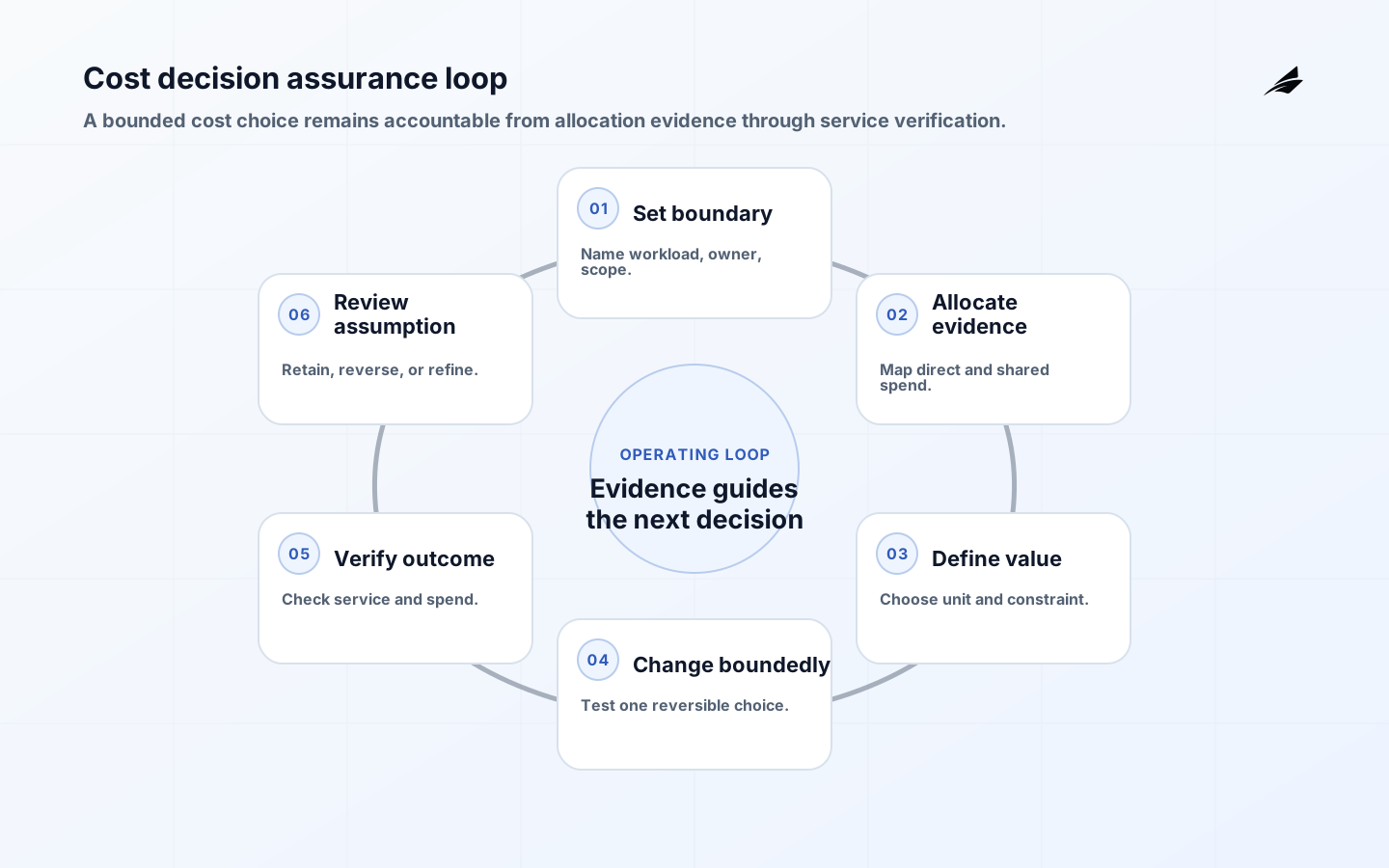
A first-principles cost review should follow one decision from evidence to outcome. Pick a workload with an identifiable owner, a stable demand measure, and a change that can be contained. Write the baseline, the unit of value, the relevant reliability constraint, the expected saving or avoided growth, and the point at which the change will be reversed. The AWS Cost Optimization Pillar and Google Cloud cost optimization framework both support this kind of lifecycle thinking. The review is strongest when it can show not only that a number moved, but that the service remained fit for purpose.

Make allocation and governance proportional to the decision. FinOps defines cost allocation through accounts, tags, labels, and shared-cost strategies; that evidence should be clear enough that a product or platform owner can see the part they can influence. Azure's cost optimization guidance adds a useful cross-cloud perspective on trade-offs, while the FinOps Framework keeps collaboration and business value in view. Keep unallocated or shared spend visible rather than distributing it with false precision. A transparent estimate can support a decision; a precise-looking but unsupported number can mislead it.
Use Edilec's plain-language cost optimization guide, GitOps cost and scaling guide, and platform engineering cost guide to extend the decision into delivery. The durable pattern is small and repeatable: allocate, measure, choose, change, verify, and record the next review date. Cost optimization is then part of service ownership rather than an annual request for cuts.
- Name the unit of value and the reliability constraint.
- Track shared and unallocated spend honestly.
- Reverse a change when the service or evidence crosses its limit.
- Keep a review date for every material assumption.
For a connected Edilec reading path, see Edilec CLD-0151, Edilec CLD-0166, Edilec CLD-0179. These related guides keep the implementation detail close to the operating decision and help teams compare ownership, evidence, and recovery across adjacent systems (for first-principles cost decisions test one).
Key takeaways
- Define cloud cost optimization around a specific boundary, accountable owner, and user or business outcome.
- Make allocation tags, usage data, unit economics, and capacity decisions visible before automating a broad policy or workflow.
- Use a stop rule: do not buy a commitment or resize a service until usage, demand shape, and recovery constraints are understood.
- Treat a cheaper component that creates latency, availability, or engineering toil elsewhere as a design risk, not an afterthought.
- Measure allocated-spend coverage, cost per useful transaction, utilization, idle-resource age, and service-level indicators together, because one measure rarely explains the whole outcome.
- Exercise the recovery or exception path before standardizing the approach.
- Turn recurring exceptions into a small owned improvement with a due date and a review (for first-principles cost decisions key takeaways).
What cloud cost optimization covers in practice
Cloud cost optimization is not a promise that every technical concern disappears. It is a way to make a defined decision repeatable and reviewable (for first-principles cost decisions cloud cost). Begin by naming what is included, what is deliberately outside the boundary, and which evidence is authoritative (for first-principles cost decisions cloud cost). That framing prevents a local optimization from becoming an unowned system-wide change (for first-principles cost decisions cloud cost). The published guidance from AWS Well-Architected Cost Optimization Pillar is useful here because it emphasizes controls and operating evidence rather than a one-time tool choice (for first-principles cost decisions cloud cost).
| Decision area | Question to settle | Evidence to retain |
|---|---|---|
| Outcome | What customer, service, or operational result does the practice protect? | A named journey, baseline, and owner for cloud cost optimization. |
| Scope | Which systems, environments, and exceptions are included? | A boundary statement and dependency map for a workload, its environment, and the customer outcome it supports. |
| Authority | Who can proceed, pause, or approve an exception? | A role, escalation route, and dated decision record. |
| Verification | What observation proves the change is acceptable? | allocated-spend coverage, cost per useful transaction, utilization, idle-resource age, and service-level indicators over an agreed observation window. |
Set a decision boundary before implementation for cloud cost optimization
A boundary is more than a diagram. For cloud cost optimization, it identifies the actor, trigger, records, actions, and recovery authority. Separate facts from assumptions: a dashboard trend may suggest a problem, while a trace, billing record, policy evaluation, or user report can establish what happened (for first-principles cost decisions set decision). Record the version and time context as well. That discipline matters when several changes occur at once, because it lets the next reviewer distinguish correlation from a cause worth acting on (for first-principles cost decisions set decision).
Implementation and controls for cloud cost optimization
Start with the smallest useful path and make its control points explicit (for first-principles cost decisions implementation controls). The core mechanics are allocation tags, usage data, unit economics, and capacity decisions. Assign an owner for each external dependency and state what happens when its input is absent, late, or contradictory (for first-principles cost decisions implementation controls). A controlled first implementation should keep actions attributable, make the expected result observable, and allow a human to pause safely (for first-principles cost decisions implementation controls). Google Cloud cost optimization framework supplies a useful reference for details that should be adapted to the consequence of the work, rather than copied as a generic checklist (for first-principles cost decisions implementation controls).
| Stage | Control | Decision rule |
|---|---|---|
| Prepare | Confirm scope, identity, prerequisites, and a baseline. | Do not proceed when ownership or required evidence is missing. |
| Act | Apply the smallest change that tests the assumption. | Stop when the agreed guardrail is crossed. |
| Observe | Compare technical signals with the expected user outcome. | Expand only when evidence remains within bounds. |
| Recover | Reverse, compensate, or reconcile the affected state. | Close only after recovery evidence is recorded. |
Failure modes that weaken cloud cost optimization
The dangerous failure mode is often not an obvious outage; it is a plausible-looking result with missing context. A cheaper component that creates latency, availability, or engineering toil elsewhere is a design risk, not an afterthought. Counter this by preserving identifiers, control decisions, and the source of each important input (for first-principles cost decisions failure modes). Make exceptions visible instead of turning them into silent workarounds. A temporary bypass may be justified during an incident, but it needs a named authority, an expiry, and a review that restores the normal control (for first-principles cost decisions failure modes). Otherwise the bypass quietly becomes the actual operating model.
Operating signals and review cadence for cloud cost optimization
Review allocated-spend coverage, cost per useful transaction, utilization, idle-resource age, and service-level indicators with a concrete case, not as a dashboard ritual. Pair a leading indicator, such as an invalid configuration or denied request, with an outcome measure such as a failed journey, delayed completion, or excess spend (for first-principles cost decisions operating signals). Set an observation window that matches the workload: a synchronous request may show harm in minutes, whereas a batch or retention policy may need days (for first-principles cost decisions operating signals). A short recurring review should ask what changed, which signal moved, and whether the existing rule still fits reality (for first-principles cost decisions operating signals).
A bounded example for cloud cost optimization
A reporting service runs only during office hours, yet its development database and batch workers run every night. The owner tags the workload, measures weekday demand, schedules non-production shutdowns, and verifies the morning data job before extending the policy. The saving is real because the schedule has an owner, a documented exception for month-end, and a health check rather than an unexplained switch-off. This is the shape of a useful cloud cost optimization experiment: a named assumption, limited blast radius, observable result, and an explicit next decision. It is more valuable than a large rollout that produces activity but no dependable evidence (for first-principles cost decisions bounded example).
Ownership and evidence for cloud cost optimization
The owner of cloud cost optimization is not expected to know every implementation detail. They are responsible for the decision record: why the boundary exists, which evidence is trusted, who can change the control, and how exceptions are handled (for first-principles cost decisions ownership evidence). Engineering should keep implementation and observability usable; operations should own the readiness and recovery routine; security or finance should participate where the consequence requires it (for first-principles cost decisions ownership evidence). This division helps a team avoid both centralized bottlenecks and unaccountable self-service (for first-principles cost decisions ownership evidence).
Cost decisions to test first
Start with allocation quality, then look for idle non-production resources, oversized steady workloads, unnecessary data movement, and a pricing choice that no longer matches demand. Do not make a reservation or long-term commitment because a chart is temporarily flat. Compare the expected saving with the cost of reduced flexibility, then write down the demand assumption and the date on which it will be revisited. Cost control works when a service owner can explain what a resource is for and why its current shape is justified.
An adoption sequence for cloud cost optimization
Start cloud cost optimization with one bounded, representative case and a named person who can decide whether it is ready to expand. Capture the baseline, the assumption, the guardrail, and the recovery action before changing production behavior (for first-principles cost decisions adoption sequence). Review the result with the people who build and support the service, then make one precise improvement to the routine (for first-principles cost decisions adoption sequence). This sequence is deliberately modest: it reveals missing dependencies and unclear authority while the consequence is small, and it gives later standardization a real operational record rather than an aspirational policy (for first-principles cost decisions adoption sequence).
Keep an evidence sample with every cloud cost optimization review. Select one normal case, one boundary case, and one exception; trace the decision from input to outcome; and note whether the records answer the next operator's question (for first-principles cost decisions adoption sequence). This is a practical quality check because it catches controls that exist on paper but are difficult to use during ordinary work (for first-principles cost decisions adoption sequence). When the sample reveals ambiguity, improve the smallest relevant contract, alert, permission, runbook, or ownership rule before widening the practice (for first-principles cost decisions adoption sequence).
Frequently asked questions about first-principles cloud cost optimization
Question: What does first-principles cloud-cost optimization mean? Answer: Follow one decision from evidence to customer or business value, reliability constraint, expected effect, owner, and reversal condition. Question: When should a cost assumption be revisited? Answer: Revisit it after material demand, architecture, pricing, retention, region, or customer-segment changes rather than defending a historical saving.
Does cloud cost optimization require a new platform? Not necessarily. Start with the evidence and control you need; a spreadsheet, runbook, policy, or existing tool may be enough for the first bounded path (for first-principles cost decisions frequently asked). When should the practice expand? Expand only after the team can show that the initial path protects the intended outcome, that exceptions have an owner, and that recovery has been tested (for first-principles cost decisions frequently asked). Azure Well-Architected cost optimization and FinOps Framework are good references for a deeper technical review.
Conclusion
Cloud cost optimization becomes durable when it turns a recurring decision into a visible routine: define the boundary, apply proportionate controls, observe the outcome, and improve from real exceptions. Begin with one owned path and let evidence, rather than enthusiasm, determine the next expansion (for first-principles cost decisions conclusion).
Review assumptions when demand changes
Cost decisions age as demand and architecture change. A commitment that fit a stable workload may become restrictive after migration; a lifecycle policy may become too short after recovery requirements change; a platform default may be cheap for one tenant and expensive for another. Put the review trigger next to the assumption: traffic threshold, retention change, new region, customer class, or material pricing change. The FinOps Framework provides shared language, but the owner still needs a local signal and date.
When an assumption no longer holds, do not defend the old optimization because it once saved money. Compare the current outcome with the baseline, state what changed, and choose whether to renew, reverse, or redesign. Keep the explanation close to the workload record so the next team sees the reasoning, not just the configuration. That is how first-principles optimization remains a service practice rather than a collection of forgotten controls.