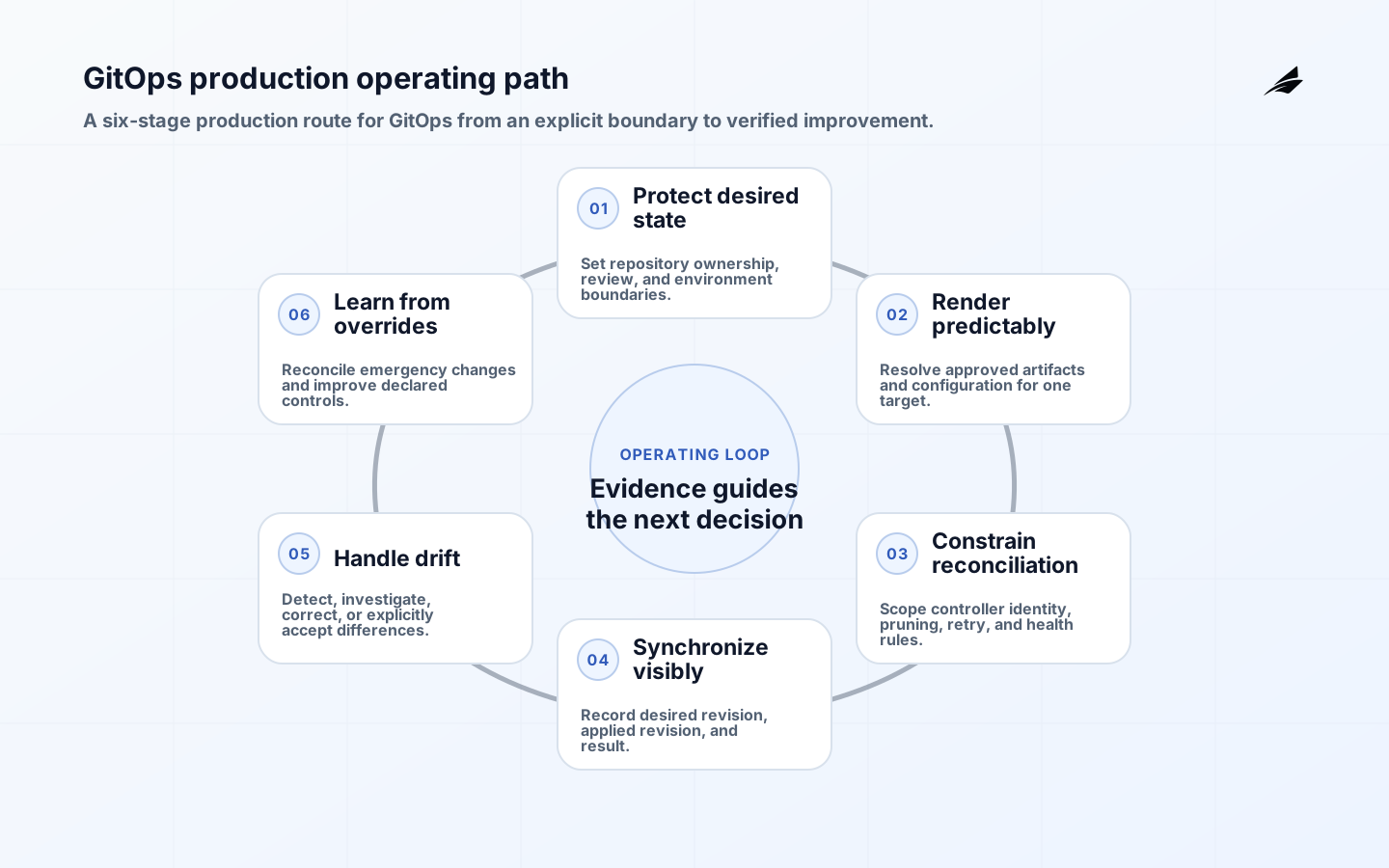
GitOps becomes consequential in production when a repository commit can cause a reconciler to alter a live environment. OpenGitOps describes declarative, versioned, automatically pulled, and continuously reconciled desired state; those principles are useful, but they leave important operational questions for each team. Which repository and branch define intent? What identity may reconcile it? How are secrets represented? What happens when an urgent incident requires a manual change? Production GitOps works when those answers are visible before automation is given broad authority. The Argo CD automated sync policy and Flux core concepts provide concrete reconciliation context.
GitOps takeaways for production control
- Treat GitOps as an accountable production capability with an explicit owner and boundary.
- Use evidence that connects the declared change or event to the effective runtime result.
- Match controls to consequence: protect irreversible, customer-impacting, or security-sensitive actions most strongly
- Test an unhappy path and a recovery path before expanding exposure.
- Review the operating signals after routine work, not only after a visible failure.
Decide what GitOps is allowed to change
Treat the desired-state repository as a controlled interface, not a dumping ground for every generated manifest. Separate environment overlays and shared components so reviewers can see what is intended for a given target. Protect the production branch, require reviews proportionate to risk, and make ownership of paths and applications discoverable. A commit should identify both the desired revision and the source of the image or artifact it promotes. Avoid a chain of mutable tags and unreviewed generators that makes a deployed result impossible to reconstruct from version control.
| Decision area | Question to settle | Evidence to retain |
|---|---|---|
| Intent | Which repository path is authoritative? | Protected branch and ownership rule. |
| Actor | What may the controller change? | Scoped workload identity and RBAC. |
| Drift | How are differences treated? | Detection, correction, or acceptance record. |
| Emergency | How can response intervene? | Audited pause or override procedure. |
Make reconciliation ownership explicit
Scope the reconciler's reach tightly. Give each controller the minimum cluster, namespace, and resource permissions required for its applications, and use separate identities where ownership differs. Configure source verification where the tooling and workflow support it, and keep deployment credentials out of the repository. Reconciliation interval, pruning behavior, health checks, dependencies, and retry rules are production choices: aggressive pruning can turn a mistaken desired state into fast deletion, while unbounded retries can conceal a broken dependency. Make the intended behavior and suspension control visible to operators. NIST Secure Software Development Framework supports making permissions and recovery evidence part of the release.
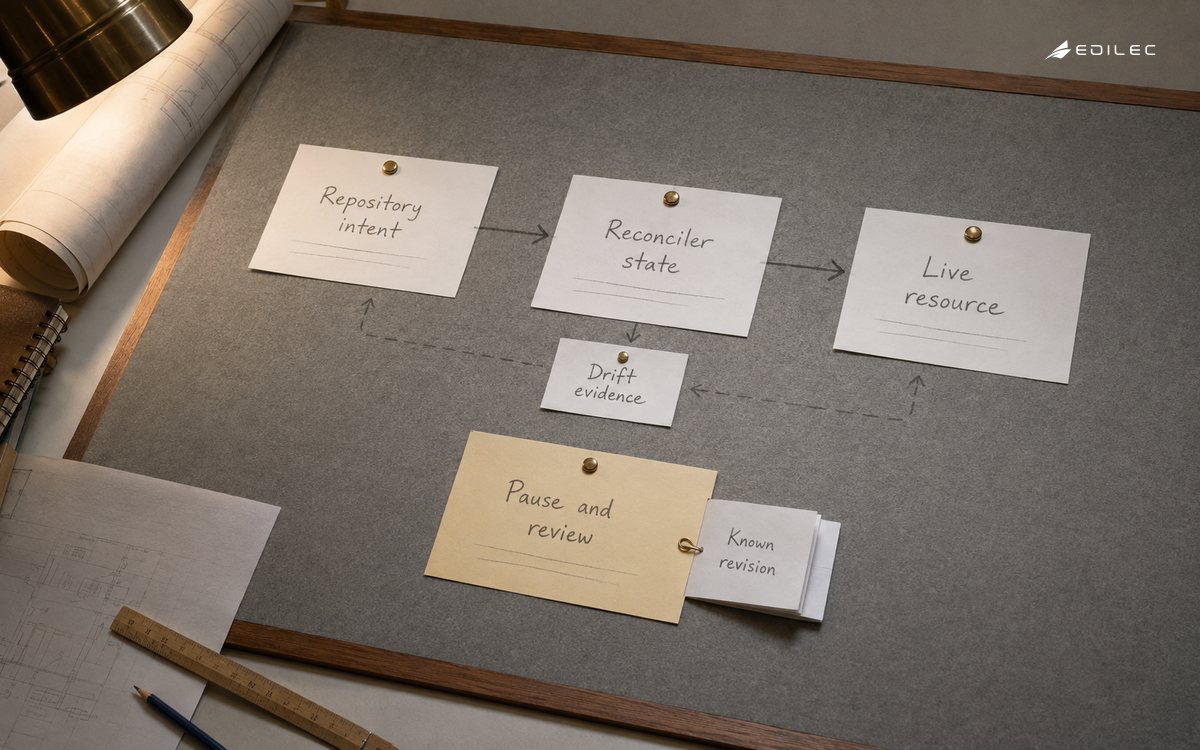
Design the emergency path before the first outage. A manual production change may be necessary to restore service, but it should be time-bounded, recorded, and reconciled back into declared state or explicitly reverted. Do not create a culture in which responders permanently fight the controller. Require a short change record for forced synchronization, disabled pruning, bypassed policy, or direct cluster access, then review it after recovery. This preserves GitOps' audit value without pretending that emergencies never require judgment.
| Control | Practical implementation | Signal to review |
|---|---|---|
| Source review | Protect paths and promotion branches. | Unreviewed production revisions. |
| Controller scope | Limit reconciliation permissions. | Denied actions or cross-namespace changes. |
| Override discipline | Record and reconcile emergency changes. | Long-lived drift and disabled pruning. |
Introduce reconciliation on a testable slice
Adopt GitOps for one bounded application and environment first. Validate repository access, rendering, policy checks, controller permissions, synchronization, health evaluation, and rollback behavior. Intentionally introduce a harmless drift change and observe whether the system detects, reports, or corrects it as designed. Then test a bad desired revision: confirm who can pause reconciliation, restore the previous commit, and verify workload health. Expand only after the team can explain the difference between repository state, controller state, and the live resource state during an incident. Kubernetes Managing Workloads is a useful reference when checking the workload behavior behind the reconciliation boundary.
Watch drift, sync health, and emergency intervention
Track the reconciliation loop rather than relying on commit history alone. Observe last successful sync, desired versus applied revision, health status, drift events, pending changes, permission denials, policy rejections, and manual interventions. Pair those delivery signals with service health, because a green controller can still promote a faulty application configuration. Review time to detect and repair drift, frequency of urgent bypasses, and stale applications that no longer have an owner. These are signs that the GitOps boundary or ownership model needs attention.
A production failure mode for GitOps is a reconciler with authority over resources no team intended it to own, or a live emergency patch that the next sync quietly erases. That kind of gap is dangerous because a local success signal can hide an operationally incomplete result Add the condition to acceptance criteria and state the expected response before the next change. The record should show who owns the boundary, what evidence proves normal behavior, and how a responder distinguishes a transient delay from a condition that must be stopped This turns a surprising edge case into a reviewed part of the operating model rather than a lesson trapped in one engineer's memory
Use a regular operating review to review stale revisions, suspended syncs, repeated health failures, manual interventions, audit records, and abandoned definitions as one operating system. Keep the discussion close to a real example rather than an abstract maturity score. Note where the team had to infer missing state, cross a permission boundary, or leave the normal workflow to understand the result Assign one or two concrete improvements with an owner and date, then inspect them after the next ordinary production change This cadence catches accumulated ambiguity early and prevents controls from becoming documentation that no longer describes the live system
A practical drill should pause a controller after a valid but harmful commit, restore known-good intent, repair dependent resources, and deliberately resume convergence. Include the people and systems that would be involved outside the primary tool: on-call ownership, access approvals, deployment or recovery records, customer communication, and the final verification query Measure the time needed to reach a safe decision, but also document why it took that long. The most valuable outcome is a revised procedure that a different responder can follow with the same evidence, especially when the original author is unavailable
Keep the GitOps review bounded but complete. Map repository intent, rendered configuration, controller authority, live state, and incident overrides to the people who can change, inspect, and recover each element. A responsibility map should identify routine ownership as well as escalation authority, because production work crosses team boundaries at the moment a normal control fails Document dependencies that are outside the immediate service or tool, including identity providers, registries, queues, cloud accounts, and vendors This context lets reviewers judge blast radius before a change and gives responders a starting point when the visible symptom appears somewhere else
Make verification concrete by retaining the desired revision, the applied revision, and the actual service state. Compare it with an agreed baseline and record the decision to continue, pause, recover, or investigate Verification should happen after the system has had enough time to exhibit the behavior that matters, not only at the instant an API accepts a change When the evidence is incomplete, say so and keep exposure constrained. This is how teams preserve learning speed without confusing automation activity with a trustworthy production outcome
Before granting a reconciler wider scope, verify source ownership, rendered intent, permissions, pause authority, and drift procedure in one bounded application. This prevents convenience from quietly becoming unbounded production control.
Keep the controller status, repository revision, and live-resource evidence together during review. That shared view prevents teams from mistaking a synchronized controller for a healthy service or a corrected drift condition.
GitOps questions from production teams
Does GitOps eliminate manual operations? It should reduce untracked routine changes, but responders still need controlled emergency access. Is every Kubernetes manifest a GitOps candidate? Put durable desired state under version control; avoid committing short-lived runtime noise or secrets in plaintext. What is drift? It is a meaningful difference between declared and live state, which might be expected, unsafe, or evidence of an incident. How should rollback work? Restore a known-good desired revision, allow or trigger reconciliation, and verify the resulting service rather than assuming a reverted commit fixes every dependency.
Conclusion: protect the convergence contract
GitOps is a production control loop, not merely a repository convention. Protect the source of desired state, constrain the actor that enforces it, and give responders an accountable way to intervene. The payoff is a more explainable connection between a decision and the environment it shaped. Keep the repository revision, rendered output, controller status, live-resource health, and override record together so the next responder can reconstruct what happened. A rollback is not complete until dependent resources and customer-facing behavior are verified. Continue with Kubernetes deployment checks, secrets management, and the GitOps practical guide.
A GitOps operating record should let a responder compare repository intent, rendered manifests, controller status, live resources, and any emergency override without reconstructing the story from chat messages. Keep the responsible team, revision, permission scope, drift state, and next review date together. That compact trail is what turns reconciliation from a mechanism into a production control.
Frequently asked questions
When should a platform team offer a paved path? Offer it when repeated delivery work has a stable contract, an accountable owner, and evidence that a supported path reduces risk without hiding important choices.
How should teams measure platform value? Track successful self-service outcomes, recovery time, adoption by the intended teams, and the operational load created by the platform itself.
Run one bounded GitOps drill before expanding scope: submit a valid revision, introduce harmless drift, pause reconciliation, restore known-good intent, and verify the service rather than only the controller. Retain the desired revision, applied revision, permission decision, responder, and recovery time. If the team cannot explain a difference between repository and live state, the next change should wait for a clearer control or runbook.