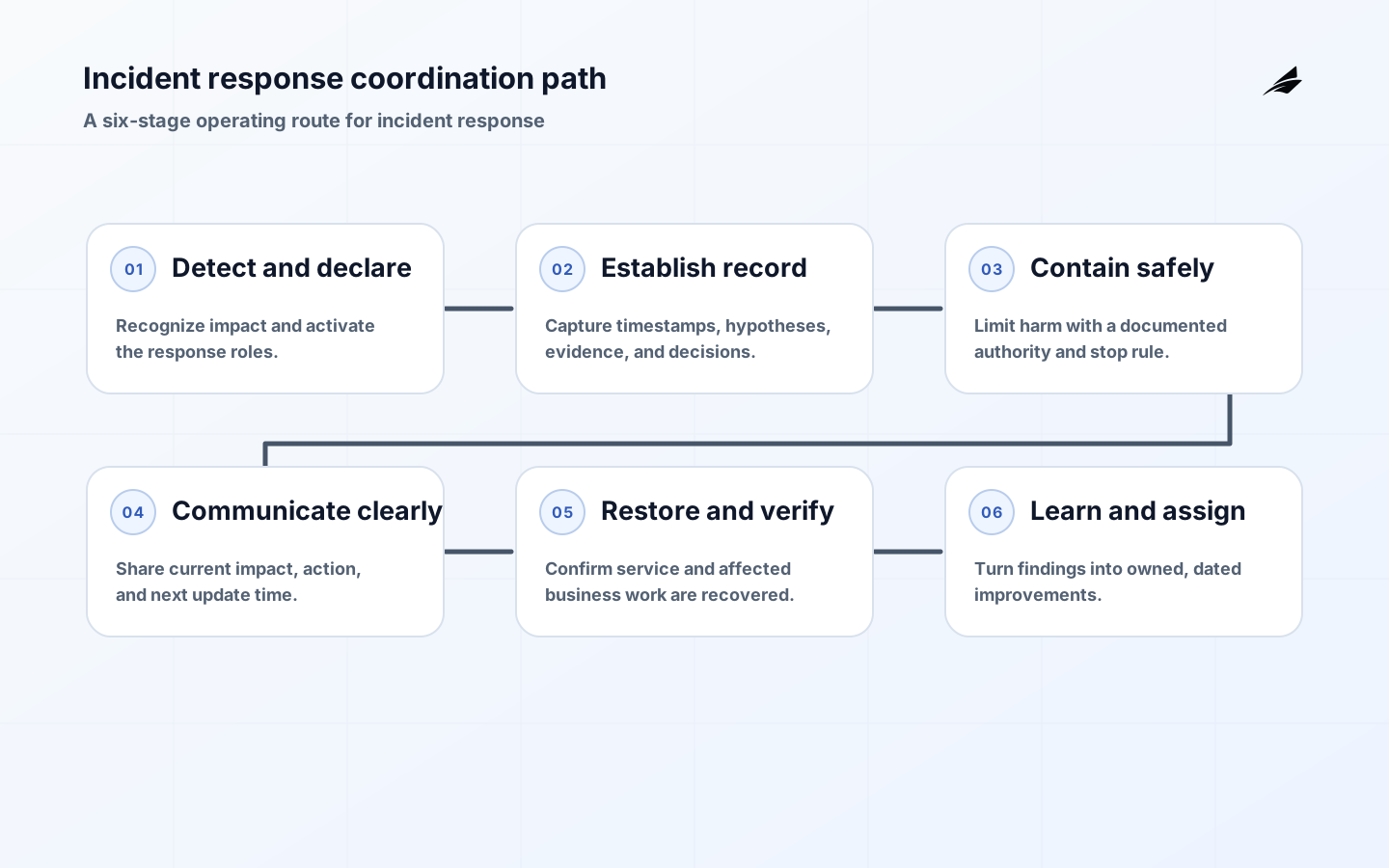
Incident response needs an operating model, not a loose collection of tools. Incident response is the coordinated work of detecting, containing, recovering from, and learning from an event that threatens service, security, or customer trust. It is not a document that starts after an outage. The plan is useful only when the team can find the right people, protect evidence, make bounded decisions, communicate plainly, and verify recovery under time pressure. This guide focuses on the choices that make the work inspectable by the people who build, operate, and support it.
Key takeaways
- Define the boundary and accountable owner before standardizing incident response.
- Keep the records that explain an outcome close to the action that created it.
- Use controls that match the consequence of failure instead of copying generic checklists.
- Test an uncomfortable but realistic failure path while impact is bounded.
- Measure recovery and operating effort alongside speed or throughput.
- Turn repeated exceptions into an owned improvement rather than private knowledge.
What incident response means in practice
An event becomes an incident when it needs coordinated response beyond normal handling. Severity should reflect impact, urgency, scope, and confidence, not merely the loudness of an alert. A technical fix is only one workstream: incident command, operations, communications, security or privacy assessment, customer support, and evidence management may need separate but connected ownership. For adjacent operating decisions, compare observability and backup and restore.
| Decision area | Question to settle | Useful evidence |
|---|---|---|
| Boundary | What part of incident response is in scope? | Named owner, entry point, and expected outcome. |
| Identity | Which version, record, or state is authoritative? | An inspectable identifier tied to the action. |
| Control | What condition must hold before expansion? | A test, review, or policy result with a decision rule. |
| Recovery | How will the team verify a safe outcome? | A documented action, check, and accountable responder. |
An operating model for incident response
Define an incident commander who owns coordination, a technical lead who drives diagnosis and mitigation, a communications owner, and a scribe who records decisions, timestamps, hypotheses, and actions. Prepare an escalation path and channels that work when ordinary tooling is impaired. Classify evidence, preserve relevant logs and snapshots, and set decision thresholds for containment actions such as disabling a feature, revoking credentials, or failing over. The design should make the next decision easier for someone who did not create the original implementation.
A practical implementation path
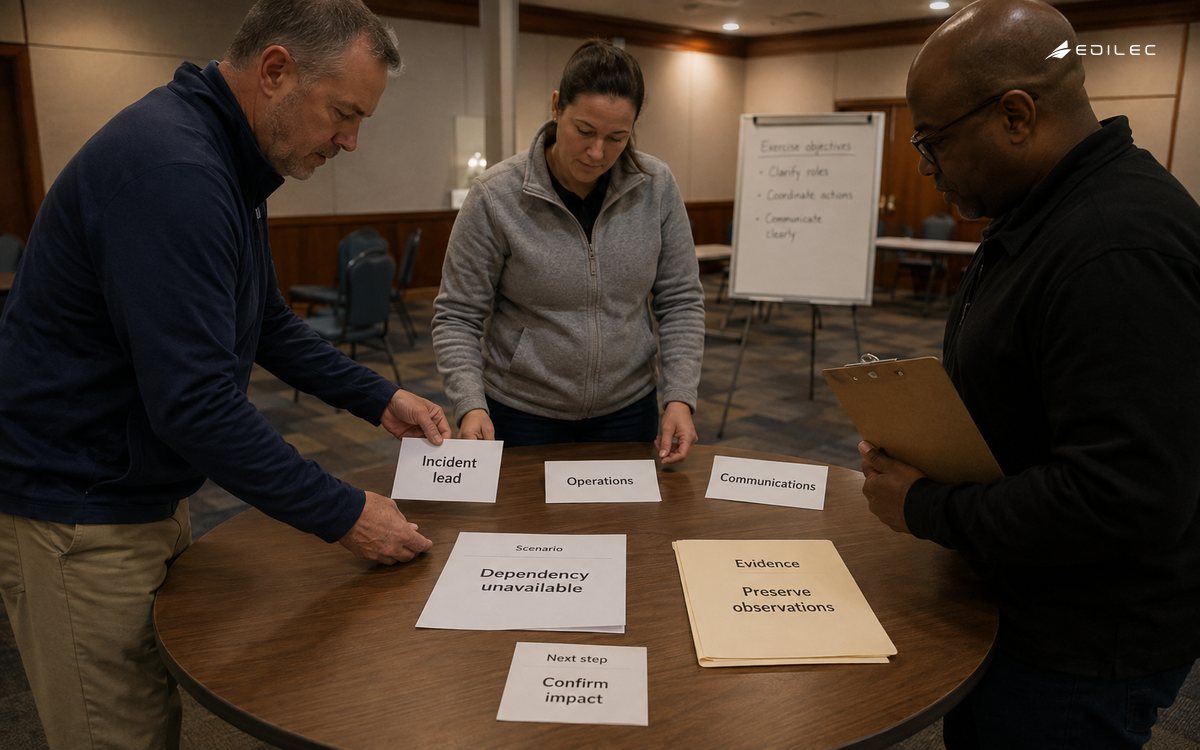
Begin with the most plausible high-impact scenarios: a production regression, unavailable dependency, credential exposure, data integrity problem, or ransomware indicator. For each, write the first ten minutes: how the issue is detected, where the response is declared, who is paged, which customer-facing action is safe, and how to capture initial evidence. Exercise the plan with a small scenario and record every point where ownership or access is unclear. Prefer a sequence that creates evidence at every stage rather than a broad first release that makes causality difficult to recover.
Risks and controls to make explicit
The usual failure is uncontrolled activity: several people change production, messages contradict each other, and the record of what happened is reconstructed afterward. Containment can also cause harm if it cuts off evidence or creates a wider outage. Grant break-glass access sparingly, log its use, and set a review requirement after the incident. Avoid promising a cause or recovery time before evidence supports it. Write the exception route down as well: an emergency action may be necessary, but it should leave an attributable record and return to normal control once the immediate condition is resolved.
| Stage | What to check | Decision rule |
|---|---|---|
| Prepare | Scope, identity, access, and prerequisites. | Do not proceed when ownership or required evidence is unclear. |
| Change | The control that addresses the main failure mode. | Pause when a required test, policy, or review fails. |
| Observe | Technical and user-facing consequences. | Expand only when the agreed signals remain inside bounds. |
| Recover | State, data, and follow-up work. | Close only after the relevant verification is recorded. |
Signals that show whether it is working
Measure time to acknowledge, time to declare, time to contain, time to restore, alert quality, handoff delays, and the age of follow-up actions. Review customer impact separately from infrastructure recovery; a service can be available while orders, notifications, or records remain incomplete. Track whether the timeline and decision log were sufficient for a new responder to understand the current state. Review the signals with a real example, because a metric becomes useful only when it changes a decision or confirms that an earlier decision was sound.
A incident response checklist for the next change
Run a tabletop that includes conflicting indicators and an incomplete mitigation. One participant should need to decide whether to disable a risky feature, another should draft a status update, and the scribe should record the rationale. The exercise is successful when it reveals an access gap, an unclear authority boundary, or a missing verification step before a real incident exposes it. The result should be a short, owned change to the routine, not a retrospective statement that the team should have been more careful.
A worked decision example
A deployment causes intermittent checkout errors for a subset of users. The incident commander declares severity based on completed-purchase impact, the technical lead halts rollout and routes traffic to the prior version, and the scribe records the configuration revision and error evidence. After infrastructure health returns, the team reconciles failed orders before closing the incident, because customer recovery is not proved by a green dashboard alone.
How to phase adoption
Phase incident response planning around a small number of scenarios that combine technical and customer impact. Start with the first ten minutes, then test the handoff to longer-running recovery and communications work. Give participants the access they would use in reality, but keep exercises scoped and reversible. The plan becomes credible when a new responder can find the channel, roles, evidence location, and decision authority without an informal introduction from the person who wrote it.
Decision records and ownership
Maintain an incident record that captures declaration time, severity rationale, roles, observed impact, affected systems, hypotheses, evidence links, actions, approvals, customer communications, and recovery checks. The record should distinguish facts from assumptions and note when a statement was last verified. This enables a controlled handoff when people change shifts and supports later review without forcing participants to reconstruct a narrative from fragmented chat messages and personal memories.
Design boundaries that matter
Communications are a response control, not a public-relations afterthought. Establish a predictable status cadence, state what is known and unknown, describe the current customer impact, and give the next update time. Keep internal technical detail appropriate to the channel, but ensure support teams receive language they can use with affected people. Avoid certainty that evidence does not support; a credible update can say that investigation continues while the team has taken a specific containment action. Clear communication reduces duplicate work and lets responders concentrate on recovery instead of answering the same question through uncoordinated channels.
Deeper operating considerations
Containment decisions need pre-agreed trade-offs. Disabling an integration may stop data exposure but block customer workflows; revoking a credential may interrupt a batch job while protecting a wider system. Record who can authorize each action, the signal that triggers it, expected collateral effects, and the check that proves it can be lifted safely. During an event, use that guidance to choose a bounded action and log the rationale. Afterward, review whether the trade-off matched real impact. This turns an emergency choice into an improving control rather than an undocumented act of individual judgment.
A useful review cadence
Review incidents and exercises through one normal alert, one ambiguous security or integrity signal, and one case where technical availability returns before customer work is reconciled. Confirm that the escalation rules fit current staffing, communications were accurate, and follow-up tasks have an owner and due date. Use the review to improve a decision boundary, not to produce a ceremonial report. Reliable response grows from small corrections that make the next coordination event less uncertain.
Frequently asked questions
A post-incident review should focus on the system conditions and decisions that shaped the outcome, not on finding a person to blame. A small team can combine roles, but it should still name who coordinates, who changes systems, and who communicates. Close an incident only after both the technical state and the affected business process have a documented verification result.
Before expanding the practice
Before an incident, decide how recovery work will transition back to normal delivery. A temporary mitigation may leave a feature disabled, a queue paused, credentials rotated, or records awaiting reconciliation. Name the person who owns each residual condition and the evidence required to remove it from incident status. This avoids the familiar outcome where the page is quiet but support and engineering spend days discovering unfinished customer work. Treat the handoff as a formal decision: the immediate incident can close when its verification is complete, while durable fixes move to a tracked improvement process with priority, owner, and review date.
A final field test
Field test: give a new responder the incident channel and scenario, then ask them to find authority, evidence, and the next update time. Any missing answer is a practical correction to the response plan.
Conclusion
Incident response improves when responsibility, evidence, and recovery checks are prepared before stress arrives. Practice the first minutes, limit uncontrolled changes, and make customer recovery part of the definition of done.