Platform engineering for cost and scaling becomes valuable when a team treats it as an operating decision rather than a product label. It should remove repeated delivery and operational friction for a defined user group. The practical question is whether people can make a bounded change, explain the evidence, and recover without relying on memory, especially when capability growth must remain evidence-led. Google SRE release engineering and Google Cloud operational excellence guidance provide technical anchors; the operating model turns them into choices a CTO's team can use in planning and review.
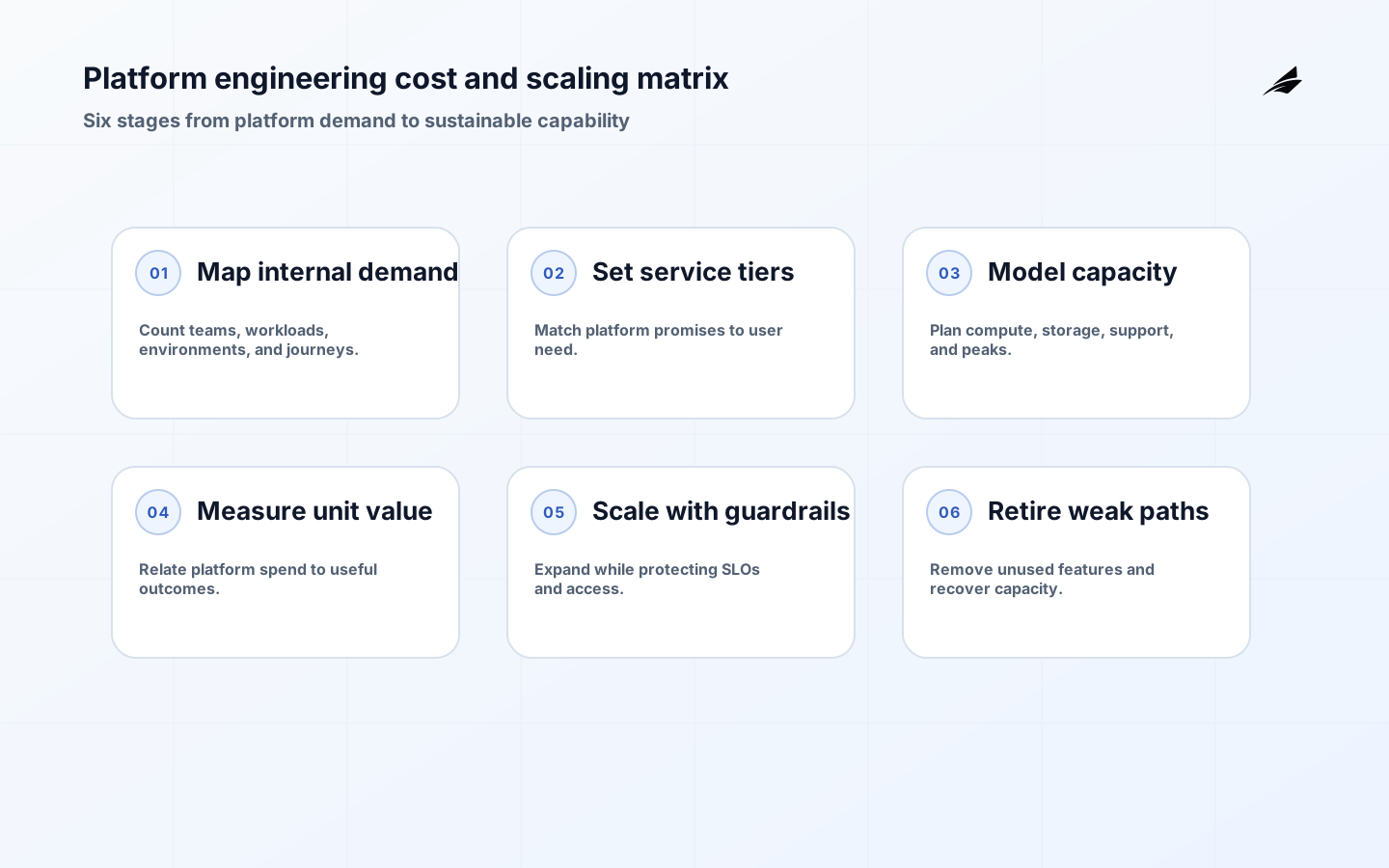
Platform engineering cost and scaling should connect platform demand to product value, not reward creation of more shared infrastructure. The CNCF Platforms White Paper describes internal platforms as curated capabilities for internal customers, and the CNCF maturity model evaluates outcomes and practices rather than a fixed blueprint. The AWS Cost Optimization Pillar provides ownership, usage, demand, and review principles; Azure cost maturity guidance emphasizes cost ownership, visibility, production insight, and trade-offs. Connect the operating model to Edilec platform engineering, cloud cost optimization, and SLOs. Define platform boundary, internal customers, service tiers, shared-cost allocation, and capacity assumptions. Scale from measured demand: active teams, workloads, environments, build volume, deployments, support load, and reliability targets. Test whether new capability removes toil or adds a service to maintain. Review unit cost per outcome, adoption, idle capacity, incidents, and time saved. Keep an exit path for features that no longer earn their operating cost.
Key takeaways
- Define platform engineering around a specific boundary, accountable owner, and user or business outcome.
- Make golden paths, self-service interfaces, reusable controls, adoption feedback, and a cost model for shared services visible before automating a broad policy or workflow.
- Use a stop rule: do not call a collection of central tools a platform until users can complete a valuable path with clear ownership and support.
- Treat building a broad portal that adds another queue while leaving teams unable to understand cost, policy, or exceptions as a design risk, not an afterthought.
- Measure time to complete a paved path, adoption by eligible teams, support demand, unit cost, template drift, and developer feedback together, because one measure rarely explains the whole outcome.
- Exercise the recovery or exception path before standardizing the approach.
- Turn recurring exceptions into a small owned improvement with a due date and a review, especially when capability growth must remain evidence-led.
What platform engineering covers in practice
Platform engineering is not a promise that every technical concern disappears. It is a way to make a defined decision repeatable and reviewable, especially when capability growth must remain evidence-led. Begin by naming what is included, what is deliberately outside the boundary, and which evidence is authoritative, especially when capability growth must remain evidence-led. That framing prevents a local optimization from becoming an unowned system-wide change, especially when capability growth must remain evidence-led. The published guidance from Google SRE Book: Release Engineering is useful here because it emphasizes controls and operating evidence rather than a one-time tool choice, especially when capability growth must remain evidence-led.

| Decision area | Question to settle | Evidence to retain |
|---|---|---|
| Outcome | What customer, service, or operational result does the practice protect? | A named journey, baseline, and owner for platform engineering. |
| Scope | Which systems, environments, and exceptions are included? | A boundary statement and dependency map for a product-like internal capability that removes repeated delivery and operational friction for a defined user group. |
| Authority | Who can proceed, pause, or approve an exception? | A role, escalation route, and dated decision record. |
| Verification | What observation proves the change is acceptable? | time to complete a paved path, adoption by eligible teams, support demand, unit cost, template drift, and developer feedback over an agreed observation window. |
Set a decision boundary before implementation for platform engineering
A boundary is more than a diagram. For platform engineering, it identifies the actor, trigger, records, actions, and recovery authority. Separate facts from assumptions: a dashboard trend may suggest a problem, while a trace, billing record, policy evaluation, or user report can establish what happened, especially when capability growth must remain evidence-led. Record the version and time context as well. That discipline matters when several changes occur at once, because it lets the next reviewer distinguish correlation from a cause worth acting on, especially when capability growth must remain evidence-led.
Implementation and controls for platform engineering
Start with the smallest useful path and make its control points explicit, especially when capability growth must remain evidence-led. The core mechanics are golden paths, self-service interfaces, reusable controls, adoption feedback, and a cost model for shared services. Assign an owner for each external dependency and state what happens when its input is absent, late, or contradictory, especially when capability growth must remain evidence-led. A controlled first implementation should keep actions attributable, make the expected result observable, and allow a human to pause safely, especially when capability growth must remain evidence-led. Google Cloud operational excellence framework supplies a useful reference for details that should be adapted to the consequence of the work, rather than copied as a generic checklist, especially when capability growth must remain evidence-led.
| Stage | Control | Decision rule |
|---|---|---|
| Prepare | Confirm scope, identity, prerequisites, and a baseline. | Do not proceed when ownership or required evidence is missing. |
| Act | Apply the smallest change that tests the assumption. | Stop when the agreed guardrail is crossed. |
| Observe | Compare technical signals with the expected user outcome. | Expand only when evidence remains within bounds. |
| Recover | Reverse, compensate, or reconcile the affected state. | Close only after recovery evidence is recorded. |
Failure modes that weaken platform engineering
An especially dangerous failure mode is a plausible-looking result with missing context: building a broad portal can add another queue while teams still cannot understand cost, policy, or exceptions. Counter this by preserving identifiers, control decisions, and the source of each important input, especially when capability growth must remain evidence-led. Make exceptions visible instead of turning them into silent workarounds. A temporary bypass may be justified during an incident, but it needs a named authority, an expiry, and a review that restores the normal control, especially when capability growth must remain evidence-led. Otherwise the bypass quietly becomes the actual operating model.
Operating signals and review cadence for platform engineering
Review time to complete a paved path, adoption by eligible teams, support demand, unit cost, template drift, and developer feedback with a concrete case, not as a dashboard ritual. Pair a leading indicator, such as an invalid configuration or denied request, with an outcome measure such as a failed journey, delayed completion, or excess spend, especially when capability growth must remain evidence-led. Set an observation window that matches the workload: a synchronous request may show harm in minutes, whereas a batch or retention policy may need days, especially when capability growth must remain evidence-led. A short recurring review should ask what changed, which signal moved, and whether the existing rule still fits reality, especially when capability growth must remain evidence-led.
A bounded example for platform engineering
A platform team begins with a service bootstrap path, not a portal. It supplies a repository template, provenance checks, workload identity, observability defaults, and a documented exception route. Teams can still choose a different runtime when justified, but the platform makes the supported path cheaper to adopt and easier to operate. Usage and support data decide what the team builds next. This is the shape of a useful platform engineering experiment: a named assumption, limited blast radius, observable result, and an explicit next decision. It is more valuable than a large rollout that produces activity but no dependable evidence, especially when capability growth must remain evidence-led.
Ownership and evidence for platform engineering
The owner of platform engineering is not expected to know every implementation detail. They are responsible for the decision record: why the boundary exists, which evidence is trusted, who can change the control, and how exceptions are handled, especially when capability growth must remain evidence-led. Engineering should keep implementation and observability usable; operations should own the readiness and recovery routine; security or finance should participate where the consequence requires it, especially when capability growth must remain evidence-led. This division helps a team avoid both centralized bottlenecks and unaccountable self-service, especially when capability growth must remain evidence-led.
Scale the platform by product evidence
A platform should earn new scope through demonstrated use, not through an organizational chart. Measure how many teams can complete a valuable path without bespoke help, which exceptions recur, and whether the shared service reduces total effort rather than moving it to a central queue. Publish a simple cost model for shared capacity and support. When a capability has no clear consumer, owner, or outcome, leave it as an experiment rather than silently turning it into mandatory infrastructure.
An adoption sequence for platform engineering
Start platform engineering with one bounded, representative case and a named person who can decide whether it is ready to expand. Capture the baseline, the assumption, the guardrail, and the recovery action before changing production behavior, especially when capability growth must remain evidence-led. Review the result with the people who build and support the service, then make one precise improvement to the routine, especially when capability growth must remain evidence-led. This sequence is deliberately modest: it reveals missing dependencies and unclear authority while the consequence is small, and it gives later standardization a real operational record rather than an aspirational policy, especially when capability growth must remain evidence-led.
Keep an evidence sample with every platform engineering review. Select one normal case, one boundary case, and one exception; trace the decision from input to outcome; and note whether the records answer the next operator's question, especially when capability growth must remain evidence-led. This is a practical quality check because it catches controls that exist on paper but are difficult to use during ordinary work, especially when capability growth must remain evidence-led. When the sample reveals ambiguity, improve the smallest relevant contract, alert, permission, runbook, or ownership rule before widening the practice, especially when capability growth must remain evidence-led.
Frequently asked questions
Question: How should platform engineering scale with a growing team? Answer: Scale the supported product paths and evidence before multiplying components. Add capabilities when demand, ownership, service quality, and recovery data show a repeatable need, then retire paths that no longer justify their operating cost.
Question: Which signals show a platform is healthy? Answer: Look at successful self-service, lead time, change failure and recovery, support load, adoption by supported paths, policy exceptions, capacity, and cost. Interpret the signals with teams’ outcomes rather than treating usage as success.
Question: Who owns platform engineering decisions? Answer: The platform team owns its product boundary and service commitments, while application teams retain responsibility for their services. Shared decisions need named authorities, escalation paths, and evidence of the effect on delivery and reliability.
Does platform engineering require a new platform? Not necessarily. Start with the evidence and control you need; a spreadsheet, runbook, policy, or existing tool may be enough for the first bounded path, especially when capability growth must remain evidence-led. When should the practice expand? Expand only after the team can show that the initial path protects the intended outcome, that exceptions have an owner, and that recovery has been tested, especially when capability growth must remain evidence-led. Google SRE Book: Release Engineering and Kubernetes concepts are good references for a deeper technical review.
Conclusion
Platform engineering becomes durable when it turns a recurring decision into a visible routine: define the boundary, apply proportionate controls, observe the outcome, and improve from real exceptions. Begin with one owned path and let evidence, rather than enthusiasm, determine the next expansion, especially when capability growth must remain evidence-led.