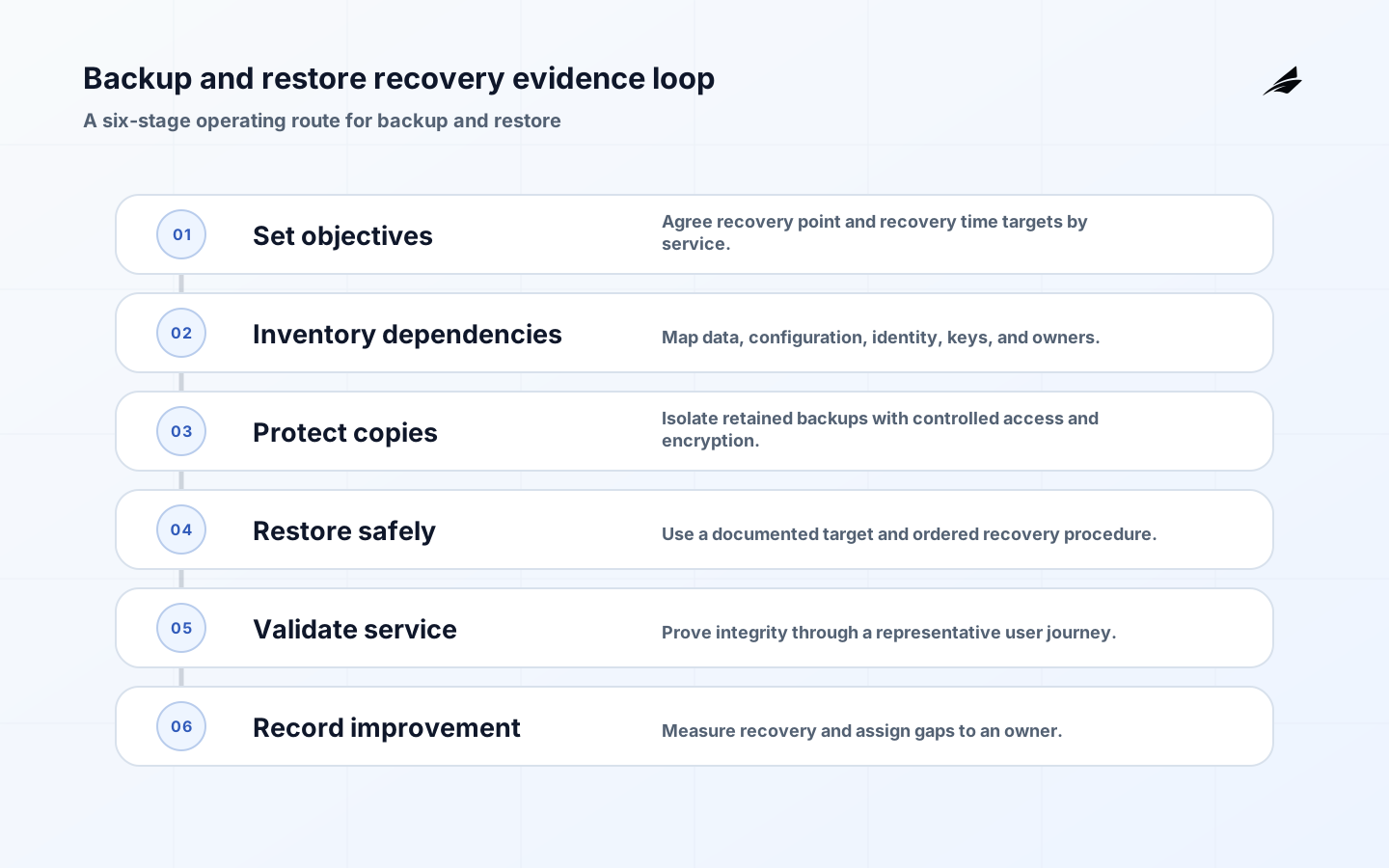
Backup and restore needs an operating model, not a loose collection of tools. Backup and restore is the capability to recover defined data and service states within agreed time and data-loss limits. A backup job succeeding is not proof of recovery. The capability is only real when a team can identify the required recovery point, access an isolated copy, restore into an appropriate environment, validate integrity and permissions, and return the affected business workflow to service. This guide focuses on the choices that make the work inspectable by the people who build, operate, and support it.
Key takeaways
- Define the boundary and accountable owner before standardizing backup and restore.
- Keep the records that explain an outcome close to the action that created it.
- Use controls that match the consequence of failure instead of copying generic checklists.
- Test an uncomfortable but realistic failure path while impact is bounded.
- Measure recovery and operating effort alongside speed or throughput.
- Turn repeated exceptions into an owned improvement rather than private knowledge.
What backup and restore means in practice
Recovery point objective describes the maximum acceptable data loss measured in time; recovery time objective describes the target time to restore a service or function. They are business decisions that shape replication, backup frequency, retention, staffing, and cost. A system may need several recovery tiers: a transactional database, an object archive, configuration, identities, and encryption keys do not necessarily share the same recovery path. For adjacent operating decisions, compare incident response and Kubernetes deployments.
| Decision area | Question to settle | Useful evidence |
|---|---|---|
| Boundary | What part of backup and restore is in scope? | Named owner, entry point, and expected outcome. |
| Identity | Which version, record, or state is authoritative? | An inspectable identifier tied to the action. |
| Control | What condition must hold before expansion? | A test, review, or policy result with a decision rule. |
| Recovery | How will the team verify a safe outcome? | A documented action, check, and accountable responder. |
An operating model for backup and restore
Inventory data, configuration, dependencies, ownership, classification, recovery objective, retention, and restore order. Keep copies in a separate administrative and security boundary where a compromise of the primary environment cannot easily delete or encrypt them. Protect backup credentials, use encryption and immutable or protected retention where appropriate, and document how keys, network access, and application configuration are recovered alongside the data. The design should make the next decision easier for someone who did not create the original implementation.
A practical implementation path
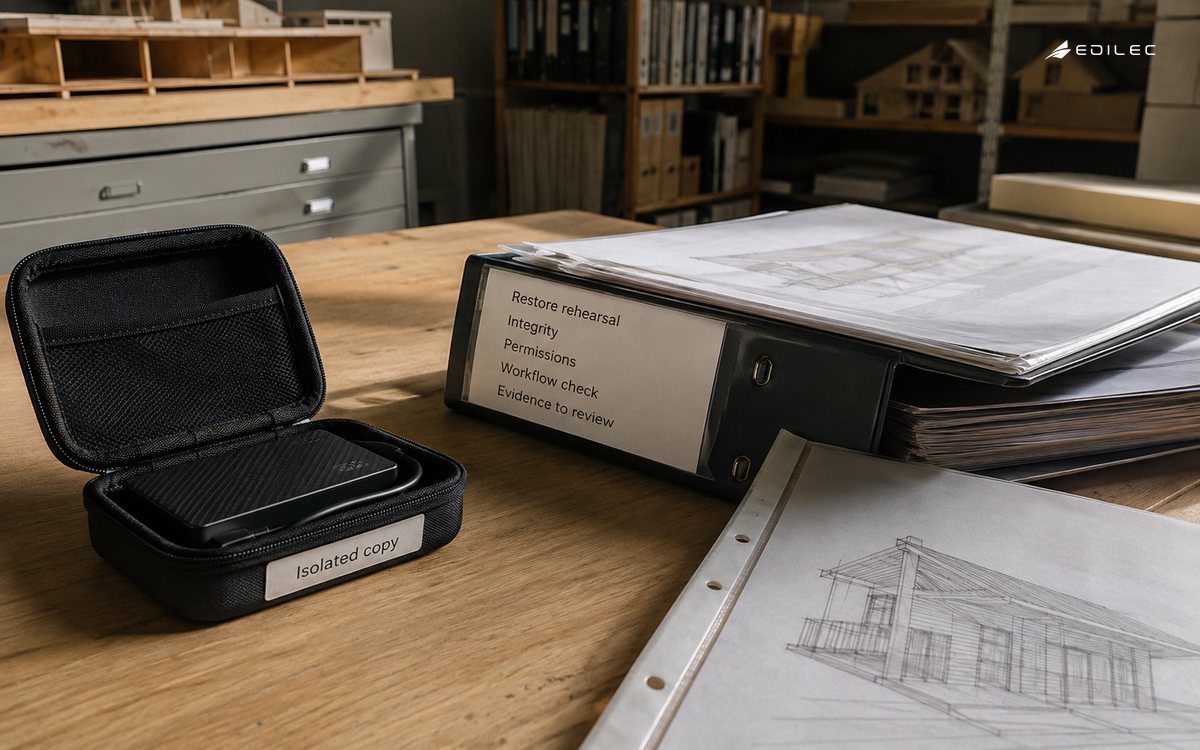
Start with one critical service and create a restore runbook that names the target environment, required identities, sequence, validation queries, and decision owner. Restore into an isolated test location on a schedule, not only when a production crisis forces it. Measure the actual time from authorized start to validated application availability, including infrastructure provisioning, data transfer, index rebuilds, and reconciliation. Prefer a sequence that creates evidence at every stage rather than a broad first release that makes causality difficult to recover.
Risks and controls to make explicit
Backups can fail silently through exclusions, expired credentials, corrupted copies, inaccessible keys, or a retention policy that removes the only useful recovery point. A backup in the same account with the same broad administrator access may not survive a destructive compromise. Replication improves availability but can replicate deletion or corruption; it is not automatically an independent recovery copy. Write the exception route down as well: an emergency action may be necessary, but it should leave an attributable record and return to normal control once the immediate condition is resolved.
| Stage | What to check | Decision rule |
|---|---|---|
| Prepare | Scope, identity, access, and prerequisites. | Do not proceed when ownership or required evidence is unclear. |
| Change | The control that addresses the main failure mode. | Pause when a required test, policy, or review fails. |
| Observe | Technical and user-facing consequences. | Expand only when the agreed signals remain inside bounds. |
| Recover | State, data, and follow-up work. | Close only after the relevant verification is recorded. |
Signals that show whether it is working
Track backup completion and failure by asset, age of the newest recoverable point, restore-test success, measured recovery duration, restore integrity results, retention coverage, access-policy changes, and unprotected dependencies. Report against recovery objectives in business terms. A daily green status is insufficient if no one can restore the application configuration or reconcile the orders created after the last backup. Review the signals with a real example, because a metric becomes useful only when it changes a decision or confirms that an earlier decision was sound.
A backup and restore checklist for the next change
Conduct a restore drill that begins with a documented recovery point and ends with a user-level validation, such as creating and reading a test transaction without using production credentials. Include one unavailable dependency or missing permission in the scenario. The lesson should identify which prerequisite was absent and who owns it, rather than silently granting broad access to make the exercise pass. The result should be a short, owned change to the routine, not a retrospective statement that the team should have been more careful.
A worked decision example
A customer portal depends on a database, object storage, DNS configuration, and an encryption key. A database restore alone brings the process up but documents cannot be read because the key policy and object permissions were not part of the runbook. The revised plan inventories each dependency, restores to an isolated environment, validates a representative customer journey, and records the measured recovery time against the agreed objective.
How to phase adoption
Phase backup and restore work through the service whose loss would cause the clearest customer or operational harm. Inventory the data and dependencies, agree the recovery objectives with the business owner, and write a restore runbook before expanding retention or tooling. Test in an isolated destination with the real permissions and keys the recovery team will need. A successful first drill establishes a trustworthy baseline for other services; an untested claim of coverage does not.
Decision records and ownership
Keep a recovery decision record with asset owner, classification, recovery point and time objectives, backup schedule, retention, copy location, encryption and key dependency, restore order, validation query, and access approver. Include the result and duration of the last restore test. This allows leadership to see the difference between a policy promise and a measured capability, and it lets responders identify which condition prevents recovery when a backup exists but cannot be used.
Design boundaries that matter
Recovery objectives must be negotiated against the actual business process. A five-minute recovery point may be essential for a transactional ledger but unnecessary for a document archive, while a low recovery-time target can demand warm capacity, automation, and trained responders that cost more than the service warrants. Document the assumption behind each objective and revisit it when data volume, regulations, customer commitments, or architecture changes. This prevents an appealing target from becoming an unfunded promise. It also provides a rational basis for prioritizing restore tests: the highest-impact, fastest-changing systems deserve more frequent proof.
Deeper operating considerations
Isolation is stronger than copying data to another folder. Consider whether an attacker or faulty administrator in the primary environment can alter backup policies, delete recovery points, access encryption keys, or erase audit records. Use separate accounts, roles, keys, retention controls, or offline arrangements where the threat model calls for them, then test the access route under the same separation. Recovery also needs configuration and identity evidence, not only application data. A restore that cannot authenticate, resolve its dependencies, or decrypt a representative record is a partial artifact, not a recovered service.
A useful review cadence
Review one routine restore, one expired or missing prerequisite, and one scenario where data recovery must be followed by business reconciliation. Check that the backup remains isolated from the primary administrative boundary, that retention still covers the agreed objective, and that restored data and service behavior are validated together. Record the measured time and the smallest corrective action. This keeps recovery planning grounded in the complete service, not just the storage system that holds a copy.
Frequently asked questions
The 3-2-1 idea is a useful starting heuristic, but it does not replace an application-specific recovery design. Backups should be tested at the frequency warranted by impact and change rate. Recovery testing does not need to endanger production; use isolated environments, controlled data handling, and an explicit validation routine that proves the restored state is usable.
Before expanding the practice
Before relying on a backup platform, verify who can initiate a restore and under what conditions. The authority to read production data, create a recovery environment, access encryption keys, and change DNS or application configuration may be distributed across several teams. A runbook that assumes a single administrator can do everything will fail exactly when access boundaries are most important. Exercise the approvals and role assumptions as part of the drill, and preserve a contact and escalation path outside the primary environment. Recovery succeeds through coordinated access to a complete system, not simply through the existence of a stored data copy.
A final field test
Field test: restore a representative record in an isolated environment and verify the required key, identity, configuration, and user journey. A successful storage restore without this result is not yet usable recovery.
Conclusion
Backup and restore is a practiced recovery capability, not a storage feature. Define realistic objectives, isolate copies, test the complete dependency chain, and keep evidence that the restored service actually works.