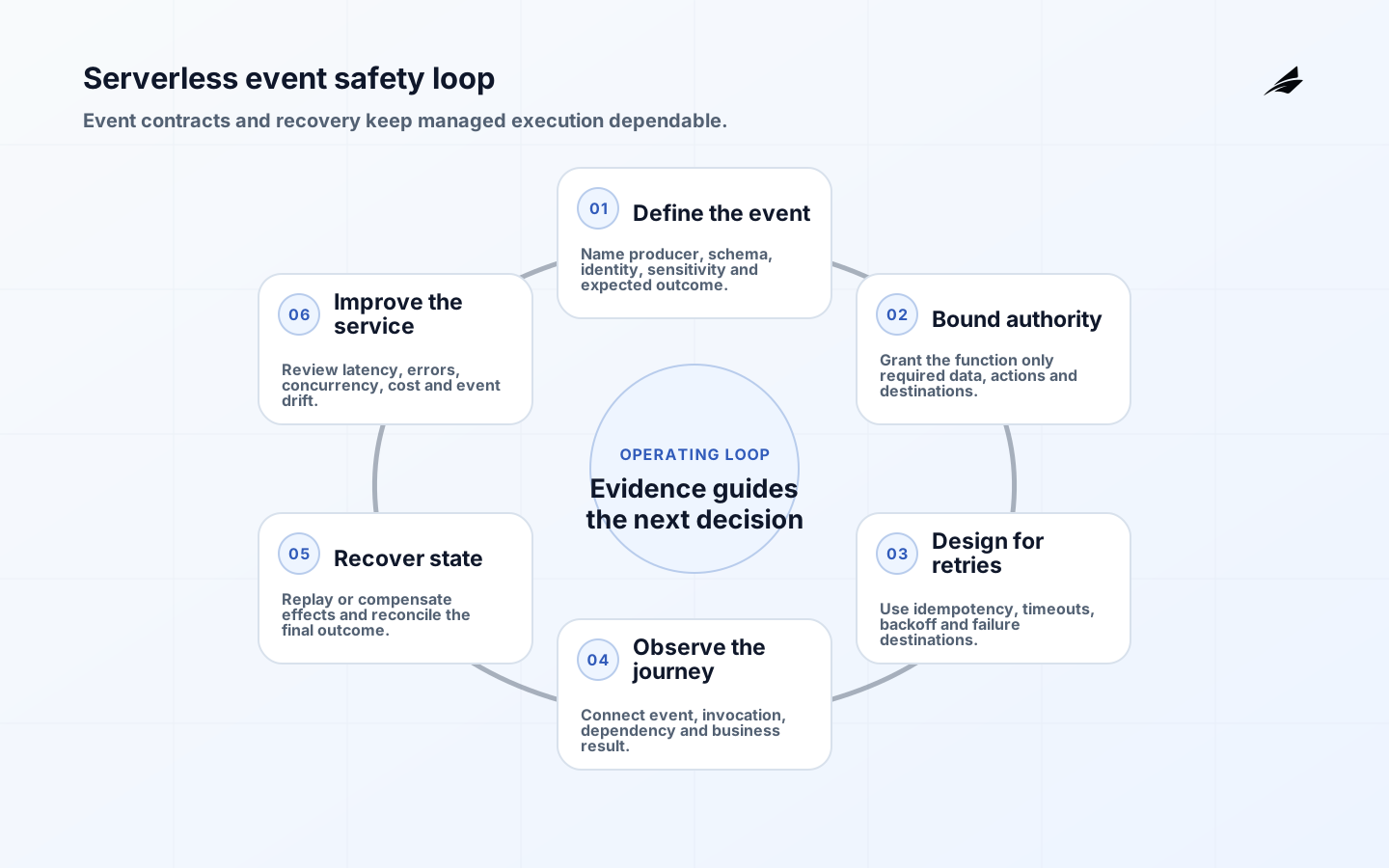
Serverless architecture operations begin where the provider's managed execution ends. A platform may allocate compute, replace hosts and scale invocation capacity, but the application team still owns event meaning, permissions, side effects, dependency behavior, recovery and customer outcomes. The practical design question is not whether servers disappear; it is whether a specific event path becomes simpler to operate without hiding failure or creating uncontrolled cost.
This guide focuses on event-driven functions and managed integrations used in cloud and DevOps delivery. Compare the event-driven systems security review, event-driven production guide and serverless mistakes and fixes for adjacent decisions about schema trust, replay and production ownership.
Key takeaways
- Treat every trigger as a contract with a business result.
- Bound function identity and downstream authority independently.
- Assume duplicate, delayed and out-of-order delivery where the platform allows it.
- Observe the complete event journey, not only invocation success.
- Design replay, compensation and reconciliation before release.
- Measure cost per useful outcome alongside reliability.
Define the event purpose and operating boundary
Start with the occurrence that matters to the business: an order accepted, file uploaded, account changed or timer elapsed. Name the producer, consumer, schema owner, delivery semantics, sensitivity and outcome deadline. Then identify every store, queue, API and human decision touched before the outcome is complete. A short function can still sit inside a large operational boundary when it changes money, access or authoritative records.

Specify what accepted, rejected, duplicated, late and malformed events mean. The CloudEvents specification standardizes common event context for interoperability, but domain semantics remain application responsibilities. Version schemas deliberately, define compatibility expectations and avoid sensitive data in routing metadata. Consumers should reject or quarantine events they cannot interpret rather than guessing at changed meaning.
AWS guidance on Lambda application design, Lambda best practices and the Serverless Lens emphasizes application-level behavior, idempotency and managed-service constraints. Apply those principles to the whole path, including queues, databases and external calls, instead of reviewing each function in isolation.
| Boundary question | Decision to record | Failure if omitted |
|---|---|---|
| Event identity | Unique key, source and retention period | Retries create duplicate business effects |
| Authority | Allowed data, actions and destinations | A compromised handler gains excessive reach |
| Completion | Business result and deadline | Invocation success is mistaken for service success |
| Repair | Replay, compensation and reconciliation owner | Failures accumulate without a safe correction path |
Assign ownership across managed services
Give one service owner accountability for the user outcome and name technical owners for producers, consumers, schemas, queues, state stores and external dependencies. Define who can pause a trigger, reduce concurrency, replay a message, change a schema and approve a compensating action. These decisions must be usable during an incident, when the original developer may be unavailable and evidence may be incomplete.
Separate deployment identity, runtime identity and operator access. Runtime roles should contain only the resources and actions required by the handler. Operators need controlled diagnostic and recovery permissions without inheriting unrestricted production administration. Protect emergency access, log its use and rehearse revocation. Provider-managed scaling does not prevent a badly scoped role from multiplying the impact of an error.
Engineer retries, idempotency and retained evidence
Assume that an event may be delivered more than once whenever the source or integration uses at-least-once semantics. Use a stable idempotency key at the business side effect, not only at function invocation. Store enough state to recognize prior completion and define the retention window from realistic retry and replay periods. For batch sources, isolate failed records where the platform supports partial handling so one bad item does not repeatedly reprocess successful work.
Set timeouts from dependency behavior and outcome deadlines. Use bounded retries with backoff and jitter, then route exhausted work to a durable failure destination or explicit terminal state. A dead-letter queue is not recovery by itself; it needs an owner, alert, inspection method, replay criteria and data-retention rule. Validate payloads before side effects and avoid logging secrets or unrestricted personal content.
| Observed symptom | Immediate containment | Evidence to preserve | Follow-up decision |
|---|---|---|---|
| Retry surge | Pause or cap consumption | Event IDs, versions and dependency errors | Repair dependency, handler or retry policy |
| Duplicate effect | Disable affected action | Idempotency keys and state transitions | Reconcile data and strengthen atomicity |
| Growing queue age | Protect critical cohorts | Arrival rate, concurrency and duration | Add capacity or reduce upstream demand |
| Cost anomaly | Limit concurrency or source volume | Invocation, duration and downstream usage | Correct loop, payload or architecture |
Observe the event journey and service objective
Monitor accepted events, age, completion latency, failures, throttling, retries, concurrency, dead-letter volume and downstream errors. Add a business completion signal so the team can distinguish “function returned successfully” from “customer notification was recorded and delivered.” Correlate event identity across logs, traces and state changes. Sample carefully, because rare failed events often carry the evidence most needed for repair.
Define an objective at the outcome boundary, such as a percentage of valid uploads processed correctly within a stated time. Use error-budget or threshold behavior to guide release and capacity decisions. Review cold-start latency only when it affects that objective. A technically interesting metric should not dominate the operating model unless it changes user experience, recovery or cost.
Adopt serverless architecture in bounded increments
Choose a workload with variable demand, a clear event contract and a reversible repair path. Document current cost and operational burden before migration. Build one complete route through identity, telemetry, failure handling and reconciliation, then test duplicates, dependency timeout, malformed input and sudden volume. Expand only after operators can diagnose and recover the path without private developer knowledge.
Avoid organization-wide mandates that force persistent, low-latency or specialized workloads into an unsuitable runtime. Compare managed functions with containers, workflows and long-running services using execution pattern, control needs, portability, team skill and total operating cost. A mixed architecture is often correct. Standardize event envelopes, identity, observability and recovery patterns where they reduce repeated work, not where they conceal important domain differences.
Govern cost, concurrency and downstream pressure
Model cost from the whole event path: source requests, queue operations, invocation count, execution duration, provisioned capacity, state reads and writes, telemetry, data transfer and downstream APIs. Use representative payload sizes and retry rates rather than a happy-path calculator. Allocate spend to a service or tenant where that distinction supports action. An anomaly threshold should route to an owner who can contain the trigger, concurrency or dependency before a software loop becomes a large bill.
Concurrency is both a scaling mechanism and a safety control. Set limits with downstream capacity, account quotas and recovery objectives in view. A high limit may overwhelm a database; a low limit may push queue age beyond the service objective. Load-test the combined system, including throttling and retry behavior, then retain the approved assumptions. Review them when event volume, payload size, provider limits or dependency contracts change.
Work through a partial side effect
Consider a document-upload event. The handler validates metadata, stores a processing record and calls an external conversion service. The call times out after the external service accepts the file. A blind retry can create another conversion and inconsistent billing. A safe design uses the upload ID as an idempotency key, queries or reconciles external status, records the definitive result and routes unresolved cases for controlled review.
Test the scenario by injecting timeout after each side effect. Confirm that duplicates do not create extra records, exhausted retries reach an owned queue, operators can find all affected documents and replay does not bypass current authorization. Measure the elapsed time to restore a correct business state. This exercise reveals transaction boundaries that ordinary unit tests and happy-path invocation metrics do not expose.
Prove operational readiness before broader traffic
A readiness review should follow one real event from producer to final state. Verify schema compatibility, least privilege, secret handling, idempotency, timeouts, retry limits, failure destinations, dashboards, alarms, runbooks and cost controls. Ask someone outside the implementation pair to diagnose an injected fault. Record the evidence and unresolved exceptions, with owners and expiry dates.
Include provider quotas and regional dependencies in capacity and recovery tests. Reserved or maximum concurrency can protect downstream services but may increase queue delay; model that tradeoff. Confirm infrastructure definitions can recreate the path and that restoration includes state stores, event sources and permissions. A deployed function package alone cannot recover an event-driven service.
Frequently asked questions about serverless architecture
Is serverless architecture always cheaper?
No. It can reduce idle compute and host-management effort for variable workloads, but invocation volume, duration, provisioned capacity, logs, data transfer, queues and downstream services all contribute. Compare cost per completed business outcome at realistic demand, including engineering support and failure recovery. Stable high utilization may favor another runtime.
When is a serverless function a poor fit?
It may be unsuitable for persistent connections, specialized hardware, very long execution, strict runtime control or latency requirements that conflict with platform behavior. Quotas and portability needs also matter. Decompose the requirement before deciding: an event intake function may still work well while heavy processing runs in a container or managed batch service.
What evidence should a service owner request?
Ask for an event and dependency map, identity policies, schema compatibility tests, duplicate and timeout scenarios, recovery results, user-facing service objectives, cost model and named operating roles. The strongest evidence is a controlled exercise in the target environment where the receiving team contains a fault, reconciles state and safely resumes consumption.
Conclusion
Serverless architecture operations are dependable when managed execution is surrounded by explicit event contracts, limited authority, observable outcomes and practiced repair. Begin with one bounded service promise, test the uncomfortable delivery cases and measure both reliability and unit cost. The platform can remove server administration; disciplined engineering makes the resulting service operable.