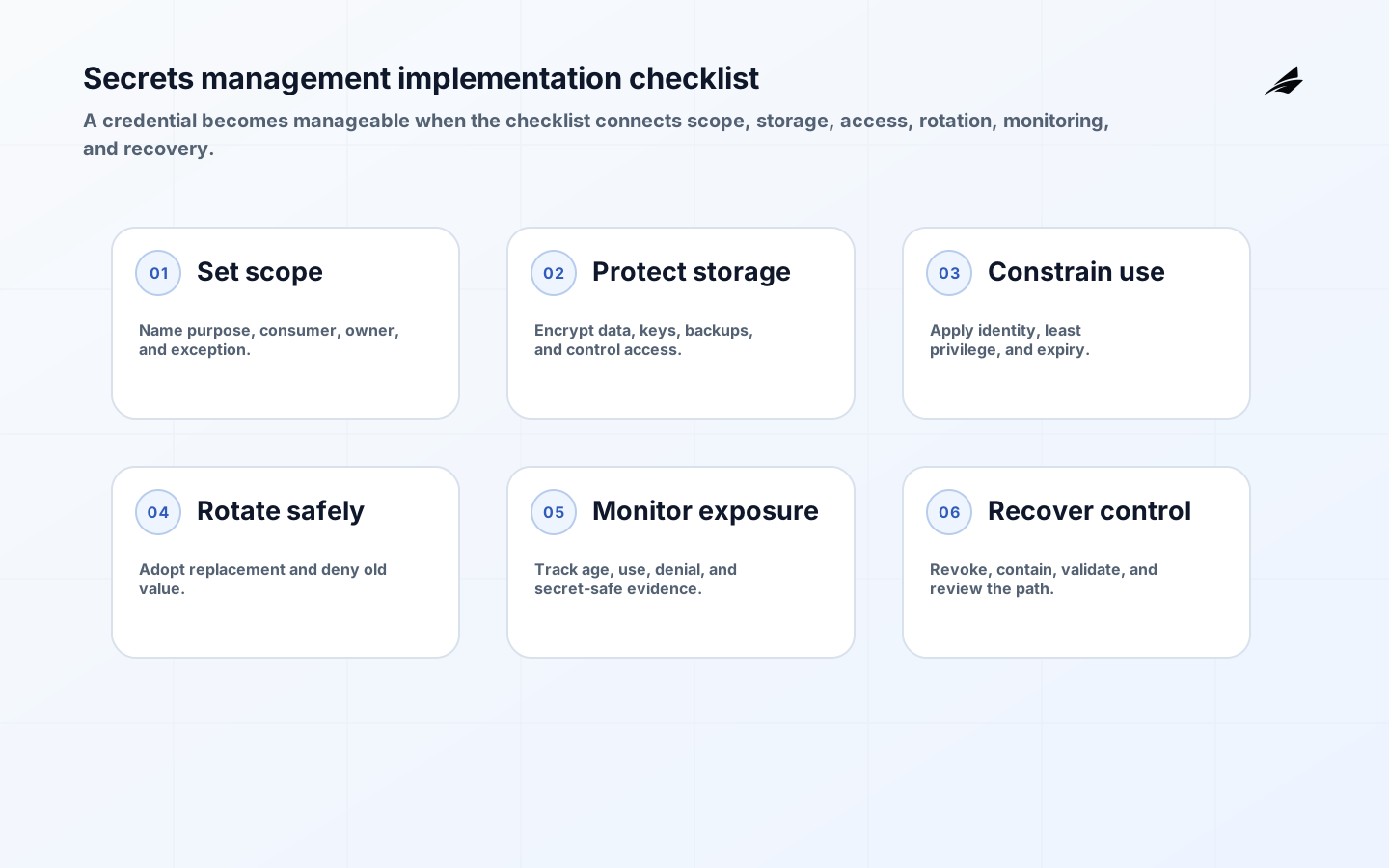
Secrets management becomes dependable when a team can explain a credential’s purpose, owner, scope, storage, delivery, use, rotation, revocation, and evidence. The Kubernetes Secrets documentation describes a configuration object, not a complete governance model. The OWASP Secrets Management Cheat Sheet and NIST SP 800-57 Part 1 add lifecycle, key-management, access, rotation, and recovery considerations. This checklist turns those principles into decisions a product and platform team can verify.
Use the checklist for one bounded path before standardising across every environment. Edilec’s cloud secrets guide, container security guide, and Terraform modules guide help connect the credential to workload identity, operations, and response. The aim is a record that lets the next operator act safely without relying on memory or a private tool configuration.
Set scope and ownership
Define which secrets, keys, tokens, certificates, environments, teams, and exceptions are covered. Name the business outcome the credential protects and the owner who can approve, pause, rotate, or revoke it. Identify the authoritative inventory and record what is deliberately outside the boundary. Include CI/CD systems, support access, backups, replicas, logs, and third-party integrations. A secret without an owner is not merely undocumented; it is difficult to rotate or revoke fairly during an incident.
| Checklist item | Question | Pass evidence |
|---|---|---|
| Purpose | What operation needs this value? | Named service, action, and data boundary. |
| Identity | Which workload or person receives access? | Stable identity and membership policy. |
| Scope | What resources, environments, and time limit apply? | Least-privilege rule and expiry. |
| Authority | Who can create, approve, rotate, or revoke? | Role map and escalation path. |
| Recovery | What happens if the value is exposed or unavailable? | Runbook and tested response. |
Protect storage and delivery
Kubernetes notes that Secret values are base64-encoded in manifests and require deliberate protection; review who can read them, how they are stored, and how they enter a pod. The Kubernetes encryption guidance describes encrypting confidential data at rest and managing the provider configuration. Protect the control plane, backups, snapshots, API access, and operator credentials. Avoid putting reusable values in source control, container images, build output, tickets, shell history, or broad environment dumps. Runtime retrieval and workload identity are preferable when the platform supports them.
Constrain access and use
Separate read, write, rotate, and revoke permissions. A service that only needs to call one endpoint should not receive a platform administrator key. Bind access to a workload or named human identity, use short lifetimes where practical, and record the secret version requested without recording its value. Apply authorization again at the target service because a secret store cannot narrow a credential’s downstream authority. Review unused grants, inherited roles, cross-environment access, and support or break-glass paths.

| Control | Common failure | Review test |
|---|---|---|
| Least privilege | A consumer can read unrelated credentials or resources. | Attempt denied access with a real workload identity. |
| Encryption at rest | Storage or backup access exposes plaintext. | Inspect provider, key, and restore configuration. |
| Secret scanning | A value remains in old commits or artifacts. | Scan source, history, logs, images, and build output. |
| Rotation | The store changes but the consumer still uses the old value. | Rotate, verify service, and revoke the previous version. |
| Break-glass | Emergency privilege remains permanently active. | Exercise expiry, logging, approval, and removal. |
Make rotation and revocation observable
Document trigger, overlap, consumer update, validation, and revocation for each credential class. Coordinate connection pools, caches, long-running jobs, deployments, and external vendors. Alert on age and failed rotation, but do not treat an alert as evidence that the consumer adopted the new value. Verify authentication, authorization, business completion, and old-value denial. For keys used to sign or encrypt data, plan compatibility, key version, re-encryption, and recovery of the key-encryption hierarchy according to the consequence.
Monitor without exposing values
Track age, expiry, access denials, unexpected consumers, unused grants, rotation success, failed retrieval, exposed-secret findings, revocation time, and downstream failures. Keep sensitive values out of logs, traces, metrics labels, error messages, and screenshots. Use a correlation ID or secret version to connect events safely. Review a normal case, a denied case, and an exception case on a regular cadence. OWASP’s guidance is most useful when it is translated into evidence that operators can inspect.
Test compromise and recovery
Exercise a suspected leak from source control, a build runner, a support channel, and a workload. The response should identify the secret and consumers, stop or restrict use, rotate or revoke, inspect access evidence, restore service, and communicate the impact. Test an unavailable secret store and an expired certificate as well. Keep the emergency route separately protected, time-limited, attributable, and reviewed after use. Recovery is complete only when the normal control is restored and evidence shows the affected service is safe.
A practical first implementation uses one queue worker and one narrowly scoped credential. Inventory the consumer, move delivery to runtime retrieval, set an expiry, rotate it during a controlled window, and revoke the old value. Ask an operator to find the owner and recovery instructions without private context. The exercise reveals whether the missing improvement is technical storage, identity, monitoring, runbook clarity, or decision authority.
Run the checklist against one real credential
A checklist is useful only when it is applied to a real secret and its consumer. Select a credential that matters but can be changed safely. Record its purpose, owner, identity, permissions, store, encryption, delivery, rotation trigger, expiry, monitoring, and revocation authority. Then ask a second operator to verify each item from the platform and service records. Any answer that depends on an undocumented convention is a missing control or a deliberate exception that needs an owner and review date.
For a Kubernetes workload, inspect who can read the Secret object, whether data at rest is encrypted, how the pod receives the value, whether it appears in logs or crash output, which downstream action it enables, and how the team can cut access. Rotate it while the workload is serving a representative operation, verify the new version, deny the old version, and review the audit evidence. If the workload must restart, decide whether the restart is acceptable and whether the runbook protects in-flight work.
Review the checklist after deployments, ownership changes, provider changes, incidents, and a scheduled interval appropriate to the risk. Track exceptions rather than hiding them in comments. A recurring exception may mean a platform limitation, a vendor contract, a missing identity primitive, or an application that cannot reload configuration safely. The next improvement should address that cause and leave a record of the decision, not simply add another warning to the checklist.
Document exceptions instead of weakening the checklist
A checklist should make exceptions visible without turning them into permanent bypasses. If a vendor cannot rotate a token, a legacy workload cannot reload configuration, or a certificate must overlap during migration, record the exact constraint, compensating control, responsible owner, expiry or review date, and evidence required for closure. The exception should not be a free-text note that disappears when the original operator leaves. Treat recurring exceptions as candidates for platform, application, or supplier change.
The checklist also needs a clear stop rule. Do not proceed when ownership, destination, permission, encryption, or recovery evidence is missing. Do not approve a rotation when the consumer cannot prove adoption. Do not close an incident when the old credential remains active without a documented reason. These rules make the checklist operational: they help a person pause safely and explain what is needed next rather than encouraging a hurried pass through incomplete controls.
The checklist is strongest when every item has an accountable role. A service owner explains why the credential exists and what the consumer needs; a platform owner operates storage, identity, delivery, and audit; a security owner reviews exposure and recovery; and an incident owner can revoke access under pressure. Keep the escalation path beside the checklist. When a control cannot be met, the decision should identify the compensating measure and the person who accepts the remaining risk.
Make the checklist easy to use during ordinary delivery. Include the expected identity, storage, permission, rotation, monitoring, and recovery evidence beside the implementation step, and provide a safe test environment that does not use production values. Link the checklist to deployment and incident workflows so a new consumer cannot be approved without an owner and a revocation path. Review the wording when teams repeatedly misunderstand an item. A checklist that people can apply at the moment of change is more protective than a policy that is read only after an exposure.
Close a checklist item only when the evidence is current and the responsible person can explain it. A copied policy statement is not proof that the workload, store, consumer, and recovery route behave as expected. Pair each important control with a small test or record that a reviewer can inspect without seeing the secret value.
Key takeaways
- Define purpose, owner, consumer, scope, lifecycle, and recovery before selecting a storage tool.
- Protect control planes, backups, manifests, artifacts, logs, and operator access as part of the secret boundary.
- Use least privilege, workload identity, short lifetimes, and separate rotate and revoke authority.
- Verify consumer adoption and old-value denial after every rotation.
- Rehearse exposure and recovery so the emergency path does not become the normal path.
Frequently asked questions
Question: What is the first secrets checklist decision? Answer: Name the credential's purpose, owner, scope, consumer, and failure consequence before choosing storage. Question: When is a rotation complete? Answer: Only when the new value works, the old value is revoked or expired, access is observable, and recovery has been verified.
What belongs in a secrets implementation checklist?
Answer: Ownership, storage encryption, access scope, delivery, rotation, revocation, audit evidence, monitoring, and a tested response to exposure belong in the checklist.
How should exceptions to secret policy be recorded?
Answer: Name the credential, reason, approving authority, compensating controls, expiry, and removal owner. An exception should not become a permanent undocumented path.
What is the first secret to review?
Answer: Choose a credential with meaningful access and a known consumer, then trace its complete lifecycle from creation through use, rotation, revocation, and evidence.
Is base64 encoding encryption? No; it is an encoding and should not be treated as confidentiality. Should every secret rotate daily? Not necessarily; lifetime should match risk and the consumer’s ability to adopt change safely. Can a secret manager replace authorization? No; downstream services still need scoped permissions. What is the most important checklist item? A named owner and a tested revocation path, because both determine whether the team can respond when the value is wrong or exposed.
Conclusion
Secrets management is an operating discipline that makes access changeable and recoverable. Set the boundary, protect storage and delivery, constrain use, rotate with evidence, and test revocation. A concise checklist is valuable when it describes the real control path and gives the next operator enough information to act safely.