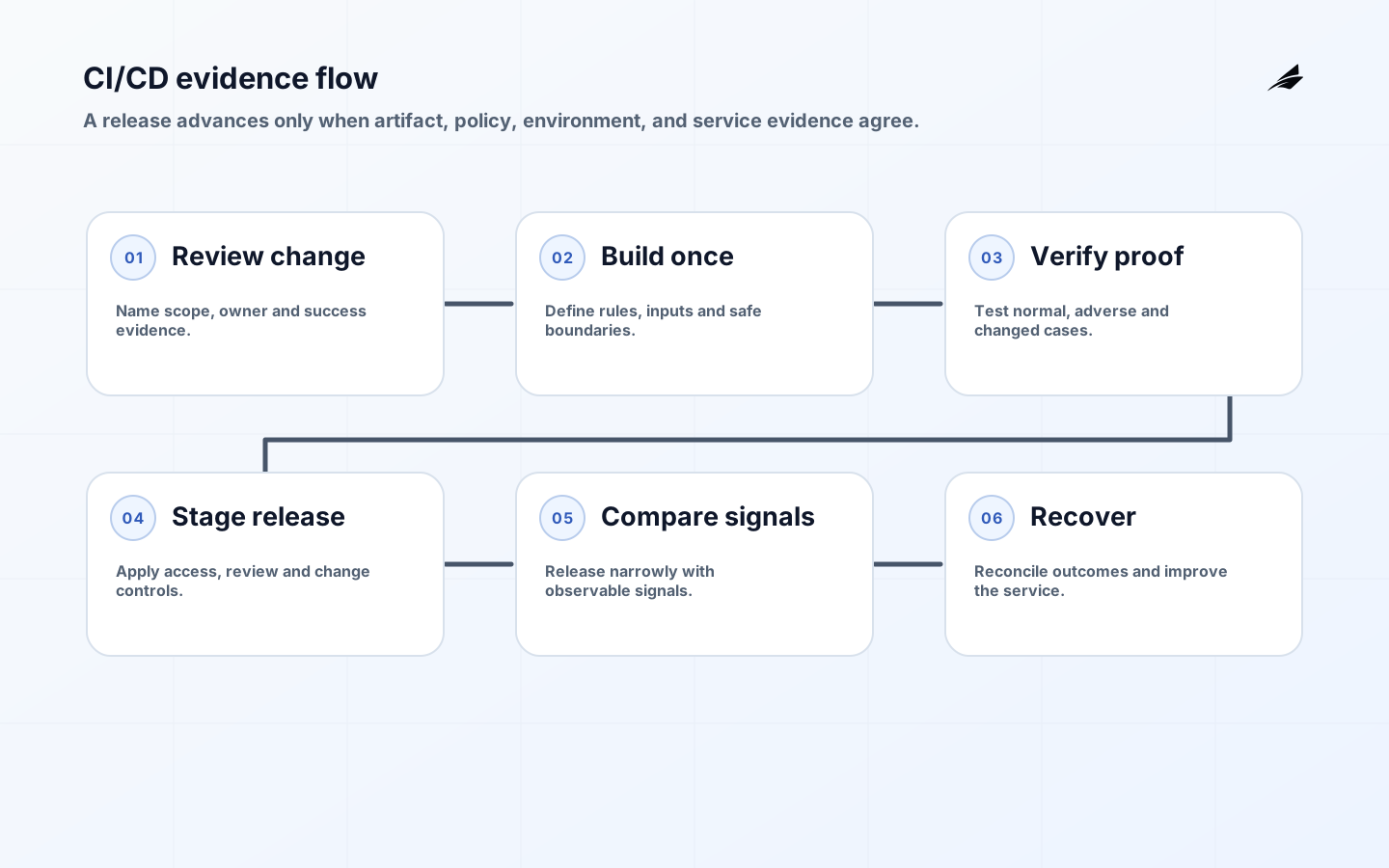
CI/CD pipeline best practices should make a release repeatable, attributable, and recoverable. The pipeline turns a reviewed change into an immutable artifact, applies verified configuration to a known environment, observes the customer result, and preserves enough evidence for another engineer to understand what happened. This matters once ad hoc scripts, environment drift, or developer-only knowledge make routine releases unpredictable and emergency fixes slow. A growing team does not need an elaborate internal platform on day one; it needs one supported route that protects the product's highest-consequence changes and makes exceptions visible. Treat delivery as part of the production service rather than a build server that ends at deployment. The incident response planning guide provides response context, while the rollback architecture guide and canary release review examine two containment techniques in depth.
Prove one release from commit to recovery
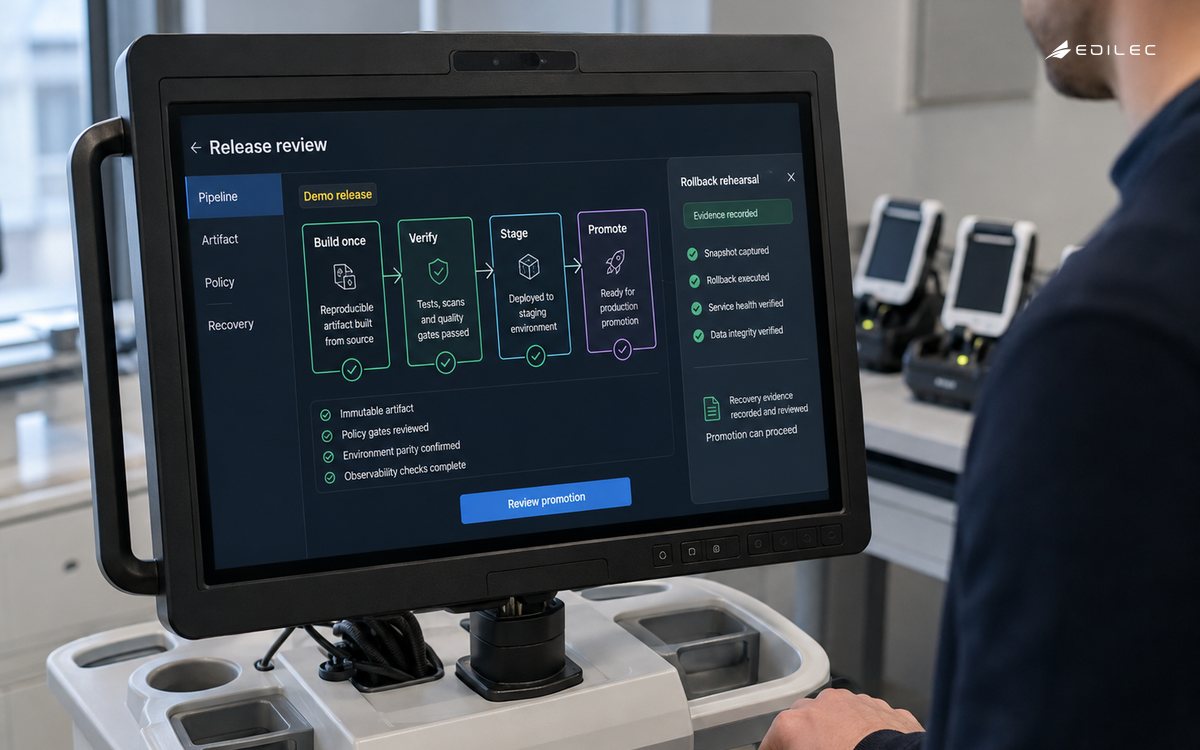
Reconstruct one release from reviewed commit through dependency lock state, build environment, tests, artifact identity, deployment policy, configuration, rollout cohort, service signals, and final disposition. Promote the same immutable artifact between environments instead of rebuilding for production. Rehearse rollback or roll-forward with compatible schema and configuration. An operator should be able to identify exactly what runs, why it was allowed, what users experienced, and how normal service was restored.
Use this review with the article tables and linked Edilec guides. Sample completed records as well as exceptions, retain the rule and source versions that produced each outcome, and assign every corrective action to a policy, data, interface, integration, security, or operating owner. Metrics indicate where to investigate; representative cases reveal what must change. Before scope expands, repeat the exercise with an unavailable dependency, a delayed message, an unauthorized user, and a correction after the nominal process has finished. This review is specific to software releases and service recovery.
- Build once from reviewed pinned inputs.
- Use short-lived environment identity.
- Retain test policy and provenance results.
- Test mixed-version schema compatibility.
- Compare canary and control outcomes.
- Measure rollback success and recovery time.
Key takeaways
- Connect each production deployment to a reviewed revision, reproducible artifact, configuration, and target environment.
- Choose pipeline gates for explicit risks such as secret exposure, dependency integrity, migration compatibility, and excess privilege.
- Evaluate rollout cohorts with both service telemetry and a product transaction that represents customer success.
- Practice pausing promotion, identifying affected releases, and restoring the service before making the path the organizational standard.
Set the purpose and boundary for CI/CD Pipelines
Draw the delivery boundary from source revision to verified production behavior. Identify separate inputs for application code, infrastructure definitions, dependency locks, database migrations, feature configuration, and secret references. Decide which stage compiles or packages them, where immutable artifacts live, which identity promotes them, and which environment supplies runtime configuration. The release record should connect commit, review, build provenance, artifact digest, policy results, deployment target, configuration version, and rollout outcome. Do not label a successful deploy as a successful release until a service or product check validates the intended journey. External registries, cloud control planes, test services, and approval systems remain dependencies; name their failure behavior and owner. This boundary lets responders determine whether to rebuild, redeploy, change configuration, pause promotion, or involve another team without guessing which unseen step altered production.
For a release path, state the customer result that must hold after deployment, such as a completed checkout, and name the technical and business signals that can stop expansion. The failure statement should say whether traffic, a feature, or a migration must be contained and who validates repair.
| Release element | Why it matters | Practical evidence |
|---|---|---|
| Immutable artifact | Prevents ambiguity about deployed code | Commit, digest, build time, and test result |
| Environment configuration | Separates code from target-specific settings | Reviewed revision and scoped secret reference |
| Rollback or repair route | Limits customer harm after a bad change | Tested traffic, feature, and data-reconciliation action |
Build an operating model for CI/CD Pipelines
Give service teams a paved release path and keep platform responsibilities explicit. The service owner defines health checks, rollout cohorts, dependency order, and customer recovery; the platform team maintains runners, artifact storage, shared templates, identities, and telemetry; security defines organization-wide checks and exception review. Routine promotion can be automatic when evidence meets policy, while higher-risk changes—privilege expansion, destructive migration, or regulated configuration—may require an accountable approval. Approval should examine the actual artifact and plan, not rebuild them afterward. Establish an emergency route with short-lived permissions, mandatory logging, and prompt review so responders can restore service without sharing credentials or bypassing every guardrail. Database evolution deserves its own sequence: introduce backward-compatible structures, deploy code that tolerates both forms, migrate and verify data, and remove the old form only when rollback no longer depends on it.
Use proportionate controls and retained evidence
Map each gate to a delivery risk. Protected review reduces unexamined source changes; hermetic or reproducible builds reduce hidden build inputs; dependency, license, and secret scanning expose known supply-chain hazards; signed provenance connects the artifact to its build; and workload identity limits what a deployment job can change. Test the deployed artifact rather than recompiling during promotion. Use environment-scoped, short-lived credentials and prevent pull-request code from reaching production secrets. Retain the policy result, artifact digest, destination, cohort, start and finish times, operator or approver where required, and observed rollout signals. A responder can then identify precisely which change reached an affected cohort and whether redeployment is safe. Recovery may mean disabling a flag, restoring configuration, or forwarding a fixed artifact rather than reversing binaries. See deployment rollback architecture for designing those choices before an incident.
| Change type | Release treatment | Stop condition |
|---|---|---|
| Stateless behavior | Deploy gradually and compare baseline | Customer error or latency deterioration |
| Schema expansion | Run old and new versions together | Reader or writer incompatibility |
| External side effect | Use idempotency and reconciliation | Duplicate, rejected, or missing business action |
Measure the service outcome and operating health
Measure both delivery flow and release safety. Lead time, deployment frequency, failed-promotion rate, change failure rate, and restoration time reveal how the path behaves; artifact traceability and rollback-exercise completion show whether recovery is supported. Tie rollout telemetry to revision and cohort, then pair technical indicators—error ratio, saturation, latency, queue age—with a product outcome such as paid checkout or completed file processing. Define automatic pause thresholds before release and make the service owner responsible for interpreting ambiguous changes. Median pipeline duration alone can hide long-tail queues that delay emergency patches, while a global error average can miss one region receiving the new revision. Review false alarms, undetected customer harm, and time spent diagnosing recent releases. Retire signals that never alter a decision and add evidence that shortened containment during real events.
Adopt CI/CD Pipelines in deliberate increments
Adopt the pipeline through one representative service and one real production path. Inventory its current commands, credentials, handoffs, tests, migrations, and rollback steps. First create an immutable build and release manifest; next automate promotion to a production-like environment; then add a limited production rollout with health-based pause. Keep the previous manual route available until operators have exercised the replacement and can explain its failure modes. Convert recurring service-specific steps into documented extensions rather than forks of the shared pipeline. Publish ownership and support hours for the reference path, plus a time-limited exception process for workloads it cannot yet serve. After a failed release or recovery drill, change the template, documentation, or service contract that allowed the confusion. Standardization earns adoption when it removes bespoke risk and shortens diagnosis, not when every repository happens to contain the same YAML.
Worked operating scenario
Suppose a subscription service changes entitlement calculation and adds a supporting database field. The pipeline creates one signed image, records its digest, tests old and new schema compatibility, and deploys the field addition before enabling new calculation code. Internal tenants receive the feature flag first. A reconciliation check compares granted entitlements with contracted plans and detects mismatches despite healthy HTTP metrics. The rollout controller pauses; the product owner disables the flag; engineering queries the release manifest and correlation IDs to identify affected accounts. Because the schema change was additive, the previous calculation can continue while the team corrects migrated records and adds the missed case to integration tests. Expansion resumes only after the business reconciliation is clean. This scenario proves more than automated deployment: artifact identity, migration ordering, cohort control, product monitoring, repair ownership, and a forward-compatible recovery path all operate together.
Run a readiness review for CI/CD Pipelines
Run readiness as a release reconstruction and recovery exercise. Select a recent production revision and ask an engineer who did not author it to locate the review, build provenance, artifact digest, configuration, migrations, target history, cohort signals, and final promotion decision. Verify that the artifact in production matches the recorded digest. Then inject a safe failure—an incompatible configuration, failing smoke transaction, or rollout threshold breach—and observe whether the pipeline stops further exposure. The service owner should choose the recovery action and demonstrate customer validation afterward. Record detection and containment time, missing access, unclear instructions, orphaned approvals, and any evidence available only from the original developer. Assign every correction and repeat the relevant portion after it lands. A pipeline is ready when unfamiliar responders can use its controls under pressure, not when its diagram and happy-path run look complete.
Frequently asked questions about CI/CD Pipelines
Do CI/CD pipelines require every change to deploy automatically?
No. Continuous integration means changes are integrated and tested frequently; delivery can still use a deliberate release decision. Automate evidence collection and the ordinary path, then apply proportionate review to regulated, stateful, or high-blast-radius changes.
What should be the first pipeline investment for a growing product?
Make the production artifact traceable to source and tests, then make deployment repeatable. Those two capabilities shorten investigation and prevent the common failure where the team cannot tell exactly what reached production.
What evidence should leaders ask for?
Leaders should request a trace from one production deployment: reviewed commit, build provenance, immutable artifact digest, policy results, environment and configuration, rollout cohorts, service and product signals, and the recorded recovery decision if something failed. Add evidence from a recent rollback or containment drill. This compact chain shows whether ownership and controls work together; a long list of pipeline features does not.
Conclusion
A reliable CI/CD pipeline connects a reviewed change to an identifiable artifact, a controlled rollout, and observable customer behavior. Build one supported path, apply gates that answer real risks, and rehearse containment with service owners. Delivery speed then comes from repeatable decisions and fast recovery—not from skipping the evidence needed to operate production safely.