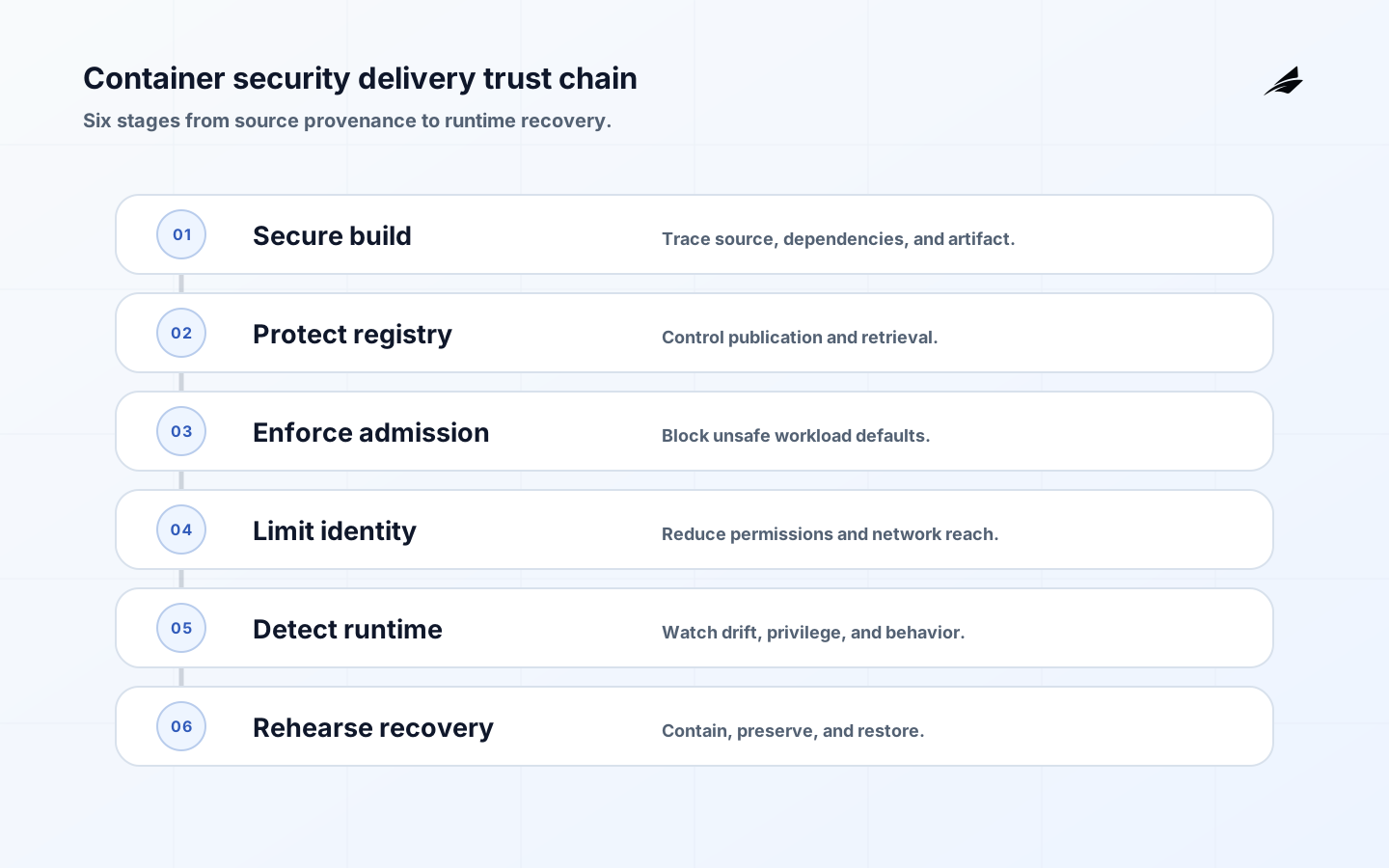
Container security is a chain of controls across source code, dependencies, build workers, registries, admission, runtime identities, network reachability, and incident response. Scanning an image once cannot prove that a running workload is safe: a privileged service account, mutable tag, exposed endpoint, or unpatched host can change the risk after the scan. The NIST Application Container Security Guide separates image, registry, orchestrator, and runtime concerns. Use that separation to map the actual path from source revision to running workload and assign controls to an owner who can operate them. See Docker images in production and container security for growing teams for adjacent image and runtime decisions.
Secure the image supply chain
Build from maintained base images, pin dependencies where practical, and produce an immutable artifact identified by digest rather than relying on a mutable tag. Run vulnerability and secret checks early enough for developers to repair findings, but prioritize by exploitability, exposure, runtime use, and available fix. Generate software inventory and provenance evidence where the build system supports it. Restrict registry publication, protect signing keys, and make a production deployment traceable to source, builder, dependencies, and approval. A clean scan is evidence about one moment and configuration, not a permanent safety certificate.
| Control point | Question | Evidence |
|---|---|---|
| Source and build | What code and dependency inputs produced the image? | Revision, builder, lock files, and build record. |
| Registry | Who may publish or pull the artifact? | Identity policy, digest, signature, and access log. |
| Admission | What must be true before the workload starts? | Policy result, exception owner, and expiry. |
| Runtime | What authority and reach does the process have? | Service account, capabilities, network paths, and events. |
Harden workload defaults
Prefer a non-root user, a read-only root filesystem where possible, dropped Linux capabilities, no privilege escalation, scoped service accounts, and explicit resource requests and limits. Apply baseline and restricted policy through tested templates and admission controls, not a document that teams may forget. The Kubernetes Pod Security Standards provide a concrete reference for workload settings. Make exceptions time-bound and reviewable. A privileged workload may be necessary, but it should be an explicit design decision with compensating controls and an owner.
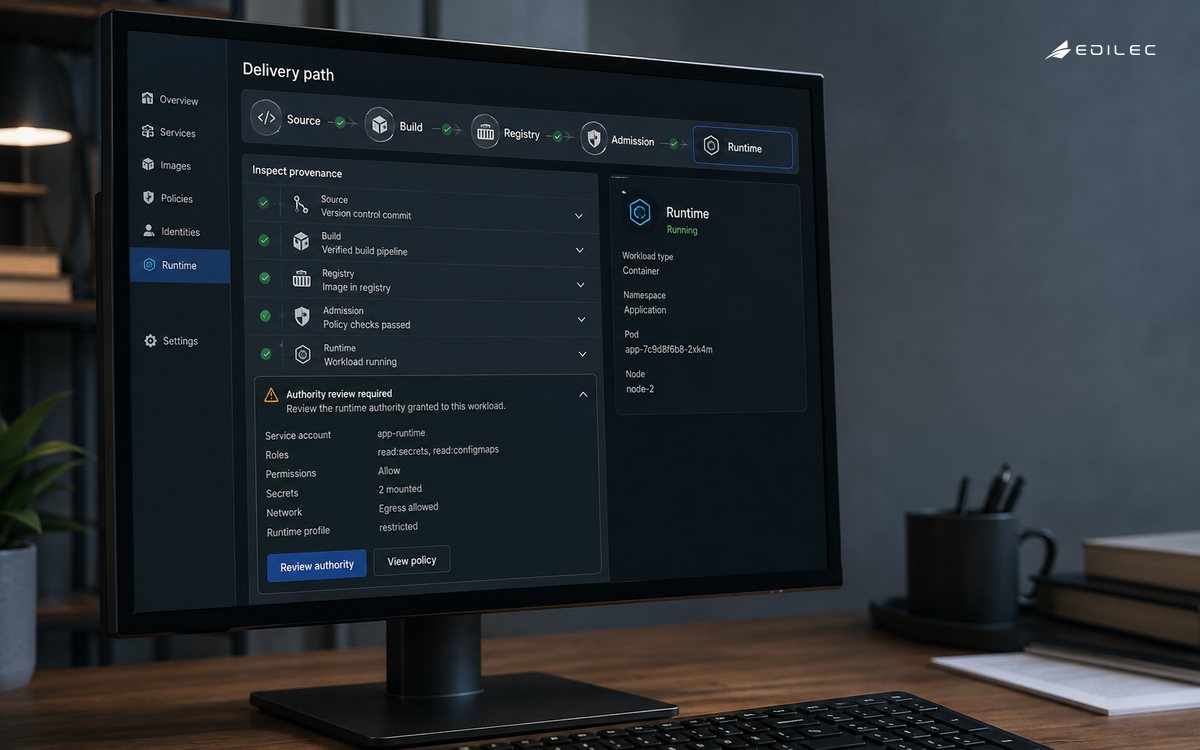
Separate application concerns from cluster-wide authority. A workload that only reads one service’s data should not inherit a broad platform identity. Verify namespace, pod, node, and cloud permissions together because a narrow Kubernetes role can still lead to a powerful external identity. Apply network policy to reduce reachable paths, but remember that segmentation does not fix a compromised application or stolen credential. The Kubernetes security checklist is useful for checking access, node, network, and control-plane concerns as a set.
Limit identity and network reach
Inventory what a workload can call, read, write, and administer. Start with normal connections and expected destinations before enforcing a restrictive rule, so the team can distinguish an unneeded path from an undocumented dependency. Use short-lived credentials, rotate long-lived material, and avoid mounting secrets into every container by default. Log authentication, authorization denials, policy changes, image changes, and privileged operations with enough context for review. Keep network controls near the resource boundary and test them from the workload’s actual identity rather than from an administrator session.
| Exposure | Typical failure | Practical control |
|---|---|---|
| Process privilege | A compromised process changes the host or other workload. | Non-root, dropped capabilities, and no escalation. |
| Service identity | The workload reads or mutates unrelated resources. | Least-privilege role, scoped token, and review. |
| Network path | Unexpected lateral movement or data access. | Default-deny policy with tested required flows. |
| Administration | Emergency access becomes permanent and opaque. | Protected channel, time bound, and audit record. |
Detect and respond at runtime
Collect evidence for unexpected process execution, privilege changes, image drift, anomalous network use, failed admission, and identity behavior. Prioritize signals tied to material action rather than alerting on every debug event. During containment, isolate the workload or revoke its identity while preserving the image digest, manifest, configuration, event timeline, and relevant logs. The OWASP Kubernetes Security Cheat Sheet offers a useful cross-check for cluster hardening and response. Practice the path before a live event determines whether the evidence is available.
Make security operable for delivery teams
Controls last when they fit the normal delivery path. Provide maintained base images, clear severity and exception criteria, named remediation owners, and fast feedback in pull requests or builds. Track the age of critical findings, privileged workload count, image provenance coverage, policy exception expiry, and runtime control failures. Review trends with product and platform owners so security work can compete fairly with feature work. A policy that blocks without a workable repair route creates shadow processes; a policy that explains the next action improves both security and release quality.
Run the container security control exercise
Choose one high-risk service and trace it from source revision to registry digest, admission decision, workload identity, network policy, runtime signal, and recovery action. Test a denied deployment, a revoked credential, a quarantined workload, and a return to a known approved version in a noncritical environment. Ask whether the operator can identify what ran, stop new replicas, retain evidence, and restore service without bypassing every control. Link the exercise to the secrets management checklist and canary review when delivery exposure is part of the threat model.
Make the secure default easy to inherit. Maintain approved base images, example workload policies, registry rules, and identity templates close to the delivery workflow. Tell teams what the default protects, what it does not cover, and how to request an exception. A central security team should measure adoption and repair time, not only count violations. When a shared control changes, publish the migration evidence and give owners a safe test environment. This boundary belongs in the service review record.
Treat vulnerability findings as a prioritization conversation. A severe package in an unreachable build tool does not have the same immediate consequence as an exploitable library in an internet-facing service, though both deserve ownership. Record exposure, compensating controls, fix availability, and expiry for accepted risk. Recheck after image rebuilds and runtime changes because context can turn a low-priority finding into a material one. This boundary belongs in the service review record.
Do not forget the host and control plane. Workload hardening reduces application privilege, while node patching, API access controls, admission security, and backup protection address other layers. Review where a container can cross a boundary and which team can revoke that path. The strongest container security checklist is a set of cooperating controls with a tested escalation route, not a single scan or policy profile. This boundary belongs in the service review record.
After a security event, compare the actual response with the intended path. Was the digest available, did identity revocation take effect, did network isolation work, and could the team restore an approved artifact? Preserve the answers with the workload owner and platform team. Each exercise should close one practical gap, such as a missing audit field, an overbroad role, or a runbook that assumes access no responder has. This boundary belongs in the service review record.
Maintain a secure container baseline that delivery teams can inherit without copying policy by hand. Keep approved base images, workload examples, registry rules, and identity templates versioned near the build path. Explain what each default protects, what it cannot cover, and how an owner requests an exception with an expiry and compensating control.
Prioritize vulnerability findings with deployment context. A severe package in an unreachable build tool does not carry the same immediate exposure as an exploitable library in an internet-facing service, though both need ownership. Recheck after image rebuilds and runtime changes because reachability, privilege, and network placement can turn a low-priority finding into a material one.
Container hardening is only one layer of the boundary. Workload privilege, node patching, API access, admission security, network policy, and backup protection should have separate owners and evidence. Review where a container can cross a boundary and which team can revoke that path; a secure image cannot compensate for an overbroad cluster identity.
After a security event, compare the actual response with the intended path: confirm the digest, identity revocation, network isolation, and restoration of an approved artifact. Close the exercise only when it exposes a practical gap, such as a missing audit field, an overbroad role, or a runbook that assumes access no responder has. Record the repair and retest the path.
Key takeaways
- Secure the full path from source and build to registry, admission, runtime, and response.
- Deploy immutable, traceable artifacts and distinguish scans from ongoing runtime controls.
- Use least privilege for processes, service identities, network paths, and administrators.
- Make policy exceptions explicit, time-bound, owned, and observable.
- Preserve evidence during containment so response does not erase learning.
- Give delivery teams maintained defaults and actionable remediation feedback.
Frequently asked questions about container security
Do we need to fix every image finding immediately? Prioritize by exposure, exploitability, severity, and fix availability, then document residual risk. Can a container run as root? Sometimes, but the need should be explicit and compensated. Are network policies enough? No; combine identity, workload hardening, artifact controls, and runtime evidence. Is signing an image sufficient? No. It improves provenance and integrity, while admission and runtime controls address how the artifact is used. Who owns remediation? The service team owns its workload risk, supported by platform and security teams for shared controls.
Conclusion
Container security becomes manageable when each stage has a purpose, owner, and evidence trail. Harden artifacts and workloads, minimize runtime authority, control network reach, and rehearse response. The goal is not an impressive scan report; it is a delivery path in which unsafe state is harder to introduce, easier to detect, and possible to contain without losing the facts needed to improve.