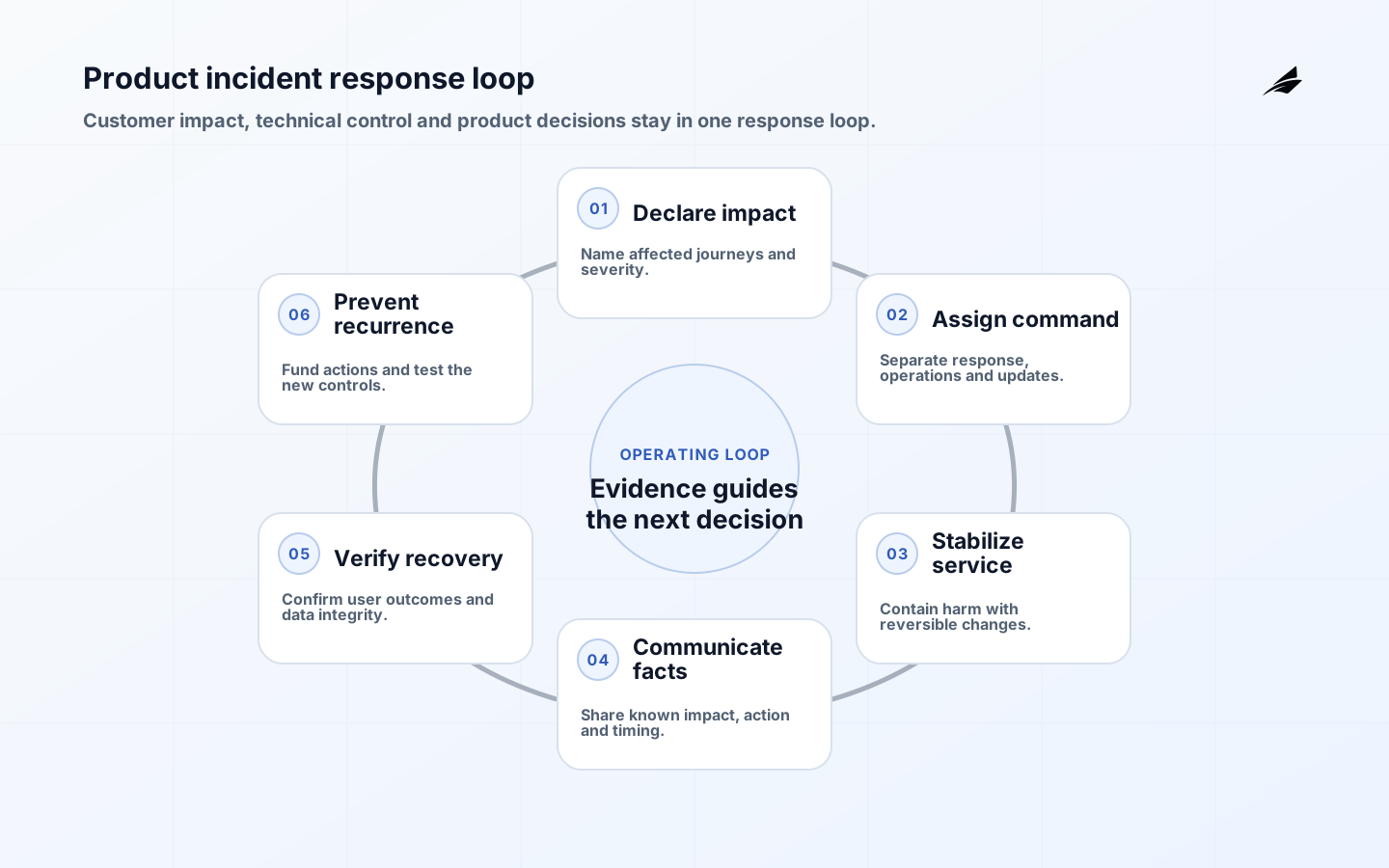
Incident response for product teams begins with customer impact and ends only when recovery is verified and prevention work is owned. Product managers are not substitutes for incident commanders or security responders. They contribute journey context, decision priorities, customer communication and the authority to trade feature work for reliability. That role deserves preparation before the alert arrives.
Edilec's cloud incident response planning guide covers core readiness. Pair it with deployment rollback architecture and backup and restore operations so the product response is backed by tested technical recovery, not optimistic status updates.
Key takeaways
- Declare based on credible impact and uncertainty; do not wait for a complete diagnosis.
- Separate incident command, technical operations, investigation and communication roles.
- Track affected journeys, populations and data integrity alongside infrastructure symptoms.
- Stabilize with reversible actions and verify recovery from the customer's perspective.
- Give post-incident actions owners, deadlines and product capacity.
Prepare around critical customer journeys
List journeys whose failure creates material customer, legal, financial or safety impact: sign-in, checkout, payment, clinical access or account recovery, for example. Map service owners, dependencies, data stores, vendors, rollback paths and business contacts. Define service indicators and impact thresholds. A product team should know which degraded functions can be disabled and which require immediate escalation.
The current NIST SP 800-61r3 integrates incident response across all six NIST Cybersecurity Framework functions and supersedes revision 2. Use that broader lifecycle: governance, asset knowledge, safeguards and recovery preparation influence response quality long before detection. Security incidents also need legal, privacy and evidence-preservation paths that ordinary availability incidents may not.
| Prepared artifact | Product contribution | Operational owner | Exercise question |
|---|---|---|---|
| Severity model | Customer and business impact thresholds | Incident management | Would two teams classify the same case alike? |
| Journey map | Critical users, states and alternatives | Service owners | Can responders identify affected transactions? |
| Communication plan | Audience, channels and approval path | Communications lead | Can an update ship in 15 minutes? |
| Recovery catalog | Acceptable degradation and priorities | Engineering | Are rollback and restore actually tested? |
| Decision log | Product trade-offs and assumptions | Incident commander | Can later reviewers reconstruct choices? |
Declare early and size impact honestly
Declare when credible evidence shows material impact or an unresolved condition could become material. Declaration creates coordination; it is not a verdict on cause. Record start time, detection source, affected journeys, observed regions or cohorts, data-integrity concern, current mitigation and uncertainty. Use a conservative severity until evidence supports changing it.
Count failed or delayed customer outcomes, not only error rates. A small percentage can represent every user in one market or every high-value payment. Check support contacts, synthetic journeys, business events and external reports. Preserve raw telemetry and the timeline. Avoid changing dashboards or deleting noisy evidence during the response unless the change itself is logged.
Establish command and decision rights
Assign one incident commander who coordinates objectives and decisions. A technical operations lead runs mitigation; investigators develop hypotheses; a communications lead produces updates; a scribe keeps the timeline. Product supplies impact interpretation, degraded-mode priorities and customer-policy decisions. Combining all roles in one expert creates a bottleneck and makes strategic decisions compete with terminal work.

Set a short operating cadence: current impact, changes since last check, active hypotheses, mitigation status, risks and next decision. Use one incident channel and one source of truth. The CISA incident response playbook is written for federal cybersecurity response, but its explicit phases, coordination and completion checklists illustrate the value of pre-agreed roles and records.
Stabilize with reversible product choices
Prefer mitigations that reduce harm quickly and can be undone: stop a rollout, disable a feature flag, route traffic, rate-limit an abusive path, move to read-only mode or pause a workflow. State the expected effect and rollback condition before acting. Multiple uncoordinated changes destroy diagnostic clarity. For suspected compromise, follow security authority on containment and evidence preservation.
Product decisions may include prioritizing existing customers over acquisition traffic, suppressing a broken notification, waiving a fee or disabling a nonessential capability. Record who authorized each decision, affected users and follow-up obligation. A degraded mode is successful only if customers understand its limits and data created during it can later be reconciled.
| Response stage | Product question | Evidence to retain | Exit condition |
|---|---|---|---|
| Detect | Which journey appears harmed? | Alerts, reports and business events | Impact credible enough to declare |
| Contain | What can be limited safely? | Decision and change timeline | Harm is no longer expanding |
| Recover | Which functions return first? | Rollback, restore and reconciliation results | Critical journeys work |
| Communicate | What can customers act on? | Published updates and approvals | Normal update path resumes |
| Close | What residual risk remains? | Monitoring and owner acceptance | Recovery is sustained |
Communicate facts customers can use
Publish early acknowledgement when the issue is material. State affected functionality, observed start time, what customers may experience, safe workaround if verified and next update time. Separate known facts from investigation. Avoid premature root-cause claims and vague assurances. Keep internal, status-page, support and account-team messages aligned from one approved fact set.
Update on schedule even when diagnosis has not changed. Explain material change, current impact and next action. Do not expose sensitive investigative details or customer data. Give support agents approved language and escalation routes. After recovery, correct earlier estimates transparently. Product owns clarity about user experience; legal and security owners determine notification duties.
Verify recovery and reconcile customer state
A healthy CPU graph does not prove customer recovery. Run critical synthetic and real transaction checks, confirm queues drain, verify payment or order state, inspect data consistency and sample affected cohorts. Watch for retry storms and delayed notifications. Keep the incident active through an agreed observation window and communicate any residual limitations.
Reconcile work performed during degradation: duplicate orders, delayed jobs, stale permissions, failed webhooks and manual support actions. Assign compensation and customer follow-up. The Google SRE incident management guide emphasizes learning and connecting action items to reliability priorities; closure without tracked residual work simply moves incident cost into normal operations.
Turn the review into funded prevention
Write a blameless review using the information available to people at the time. Include impact, detection, timeline, contributing technical and organizational conditions, response effectiveness and what made recovery harder. Google SRE's postmortem culture guidance recommends official ownership and broad learning. Avoid reducing a complex event to one person's mistake or one root cause.
Create actions that change systems: add a tested safeguard, reduce dependency coupling, improve an alert, rehearse a restore, clarify authority or remove a dangerous default. Give each an owner, due date and verification method. Product leadership must reserve capacity and review overdue high-risk actions. Track recurrence and action effectiveness across incidents, not merely document completion.
Worked example: duplicate checkout charges
Support reports several customers seeing two pending card charges after checkout. The team declares a high-severity incident because financial impact is plausible even though application error rate is modest. Product identifies affected payment journeys and markets; the commander assigns payment operations, investigation, communications and timeline roles. The first message acknowledges duplicate pending charges and gives a next-update time without promising when banks will release them.
Investigators find retries after a gateway timeout. The team disables automatic payment retries behind a feature control and keeps checkout available with a clear retry message. It preserves gateway identifiers and avoids refunding every authorization blindly, which could create additional transactions. Finance and payment-provider contacts confirm how pending and captured charges should be distinguished.
Recovery verification joins orders, internal payment attempts and gateway state. Product defines customer cohorts for proactive communication and fee remediation. Support receives a lookup procedure and avoids asking customers to place another order. The incident remains open until new checkouts succeed, retry queues are reconciled and no unexplained captured duplicates remain.
The review identifies missing idempotency enforcement, an alert based only on failed requests and an unclear product decision for degraded checkout. Actions add a payment key constraint, a duplicate-authorization signal, a gateway-timeout runbook and a tested customer-message template. Leadership funds the work before the next conversion experiment, turning the incident into a changed control rather than a cautionary document.
The product owner also reviews cohort impact: customers who retried, customers whose orders failed, and customers who contacted support. That analysis drives targeted remediation and reveals whether mobile, region or payment-method groups experienced different harm. The incident dashboard is retained with definitions so later trend analysis compares like with like rather than relying on a memorable headline number.
Product incident readiness checklist
- Critical journeys, severity thresholds and decision owners are current.
- Commander, operations, communications and scribe roles are practiced.
- Status updates have channels, templates and approval paths.
- Degraded modes, rollback, restore and reconciliation are tested.
- Customer-impact telemetry complements infrastructure monitoring.
- Review actions compete visibly for product capacity.
Frequently asked questions
When should a product team declare an incident?
When observed or plausible impact requires coordinated response beyond routine handling. Declaration can be downgraded later; waiting for certainty often increases harm and loses evidence.
Should the product manager command the incident?
Only if trained and assigned. Usually product provides impact and priority decisions while a practiced incident commander coordinates the response.
When is an incident closed?
After critical journeys are verified, recovery remains stable, data reconciliation is owned, communication is complete and residual risk is accepted. Root-cause analysis may continue afterward.
Conclusion
Incident response for product teams protects the customer journey through fast declaration, clear command, reversible stabilization, useful communication and verified recovery. The product role continues after restoration by funding the controls that make recurrence less likely and the next response less chaotic. Practice those decisions in exercises that include support, communications and data reconciliation, not only infrastructure failover. Customers experience the whole service boundary, so readiness must cross it too, with clear authority and tested evidence at every stage.