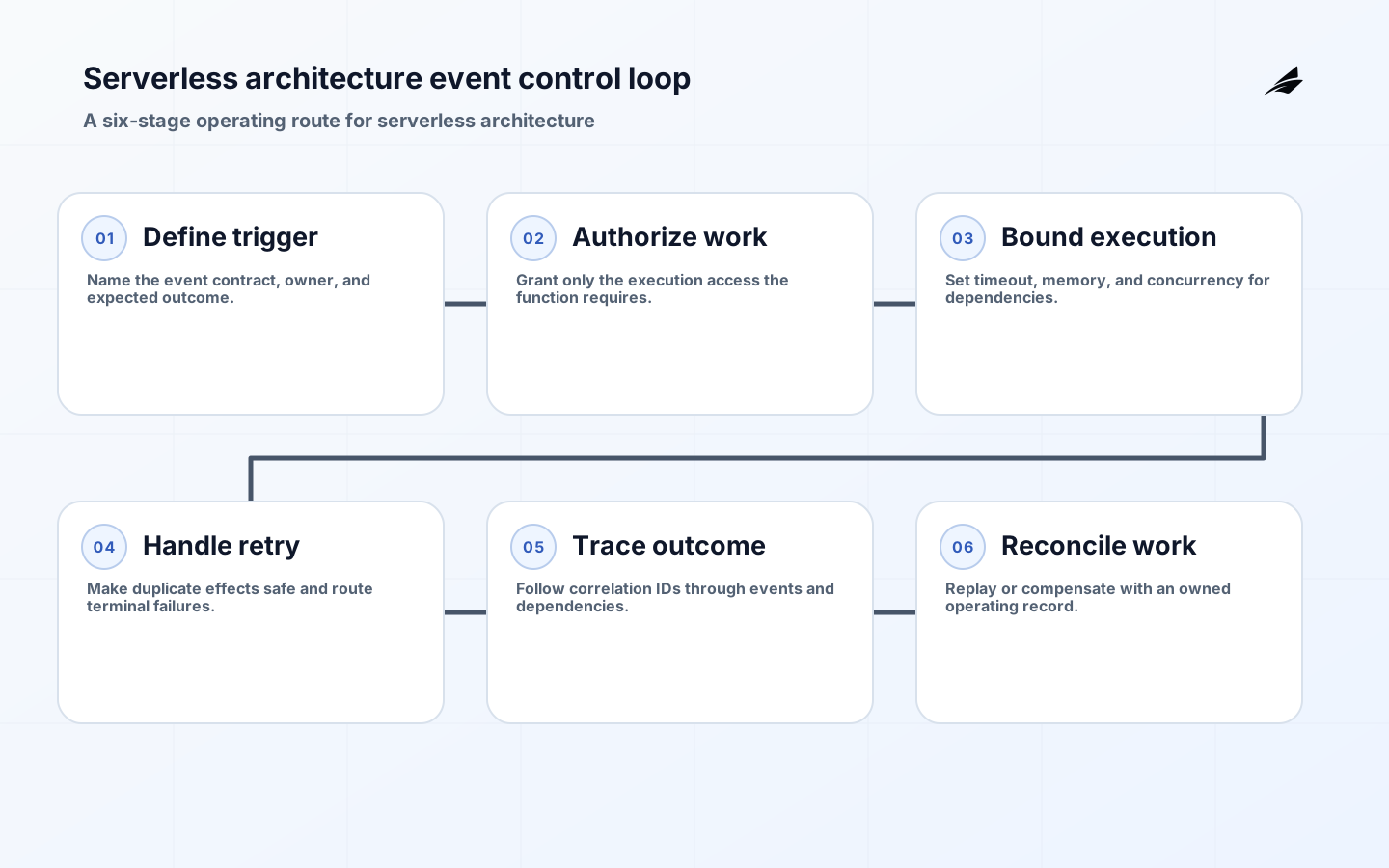
Serverless architecture needs an operating model, not a loose collection of tools. Serverless architecture moves infrastructure provisioning and much of runtime scaling behind a managed execution service, but it does not remove design responsibility. The application still needs clear event contracts, permissions, state boundaries, failure handling, and cost limits. The useful question is not whether a function is small; it is whether the complete request or event path remains understandable when it fails. This guide focuses on the choices that make the work inspectable by the people who build, operate, and support it.
Key takeaways
- Define the boundary and accountable owner before standardizing serverless architecture.
- Keep the records that explain an outcome close to the action that created it.
- Use controls that match the consequence of failure instead of copying generic checklists.
- Test an uncomfortable but realistic failure path while impact is bounded.
- Measure recovery and operating effort alongside speed or throughput.
- Turn repeated exceptions into an owned improvement rather than private knowledge.
What serverless architecture means in practice
A function may be invoked synchronously, asynchronously, or from a polling source. Those invocation models create different retry, acknowledgement, and duplicate-delivery behavior. Stateless execution does not make the workflow stateless: durable records, queues, object stores, and third-party APIs still carry the business state and need an explicit ownership and reconciliation model. For adjacent operating decisions, compare GitOps and distributed tracing.
| Decision area | Question to settle | Useful evidence |
|---|---|---|
| Boundary | What part of serverless architecture is in scope? | Named owner, entry point, and expected outcome. |
| Identity | Which version, record, or state is authoritative? | An inspectable identifier tied to the action. |
| Control | What condition must hold before expansion? | A test, review, or policy result with a decision rule. |
| Recovery | How will the team verify a safe outcome? | A documented action, check, and accountable responder. |
An operating model for serverless architecture
Define the trigger, payload schema, identity, timeout, memory, concurrency limit, downstream dependencies, and failure destination for each function. Put idempotency where retries could repeat an effect, such as charging a card or sending a message. Use a queue or durable event boundary when work may outlive a request, and record a correlation identifier that follows the work across functions and services. The design should make the next decision easier for someone who did not create the original implementation.
A practical implementation path
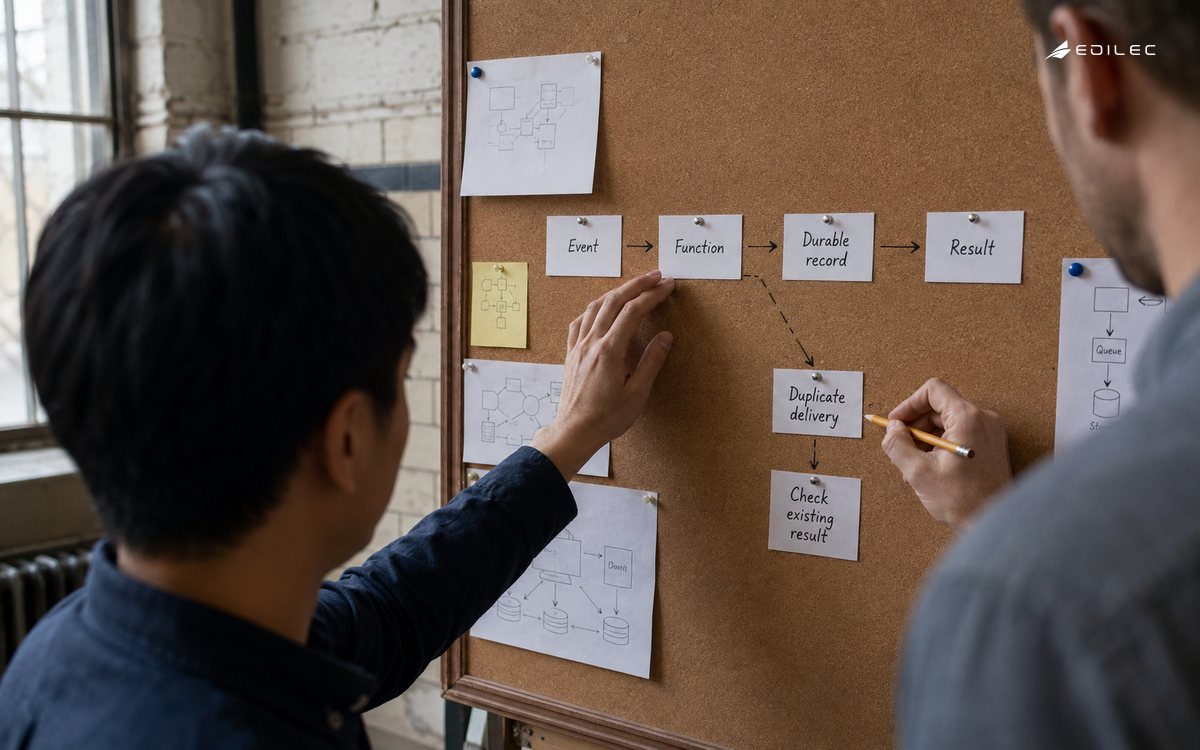
Start with one narrow event path and make the failure route visible before adding fan-out. Set a timeout that leaves time for the platform to report failure, cap concurrency when a downstream system has finite capacity, and choose dead-letter or on-failure handling that an operator actually monitors. Load-test cold starts and downstream throttling with realistic payload sizes rather than a trivial hello-world function. Prefer a sequence that creates evidence at every stage rather than a broad first release that makes causality difficult to recover.
Risks and controls to make explicit
The most expensive mistake is an unbounded feedback loop: retries, fan-out, or a malformed event can multiply invocations and writes. Another is assuming an asynchronous invocation succeeded because it was accepted. Monitor delivery failures and age of queued work. Least-privilege execution roles matter because an event processor often has access to sensitive stores it does not need to administer. Write the exception route down as well: an emergency action may be necessary, but it should leave an attributable record and return to normal control once the immediate condition is resolved.
| Stage | What to check | Decision rule |
|---|---|---|
| Prepare | Scope, identity, access, and prerequisites. | Do not proceed when ownership or required evidence is unclear. |
| Change | The control that addresses the main failure mode. | Pause when a required test, policy, or review fails. |
| Observe | Technical and user-facing consequences. | Expand only when the agreed signals remain inside bounds. |
| Recover | State, data, and follow-up work. | Close only after the relevant verification is recorded. |
Signals that show whether it is working
Track invocation count, error rate, duration percentiles, throttles, concurrent executions, retry count, dead-letter arrivals, queue age, and downstream error codes. Pair these with unit economics such as cost per completed business action. A low average duration can hide a small number of timed-out items that customers experience as missing work, so inspect distributions and failure destinations. Review the signals with a real example, because a metric becomes useful only when it changes a decision or confirms that an earlier decision was sound.
A serverless architecture checklist for the next change
Choose a duplicate event and a deliberately slow dependency as acceptance tests. The function should either perform the effect once or record a safe no-op, and it should exhaust retries into a destination that is visible to an owner. This exercise is more revealing than measuring only the happy-path latency of a single invocation. The result should be a short, owned change to the routine, not a retrospective statement that the team should have been more careful.
A worked decision example
An order event triggers inventory reservation, notification, and analytics functions. A retry after a network timeout sends two notifications because the notification function has no idempotency key. The fix records the order-event identifier with the notification action, makes the side effect conditional, limits fan-out concurrency, and places failures in a queue with an alert and a replay procedure.
How to phase adoption
Phase serverless architecture through a single event path with bounded impact. Document the producer, payload schema, execution identity, downstream dependency, retry rule, and terminal failure destination before adding another consumer. Start with low concurrency and an observable queue or event log, then raise limits only after a realistic load test proves the downstream system can cope. This sequence avoids a common trap: scaling an invocation source faster than the data store, vendor API, or support process can recover.
Decision records and ownership
Maintain a decision record for each function that names the trigger, idempotency key or duplicate policy, timeout, memory setting, concurrency ceiling, permissions, data classification, and owner of failed work. Link it to the dashboard and replay or compensation routine. The record is especially useful after a partial failure, because a successful retry count does not prove that every business effect occurred once. It gives the team a common way to distinguish a platform failure from an incomplete workflow.
Design boundaries that matter
Choose the event boundary before choosing the function count. A request that needs an immediate customer answer should fail or degrade within a clear response contract; work that can complete later should move through a durable queue or event stream with its own acknowledgement and monitoring rules. Mixing those models often creates a function that waits synchronously for slow downstream work and then retries after the caller has already timed out. State the expected completion path, maximum delay, and user-visible status for every event-driven workflow. That makes latency, retry, and compensation choices understandable to both product and operations owners.
Deeper operating considerations
Cost control in serverless systems is mainly a behavior problem. Invocation charges, duration, payload transfer, retries, logs, and downstream writes can all grow when an input pattern changes. Set concurrency ceilings and budgets where the platform allows, but also instrument completed business actions and failed attempts so the team can see a multiplier developing. A queue that grows slowly, a handler that retries an invalid event, or a fan-out that creates unnecessary writes should be corrected in code and policy. Billing data is most useful when it is connected to the workload and event pattern that created it.
A useful review cadence
Review one successful asynchronous flow, one duplicate delivery, and one exhausted retry on a regular cadence. Check the queue age, failure destination, correlation context, and the operator path for replay. Use the results to tune timeouts and limits rather than relying on vendor defaults. A mature serverless system makes delayed or failed work visible enough that it can be repaired deliberately, instead of treating the absence of an immediate error as proof of completion.
Frequently asked questions
Serverless architecture can reduce operations work for bursty or event-driven workloads, but long-running, low-latency, or connection-heavy services may fit another runtime better. A function timeout is not a recovery strategy. Decide what happens to partially completed work, where failed events go, and how an operator can safely replay or compensate for them.
Before expanding the practice
Before adding more functions, inspect the ownership boundary around data and events. A team should know which component validates a payload, which system owns the durable record, and which handler is permitted to create an external effect. Avoid using the event stream as an undocumented database of mutable truth; schemas evolve, consumers arrive late, and replay can repeat work. Version event contracts, make compatibility expectations explicit, and retain enough context to diagnose a past event without storing unnecessary sensitive data. These choices make serverless systems easier to evolve because a new consumer can be introduced deliberately instead of relying on assumptions hidden in the first producer.
A final field test
Field test: submit one duplicate event and one invalid payload, then verify the external effect, failure destination, and operator record. The event path is ready only when each outcome has an explicit owner. Record the observed result and the next corrective action before adding new consumers.
Conclusion
Serverless architecture works best when events, retries, and responsibility are designed as one system. Bound concurrency, make duplicate handling intentional, and keep the failed-work path as observable as the successful one.