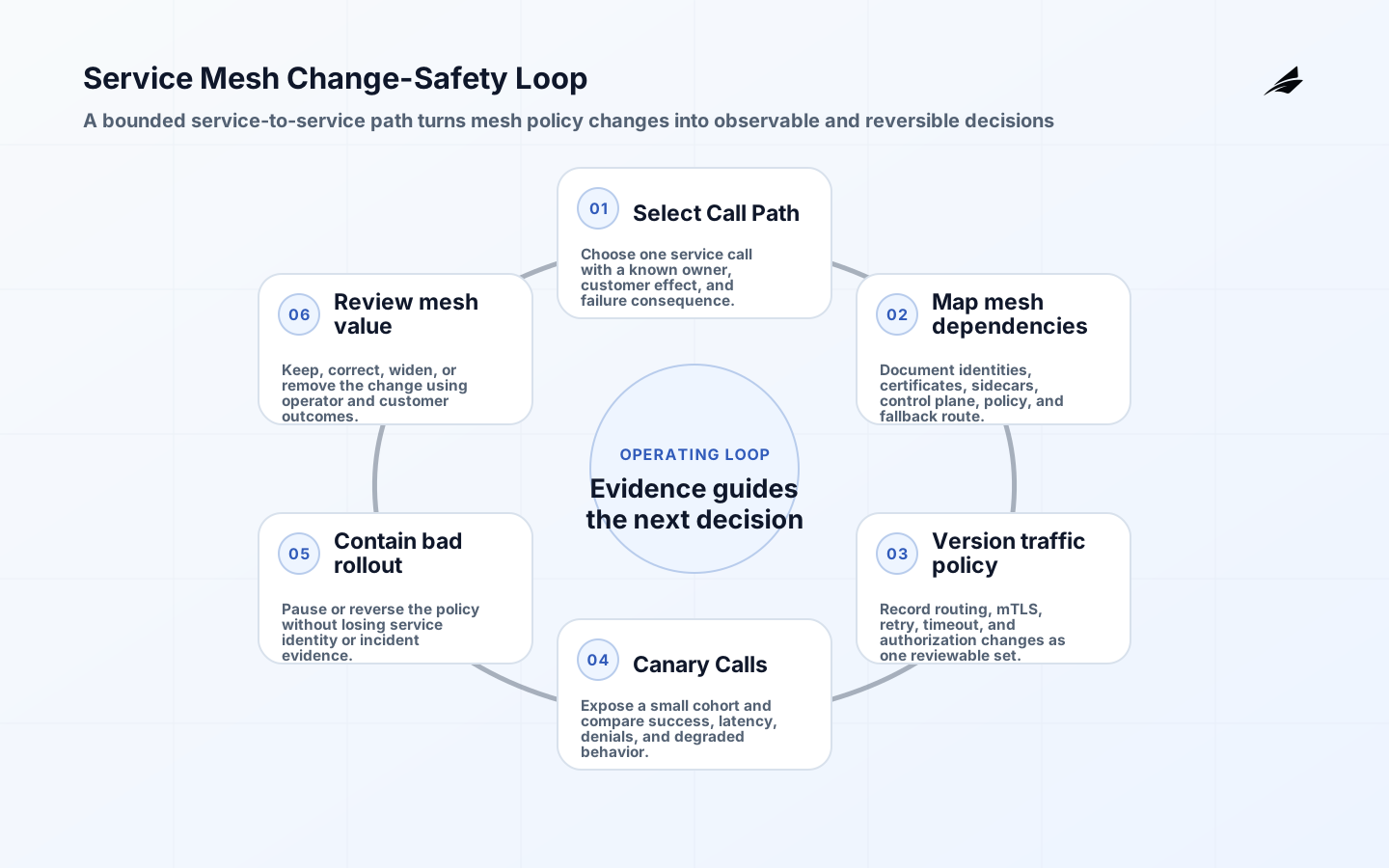
A service mesh adds a shared layer for service-to-service communication. Depending on the implementation, it can provide workload identity, mutual TLS, authorization, traffic shaping, retries, telemetry, and other cross-cutting behavior. For a CTO, the decision is architectural and operational: does the organization have a recurring communication problem that deserves a platform layer, and can teams operate that layer when it is degraded? A mesh is valuable when it reduces duplicated risk and makes important behavior visible. It is a poor fit when it adds control-plane complexity without solving a problem that application libraries, gateways, or existing cloud services cannot handle well.
Identify the cross-service problem first
List the concrete problems behind the proposal: inconsistent service authentication, unclear authorization, unreliable retries, difficult traffic experiments, missing request correlation, or policy that must span many clusters. For each problem, document its current owner, failure cost, and simpler alternative. A mesh should earn its place by improving a defined path, not by offering an attractive feature list. Start with a small set of services that share a stable dependency and whose owners are willing to test policy, latency, certificate rotation, and recovery. Keep workloads with unusual networking, strict latency, or special protocol needs in the initial boundary only when the team can explain how they will be supported.

Model the data path and control plane
Draw the path a request takes through sidecars or other data-plane components, DNS, load balancing, gateways, policies, certificates, and telemetry. Then draw the control path that distributes configuration and trust. Decide what happens when the control plane cannot update a proxy, when a certificate is close to expiry, or when a policy is malformed. Existing traffic may continue, fail closed, or fail open depending on the design; the CTO should require that behavior to be known and tested. The control plane is not the same as the request path, and a healthy dashboard does not prove that every workload is enforcing the intended policy.
| Decision area | Working rule | Evidence to retain |
|---|---|---|
| Identity | Give each workload an explicit trust identity. | Certificate and identity mapping. |
| Authorization | Express service intent narrowly. | Policy version and decision event. |
| Traffic | Bound retries, timeouts, and routing changes. | Request-path experiment result. |
| Operations | Keep failure and rollback behavior visible. | Runbook and exercise record. |
Design identity and authorization together
Encryption protects a connection, but it does not decide whether one service should call another. Establish how workloads receive identity, how trust is established across clusters or environments, and how identity changes are revoked. Write authorization in terms of service identity, route, method, environment, and data consequence where the system supports that distinction. Avoid a broad allow rule that merely moves network access into a different configuration file. Keep policy ownership close to the people who understand the business interaction, with platform support for the common mechanics. A denied call should expose enough context for the service owner to fix or request review without weakening the default.
Control traffic without amplifying failure
Traffic policy needs application context. A retry that is safe for an idempotent read may duplicate a payment or update. Timeouts should reflect dependency behavior and user expectations rather than a universal value. Route changes should be staged, observable, and reversible. Define the conditions for a circuit breaker and the signal that tells an operator whether it is protecting the system or hiding a deeper defect. Compare mesh behavior with application-level resilience so the two layers do not retry the same request. The service owner remains accountable for correctness even when the mesh supplies a common mechanism.
Make observability useful to service owners
Mesh telemetry should help someone decide what to do. Correlate request identity, source and destination workload, route, response class, latency, policy decision, and deployment context while respecting data protection and retention requirements. Keep a distinction between traffic that a proxy observed and traffic that the application actually completed successfully. Give on-call engineers a query or dashboard that starts from a customer symptom and reaches a responsible service. If operators need a mesh specialist to interpret every signal, the platform has not yet become an operational capability.
| Scenario | Expected response | Verification |
|---|---|---|
| Policy change | Review, stage, observe, and roll back if needed. | Owner explains the decision. |
| Certificate rotation | Rotate trust without an avoidable outage. | Old trust retires visibly. |
| Proxy failure | Degrade according to the documented data path. | Impact and recovery are known. |
| Upgrade | Test compatibility before broad rollout. | Rollback route is viable. |
Test change and failure before expansion
A serious pilot denies a legitimate dependency call, introduces a slow upstream, rotates trust material, changes a route, and makes a data-plane component unavailable. Observe whether the event is actionable, whether the policy can be rolled back, and whether customer behavior matches expectations. Test both a controlled application and a workload with a meaningful dependency chain. Benchmark the path under normal and degraded conditions in an environment that resembles production. Generic latency claims are less useful than evidence from the actual protocol, traffic shape, cluster network, and workload limits.
Build the operating model before the mesh
Name who owns the control plane, data-plane upgrades, policy review, certificate lifecycle, telemetry cost, and incident escalation. Separate authority to observe, change, approve, and override. A service team needs a fast path for routine policy work; a material exception needs context and a durable decision. Define how external services, batch jobs, multi-cluster traffic, and emergency access are represented. Budget for training and support as well as compute. Revisit the choice as managed platform features improve. A mesh should have an exit criterion: if the shared layer no longer reduces risk or repeated application work, the organization can narrow or retire it safely.
Make adoption a staged architecture decision
Set a clear pilot boundary before enrolling a large fleet. Choose services with owners who can describe the dependency contract, accept a policy change, and participate in an incident exercise. Define what success would look like, such as a narrower authorization rule, faster diagnosis, or less duplicated resilience code. Define the stop condition as well: unacceptable latency, confusing failure behavior, excessive support demand, or a control that application teams cannot maintain. A pilot that has no stop condition is a deployment plan disguised as an experiment.
At the review, compare the mesh with the alternative that was available when the decision began. Include platform staffing, telemetry storage, upgrade effort, certificate and policy ownership, and the cost of educating service teams. Preserve the evidence from denied requests, route changes, degraded dependencies, and rollback. The CTO can then decide whether the shared layer solved a material problem, needs a narrower scope, or should not expand. That decision is more durable than a conclusion based only on successful enrollment.
- State the cross-service problem in operational terms.
- Model identity, policy, data path, and control path separately.
- Bound retries and timeouts by request semantics.
- Give service owners useful telemetry and a rollback route.
- Pilot with on-call engineers and preserve an exit decision.
Key takeaways for CTOs
- A mesh is justified by a repeated cross-service control problem, not by feature count.
- mTLS provides protected communication; authorization still needs service intent.
- The request path and control plane need different failure analysis.
- Traffic automation must respect idempotency and dependency behavior.
- An adoption decision includes staffing, telemetry, upgrades, support, and retirement.
Frequently asked questions
When does a company need a service mesh?
Consider one when many services need consistent identity, authorization, traffic policy, or telemetry and the organization can support a shared layer. If the problem is small or isolated, a gateway, library, cloud feature, or network policy may be the better fit.
Does mTLS solve service security?
No. It helps establish encrypted, authenticated communication. Teams still need authorization, workload identity lifecycle, least privilege, application correctness, observability, and a response for compromised or misconfigured workloads.
How should a CTO evaluate overhead?
Measure the representative request path and include control-plane operations, upgrades, support, telemetry, training, and incident complexity. Compare those costs with the repeated application work and risk the mesh is expected to remove.
Further reading and adjacent practice
For surrounding platform and reliability context, use the Kubernetes documentation, Google SRE Book, AWS Well-Architected Framework, and OpenTelemetry documentation. Reliability targets are covered in the related guide on how engineering teams should think about SLOs.
For adjacent decisions, continue with Edilec's How Engineering Teams Should Think About SLOs and Terraform Modules in Production: Interfaces, Tests, and Safe Evolution.
Conclusion: choose a mesh for an owned problem
A service mesh is a long-lived operating commitment. Choose it when a bounded set of service interactions needs shared identity, policy, traffic control, or evidence that simpler mechanisms cannot provide consistently. Start with a real path, test the failure modes, make ownership explicit, and let service teams judge whether the signals help them work. The best mesh is the one that makes change and recovery more predictable without making the system harder to understand.