Secrets Management for Cloud and DevOps: Rotation Without Surprises
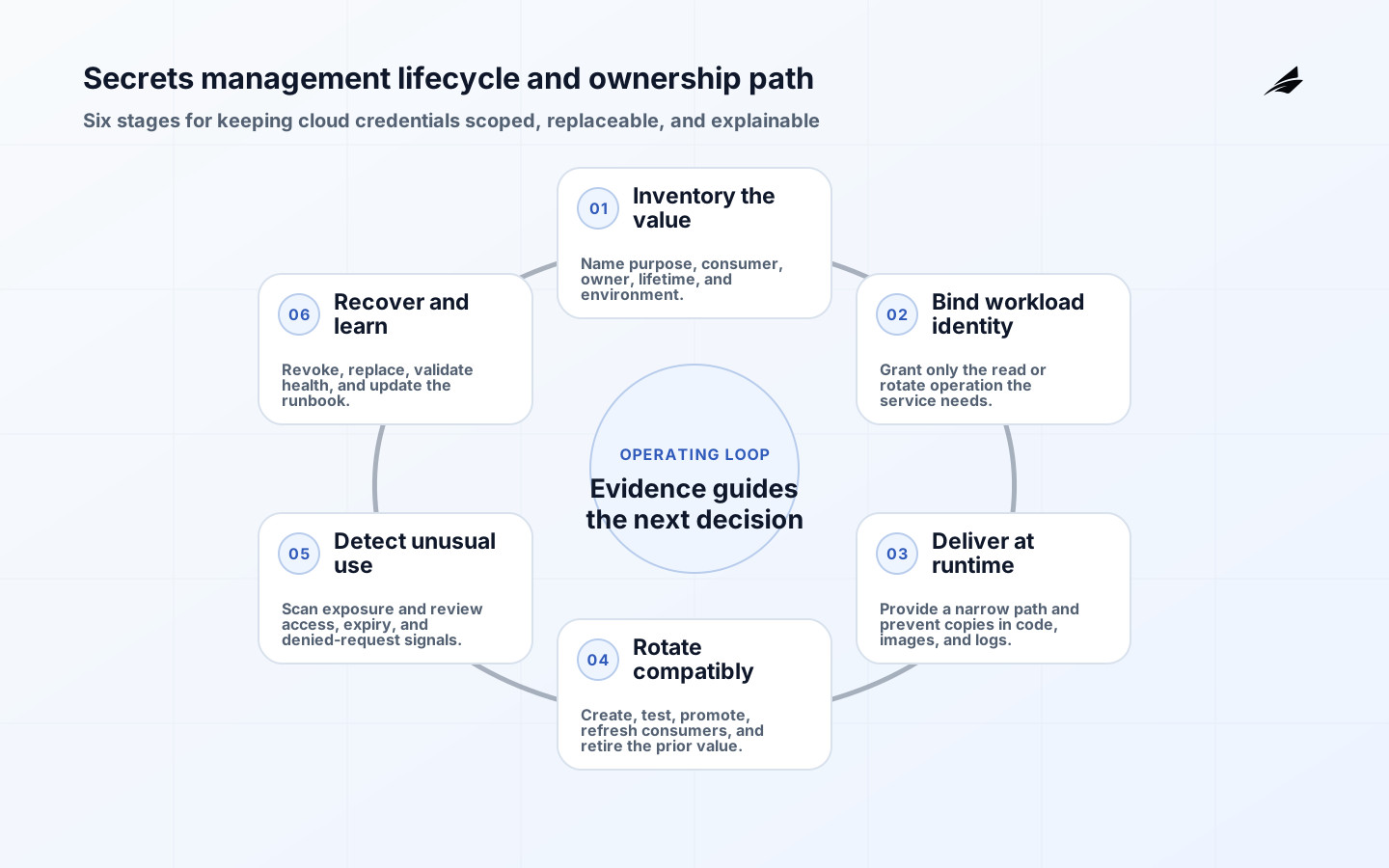
Secrets management is a service boundary, not a password drawer. It decides which workload may obtain which credential, for how long, through what delivery path, and how an operator will revoke or replace it when circumstances change. Treat passwords, API tokens, private keys, certificates, and connection strings as production dependencies with an owner and a recovery objective. A checkout service should receive a named identity and a rehearsed change path rather than inherit a shared database password because it was convenient. The rest of this guide turns that promise into inventory, delivery, rotation, detection, and recovery evidence.
Set the credential boundary before choosing a store
Map credentials by consumer, privilege, environment, lifetime, and failure consequence. Separate a human administrator's break-glass key from a workload identity, a signing key from a database password, and a development token from a production credential. This makes policy concrete: a short-lived read token may be issued automatically, while a root recovery key may require dual approval and offline protection. Ask which systems can read the value, where it appears during deployment, which logs might capture it, and what will stop working when it changes. OWASP recommends fine-grained access, rotation or dynamic creation, revocation, and logging that never records plaintext secrets. Those controls become testable only after the team has named the service and decision each secret supports.
| Secret decision | Good default | Evidence to retain |
|---|---|---|
| Who may read it? | A workload identity with one purpose and environment scope. | Policy, role binding, owner, and last access review. |
| How long should it live? | Use a dynamic or short-lived value where the dependency supports it. | Expiry, rotation trigger, and dependency test. |
| Where is it delivered? | Prefer an in-memory or mounted secret path over source or image layers. | Manifest, runtime path, and redaction test. |
| What happens when exposed? | Revoke, issue replacement, verify consumers, and preserve incident evidence. | Runbook, audit events, and recovery exercise. |
Give each workload one explainable identity
A dependable architecture has a clear trust boundary. The deployment system authenticates with a workload or platform identity, requests only the named secret, and delivers it to the process through a controlled interface. The application must not need vault administrator rights, and a CI job should not be able to read every production credential just because it can build an image. Keep secret metadata separate from secret values: ownership, purpose, environment, rotation cadence, dependencies, and emergency contacts are useful to operators and safe to index. For Kubernetes, remember that a Secret object is not automatically a complete confidentiality solution. Kubernetes documents that base64 encoding only obscures content; teams should enable encryption at rest, use least-privilege RBAC, restrict access to the containers that need it, and consider an external secrets provider. The Kubernetes Secrets good practices make those boundaries explicit.
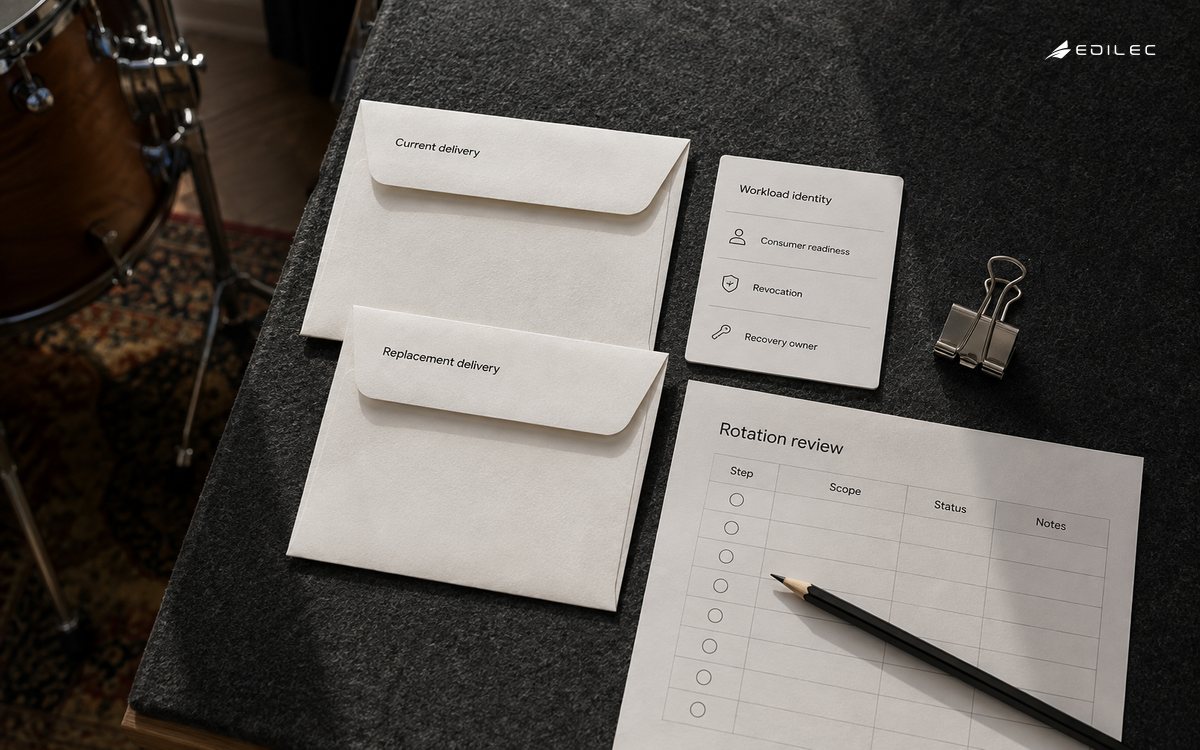
The delivery method should match the application's behavior. Environment variables are familiar but can be copied into diagnostics or crash reports; a mounted file can support refresh but requires the application to notice updates; a sidecar or CSI integration can separate retrieval from business code but adds operational dependencies. Choose based on restart behavior, refresh support, auditability, and the blast radius of a compromised process. A payment worker that can restart safely may use a short-lived mounted credential. A long-running connection pool may need a coordinated refresh and drain. Record the choice as an application contract instead of assuming every framework handles rotation identically. Internal guidance on Docker image architecture is useful when checking that secrets never enter image layers or build caches.
Rotate credentials without breaking consumers
Rotation fails when teams update the vault value but forget the consumer, rotate during a connection surge, or cannot distinguish the new version from the old one. Define a sequence: create a candidate, update the dependency, test authentication and authorization, promote the candidate, drain or refresh consumers, and retire the previous value. AWS Secrets Manager documents multi-step rotation patterns that separate creation, setting, testing, and finishing; the exact service differs, but the separation is valuable. For a database password, support a brief overlap only when the database and application can safely accept both versions, and define who closes the overlap. For signing keys, publish verification material before switching signers and retain enough history to validate existing artifacts.
| Failure mode | Preventive control | Operator decision |
|---|---|---|
| Old credential remains in a build artifact | Secret scanning, clean build inputs, and short-lived build identity. | Quarantine artifact and revoke the value. |
| Rotation breaks pooled connections | Refresh test, overlap policy, and connection-drain rehearsal. | Pause promotion or drain consumers. |
| Emergency key cannot be found | Inventory owner, protected recovery copy, and access audit. | Use break-glass approval and record custody. |
| Application logs the value | Redaction tests, safe diagnostics, and review of crash paths. | Contain logs, rotate, and preserve incident scope. |
Detect exposure before revocation becomes urgent
Measure whether the practice reduces exposure and speeds a safe response. Useful signals include secrets with no owner, credentials past their intended lifetime, access outside the expected workload, failed rotation attempts, scanner findings by source, time to revoke, and time to restore a service with a replacement value. Do not turn rotation count into a vanity metric: frequently rotating an unused token is less important than proving that a high-impact credential can be replaced without downtime. Review the access log with the service owner, security engineer, and platform operator. They should be able to explain a normal read, an unusual read, a denied read, and a recovery read. OWASP's incident guidance emphasizes rapid revocation, automated replacement, removal from exposed systems, and evidence about who had access; put those steps in the runbook before an incident.
Run a practical exercise every time the system boundary changes materially. Expose a test credential in a disposable repository, verify detection, revoke it, issue a replacement, and confirm that the service returns to a healthy state. Test a vault outage separately: does the workload fail closed, continue with a bounded cached value, or create a misleading healthy state? The correct answer depends on the business action. A fraud scoring service may tolerate a brief cached configuration; a privileged administrative action should not silently continue with stale authorization. Track exceptions and expiry dates so temporary workarounds do not become permanent infrastructure. Teams responsible for deployment rollbacks should include secret compatibility in their rollback test, because an old release may not understand a newly shaped credential.
Review high-impact secrets with the service owner
Run a short monthly review for the highest-risk values and a deeper quarterly review for the inventory. The monthly sample can include one production database credential, one workload identity, one certificate, one recently rotated secret, and one denied request. Confirm that the owner still exists, the consumer still needs the value, the policy matches the observed access, and the next rotation or expiry is actionable. During the quarterly review, look for shared credentials, broad roles, long-lived tokens, unmanaged copies, and recovery material that nobody has tested. Keep the review outcome simple: retain, restrict, rotate, replace, or retire. A decision log is more useful than a compliance score because it records why the team accepted a risk and when it will revisit it.
Make the review collaborative. The platform operator can explain delivery and audit events; the service owner can explain dependency behavior; security can assess exposure and incident readiness; and the business owner can decide whether a temporary workaround is acceptable. If any participant cannot answer a basic question, create a bounded action with a named owner rather than hiding the gap in a policy document. Revisit the review after a new cluster, build runner, backup service, or observability integration is introduced, because infrastructure changes often add secret copies and identities without changing application code.
Related Edilec reading: blue-green deployment, log aggregation, and deployment rollback readiness extend the same thinking about scoped change and recovery.
Source context: NIST SP 800-57 frames key lifecycle and compromise recovery; the OWASP Secrets Management Cheat Sheet covers least privilege and incident response; Kubernetes Secrets good practices explains encryption, RBAC, and the limits of base64; and AWS rotation guidance illustrates staged replacement.
Key takeaways
- Inventory secrets by consumer, purpose, privilege, lifetime, and owner before choosing a platform.
- Use workload identity and least privilege so a build, pod, or engineer cannot read unrelated values.
- Treat rotation as a compatibility change with candidate, test, promotion, drain, and retirement steps.
- Make exposure detection and revocation observable, and rehearse both secret replacement and manager outage.
- Keep metadata, access evidence, and recovery instructions close to the service contract.
Frequently asked questions
Do we need a dedicated secrets manager?
A dedicated manager is useful when the team needs scoped access, audit history, rotation workflows, or separation between deployers and readers. It does not fix an undefined owner or an application that cannot refresh credentials. Start by documenting the lifecycle and testing one high-value service; use those requirements to select a managed or self-hosted option.
Are Kubernetes Secrets safe enough by themselves?
They are a delivery object, not a complete secrets program. Enable encryption at rest, constrain RBAC and pod access, avoid committing manifests containing values, and consider an external provider when rotation, centralized audit, or cross-platform policy requires it. Validate the actual API, node, backup, and log paths in your cluster.
How often should credentials rotate?
Use risk, exposure, dependency behavior, and recovery cost rather than one universal interval. Dynamic credentials may expire with a session; static keys need a documented cryptoperiod and a tested replacement path. A shorter interval without reliable automation can create more outages than protection, so measure successful rotation and response readiness.
Use one checkout service to make the policy concrete. Inventory its payment token, database credential, signing key, and observability token separately; record each consumer, permitted operation, expiry, owner, cache location, and emergency contact. Then deny one unrelated read, rotate one busy database credential, and revoke a disposable token planted in a test repository. Measure detection, failed requests, time to replacement, and evidence quality. The exercise should leave a service contract that says whether the workload fails closed, tolerates a bounded cached value, or requires a human-approved break-glass path.
Secrets Management for Cloud and DevOps: a decision you can operate
A durable secrets practice lets the team answer who can use a value, why access exists, how long it should last, what changes during rotation, and how exposure will be contained. Keep purpose, identity, lifetime, delivery path, and recovery owner together in the service record. Prove one compatible rotation and one exposure response with evidence another operator can follow.
The goal is not a vault full of entries. It is a set of credentials that can be used, changed, revoked, and retired without losing accountability when a workload, dependency, or operator changes.