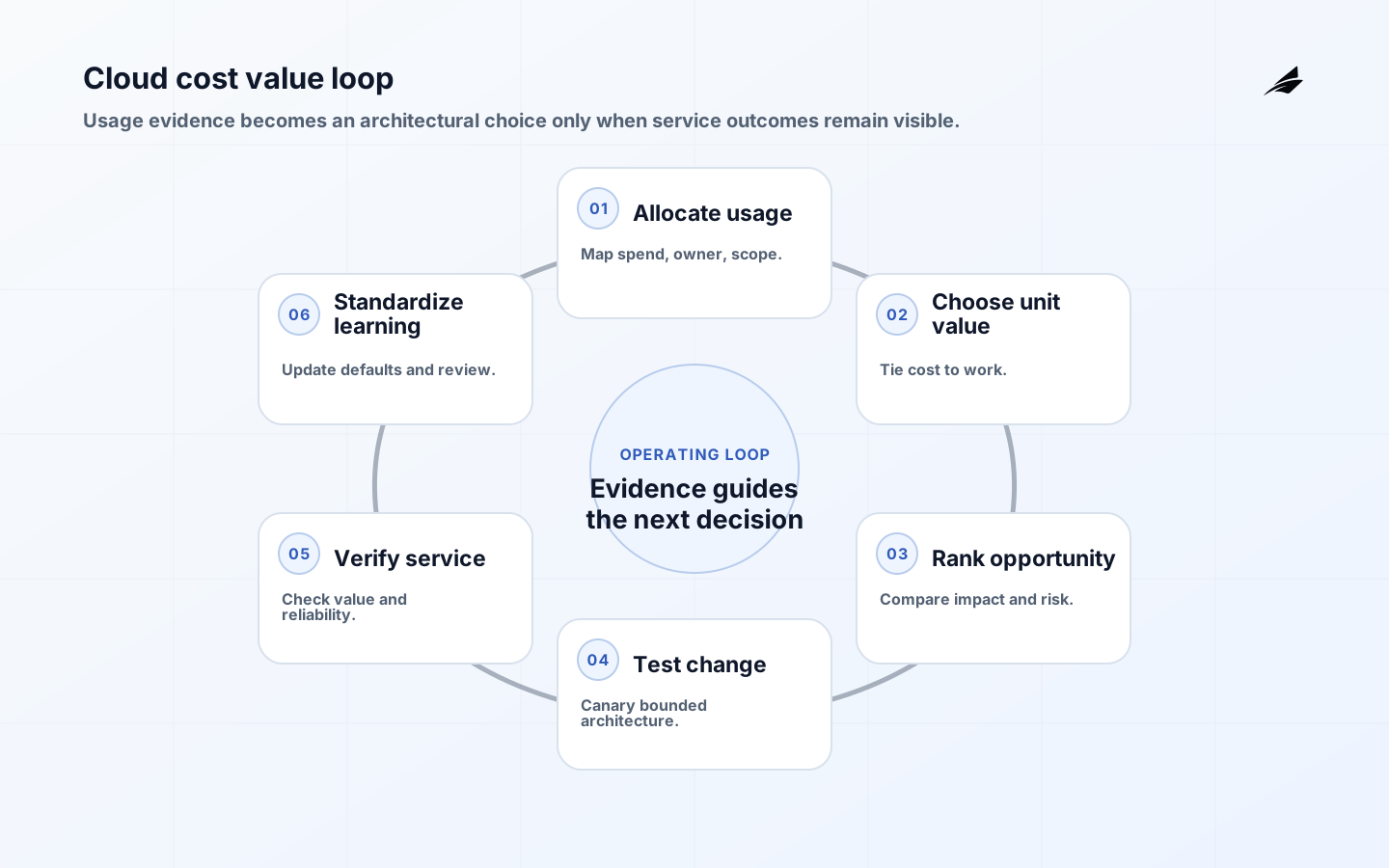
Cloud cost optimization is a decision discipline, not a campaign to make the invoice smaller. Consumption changes because demand changes, architecture changes, data accumulates, pricing changes, and teams make different reliability choices. The useful question is whether a unit of spend produces an intended customer or business outcome at an understood level of service. That framing prevents a common mistake: removing capacity or observability to improve a monthly number, then paying more through lost transactions, degraded reliability, or slower engineering. Start with credible allocation and use it to choose the next design or operating decision.
Turn spend signals into architecture choices
Cost evidence becomes useful when it changes a decision at the workload boundary. A report that a storage line rose is a signal; the architecture question may be whether data is retained for a legal need, a recovery objective, a latency promise, or an accidental default. Add the reason for the resource to the review, then compare alternatives using the same service outcome. A lower-cost storage class may be appropriate if retrieval time still meets the consumer promise. A shutdown schedule may be appropriate for development if the start-up path and morning validation are reliable. A commitment may be sensible when demand is stable and the owner accepts the loss of flexibility. The FinOps forecasting capability gives this comparison a forward-looking demand context.

Run the experiment as a controlled release. Identify the cohort or environment, baseline the relevant unit cost and service measure, choose an observation window, and define a stop condition. Google SRE's canarying releases guidance is relevant because an optimization change still has exposure and rollback concerns. FinOps' unit economics capability helps connect spending to a measurable outcome. Review the result with engineering, finance, and the service owner together when the change crosses shared infrastructure or customer commitments.
Use Edilec's plain-language cloud cost guide, platform engineering guide, and SLO planning guide to connect cost, platform defaults, and reliability targets. The goal is not a perfect forecast. It is a repeatable habit in which one owner can explain what changed, why the outcome remained acceptable, and what evidence would justify a different choice next quarter.
- State the workload outcome before proposing a saving.
- Compare alternatives with the same reliability and demand context.
- Canary high-impact changes and define a stop condition.
- Record the assumption that makes a commitment safe.
For a connected Edilec reading path, see Edilec CLD-0012, Edilec CLD-0018, Edilec CLD-0030. These related guides keep the implementation detail close to the operating decision and help teams compare ownership, evidence, and recovery across adjacent systems (for cloud cost decisions turn spend).
Key takeaways
- Treat cloud cost optimization as an operating decision with a named owner and explicit evidence.
- Separate the normal delivery path from the exception or recovery path before production pressure arrives (for cloud cost decisions key takeaways).
- Use customer, service, and operational signals together so a technically green result does not hide a failed outcome (for cloud cost decisions key takeaways).
- Improve the supported pattern from incidents, exercises, and recurring exceptions rather than relying on informal memory (for cloud cost decisions key takeaways).
Establish a baseline that connects cost, usage, and value
Collect provider billing and usage data with its freshness and limitations stated. Map material spend to products, environments, teams, and shared services using account structure, labels, and documented allocation rules. Then choose one or two unit metrics that a team can influence, such as cost per completed transaction, per active tenant, per gigabyte retained, or per successful batch. Do not compare unrelated workloads using one universal unit. The point is to see a trend within a defined service scope and to understand what changed.
Build a cost baseline alongside reliability and demand. A database cost that rises with healthy orders may be appropriate; the same rise with flat throughput demands investigation. Include deployment markers, capacity changes, data lifecycle events, and pricing commitments in the timeline. Cloud bills often arrive too late to explain a fast incident, so join near-real-time operational telemetry to billing data for early detection. The resulting view is not perfect accounting; it is enough context for an owner to make a safe next move.
| Optimization area | Evidence required | Risk to protect against |
|---|---|---|
| Idle or oversized capacity | Utilization, demand, and service objective headroom | Saving money by removing resilience. |
| Storage lifecycle | Access pattern, retention obligation, and retrieval cost | Deleting or tiering data needed for recovery. |
| Data transfer | Traffic path, request behavior, and architecture boundary | Moving cost while increasing latency or complexity. |
| Commitments | Stable baseline usage and flexibility needs | Locking in spend for a volatile workload. |
Prioritize decisions by materiality and reversibility
Rank opportunities by annualized impact, confidence in the evidence, implementation effort, customer consequence, and reversibility. Turning off a clearly abandoned preview environment is usually high confidence and reversible. Changing a multi-region architecture to reduce transfer cost may be high impact but requires deeper reliability analysis. This ordering helps teams avoid spending weeks tuning a small resource while an unowned storage class or runaway job dominates the bill. Publish the criteria so prioritization does not depend on who argues most forcefully in a review.
Use controlled experiments where the risk warrants them. Reduce capacity in one cohort, shorten a noncritical retention period in a test scope, change a query pattern behind a measurement, or trial a new instance family with a rollback route. Measure the unit cost and the service outcome over an appropriate window. Optimization is a production change; it needs the same hypothesis, observation, containment, and review as a feature release. A savings estimate is not a result until the customer and reliability effects are known.
Design the cloud cost optimization decision path
The optimization path moves from allocated cost and usage evidence through a value metric, a ranked decision, a controlled adjustment, outcome comparison, and a revised architecture or operating standard. It prevents a spreadsheet recommendation from bypassing delivery and reliability discipline.
| Cost movement | Interpretation check | Decision option |
|---|---|---|
| Unit cost falls, errors rise | Was capacity or retry behavior changed? | Restore headroom, then seek efficiency elsewhere. |
| Spend rises, unit cost falls | Did demand grow faster than cost? | Accept growth and update forecast. |
| Spend is unallocated | Can account, label, or shared rule identify owner? | Fix allocation before assigning savings targets. |
| Savings estimate misses outcome | Were discounts, transfers, or labor omitted? | Recalculate total effect and revise the business case. |
Make cost-aware choices part of platform and product work
The highest-leverage controls appear before resources are created: templates with ownership metadata, expiry for temporary environments, default lifecycle rules, budgets that route alerts to service owners, and architecture reviews for material consumption patterns. These guardrails should provide a usable default, not only a list of forbidden actions. For example, a data platform template can offer retention classes tied to recovery requirements, allowing teams to choose intentionally instead of inventing a lifecycle policy under time pressure.
Avoid setting cost targets that reward local savings while shifting cost or risk to another team. A product team may reduce its database spend by pushing work to a shared queue; a platform team may reduce telemetry retention and make incident response slower. Review the whole service chain and use shared unit definitions where a decision crosses boundaries. FinOps emphasizes collaboration among engineering, finance, and business precisely because no single bill view captures all of these consequences.
Keep optimization honest over time
Track realized savings or avoided growth with a baseline, a clear comparison period, and the owner of the assumption. Separate one-time cleanup from recurring rate improvement. Track service-level and customer measures beside the financial result, plus the time and implementation cost required to obtain it. This evidence makes it easier to stop low-value work and repeat changes that genuinely improve the system. It also builds trust when a team decides not to pursue an apparent saving because the risk is too high.
Revisit optimization decisions when demand, pricing, architecture, or obligations change. A commitment that was sensible for a stable workload may become wasteful after a product pivot; a storage tier may no longer meet a recovery objective; a cache may need resizing after a new customer segment joins. Treat these changes as normal operating inputs. Cloud cost optimization is sustainable when it is attached to ownership and delivery cadence, not when it depends on a periodic hunt for waste.
Worked optimization decision
A product team sees a large storage bill and proposes deleting objects after seven days. The allocation view shows that most cost belongs to a reporting service, but recovery exercises reveal that customers and support need thirty days of history for correction. The team avoids a false saving by separating raw uploads, derived report artifacts, and immutable audit evidence. It then tests compression and lifecycle tiering on the derived artifacts, measures retrieval time and cost per completed report, and confirms that the recovery objective still holds. The realized result may be smaller than the original headline estimate, but it is a saving the service can sustain without violating its promise.
The same approach applies to compute and network changes. Before downsizing, compare demand, headroom, error budget, and incident history; before buying a commitment, compare stable baseline use with product uncertainty. Optimization becomes a series of explicit architecture choices, each with evidence and an owner, rather than a request for engineers to find waste somewhere in the system.
For every optimization proposal, retain a short decision record with the baseline, forecasted effect, dependencies, customer constraint, rollback route, and owner who will measure the result. A storage lifecycle change may need legal review; a compute reduction may need a service-objective check; a new commitment may need finance to validate its treatment. The record keeps those constraints visible when someone later sees only a budget variance. It also protects teams from being judged on a target detached from reality. A good optimization program celebrates avoided risk and avoided growth as well as direct savings, because both can reflect a better allocation of cloud resources to real product value.
Frequently asked questions about cloud cost optimization
Question: What is the best first cloud-cost action? Answer: Establish a credible baseline that joins spend, usage, ownership, reliability, and unit value for one bounded workload. Question: How can cost optimization avoid false savings? Answer: Test the expected saving against latency, availability, capacity, and engineering effort, then keep a reversible change and review date.
What is the best first cloud cost optimization action?
Start by allocating material spend to a named service or owner and identifying an obviously unused or expired resource. This creates evidence and momentum without risking customer reliability.
Should cloud cost optimization use only provider billing data?
No. Billing data explains charges, while operational and business data explain why the charges exist and whether they are producing value. The combination is needed for good decisions.
Conclusion
Cloud cost optimization improves architecture when it links spend to demand, service outcomes, and accountable choices. Protect reliability, test material changes, and retain the evidence that shows whether an optimization actually delivered value.
Make the optimization decision durable
A cost decision should survive the person who proposed it. Store the baseline report, allocation rule, workload owner, unit metric, reliability constraint, and review date. If a service changes from batch to interactive use, old saving logic may no longer apply. If a shared platform gains tenants, the allocation method may need to change. Treat those events as review triggers rather than waiting for a budget surprise. The FinOps allocation capability is a useful reference for shared cost and ownership.
The result of an optimization experiment should be a decision about the next state: retain, reverse, widen, or redesign. Record customer and engineering effects beside the financial result. This keeps the practice honest when savings are small but reliability improves, or when a large saving creates unacceptable support work. A durable record makes later architecture reviews faster because the team can reuse evidence instead of repeating discovery.