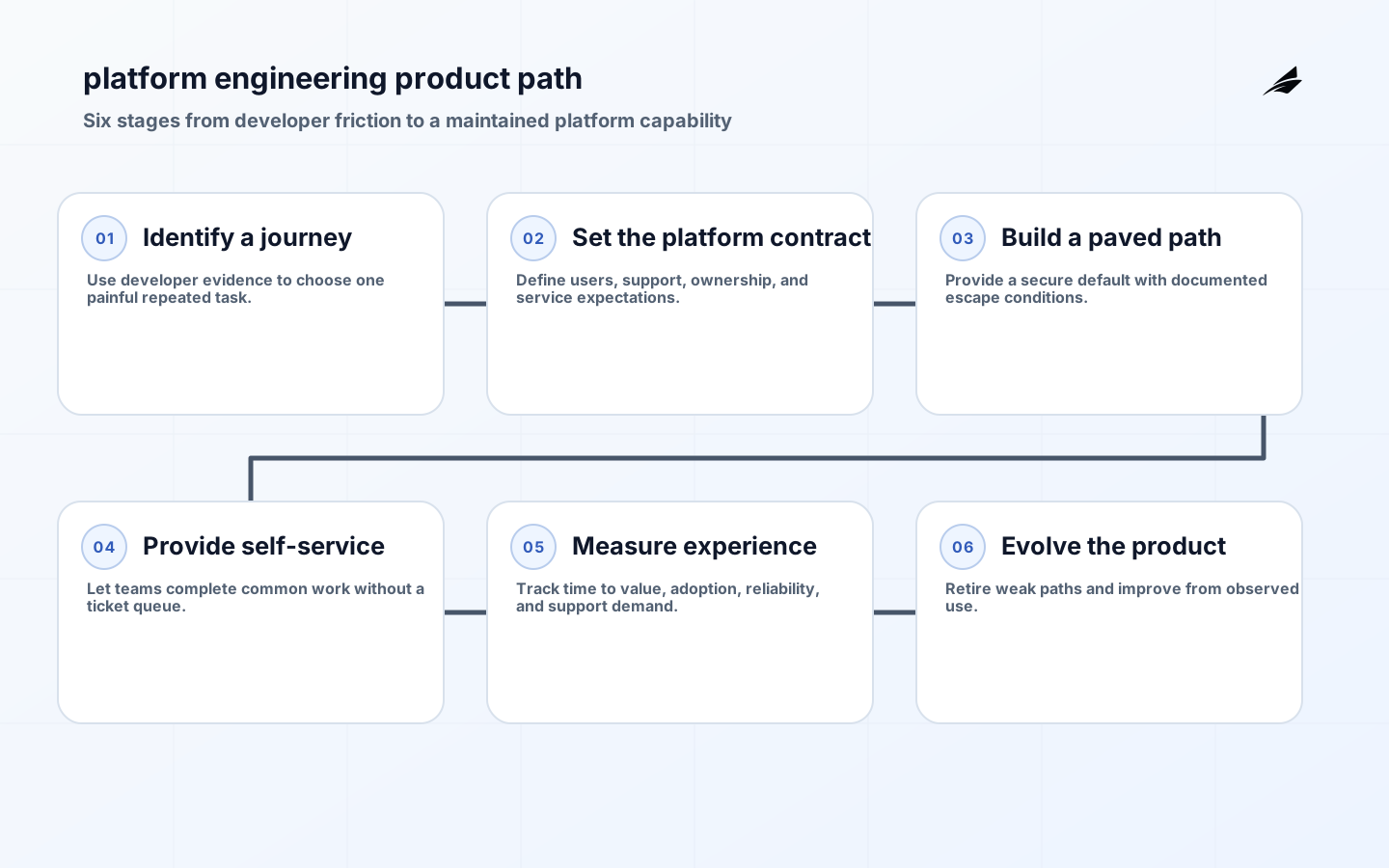
Platform engineering is the practice of treating shared delivery capabilities as a product for internal users. It is not a new name for a central infrastructure team, and it is not a portal assembled because the organization has too many tools. The starting point is a repeated developer journey that is slow, inconsistent, risky, or dependent on a small group of experts: creating a service, obtaining a compliant environment, shipping an approved change, or finding production evidence. A platform is valuable when it makes the common route easier while preserving appropriate control and an explicit path for exceptions. Before building, identify the user, their job, the outcome they need, the support promise, and the measurable friction the platform should remove.
Set a platform product boundary
Choose one journey with enough repetition to justify a supported path. For example, a product team may need to create a service with repository controls, runtime identity, observability, and a standard deployment path. That is a coherent first product. “Make engineering self-service” is not. Interview users while they perform the work, and collect the handoffs, waiting time, workarounds, and exceptions. Then decide what the platform owns versus what it integrates with. Identity may remain with an enterprise provider, application code with product teams, and the platform may own templates, policy integration, documentation, and the service contract. The platform engineering cost and scaling guide can help distinguish shared investment from an unbounded central backlog.
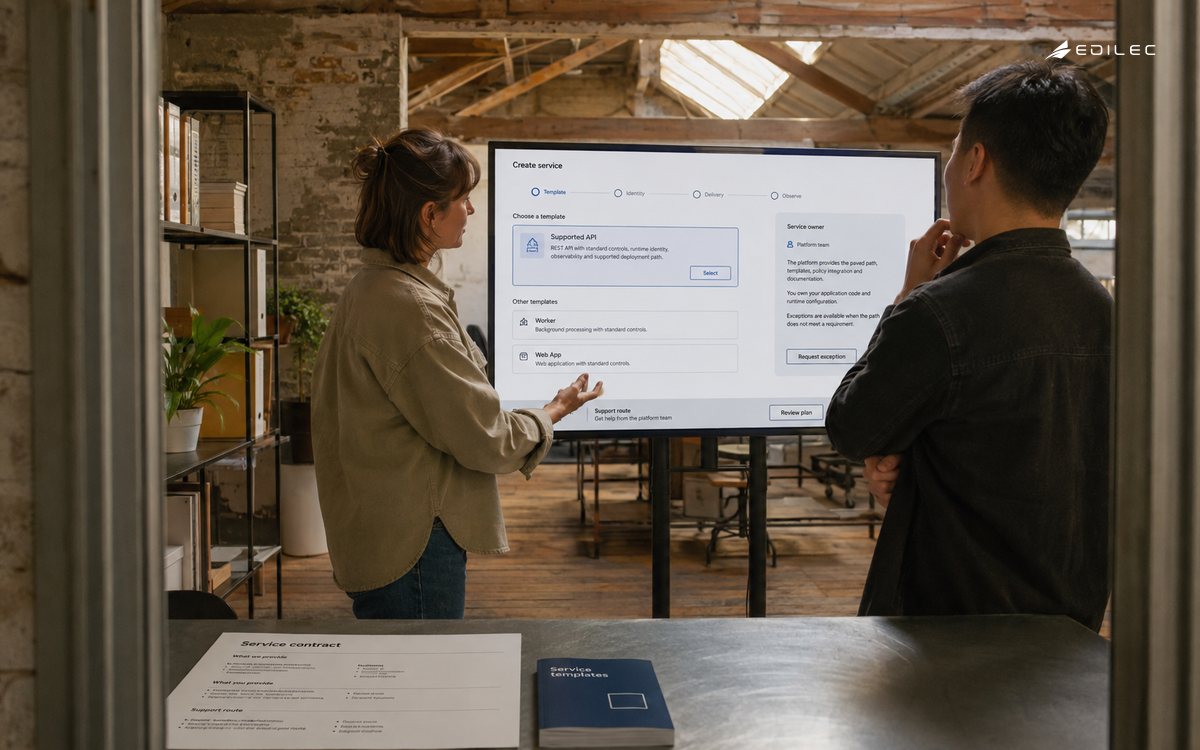
Build a paved path, not a compulsory maze
A paved path is an opinionated default that makes secure, operable behavior the easy choice. It should include the inputs users need, explain what will be created, expose status, and link to support when an assumption does not fit. It should not conceal policy decisions behind a form. For every default, document the reason, the owner, and the condition under which a team may use a different approach. This keeps a platform from becoming a rigid gate that pushes experienced teams into undocumented workarounds. Good self-service means a user can complete a routine task without a ticket, while the platform retains enough evidence to operate and improve the service.
| Platform choice | Healthy first answer | Evidence |
|---|---|---|
| User journey | One frequent, high-friction job. | Observed workflow and baseline time. |
| Product owner | A named owner accountable for adoption and support. | Roadmap and support route. |
| Default path | A secure, documented route for the common case. | Template, policy, and user documentation. |
| Exception path | A bounded process for justified differences. | Decision record and review cadence. |
| Success measure | Developer outcome plus operational quality. | Adoption, time to value, and reliability data. |
Treat the platform as a service
Internal users need to know what the platform provides, what it does not provide, when it is available, and how changes are announced. Establish a service contract for the first capability: supported environments, response expectations, ownership boundaries, data handling, and deprecation behavior. A platform team should measure its own change failure rate, support load, and user time to complete the journey, just as it asks application teams to measure their services. Avoid reporting adoption as a vanity count of created repositories or clusters. A team may create a resource once and still return to manual release steps. Measure successful use of the intended journey and investigate why users leave it.
- Start with a user journey rather than a technology catalog.
- Publish defaults and their reasons so users can predict behavior.
- Give the common path a clear support owner and service expectation.
- Record exceptions to discover missing product capabilities.
- Measure time to a useful outcome, not clicks in a portal.
- Retire paths that create cost without reliable adoption.
Compare architecture options by operating cost
A portal, a command-line interface, repository templates, and an API can all be valid platform surfaces. Choose the surface that matches the users and the task. A template may be best for a new service scaffold; an API may suit a mature automation flow; a portal can help an operator compare state and make a governed request. Do not force every capability into one interface. The harder architectural question is integration ownership: which systems remain authoritative for identity, billing, source control, deployment, and observability, and how the platform reports partial failure. A simple platform that has clear contracts is more valuable than an ambitious control plane that silently duplicates source-of-truth data.
| Option | Best fit | Trade-off |
|---|---|---|
| Repository template | Repeatable application starting point. | Needs versioning and upgrade guidance. |
| CLI or API | Automated or expert workflows. | Requires discoverability and stable contracts. |
| Portal | Status, comparison, and governed requests. | Can become a second interface for every tool. |
| Managed integration | A mature external capability. | Requires clear ownership and failure visibility. |
| Custom control plane | A distinctive repeated internal workflow. | High ongoing maintenance and support cost. |
Deliver a thin, supported capability
Map the baseline journey, decide the one task to improve, and create the smallest end-to-end path that includes policy, evidence, and support. Pilot with teams who have the real need, not only volunteers who can tolerate gaps. Observe where they need to leave the path and classify the reason: missing feature, unclear documentation, policy conflict, or a legitimate exception. Use those observations to prioritize the next release. Avoid launching a “platform” with a broad promise and no service owner; that creates a queue disguised as self-service. The first release should make a real unit of work faster, safer, and easier to understand.
Key takeaways
- Platform engineering starts with a painful, repeated developer journey.
- A paved path should be easy, supported, and explicit about exceptions.
- Treat internal capabilities as services with owners and expectations.
- Choose interfaces and integrations by user workflow and operating cost.
- Measure successful adoption and time to value, then evolve from evidence.
Frequently asked questions
Is a developer portal required? No. A platform can begin with templates, automation, and documented contracts; a portal is useful where visibility or governed requests need a shared surface. Does platform engineering replace DevOps? It changes how shared enabling capabilities are organized, but application teams still own their services and delivery responsibilities. Who funds it? Tie investment to the developer and operational outcomes of the journeys it improves. How much standardization is enough? Standardize the safe common path and the evidence it produces, while preserving a deliberate exception process for materially different needs.
Decision criteria for platform engineering
A team should make platform engineering decisions from a written comparison, not an intuition that a tool or pattern is generally safer. For a team creating a new service that needs identity, delivery controls, and operational visibility, state the baseline, the change being considered, the expected benefit, and the condition that would make the action unsafe. The decision record should name one supported developer journey and its service contract; it should also identify the smallest reversible step. That creates a practical distinction between a hypothesis and an approved change. A useful reviewer can then ask whether a platform capability release or a documented exception is possible without creating an unowned side effect, whether time to a usable outcome, repeated adoption, and support demand will be available in time, and whether the affected people understand the service consequence. The record does not need ceremony. A short change note with links to the release, owner, measurement, and recovery path is enough to make later investigation much faster.
Use an explicit example before automating the rule. Consider a team creating a new service that needs identity, delivery controls, and operational visibility. Walk through the normal case, the delayed case, and the failure case with the people who operate it. Identify which input is authoritative, what a missing or stale input looks like, and what an operator can safely do while evidence is incomplete. For platform engineering, this exercise often exposes a hidden assumption about timing, identity, or compatibility that a happy-path demonstration never reaches. It also clarifies what must be visible to support: current state, change owner, linked evidence, and the next action. Build those details into the workflow or runbook before increasing automation. A reliable default is useful only when its exceptions are observable and recoverable.
Failure analysis and recovery for platform engineering
Plan for centralizing tools without reducing handoffs or publishing who supports the resulting path. Detection should route to the platform product owner and the teams using the capability, but the alert or review item must contain enough context to start an investigation without manual archaeology. Include the relevant version or policy identifier, affected scope, timestamp, correlation reference, and the last known healthy comparison where available. The first response should reduce further harm while preserving evidence; the second should validate whether the apparent fault is data quality, a dependency condition, an operator change, or the design itself. Recovery does not always mean returning to the previous state. Sometimes it means a forward correction, an access restriction, a narrower cohort, or a temporary manual procedure. Document which action is safe for the case and who may authorize it.
- Define a precondition for a platform capability release or a documented exception and test it with a representative non-production or limited-production case.
- Keep the identifiers needed to connect one supported developer journey and its service contract to the change, investigation, and owner.
- Make time to a usable outcome, repeated adoption, and support demand visible at the point where a release or operator decision is made.
- Treat an exception as data: capture why it was needed, who approved it, and when it expires.
- Review recurring failures with the platform product owner and the teams using the capability and convert the strongest lesson into a control, contract, or runbook improvement.
Operating review for platform engineering
Set a review cadence that matches the risk and rate of change. The review should ask whether the current approach still produces the promised outcome, whether time to a usable outcome, repeated adoption, and support demand is trustworthy, and whether the exception path is being used as a substitute for a missing capability. Examine a small number of real cases instead of only aggregate charts: one successful change, one delayed or rejected change, and one recovery. This evidence makes trade-offs concrete. If the pattern repeatedly depends on expert intervention, reduce the scope or improve the supported path before expanding it. If the outcome is stable, publish the decision criteria so adjacent teams can reuse the model without copying assumptions that do not apply to them.
Conclusion
Platform engineering succeeds when it makes an important developer journey reliably easier without hiding ownership. Start narrow, operate the platform as a product, and let observed use determine what deserves to become a shared capability.