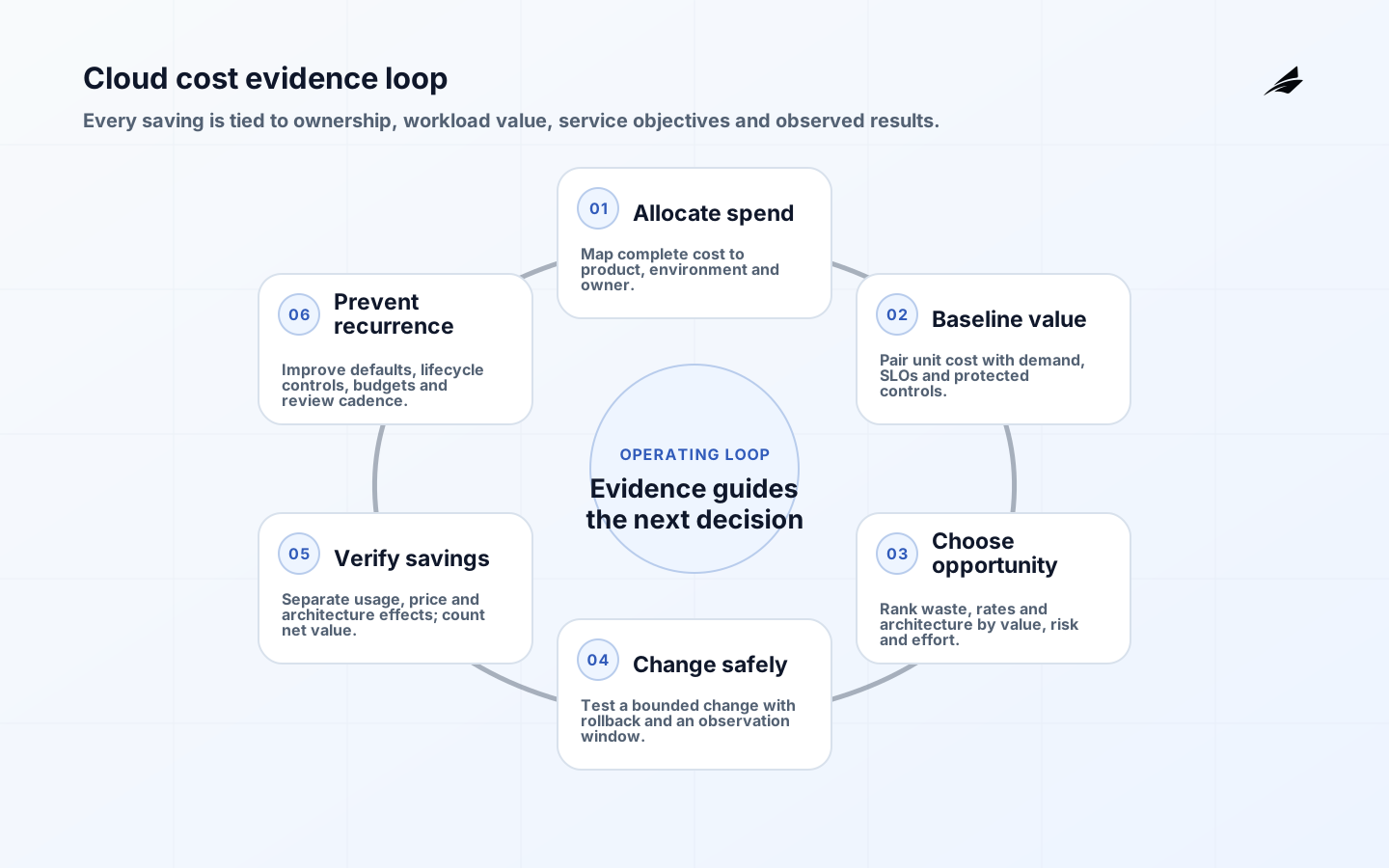
Cost-efficient cloud solutions deliver required business outcomes at a justified total cost. They are not simply the smallest invoice. Cutting backups, observability, security or capacity can move cost into incidents and lost work. Buying commitments before demand is understood can lock in waste. This checklist creates a repeatable loop: establish ownership and unit economics, identify a constrained opportunity, change safely, measure realized savings and continue operating the new configuration.
Use it with the cloud cost scope and risk plan, the cost-efficient cloud FAQ and the cloud solutions and software plan. Provider well-architected frameworks and the FinOps Framework all treat optimization as continuing cross-functional work, not a one-time discount exercise.
Make spend complete and accountable
Consolidate billing and usage data with account, service, region, pricing model and negotiated adjustments. Define a hierarchy that maps spend to product, environment, owner and cost center. Enforce metadata at provisioning and quarantine or escalate unattributed resources. Decide how shared platforms, support, network and commitments are allocated. Publish both raw provider cost and allocated product cost so teams can investigate differences. Reconcile invoices and credits before using the data for decisions.
Assign product, engineering and finance owners to every material workload. Give them budgets, forecasts and anomaly alerts with enough context to act. Establish escalation for unexpected spend without automatically shutting down production. Protect sensitive billing and resource data. A central FinOps team should enable decisions and standards; workload owners still understand demand and reliability. Measure allocation coverage and owner response time as foundation quality.
| Baseline | Why it matters | Required context |
|---|---|---|
| Monthly product cost | Shows total spend trend | Allocation and shared-cost method |
| Unit cost | Connects spend to delivered value | Transaction or customer denominator |
| Idle cost | Reveals removable waste | Owner, state and safe deletion rule |
| Commitment coverage | Shows rate strategy | Utilization and expiry |
| Forecast variance | Tests planning quality | Demand and price assumptions |
Define value, SLOs and optimization guardrails
Choose a business unit such as active tenant, order, build minute or processed record. Pair unit cost with throughput, quality and service level objectives. State protected constraints: recovery, latency, availability, security, data retention and compliance. Create a before measurement over a representative period. Seasonal or campaign workloads need comparable windows. A lower monthly bill caused by falling demand is not an engineering saving, and a saving that misses the SLO is not accepted.
Rank opportunities by expected annualized value, implementation effort, confidence, risk and reversibility. Start with obvious ownership and lifecycle defects before redesigning architecture. Require a hypothesis, owner, target resources, change plan, rollback and verification window. Avoid a giant savings backlog whose estimates are never reconciled. Expire stale recommendations when demand or pricing changes.
Remove lifecycle waste safely
Find unattached storage, old snapshots, unused addresses, idle development environments, duplicate logs, abandoned services and resources past temporary expiry. Confirm ownership and dependencies before deletion. Automate expiration for approved ephemeral patterns and preserve legal holds, recovery points and stateful workloads. Record deletion evidence and observed savings. Review why waste was created, then improve provisioning defaults and closure workflows so it does not return.
Set data lifecycle policies by purpose. Logs, backups, analytics and object versions need separate retention, tiering and deletion rules. Sampling or lower log verbosity may reduce cost, but security, incident and audit needs must remain measurable. Test restore after changing backup classes or schedules. Network transfer can dominate distributed designs; map data paths and eliminate unnecessary region, zone and internet movement without weakening resilience.
Match capacity and architecture to demand
Right-size from utilization distributions, queue behavior, latency and memory pressure, not average CPU alone. Change one bounded group, observe, then expand. Configure autoscaling with minimums, maximums, cooldown and load tests. Schedule genuinely inactive nonproduction capacity. For variable work, compare serverless, containers, managed services and fixed capacity using the full demand curve and operational labor. Architecture changes need failure and recovery tests.
Eliminate over-precision that adds cost without user value: excessive replication, high-frequency analytics, oversized retention, premium storage for cold data or synchronous processing where bounded delay is acceptable. Conversely, do not remove headroom needed for bursts or recovery. Provider calculators model services, not all engineering effort. Include migration, observability, support and lock-in exposure in the decision.
Govern rates, commitments and licenses
Apply commitments after stable baseline analysis. Model utilization under low, expected and high demand, ownership changes and product retirement. Assign an owner to coverage and expiry. Compare flexibility, upfront payment, scope and opportunity cost, not only discount percentage. Use spot or interruptible capacity only for fault-tolerant work with tested interruption handling. Review software licenses and support tiers because infrastructure rightsizing may not reduce licensed cost proportionally.
| Change | Verification | Rollback trigger |
|---|---|---|
| Right-size compute | SLO and saturation after representative load | Error or latency threshold breached |
| Shorten retention | Required investigations and restore still work | Missing mandated evidence |
| Buy commitment | Coverage and utilization meet forecast | Demand or ownership materially changes |
| Change service model | Total cost and operations improve | New dependency or support burden dominates |
| Delete idle asset | Owner and dependency checks pass | Unexpected access or recovery need |
Prove savings and sustain the control
Measure normalized cost after the observation window and separate usage, price, credit and architecture effects. Record gross saving, implementation cost, net saving, confidence and SLO result. Finance should agree when a saving is realized, especially where commitments or shared allocation delay invoice change. Close recommendations that did not work and retain the learning. Do not repeatedly count the same avoided forecast as cash savings.

Embed cost checks in architecture review, provisioning, pull requests and service review at the point each decision is made. Alert on anomalies and budget trajectory, but route to an owner with runbook context. Review unit cost, reliability and demand together. Revisit services as provider capabilities and prices change. Reward teams for durable value and prevention, not only emergency cuts that create future toil.
A ten-step optimization experiment
Treat each material optimization as a small engineering experiment with financial review. This avoids bulk changes whose savings and reliability effects cannot be separated. Keep the before data, approval, configuration version and after data together so finance and workload owners can agree whether value was actually realized.
- Choose one workload, confirm the owner and reconcile provider billing, credits, shared allocation and resource inventory.
- Define the business unit, representative baseline period, demand forecast, SLOs, recovery, security and regulatory guardrails.
- Identify the cost driver and distinguish idle waste, inefficient demand, poor architecture, rate choice, license or allocation artifact.
- Estimate annualized gross benefit, implementation effort, operational labor, risk, reversibility, confidence and earliest realization date.
- Review dependencies and obtain owner approval before deleting data, changing capacity, reducing retention or purchasing a commitment.
- Implement the smallest bounded change through version-controlled automation with telemetry, rollback and a fixed observation window.
- Exercise representative load, failure and recovery where the change could affect saturation, latency, durability or operational response.
- Compare normalized before and after unit cost, separating changes in demand, price, credits, allocation and engineering configuration.
- Record implementation cost, net saving, confidence, protected-control result and finance acceptance without double-counting avoided forecasts.
- Improve provisioning and lifecycle defaults, monitor recurrence, schedule the next review and retire recommendations invalidated by new evidence.
For high-spend workloads, add sensitivity analysis for provider price, exchange rate, growth, regional transfer and support. A change that succeeds in the expected scenario but fails under plausible demand should be redesigned or paired with a contingency. Preserve enough headroom for recovery and deployment, and make any temporary risk acceptance explicit and expiring.
Key takeaways
- Allocate every material cost to a workload and accountable owner.
- Pair unit cost with business volume, SLOs and protected controls.
- Remove lifecycle waste before adding architectural complexity.
- Use commitments only against stable, scenario-tested demand.
- Count net realized savings after verification, not recommendations or avoided forecasts twice.
Frequently asked questions
Is FinOps only a finance function?
No. Finance contributes accounting and forecasting, engineering controls architecture and usage, and product owners connect spend to value. Effective practice needs all three.
Are tags enough for allocation?
Usually not. Use account hierarchy, resource metadata, billing mappings and documented shared-cost rules, then monitor coverage and ownership continuously.
How often should optimization run?
Anomaly response may be daily, workload review monthly, and architecture or commitment review quarterly or event-driven. Match cadence to spend volatility, risk and decision lead time.
Create distinct controls for development and production. Development environments benefit from schedules, ephemeral data and expiration, while production needs traffic, recovery and change evidence before capacity changes. Give teams approved lower-cost patterns rather than blanket spending limits. Shared test services can reduce duplication only when isolation, test-data protection and scheduling remain workable. Include developer waiting time when a cheap environment slows delivery enough to erase the invoice saving.
Review observability economics as an engineering system. Identify which telemetry supports SLOs, incident response, security, audit and product decisions; then tune cardinality, sampling, retention, indexing and routing. Preserve raw or high-fidelity evidence where required and test whether responders can still diagnose representative failures. Moving data to a cheaper tier helps only if retrieval time meets the investigation need. Assign ownership to instrumentation and storage policy together.
For data and AI workloads, allocate accelerators, training, inference, feature pipelines and retained datasets separately. Measure utilization and cost per evaluated or served outcome, not reserved accelerator hours alone. Schedule fault-tolerant work, release unused capacity and choose model size against quality thresholds. Re-evaluate experiments that become permanent services; their reliability, monitoring and privacy obligations change the cost boundary materially.
Conclusion
Cost-efficient cloud solutions come from accountable operating decisions, not indiscriminate reduction. Build trustworthy allocation, protect service objectives, remove waste, match capacity to demand, govern rates and verify net savings. Repeating that loop keeps cost connected to value while preserving the reliability and security the workload exists to provide.