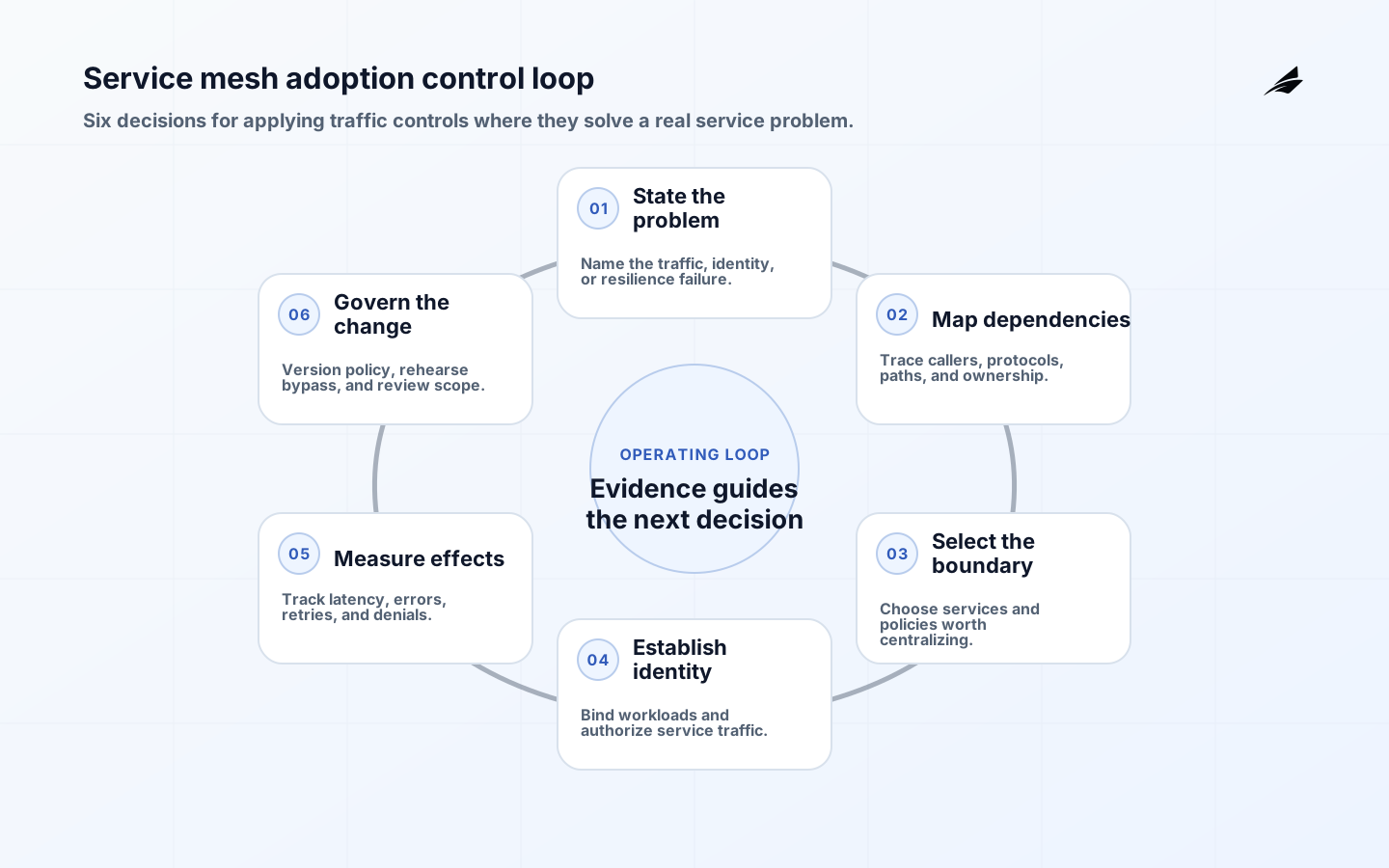
Service meshes deserve adoption only when a team can name a repeated service-to-service problem that current application libraries, gateways, and platform controls cannot reliably solve. Common candidates include workload identity, mutual authentication, consistent traffic policy, retries, observability, and progressive delivery. The first decision is the boundary: a small set of services and a measurable need, rather than every workload in a cluster.
Adoption boundary
Map callers, dependencies, protocols, ownership, and failure modes before adding a data plane. A mesh changes traffic behavior and operational responsibilities, so teams need a rollback plan, policy ownership, and visibility into proxy failures.

Traffic contract
Specify timeouts, retries, circuit-breaking behavior, and idempotency with application owners. Retrying a non-idempotent payment or write can amplify harm even when the mesh policy looks technically correct.
| Need | Decision | Evidence |
|---|---|---|
| Identity | Which workloads need authenticated service traffic? | Workload identity map. |
| Traffic | Which paths need consistent policy? | Dependency map. |
| Recovery | How is policy rolled back? | Versioned configuration. |
| Operations | Who investigates proxy failures? | Runbook and owner. |
Workload identity
Use workload identity and mutual authentication where the service boundary requires it, but avoid assuming encryption alone authorizes an operation. Application authorization and data access decisions remain necessary.
Observability
Collect latency, errors, retries, and policy denials with service and release context. A mesh can add useful evidence, but it also adds signals that need sampling, retention, and on-call ownership.
| Signal | Question | Action |
|---|---|---|
| Retries | Is a dependency failing or policy too aggressive? | Inspect cause and cap retry. |
| Latency | Which hop changed? | Compare service and proxy telemetry. |
| Denials | Is identity or policy incorrect? | Review scope and owner. |
| Resource use | Is the data plane constrained? | Adjust capacity or boundary. |
Operations
Introduce the mesh to one service path, test failure and rollback behavior, and document the support boundary. Expand only after operators can explain an incident using the added telemetry.
Key takeaways
- Adopt service meshes for a stated traffic or identity problem.
- Begin with a bounded service path.
- Version and test traffic policy rollback.
- Keep application authorization explicit.
- Operate the added telemetry and data plane.
A service mesh should be evaluated as a set of traffic, identity, and resilience controls around a concrete service problem. Istio’s architecture documentation explains the relationship between the data plane and control plane; NIST SP 800-204 provides a security strategy for microservices; Kubernetes NetworkPolicy documentation clarifies that network policy is an allow-list boundary whose behavior depends on the network plugin. The CNCF Service Mesh Landscape is useful for understanding the range of implementations, but it should not substitute for a local decision record. These sources support a disciplined adoption path: define the failure mode, map traffic, establish workload identity, measure behavior, and keep a bypass or recovery option.
The first trial should expose a narrow set of services and answer one question, such as whether mutual TLS removes an identity gap or whether retry policy is amplifying overload. Observe latency, error class, retries, policy denials, certificate rotation, and operator effort before expanding scope. For related Edilec context, compare service discovery, microservices security, and production observability. These companion articles are Service Meshes: Buyer and CTO Guide, Distributed Tracing: Keep One Transaction Intact Across Services and Queues, What Changes When Service Meshes Moves into Production.
Frequently asked questions
Question: Does a service mesh solve every service-to-service problem? Answer: No; adopt it for a named need with measurable benefit and clear ownership. Question: What should a team compare before adoption? Answer: Application controls, gateway features, identity requirements, operational burden, failure impact, and the evidence needed to justify the shared layer.
What problem justifies a service mesh?
Answer: A mesh is justified by repeated service communication needs such as workload identity, consistent traffic policy, safe shifting, or cross-service telemetry that simpler controls cannot sustain.
Does mTLS provide authorization?
Answer: No. It authenticates transport peers; authorization still decides which service, identity, or operation is permitted.
How should mesh adoption be reversed?
Answer: Keep workload policy, certificates, routes, and observability documented so a service can leave the mesh without losing a required security or reliability guarantee.
Does every Kubernetes cluster need a mesh? No. The operational cost should be justified by a concrete policy or reliability need. Does mutual TLS replace authorization? No; it authenticates workloads but does not decide what an authenticated caller may do.
Decision criteria for service mesh adoption
A team should make service mesh adoption decisions from a written comparison, not an intuition that a tool or pattern is generally safer. For three services where retries during a dependency slowdown are magnifying queue load, state the baseline, the change being considered, the expected benefit, and the condition that would make the action unsafe. The decision record should name the service path, workload identity, and traffic policy; it should also identify the smallest reversible step. That creates a practical distinction between a hypothesis and an approved change. A useful reviewer can then ask whether a policy change, route rollback, or boundary reduction is possible without creating an unowned side effect, whether service latency, retry behavior, authorization failures, and proxy resource use will be available in time, and whether the affected people understand the service consequence. The record does not need ceremony. A short change note with links to the release, owner, measurement, and recovery path is enough to make later investigation much faster.
Use an explicit example before automating the rule. Consider three services where retries during a dependency slowdown are magnifying queue load. Walk through the normal case, the delayed case, and the failure case with the people who operate it. Identify which input is authoritative, what a missing or stale input looks like, and what an operator can safely do while evidence is incomplete. For service mesh adoption, this exercise often exposes a hidden assumption about timing, identity, or compatibility that a happy-path demonstration never reaches. It also clarifies what must be visible to support: current state, change owner, linked evidence, and the next action. Build those details into the workflow or runbook before increasing automation. A reliable default is useful only when its exceptions are observable and recoverable.
Failure analysis and recovery for service mesh adoption
Plan for enabling mesh features cluster-wide before teams can explain the added failure modes and ownership. Detection should route to the service owners and the platform team responsible for the data plane, but the alert or review item must contain enough context to start an investigation without manual archaeology. Include the relevant version or policy identifier, affected scope, timestamp, correlation reference, and the last known healthy comparison where available. The first response should reduce further harm while preserving evidence; the second should validate whether the apparent fault is data quality, a dependency condition, an operator change, or the design itself. Recovery does not always mean returning to the previous state. Sometimes it means a forward correction, an access restriction, a narrower cohort, or a temporary manual procedure. Document which action is safe for the case and who may authorize it.
- Define a precondition for a policy change, route rollback, or boundary reduction and test it with a representative non-production or limited-production case.
- Keep the identifiers needed to connect the service path, workload identity, and traffic policy to the change, investigation, and owner.
- Make service latency, retry behavior, authorization failures, and proxy resource use visible at the point where a release or operator decision is made.
- Treat an exception as data: capture why it was needed, who approved it, and when it expires.
- Review recurring failures with the service owners and the platform team responsible for the data plane and convert the strongest lesson into a control, contract, or runbook improvement.
Operating review for service mesh adoption
Set a review cadence that matches the risk and rate of change. The review should ask whether the current approach still produces the promised outcome, whether service latency, retry behavior, authorization failures, and proxy resource use are trustworthy, and whether the exception path is being used as a substitute for a missing capability. Examine a small number of real cases instead of only aggregate charts: one successful change, one delayed or rejected change, and one recovery. This evidence makes trade-offs concrete. If the pattern repeatedly depends on expert intervention, reduce the scope or improve the supported path before expanding it. If the outcome is stable, publish the decision criteria so adjacent teams can reuse the model without copying assumptions that do not apply to them.
Implementation evidence for service mesh adoption
Before scaling service mesh adoption beyond its initial boundary, verify the implementation evidence. Confirm that new operators can locate the current state, execute the approved recovery action, and explain the limits of the control. Compare the expected effect with service latency, retry behavior, authorization failures, and proxy resource use; investigate material differences instead of silently changing the measure. This is also the point to test access removal, dependency failure, and a change made outside the normal path. The resulting evidence should be concise and reusable: a tested runbook, an ownership map, representative telemetry, and a decision record. That package makes the next adoption decision more credible than an assertion that the technology has been installed.
Advanced service meshes practice
Service mesh adoption needs an explicit exit and rollback criterion because the data plane becomes part of every affected request path. Before onboarding another namespace, test what happens when certificate issuance is delayed, a sidecar cannot start, a policy is malformed, or a dependency receives repeated traffic. Check that application owners can distinguish an application error from proxy or policy behavior using the standard telemetry. A staged rollout should begin with a path that has known call volume and an owner who can tolerate the learning period. Keep the policy set small: identity, one authorization or routing requirement, and one observable service-level signal. Once that path is stable, compare its incident handling and deployment experience with the previous approach. Expand only when the operational benefit is measurable, not because uniform installation appears simpler.
A useful ownership model separates shared mechanics from service decisions. The platform team can operate certificates, proxy versions, control-plane upgrades, telemetry plumbing, and baseline policy templates. Service teams remain responsible for retry safety, timeouts that match their workflow, authorization semantics, and customer impact. This division prevents a common failure: a central group changes a global default while application owners discover a behavior change only after a production incident. Version policy in source control, review it with the affected service owners, and retain a fast way to restore the last known good policy. The mesh should make this responsibility clearer, not move it into an opaque layer.
Conclusion
A service mesh is useful when a bounded adoption path makes service traffic safer and more understandable than the current approach.