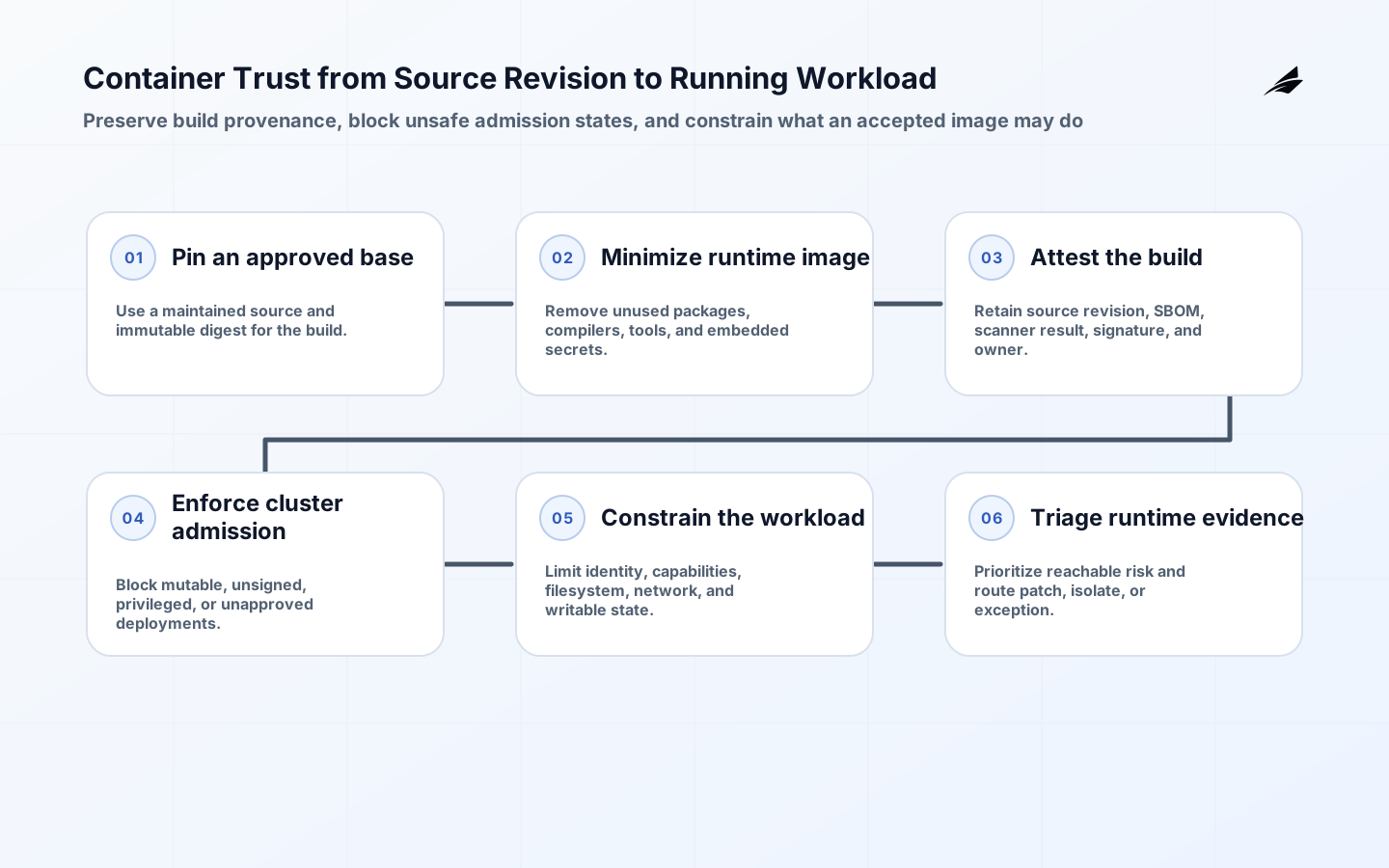
Container security is not a scan performed just before deployment. It is the set of controls that lets a team trust an image, decide whether it may run, limit what it can do at runtime, and respond when evidence changes. A container image can be built from an untrusted base, carry unnecessary packages, embed a secret, run with excessive privilege, or gain broad network access after it passes a vulnerability scan. The first design decision is the boundary: which registries, build systems, clusters, and workload classes are covered by the initial policy? Start with production workloads and the delivery path that produces them. A smaller enforceable boundary gives a team real evidence and a recovery process; a universal policy with no exceptions path becomes another document.
Set the container security boundary
Map the journey from source revision to a running workload. Identify where a base image enters, where dependencies are resolved, where the image is built and signed, where it is stored, who can alter deployment configuration, and which cluster identity launches it. The map should identify the authoritative record for each stage. A registry tag such as “latest” is not an adequate release identity because it can move; retain immutable digests and build metadata. Define which exceptions are allowed, who approves them, and how long they expire. The container security engineering notes provide related context, but the daily operating question is simpler: can an operator explain why this exact image is allowed to run in this exact environment?
Build and preserve image trust
Use minimal, maintained base images from approved sources and pin them to a digest where the workflow permits. Remove compilers, package managers, and debugging tools from the runtime image unless they are justified. Build images in controlled automation, generate a software bill of materials when feasible, and retain provenance that connects the digest to source and build inputs. Scanning is valuable for prioritizing known vulnerabilities, but severity alone is not a deployment decision. Consider exploitability, exposed functionality, whether a patch exists, and the service consequence. A policy can block critical known risk by default while providing a time-bound, reviewed exception path for a necessary release.
| Control point | Question | Evidence |
|---|---|---|
| Base image | Is the source approved and maintained? | Digest, owner, and update policy. |
| Build | Can the artifact be traced to controlled inputs? | Build record and provenance. |
| Registry | Can unapproved images be published or pulled? | Access policy and immutable digest. |
| Admission | Does deployment check the required contract? | Policy decision and exception record. |
| Runtime | What can the workload access or modify? | Identity, security context, and network policy. |
Enforce at admission and runtime
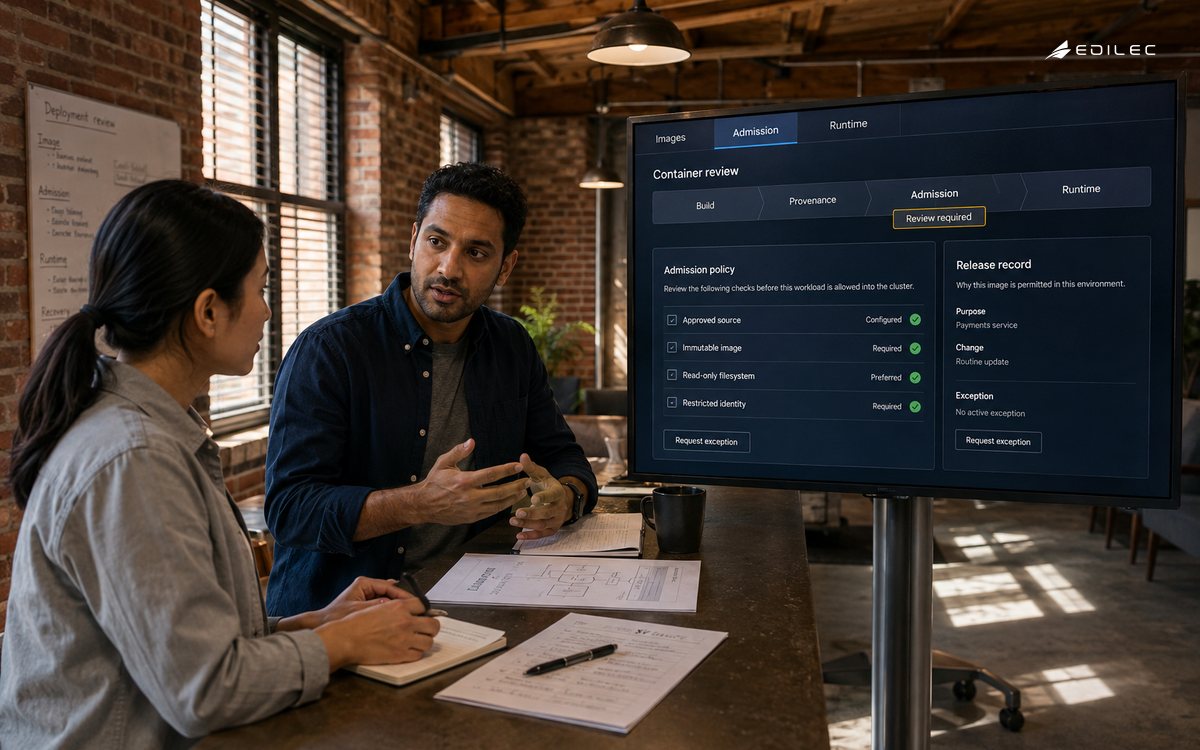
Admission is the moment to prevent a workload that violates a known policy from entering a production cluster. Useful checks include approved registry, immutable image reference, required metadata, prohibited privilege settings, and an exception that has not expired. Runtime controls then limit what an admitted workload can do: run as non-root where possible, drop unnecessary Linux capabilities, avoid privileged mode and host mounts, use a read-only root filesystem where compatible, and give the workload a narrow service identity. Network policy should reflect actual communication needs, starting with critical namespaces and sensitive dependencies. These controls require testing because a policy that breaks essential maintenance without a safe path will be bypassed.
- Use immutable image references for production deployments.
- Keep build credentials and application secrets out of images and layers.
- Apply an enforceable admission policy with an expiring exception route.
- Run workloads with the least privilege their behavior permits.
- Restrict service identity and network reachability to documented needs.
- Connect runtime findings to a service owner and a recovery action.
Make vulnerability decisions in context
A long list of findings does not tell an operator what to fix first. Triage vulnerabilities by the affected component, reachable attack path, internet exposure, privilege available to the workload, compensating controls, and remediation status. Record a decision for material findings: patch now, mitigate, accept temporarily with expiry, or remove the component. Re-scan after base image and dependency updates, but avoid treating a scanner as the source of truth for deployment authorization. The authorization decision should incorporate trusted provenance and runtime policy as well. For a critical service, add a plan for rapid image replacement and rollout rollback so a newly disclosed issue can be handled without inventing the release process during the event.
| Finding state | Appropriate response | Review trigger |
|---|---|---|
| Patch available and reachable | Update and test the image promptly. | Next supported release window. |
| No patch but exposed | Apply a compensating runtime or network control. | New vendor advisory or control change. |
| Not reachable in this workload | Document the evidence and retain monitoring. | Image or configuration change. |
| Temporary exception | Name an owner and expiry. | Expiry date or new remediation. |
| Suspected compromise | Contain the workload and preserve evidence. | Incident response declaration. |
Implement controls in an operable order
Begin by requiring approved registries and immutable digests for one production namespace. Add a minimal image standard and a build record, then test a policy violation and its approved exception path. Next, establish restrictive runtime defaults and observe which workloads need a documented deviation. Introduce network restrictions around a sensitive dependency only after mapping legitimate traffic. This order gives teams a path to compliance and avoids a broad policy rollout that produces unsupported breakage. Review deployment denials and runtime alerts weekly; they are product feedback on the platform controls as well as security signals.
Key takeaways
- Container security protects the build, registry, admission, runtime, and response path.
- Trust images through controlled inputs, immutable digests, and provenance.
- Use admission policies to stop known unsafe deployment states.
- Apply least privilege to identity, filesystem, capabilities, and network.
- Triage vulnerability findings by reachability and service consequence, not severity alone.
Frequently asked questions
Does a private registry make images secure? It controls distribution, but it does not prove build integrity or safe runtime configuration. Should every container run as non-root? It is a strong default, though some workloads need a documented, minimized exception. Are vulnerability scans enough to gate deployment? No. They are one input beside provenance, policy, exposure, and runtime controls. What is the best first control? Requiring approved immutable images in a limited production boundary is often a practical, high-signal start.
Decision criteria for container security
A team should make container security decisions from a written comparison, not an intuition that a tool or pattern is generally safer. For a production API image whose base package receives a newly disclosed vulnerability, state the baseline, the change being considered, the expected benefit, and the condition that would make the action unsafe. The decision record should name the trusted image, admission policy, and runtime workload; it should also identify the smallest reversible step. That creates a practical distinction between a hypothesis and an approved change. A useful reviewer can then ask whether a policy denial, time-bounded exception, or rapid image replacement is possible without creating an unowned side effect, whether admission decisions, image findings, and runtime behavior will be available in time, and whether the affected people understand the service consequence. The record does not need ceremony. A short change note with links to the release, owner, measurement, and recovery path is enough to make later investigation much faster.
Use an explicit example before automating the rule. Consider a production API image whose base package receives a newly disclosed vulnerability. Walk through the normal case, the delayed case, and the failure case with the people who operate it. Identify which input is authoritative, what a missing or stale input looks like, and what an operator can safely do while evidence is incomplete. For container security, this exercise often exposes a hidden assumption about timing, identity, or compatibility that a happy-path demonstration never reaches. It also clarifies what must be visible to support: current state, change owner, linked evidence, and the next action. Build those details into the workflow or runbook before increasing automation. A reliable default is useful only when its exceptions are observable and recoverable.
Failure analysis and recovery for container security
Plan for blocking a workload without an evidence-based exception path or allowing a mutable image tag as a release identity. Detection should route to the service owner, security reviewer, and platform operator, but the alert or review item must contain enough context to start an investigation without manual archaeology. Include the relevant version or policy identifier, affected scope, timestamp, correlation reference, and the last known healthy comparison where available. The first response should reduce further harm while preserving evidence; the second should validate whether the apparent fault is data quality, a dependency condition, an operator change, or the design itself. Recovery does not always mean returning to the previous state. Sometimes it means a forward correction, an access restriction, a narrower cohort, or a temporary manual procedure. Document which action is safe for the case and who may authorize it.
- Define a precondition for a policy denial, time-bounded exception, or rapid image replacement and test it with a representative non-production or limited-production case.
- Keep the identifiers needed to connect the trusted image, admission policy, and runtime workload to the change, investigation, and owner.
- Make admission decisions, image findings, and runtime behavior visible at the point where a release or operator decision is made.
- Treat an exception as data: capture why it was needed, who approved it, and when it expires.
- Review recurring failures with the service owner, security reviewer, and platform operator and convert the strongest lesson into a control, contract, or runbook improvement.
Operating review for container security
Set a review cadence that matches the risk and rate of change. The review should ask whether the current approach still produces the promised outcome, whether admission decisions, image findings, and runtime behavior is trustworthy, and whether the exception path is being used as a substitute for a missing capability. Examine a small number of real cases instead of only aggregate charts: one successful change, one delayed or rejected change, and one recovery. This evidence makes trade-offs concrete. If the pattern repeatedly depends on expert intervention, reduce the scope or improve the supported path before expanding it. If the outcome is stable, publish the decision criteria so adjacent teams can reuse the model without copying assumptions that do not apply to them.
Conclusion
Container security becomes manageable when the image-to-runtime path has clear trust decisions and recovery owners. Start with a bounded production path, make safe defaults enforceable, and improve the controls from the evidence they generate.