Cloud cost optimization begins before a team chooses instance families, commitment discounts, or a dashboard. The first job is to define what a dollar of cloud spend is buying and who can act on the answer. A founder may need the monthly cost of one product line; an engineering lead may need to decide whether a queue, cache, or database is oversized; finance may need a forecast it can reconcile to the invoice. Those are different questions, so one unqualified total is rarely enough. Treat cloud cost optimization as a decision system: usage data is allocated to a useful business boundary, changes are explained, owners choose an action, and the effect is checked against reliability and product demand. That approach avoids the familiar pattern of finding savings after a bill arrives but being unable to say whether a change was safe or durable.
Start with a decision boundary
Choose a scope that has an accountable owner and a measurable outcome. A sensible first boundary is one production service, one customer-facing workflow, or one environment that has material spend and known users. Do not start with every account and every tag. Instead, write down the decisions the group can make in the next quarter: resize compute, remove idle resources, change data retention, alter an architecture, or buy a usage commitment. Then record the signals that would make the decision unsafe, such as rising latency, a forecasted launch, or a dependency that must retain extra capacity. The cloud cost optimization fundamentals guide is useful background, but the delivery artifact should be a small ownership map and a review cadence, not a generic savings target.
Make allocation trustworthy before optimizing
Allocation is not merely a tagging project. It is a contract that says how shared, direct, and unallocated costs are treated. Direct costs can usually be assigned from account, project, cluster namespace, tenant, or workload metadata. Shared costs need a documented rule, such as proportion of requests, storage used, reserved capacity, or a deliberately retained shared-services bucket. The rule may be imperfect at first, but it must be stable enough for a reader to understand a month-over-month movement. Keep both the provider bill identifier and the business mapping version. When a team changes a tag or account structure, historical reports should not silently change meaning. Timely, accurate, accessible data and collaboration across engineering, finance, and business are central ideas in the FinOps Framework; the practical implication is that allocation disputes need an owner and a correction path.
| Question | Useful first answer | Evidence to retain |
|---|---|---|
| What is in scope? | A product, environment, or service with a named owner. | Scope definition and owner. |
| How are shared costs treated? | Use an explicit driver or retain a shared category. | Allocation rule and version. |
| What action is available? | Resize, remove, redesign, schedule, or commit. | Change request and expected effect. |
| What protects reliability? | A service or capacity guardrail accompanies savings work. | Baseline and post-change signal. |
Create a cost operating model
A useful review has two loops. The weekly loop identifies anomalies, idle resources, and ownership gaps that can be corrected quickly. The monthly loop explains material variance against forecast, reviews unit economics, and considers architectural or rate commitments that require more evidence. Use a plain change taxonomy: demand changed, rate changed, configuration changed, architecture changed, or allocation changed. Without it, a lower bill can be celebrated even when customer volume fell, and an increased bill can be treated as waste when it reflects a deliberate launch. The action log should name the hypothesis, owner, deadline, affected service, rollback condition, and verification date. Cost is therefore not an isolated operations metric; it belongs beside service health and product volume in the same release conversation.

- Give each material cost scope an engineering owner and a finance partner.
- Separate provider invoice timing from near-real-time operational telemetry.
- Review anomalies for data quality before treating them as waste.
- Estimate savings as a range when demand or pricing is uncertain.
- Record reliability guardrails before changing capacity or retention.
- Close an action only after the bill, usage, and service signals agree.
Measure value, not just a smaller bill
Good cloud cost optimization preserves the outcome a workload exists to deliver. For a subscription API, cost per successful active customer may be more useful than total compute spend. For a data pipeline, cost per timely, accepted record can expose whether a cheaper run is creating more rework. For a platform team, a shared cluster cost may need to be paired with onboarding time and workload utilization. Start with one denominator that operators and product leaders recognize, then publish the limitations. A denominator can be seasonal, affected by free tiers, or distorted by a migration; that is a reason to annotate it, not to abandon measurement. Link each cost view to the deployment and incident history so a reviewer can distinguish an optimization from a coincidental movement.
| Signal | What it answers | Caution |
|---|---|---|
| Allocated cost | Who is responsible for spend? | Shared services require a visible rule. |
| Unit cost | Is value improving as demand changes? | Choose a denominator tied to the service outcome. |
| Forecast variance | Is the plan still credible? | Explain demand and pricing assumptions. |
| Guardrail breach | Did savings weaken the service? | Use user-facing reliability signals where possible. |
Choose safe engineering actions
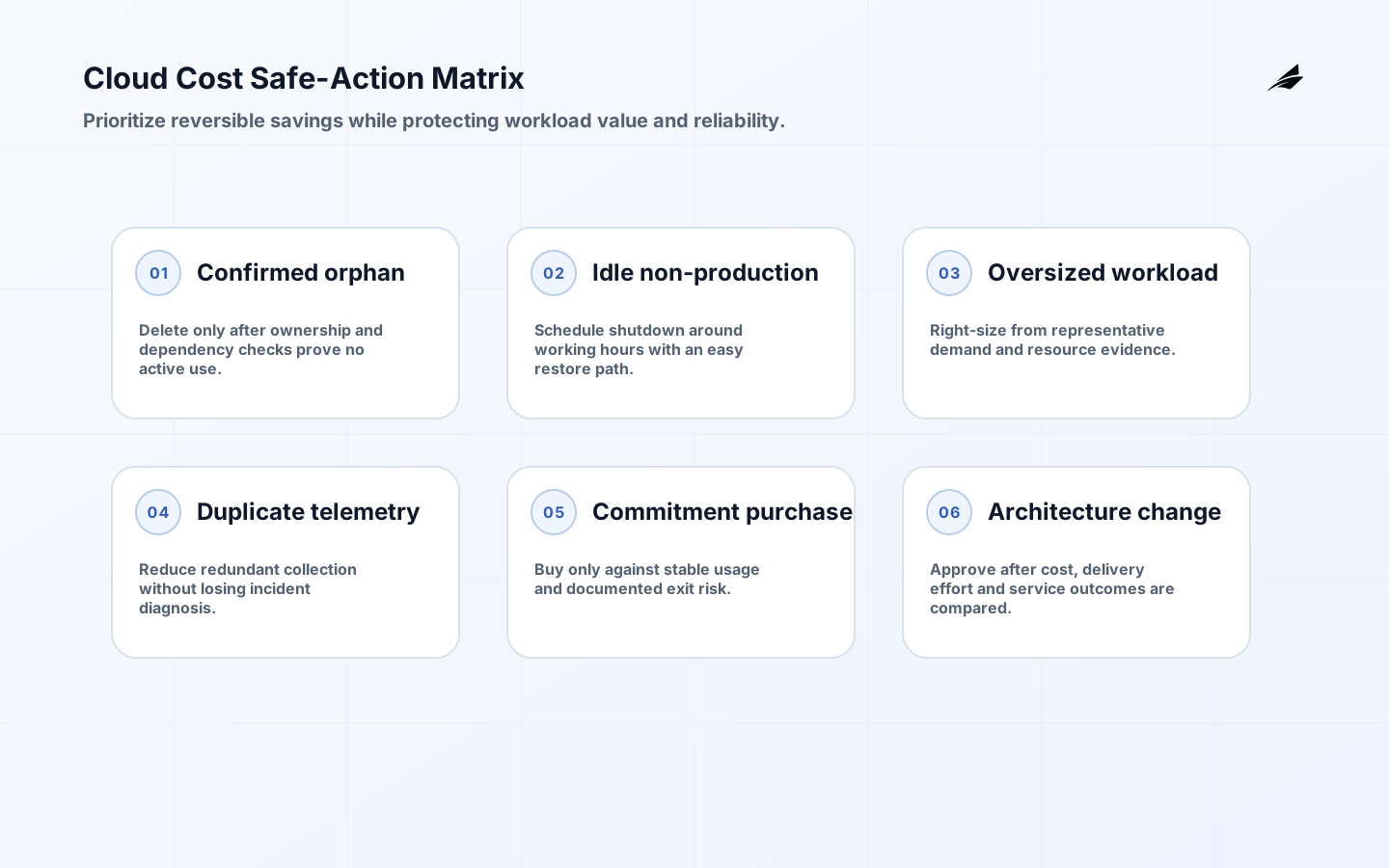
Prioritize reversible changes with clear evidence: delete a confirmed orphan, stop a non-production schedule outside working hours, right-size a workload after observing a representative period, or reduce duplicate telemetry only after confirming the diagnostic need. Architectural changes deserve a stronger case because the savings may be offset by migration risk, operational complexity, or a reliability regression. Commitment purchases are also operational decisions: they depend on a stable usage floor, a funding owner, an expiry calendar, and a plan for ownership changes. The platform engineering guide can help frame shared platform costs, but no central team should turn allocation into a penalty system. The goal is better choices with known trade-offs.
Build the first 90-day practice
In the first month, reconcile one provider export with the financial total, map the chosen scope, and publish the allocation exceptions. In the second month, select a short list of actions where the team controls both the change and its rollback. In the third, compare expected and realized effects, including any reliability or delivery impact, and improve the taxonomy. Keep the implementation small enough that people actually attend the review. Automation should reduce repeated collection and highlight changed conditions, not conceal an unexplained recommendation. A dashboard without a decision owner becomes a reporting artifact; a report tied to a weekly action log becomes part of operations.
Key takeaways
- Cloud cost optimization needs a business boundary, not only a billing export.
- Allocation rules should be explicit, versioned, and correctable.
- Explain cost movement before assigning blame or scheduling a fix.
- Pair savings work with a reliability or capacity guardrail.
- Verify realized impact after the provider billing cycle and operational signals catch up.
Frequently asked questions
Can a small team begin without a FinOps tool? Yes. A reconciled export, a documented allocation rule, a named owner, and an action log are enough to learn. Should every resource have a tag? Tagging helps, but a rule for incomplete tags and shared resources matters more than chasing perfect coverage. Are commitments always savings? Only when the organization has a credible, durable usage floor and can manage renewal and ownership. Is cost per customer always the right unit metric? No. Use the unit that represents the value and workload behavior of the service being reviewed, then state where it is incomplete.
Decision criteria for cloud cost optimization
A team should make cloud cost optimization decisions from a written comparison, not an intuition that a tool or pattern is generally safer. For a reporting service whose monthly spend rises after a product launch, state the baseline, the change being considered, the expected benefit, and the condition that would make the action unsafe. The decision record should name allocated cost and unit economics; it should also identify the smallest reversible step. That creates a practical distinction between a hypothesis and an approved change. A useful reviewer can then ask whether a right-sizing or scheduling change is possible without creating an unowned side effect, whether successful customer work, capacity headroom, and forecast variance will be available in time, and whether the affected people understand the service consequence. The record does not need ceremony. A short change note with links to the release, owner, measurement, and recovery path is enough to make later investigation much faster.
Use an explicit example before automating the rule. Consider a reporting service whose monthly spend rises after a product launch. Walk through the normal case, the delayed case, and the failure case with the people who operate it. Identify which input is authoritative, what a missing or stale input looks like, and what an operator can safely do while evidence is incomplete. For cloud cost optimization, this exercise often exposes a hidden assumption about timing, identity, or compatibility that a happy-path demonstration never reaches. It also clarifies what must be visible to support: current state, change owner, linked evidence, and the next action. Build those details into the workflow or runbook before increasing automation. A reliable default is useful only when its exceptions are observable and recoverable.
Failure analysis and recovery for cloud cost optimization
Plan for treating a delayed invoice export or a changed allocation rule as evidence of waste. Detection should route to the product engineering owner and the finance partner, but the alert or review item must contain enough context to start an investigation without manual archaeology. Include the relevant version or policy identifier, affected scope, timestamp, correlation reference, and the last known healthy comparison where available. The first response should reduce further harm while preserving evidence; the second should validate whether the apparent fault is data quality, a dependency condition, an operator change, or the design itself. Recovery does not always mean returning to the previous state. Sometimes it means a forward correction, an access restriction, a narrower cohort, or a temporary manual procedure. Document which action is safe for the case and who may authorize it.
Conclusion
Cloud cost optimization works when spending becomes an understandable input to engineering and business decisions. Establish a narrow scope, make allocation legible, act with guardrails, and verify what changed. The resulting practice produces fewer surprise discussions and more credible trade-offs than a periodic search for discounts.