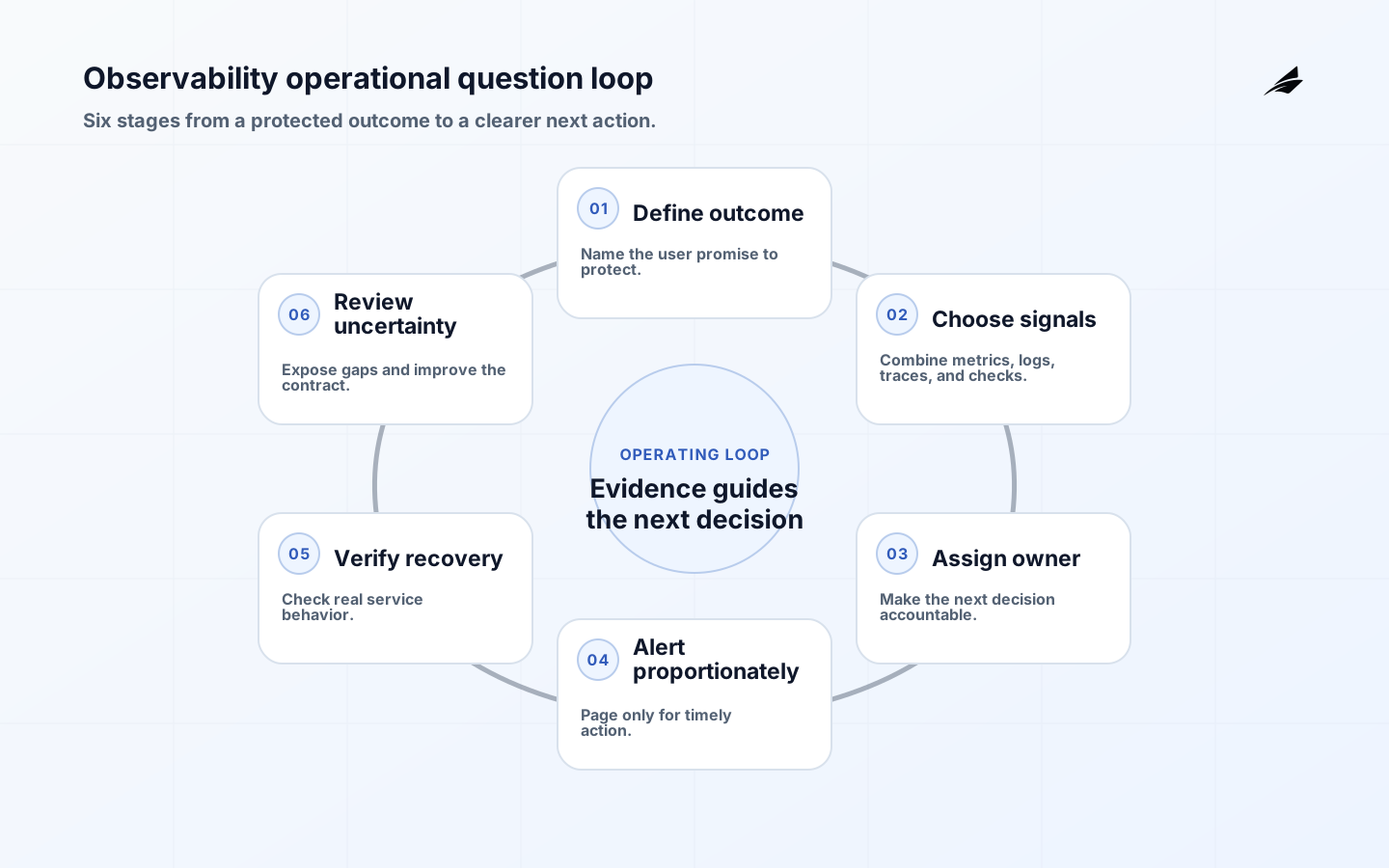
Observability is a way to make important operational questions answerable. Before the first build, an engineering team should know what an on-call person must determine during a customer-impacting failure: who is affected, what changed, where work is failing, whether the signal is trustworthy, and what action restores a safe state. Dashboards and agents are implementation choices, not the outcome. Google SRE monitoring guidance connects signals with diagnosis, while OpenTelemetry describes interoperable telemetry signals and conventions. Together they point to a practical rule: design the decision path first, then collect the smallest evidence that makes that path reliable. The log aggregation guide shows how those questions become evidence.
Define operational questions before implementation
Write three questions in the language of the service. For a file-upload product: are completed uploads meeting the user promise, which release or dependency explains failures, and can the responder protect successful work while investigating? Give each question an owner, a service boundary, a time window, and a decision. The OpenTelemetry signals guide helps distinguish metrics, logs, traces, and related evidence; it does not decide which signal a local operator needs. Start with an outcome and a failure path, not with a catalogue of every available metric.
| Question | Useful signal | Action it should support |
|---|---|---|
| Are users completing the task? | Outcome rate and latency by journey. | Protect users, adjust capacity, or declare impact. |
| Where is work failing? | Trace spans, dependency result, and error class. | Route investigation to an owner. |
| What changed? | Revision, configuration, and deployment timeline. | Pause or roll back a risky change. |
| Is recovery real? | Synthetic check and completed business event. | Close mitigation only after verification. |
Make observability risk visible
A useful observability contract names the trigger, system boundary, responsible owner, expected evidence, and unhappy paths. Include dependency timeouts, invalid state, capacity pressure, dropped events, and unavailable responders. Define service-level indicators that represent user or business outcomes, then set objectives and alerting thresholds that reflect the cost of interruption. The SLO alerting workbook is valuable because it connects alerts to error-budget consumption rather than treating every fluctuation as an emergency. Keep high-cardinality detail available for investigation without making every dimension a paging rule.
Semantic consistency matters when multiple teams own parts of one journey. Use stable names for service, operation, environment, version, tenant class where appropriate, and dependency. OpenTelemetry semantic conventions can reduce the friction of combining signals, but local attributes still need a definition and owner. Record what is sampled and what is not. A trace that is available only for successful requests cannot answer why an important failure occurred. Make signal loss visible and treat instrumentation changes as part of the service change path.
Use observability evidence, not proxy success
A healthy CPU graph does not prove that checkout works, and a low model latency does not prove that a customer received a useful result. Pair resource and component measures with completed user actions, error-budget behavior, and dependency context. Inspect false alarms, silent failures, and incidents where the dashboard looked green. The signal set should reveal uncertainty: missing telemetry, delayed aggregation, sampled traces, or a business outcome that is not directly measurable. Those limits belong in the runbook so the responder does not mistake an absence of evidence for an absence of impact.
| Signal type | Strength | Common limit |
|---|---|---|
| Metrics | Fast trend and threshold detection. | Can hide individual request context. |
| Logs | Detailed facts and error categories. | Can be noisy, sensitive, or incomplete. |
| Traces | Cross-service sequence and timing. | Sampling and propagation gaps matter. |
| Synthetic or business checks | Direct view of a user journey. | May cover only selected paths and regions. |
Start with one customer path
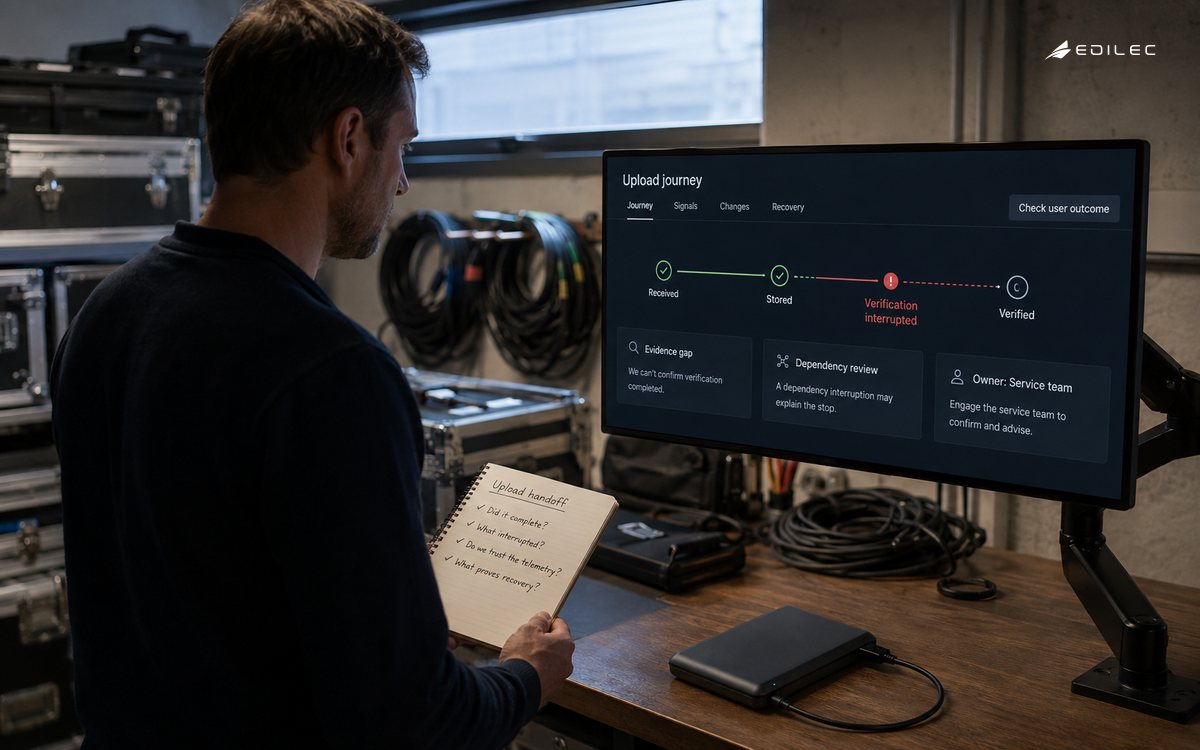
Choose one service journey with a clear owner and a known failure mode. Instrument it from entry to meaningful completion, create a small runbook, and rehearse a dependency failure. Ask whether a new responder can identify impact, scope, likely change, next action, and recovery evidence without private memory. Only then widen to other services. A narrow first path exposes naming, clock, access, and alert-fatigue problems while the team can still adjust the contract. It also demonstrates value in terms the product and operations teams can recognize.
Evaluate observability trade-offs
More telemetry can increase diagnosis quality and increase storage, query, privacy, and operational burden. High-cardinality labels can make an investigation possible and make a metrics backend expensive. Long retention can support trend analysis and enlarge access exposure. Make the trade-off per question: retain aggregate service health longer, keep sensitive payload detail shorter, and provide an approved escalation path for a high-detail investigation. Review whether each alert leads to a bounded action and whether each collected field is actually used. Remove signals that do not inform a decision.
Design observability for recovery
Observability should show when recovery is safe, but it cannot create a recovery plan by itself. Define rollback, failover, rate limiting, feature disable, or manual workaround routes alongside the signals that trigger them. Preserve the deployment and configuration revision that was active, and verify recovery from the user’s perspective. The production observability guide and distributed tracing guide can help when the first design crosses service and incident boundaries.
Observability review checklist
Before implementation, ask: what user outcome is protected, who owns the decision, which event proves success, which dependency can invalidate the assumption, which signal is missing during an incident, what access is required, and how the change will be reversed? After implementation, run a realistic failure exercise and compare the actual decision path with the intended one. The best observability plan is not the one with the most instruments; it is the one that makes a safe next action clear under pressure.
Give every important signal an owner and a freshness expectation. A stale metric can be worse than no metric if it encourages a false recovery decision. Show collection delay, last successful update, sampling, and known gaps beside the signal. When an SLO or business check changes, review the alert route and runbook at the same time. This keeps the observable contract aligned with the service promise. This boundary belongs in the service review record.
Access is part of observability design. An on-call engineer may need service health but not sensitive request content; a security investigator may need a protected audit record that product support should not see. Define these views before launch and test them with realistic identities. A signal that exists but cannot be reached under pressure is not a dependable control. A signal that is available too broadly is a different kind of operational risk. This boundary belongs in the service review record.
Use review meetings to remove ambiguity, not just to admire trend charts. Take one alert and ask what decision it should trigger, what evidence confirms it, who owns the next action, and how the action is reversed. If those answers differ by team, fix the contract or the ownership boundary. This practice turns observability from a reporting layer into a shared operating language. This boundary belongs in the service review record.
When retiring an instrument, check the runbooks, alerts, dashboards, tests, and incident templates that depend on it. Migrate consumers deliberately and keep a temporary comparison if the replacement changes semantics. Delete stale routes and permissions after the transition. Observability becomes easier to trust when the system makes it clear which signals are current and which historical views are no longer safe to use. This boundary belongs in the service review record.
Treat freshness as part of the signal definition, not an annotation added after an incident. For each important metric or trace view, show its collection delay, last successful update, sampling rule, and known blind spots. An operator can then distinguish a quiet service from a quiet telemetry path before choosing recovery action.
Access should follow the decision being made. An on-call engineer may need aggregate service health, while a security investigator may need a protected audit record and product support may need neither request content nor tenant-level detail. Test those roles during an exercise so availability and least privilege are proven together rather than traded informally.
Use the review meeting to examine one alert from trigger to action. Identify the customer outcome, evidence that confirms the condition, accountable next step, and reversal method. If different teams answer differently, update the signal contract or ownership boundary; a chart that invites debate without a decision path is not operationally complete.
Retire instrumentation as a dependency migration. Check alerts, dashboards, runbooks, tests, incident templates, and access grants, then keep a short comparison period if the replacement changes meaning. Mark historical views as archived and remove the old path only after consumers can identify which current signal supports the same operational question.
Key takeaways
- Define operational questions and protected user outcomes before selecting tools.
- Use metrics, logs, traces, and business checks for complementary purposes.
- Make ownership, missing evidence, sampling, and access part of the contract.
- Alert on decision-relevant service behavior, not every component fluctuation.
- Start with one real journey and exercise a realistic failure path.
- Design recovery evidence separately and remove telemetry that does not inform action.
Frequently asked questions about observability
What is the best first observability investment? A clear user outcome, service owner, and end-to-end path with a small runbook. Does observability remove human judgment? No; it makes judgment better informed and records the limits of evidence. Should every metric page someone? No. Page only when a timely response protects the service or users. How should success be measured? Look at detection quality, investigation time, recovery confidence, false alerts, and whether the telemetry changed a decision. Is OpenTelemetry a complete observability strategy? No. It provides instrumentation and interoperability; teams still need questions, ownership, policy, and recovery.
Conclusion
Observability before the first build is a design conversation about evidence and action. Define the questions, connect signals to outcomes, expose uncertainty, protect sensitive context, and rehearse recovery. The result is a smaller but more useful operational system—one that helps a responder understand what is happening and choose the next safe move.