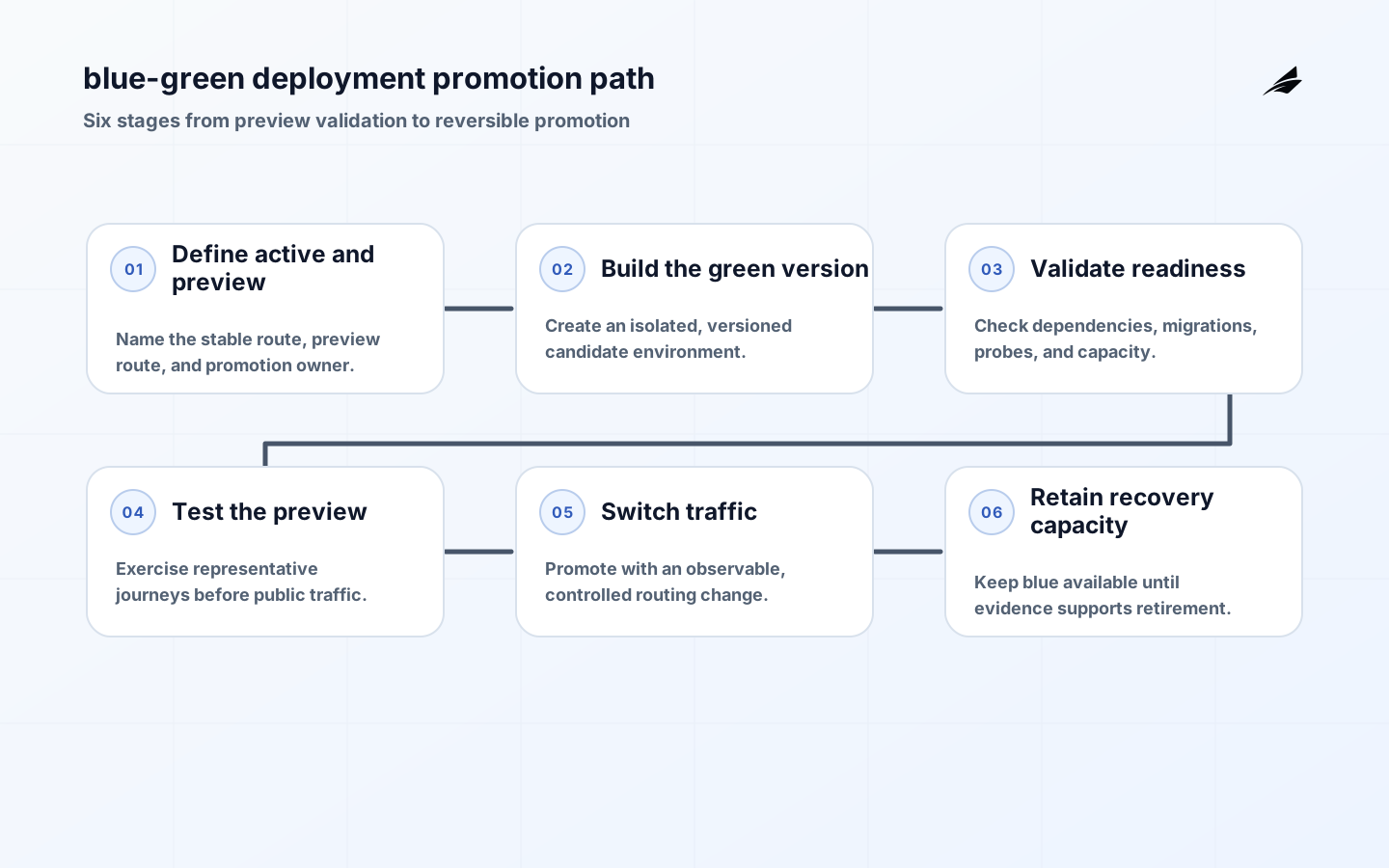
Blue-green deployment keeps two application environments or release versions available so production traffic can move from the current version to a prepared candidate. The appeal is obvious: validation can happen before the public switch, and the prior version may remain available as a recovery target. The hard part is that application instances are only one layer of a release. Data, routing, sessions, caches, background workers, permissions, and external dependencies may still make the switch unsafe. A useful blue-green deployment design begins by naming what blue and green mean in the chosen platform: active and preview service routes, separate environments, target groups, or versioned workload sets. Then decide which state must be compatible across both versions and how long the old version will remain capable of serving or recovering work.
Build the blue-green operating model
The operating model has four decisions: who prepares the candidate, who validates it, who authorizes promotion, and who can reverse the traffic decision. Those may be the same person for a small service, but the roles should still be explicit. Define an active route for normal traffic and a preview route that can reach the candidate without accidentally becoming a shadow production endpoint. State which tests are meaningful in preview: synthetic checks, contract tests, internal acceptance journeys, or controlled partner traffic. A preview that has no representative identity, data shape, or dependency access is not evidence of production readiness. The blue-green deployment guide gives a related implementation perspective; use it alongside a release checklist that includes capacity, observability, and communications.

Design for state compatibility
The safest blue-green releases use additive changes. A new column, endpoint, or message field can be introduced while the old version still operates; removal follows only after the old path is retired. Breaking schema changes, destructive backfills, and write-format changes need a different plan because switching traffic back may not restore the prior behavior. Sessions also need attention. If a user is authenticated or has work in progress when traffic changes, decide whether session state is shared, drained, or re-established. Background workers can create duplicate processing if both colors consume the same queue without an idempotency and ownership design. A traffic switch is fast only when the underlying state boundary has already been made compatible.
| Area | Decision before promotion | Useful evidence |
|---|---|---|
| Routing | Which route is active and which is preview? | Versioned route and tested switch procedure. |
| Data | Can both versions read and write safely? | Compatibility test and migration record. |
| Sessions | What happens to in-flight user work? | Session strategy and representative test. |
| Workers | Can both versions process the same event? | Idempotency rule and queue ownership. |
| Capacity | Can two versions run during validation? | Load estimate and resource guardrail. |
Use evidence for promotion and retention
A green environment becoming ready is a necessary condition, not a promotion decision. Combine readiness with the checks that matter to the changed service: an authenticated user journey, a compatibility test against a critical dependency, a security control check, and a comparison of latency or error behavior. Make the promotion policy visible. It might require a successful pre-promotion analysis and a human approval for payments, or permit automatic promotion for a reversible internal service. After traffic shifts, keep blue alive for a deliberate observation window. Routing propagation and connection draining can mean some nodes reach the old target briefly; the old version must not disappear before the routing layer and users have settled. The observation window is also where post-promotion analysis should detect a regression that preview could not reveal.
| Gate | What it checks | Decision on failure |
|---|---|---|
| Candidate readiness | The green version can start and serve dependencies. | Do not expose the version. |
| Preview journey | Critical behavior works with realistic identity and data. | Fix or reject the candidate. |
| Pre-promotion analysis | Service and business indicators meet the policy. | Pause or abort promotion. |
| Post-promotion analysis | The active route remains healthy after traffic change. | Shift back while blue is retained. |
| Retirement review | Blue is no longer needed for recovery. | Scale down and record the release. |
Accept the capacity and complexity trade-off
Running two versions consumes capacity, increases coordination, and may duplicate dependency load. It is most valuable when a clear traffic switch and retained previous version materially reduce release risk. For every small internal change, a rolling update or feature flag may be simpler. For a service with costly warm-up, strict availability needs, or a high-consequence customer journey, the added capacity may be justified. Calculate the cost as an operating choice: preview replicas, full green capacity at promotion, scale-down delay, and the maximum number of old revisions retained. Do not quietly weaken the recovery window to save resources; make the trade-off visible and ensure the chosen route is still credible.
Introduce the pattern with one suitable service
Choose a stateless or backward-compatible service with a visible request path and known capacity profile. Create separate active and preview routes, instrument both, and write a promotion and reversal runbook before automating it. Release a harmless but observable change through the full path to validate selectors, access policies, session behavior, and status communications. Next, add analysis gates that are stable enough to make decisions. Only then consider broader standardization. Teams often standardize blue-green terminology while leaving each service with a different routing and data behavior; the better platform pattern standardizes the contract and lets service owners document the justified exceptions.
Key takeaways
- Blue-green deployment separates preview validation from the active traffic switch.
- State compatibility determines whether the prior version is a real recovery target.
- Promotion needs user and dependency evidence, not only process readiness.
- Keep the old version available through an explicit post-promotion observation window.
- Use the pattern where its capacity and coordination cost is justified by reduced release risk.
Frequently asked questions
Is blue-green the same as canary release? No. Blue-green normally switches an active route between prepared versions, whereas a canary intentionally exposes a bounded share and evaluates it before expansion. Can blue-green eliminate downtime? It can reduce it, but routing behavior, data compatibility, load balancers, and dependencies still need testing. Does blue need full capacity after promotion? It needs enough retained capacity for the agreed recovery behavior and route propagation, which may differ from full production scale. Can a database be blue-green? Usually the application versions can be; database migration plans must handle compatibility rather than assume two isolated copies.
Decision criteria for blue-green deployment
A team should make blue-green deployment decisions from a written comparison, not an intuition that a tool or pattern is generally safer. For a customer portal release with a changed session format and a busy background queue, state the baseline, the change being considered, the expected benefit, and the condition that would make the action unsafe. The decision record should name the active route, preview route, and compatible data state; it should also identify the smallest reversible step. That creates a practical distinction between a hypothesis and an approved change. A useful reviewer can then ask whether a controlled promotion or traffic return to the prior version is possible without creating an unowned side effect, whether representative journey results, route health, and post-promotion behavior will be available in time, and whether the affected people understand the service consequence. The record does not need ceremony. A short change note with links to the release, owner, measurement, and recovery path is enough to make later investigation much faster.
Use an explicit example before automating the rule. Consider a customer portal release with a changed session format and a busy background queue. Walk through the normal case, the delayed case, and the failure case with the people who operate it. Identify which input is authoritative, what a missing or stale input looks like, and what an operator can safely do while evidence is incomplete. For blue-green deployment, this exercise often exposes a hidden assumption about timing, identity, or compatibility that a happy-path demonstration never reaches. It also clarifies what must be visible to support: current state, change owner, linked evidence, and the next action. Build those details into the workflow or runbook before increasing automation. A reliable default is useful only when its exceptions are observable and recoverable.
Failure analysis and recovery for blue-green deployment
Plan for scaling down blue before routing converges or before the new version has been observed under meaningful load. Detection should route to the release owner and the on-call service team, but the alert or review item must contain enough context to start an investigation without manual archaeology. Include the relevant version or policy identifier, affected scope, timestamp, correlation reference, and the last known healthy comparison where available. The first response should reduce further harm while preserving evidence; the second should validate whether the apparent fault is data quality, a dependency condition, an operator change, or the design itself. Recovery does not always mean returning to the previous state. Sometimes it means a forward correction, an access restriction, a narrower cohort, or a temporary manual procedure. Document which action is safe for the case and who may authorize it.
- Define a precondition for a controlled promotion or traffic return to the prior version and test it with a representative non-production or limited-production case.
- Keep the identifiers needed to connect the active route, preview route, and compatible data state to the change, investigation, and owner.
- Make representative journey results, route health, and post-promotion behavior visible at the point where a release or operator decision is made.
- Treat an exception as data: capture why it was needed, who approved it, and when it expires.
- Review recurring failures with the release owner and the on-call service team and convert the strongest lesson into a control, contract, or runbook improvement.
Operating review for blue-green deployment
Set a review cadence that matches the risk and rate of change. The review should ask whether the current approach still produces the promised outcome, whether representative journey results, route health, and post-promotion behavior is trustworthy, and whether the exception path is being used as a substitute for a missing capability. Examine a small number of real cases instead of only aggregate charts: one successful change, one delayed or rejected change, and one recovery. This evidence makes trade-offs concrete. If the pattern repeatedly depends on expert intervention, reduce the scope or improve the supported path before expanding it. If the outcome is stable, publish the decision criteria so adjacent teams can reuse the model without copying assumptions that do not apply to them.
Conclusion
Blue-green deployment is valuable when it gives operators a tested, observable way to validate a candidate and recover from a traffic decision. Make active and preview boundaries explicit, design state compatibility first, and retain the prior version until the evidence says the release is genuinely stable.