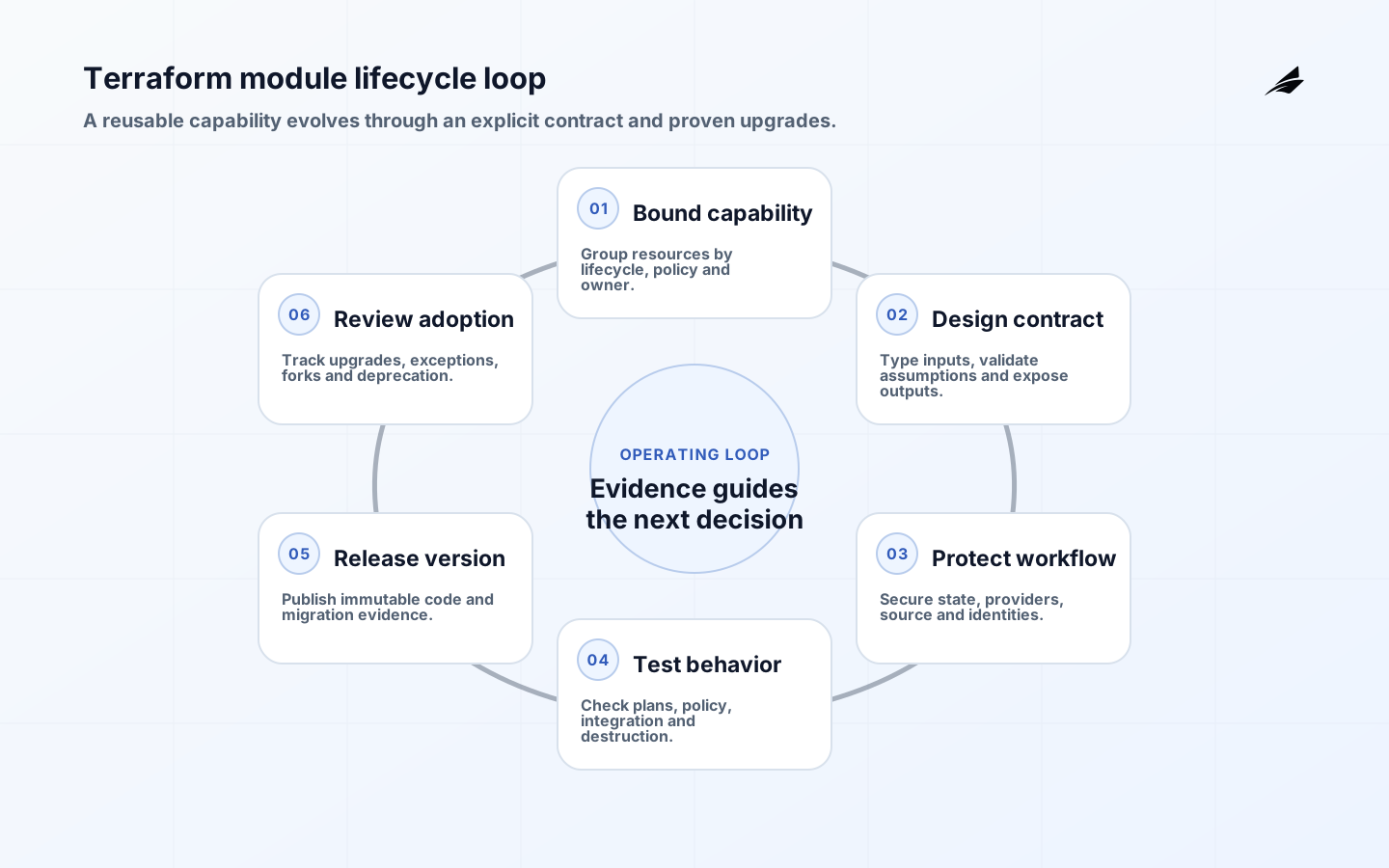
Terraform modules should encode an infrastructure capability, not hide a pile of resources behind dozens of switches. A good module gives consumers a stable, documented contract for something they need repeatedly: a private service endpoint, an application runtime, or a database with the organisation's required controls. It remains understandable in plans, produces useful outputs, and can evolve without forcing unsafe state surgery.
This guide treats Terraform modules as maintained products. It connects with Edilec's GitOps guide, deployment rollback guide, and serverless production guide for the surrounding delivery and operations model.
Key takeaways
- Create a module only for a repeated capability with a clear owner and support boundary.
- Keep module trees flat; pass dependencies through explicit inputs and outputs.
- Validate inputs, declare assumptions, minimise sensitive outputs, and never treat state as a secret store.
- Test static quality, plans, policy, behavior, upgrades, and destruction at proportionate levels.
- Publish immutable versions with migration notes and measure adoption before retiring old releases.
Choose a capability-sized boundary
HashiCorp's modules overview describes modules as collections of resources managed together. The practical design question is which resources share a lifecycle and policy. A module for an application load balancer, listeners, logs, and baseline alarms may be coherent. A module that creates networking, compute, database, DNS, monitoring, and every environment option becomes a platform hidden inside a function call.
Write a short contract before code: consumer, capability, owned resources, external dependencies, guaranteed outputs, policy defaults, unsupported cases, and upgrade promise. Do not module-ise a one-off configuration solely to reduce line count. HashiCorp's creating modules guidance warns that overuse makes configuration harder to understand. Repetition plus a stable organisational decision is the stronger signal.
| Boundary signal | Healthy choice | Warning sign |
|---|---|---|
| Lifecycle | Resources usually change and destroy together | Unrelated services coupled for convenience |
| Policy | Defaults express an approved control | Module contains team-specific workflow |
| Interface | Few meaningful inputs describe intent | Provider arguments exposed one-for-one |
| Ownership | Named maintainer and support route | Copied code with no accountable owner |
| Evolution | Compatible changes can be versioned | Every update requires state manipulation |
Design a small, typed interface
Use nouns that express intent and strongly typed objects for related settings. Add descriptions and validation for ranges, formats, and permitted combinations. Defaults should be safe and common, not merely convenient for the first caller. Avoid boolean forests such as createnetwork, createlogs, createrole, and createalarm; they generate untestable combinations. Prefer separate composable modules or a small enum-like mode when behavior is genuinely cohesive.
Expose outputs that let callers compose capabilities without depending on internal resource addresses. HashiCorp recommends flat module composition: root modules connect child modules through outputs and inputs. Pass a subnet identifier into an application module instead of letting that module create or discover a network through hidden rules. Explicit dependencies improve plans, reuse, and incident diagnosis.
Protect state, providers, and secrets
State can contain resource attributes and sensitive values even when output display is marked sensitive. Store it in a protected backend with encryption, access control, locking, audit, and recovery. Keep state boundaries small enough that teams do not need broad access for one change. Use provider configuration in the root module so credentials and aliases remain an environment concern; child modules should declare requirements without embedding authentication.
Pin Terraform, provider, and module constraints deliberately, commit dependency lock information where appropriate, and authenticate CI with short-lived workload identity. The official Terraform style guide recommends version pinning, module tests, protected credentials, and policy controls. Review third-party module source, ownership, transitive modules, required providers, license, release history, and generated plan before adoption.
Test contracts, not just syntax
Formatting and validate checks catch basic errors but do not prove behavior. Add variable validation, preconditions, postconditions, and check blocks for assumptions that can be evaluated. Use Terraform tests or ephemeral integration environments to verify outputs and provider behavior. Inspect plans for destructive or privilege-expanding changes, run policy checks for mandatory controls, and test representative callers rather than only the module's happy-path example.
| Test layer | Purpose | Example |
|---|---|---|
| Static | Catch syntax, style, and provider mistakes | Format, validate, lint, secret scan |
| Contract | Prove inputs and outputs behave | Invalid CIDR fails; endpoint output exists |
| Plan | Detect destructive or policy-breaking change | No replacement on compatible upgrade |
| Integration | Verify actual provider behavior | Encrypted service deploys and serves |
| Upgrade | Protect existing consumers and state | Previous version upgrades without recreation |
| Destroy | Confirm cleanup and retained-data policy | Temporary environment leaves no orphan |
Treat test accounts as disposable but controlled. Set budgets, quotas, ownership tags, and automatic cleanup. Do not run broad integration tests with production credentials. NIST's SSDF applies to infrastructure code too: protect source, review changes, secure dependencies and build paths, preserve evidence, and maintain a response route when a module introduces a vulnerability.
Version and evolve without surprise
Publish immutable releases and use semantic versioning as a communication tool, not a guarantee that providers will never behave unexpectedly. A compatible release can add an optional input or output; a breaking release may rename addresses, change defaults, or replace resources. Document minimum tool and provider versions, security implications, expected plan, migration steps, rollback limits, and moved or import blocks when they preserve state safely.
Before publishing, test an upgrade from every supported major version on realistic state. Release first to a volunteer root module, inspect the plan, apply, and observe. A network module update that appears harmless may recreate routes or security rules because an internal address changed. The migration note must state what consumers will see, how long it takes, and which recovery options remain once apply starts.
Work through a service endpoint module
Suppose teams repeatedly need a private object-storage endpoint with DNS, logging, and approved policy. The module accepts network and subnet identifiers, service name, permitted principals, and log retention. It creates the endpoint and controls that share its lifecycle, then returns endpoint and DNS identifiers. It does not create the network, application role, or bucket. The root module composes those dependencies and keeps environment authority visible.

- Test a normal deployment and reject public subnets or wildcard principals.
- Confirm logs are retained and the output contains no credential material.
- Upgrade from the prior module release and require a non-destructive plan.
- Run a denied-access scenario with an unapproved principal.
- Destroy the test fixture and verify retained logs follow the documented policy.
Operate the module portfolio
Maintain a registry or catalogue with owner, support status, latest release, supported major versions, examples, and deprecation date. Observe which versions root modules actually use before removing support. Track failed plans, policy exceptions, security findings, upgrade duration, and consumer questions. Repeated overrides may indicate a poor boundary; repeated forks indicate the contract is not meeting a legitimate need.
Set an intake and review cadence. Maintainers should distinguish a broadly reusable capability from a one-team feature, document rejected requests, and avoid adding switches that weaken controls. Deprecation requires a migration path and enough time for consumers to plan. Archive unsupported modules clearly so a registry search does not make an abandoned version look approved.
Review a module before publication
A publication review begins with the contract, not the README polish. Ask a consumer unfamiliar with the implementation to create a minimal root module from the documentation. They should understand required providers, inputs, outputs, external dependencies, security defaults, cost-bearing resources, and destruction behavior. Inspect the resulting plan for readable addresses and unexpected replacement. Then use invalid inputs and missing dependencies to confirm failures occur early with messages that explain the violated assumption.
Review state and authority deliberately. Identify every sensitive value that can reach state, each provider permission needed during plan and apply, and which outputs consumers will propagate. Confirm the test workflow uses isolated credentials and that a compromised pull request cannot obtain production authority. Scan examples too: users copy them into real roots, so an example with open ingress or an unpinned source can undermine safer module defaults.
The release evidence should include static checks, plan snapshots for representative configurations, policy results, integration and destroy tests, and an upgrade from the oldest supported version. Record expected resource replacement and provider-specific caveats. Publish a change log that speaks in consumer effects rather than internal commits. Assign a support owner and response path before announcing the module as approved; reuse without maintenance simply centralises future failure.
Frequently asked questions
Can public Terraform modules be used in production?
Yes, after due diligence and testing. Review source, maintainers, releases, providers, nested dependencies, permissions, license, and plan output. Pin an approved version and define who monitors advisories and upgrades. Registry presence is distribution, not organisational approval.
Should every module have its own repository?
Independent modules with distinct release cadences often benefit from separate repositories. Closely related, jointly owned modules may work in a monorepo if tooling supports clear versioning and tests. Optimise for ownership and release clarity rather than a universal rule.
Should we wrap every provider resource?
No. A wrapper that repeats every provider argument adds maintenance without expressing an organisational capability. Wrap a resource set when you can provide a stable abstraction, safe defaults, required controls, and meaningful lifecycle ownership.
Conclusion
Production Terraform modules are versioned infrastructure contracts. Choose capability-sized boundaries, make dependencies explicit, protect state and identities, test upgrades and destruction, and maintain a real consumer lifecycle. The best module reduces repeated judgment while leaving plans, ownership, and failure behavior understandable.