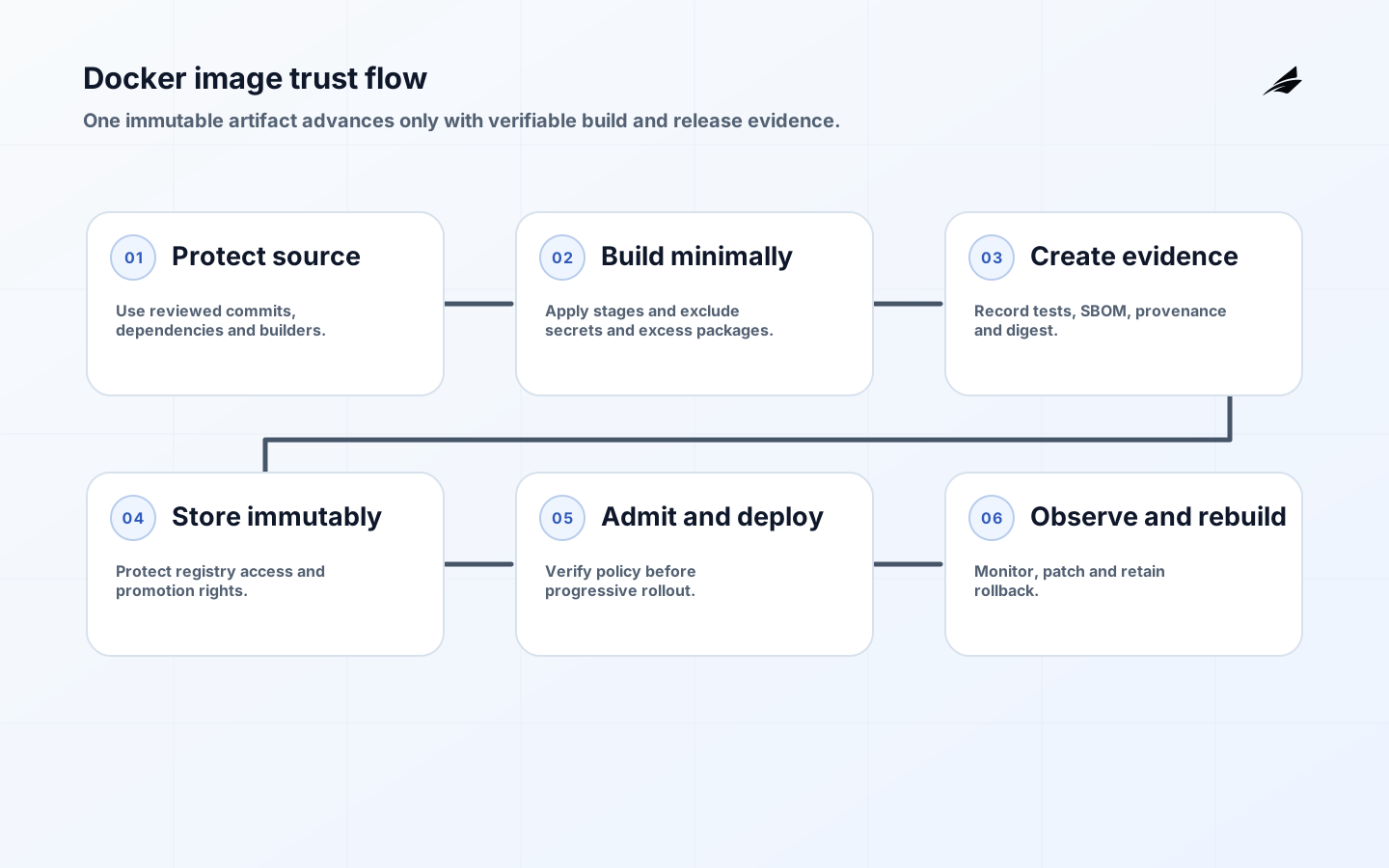
Docker Images become important when a team can no longer rely on shared memory to make a production decision. An image is a packaged runtime input, not merely a developer convenience. Operations leaders inherit the consequence of a stale base, an untracked tag, a secret copied into a layer, or a production deployment that cannot be tied to a build. The management question is whether the organization can identify, assess, and replace the exact software it is running. This guide treats the work as an operating system for change: name the service obligation, make the boundary inspectable, choose controls that match risk, and retain evidence that lets a different responder act safely. The companion Docker image architecture guidance is useful context when the topic touches a related production concern.
Use Edilec’s Docker image architecture guide for the artifact model, container security notes for runtime controls, and CI/CD in production for release ownership and rollback.
Follow one image from commit to production
Example: a small API service
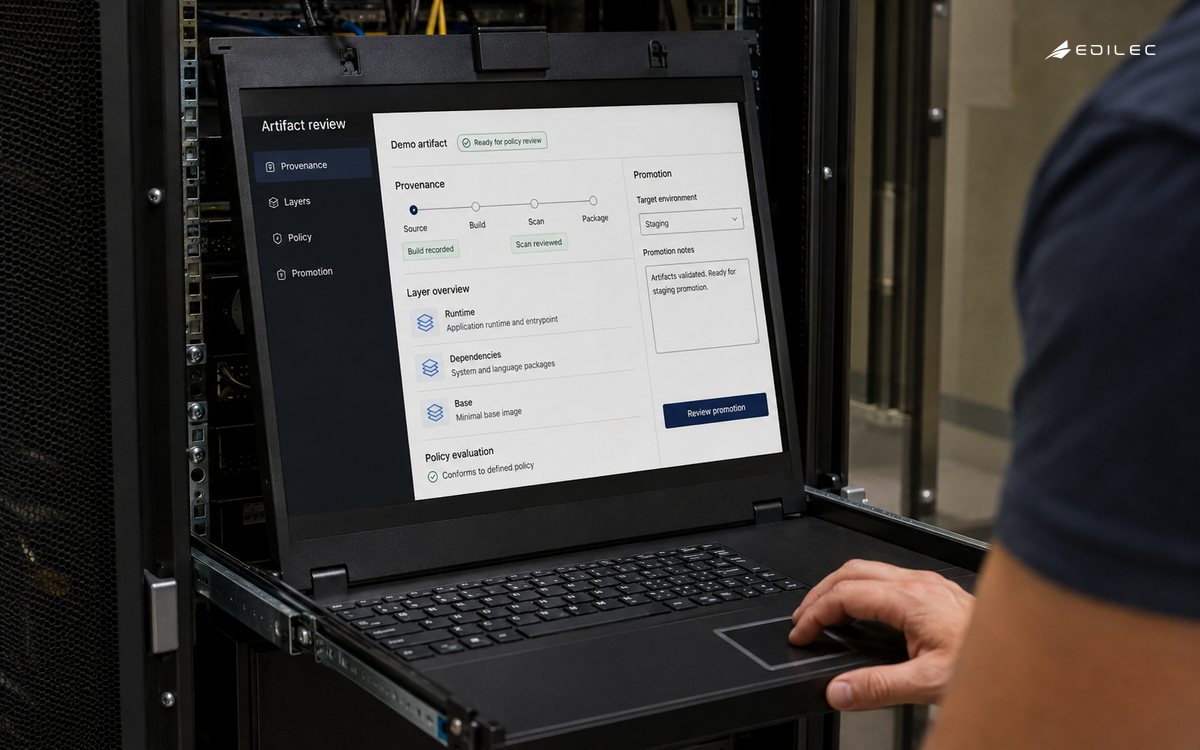
A developer merges a dependency update. CI checks out a protected commit, resolves dependencies from approved sources, and builds in isolation without embedding credentials. A multi-stage Dockerfile compiles and tests the API, then copies only required runtime files into a non-root image. The pipeline records the base digest, commit, builder, dependency inventory, tests, software bill of materials, scan findings, and produced image digest. Environments promote that immutable digest rather than rebuilding from a mutable tag.
A scan is one decision input, not a release oracle. Determine whether a vulnerable component is present and reachable, whether a fix exists, which compensating controls apply, and who accepts a time-bound exception. Admission should reject an unexpected digest or privilege request. Roll out gradually, observe health and business outcomes, and retain a known-good digest for rollback. Rebuild when bases or dependencies change even without application changes, and require emergency rebuilds to follow the same identity and evidence path.
Key takeaways
- Treat an image as a production artifact whose exact contents and origin must be identifiable.
- Build once, promote by digest, and retain the inputs and attestations needed to reproduce it.
- Pair vulnerability information with ownership, runtime exposure, remediation time, and exception expiry.
- Prove rebuild, admission, rollout, and rollback on one service before publishing the reference path.
Set the purpose and boundary for Docker Images
Draw the image boundary around everything that determines the filesystem and launch metadata a workload receives. Compilers, package managers, credentials, and test fixtures belong in an isolated build stage; required runtime binaries, libraries, certificates, and a deliberate entrypoint belong in the final artifact. Configuration and secrets should arrive through controlled runtime mechanisms, not layers. Use tags as readable labels, but use the manifest digest as the deployable identity. Registry responsibilities are part of this model: authorize repositories and publishers, protect immutability, retain artifacts for investigation and rollback, and define how a compromised item is withdrawn. The service owner remains accountable for application suitability, while platform and security owners maintain shared builders, policy, and evidence. Writing these boundaries down makes ownership clear during both routine promotion and urgent replacement.
For an image program, state what runtime behavior must remain dependable and what an unsafe artifact looks like: an unknown digest, a vulnerable component without an owner, or a secret in the build context. That statement gives responders a practical basis for promotion holds and emergency rebuilds.
| Image decision | Operational consequence | Evidence to retain |
|---|---|---|
| Parent artifact | Introduces the operating system, libraries, defaults, and upstream maintenance lifecycle | Approved publisher, pinned digest, support status, and last successful refresh |
| Build inputs | Determine reproducibility and can accidentally copy credentials or local files | Protected commit, lockfiles, fetched dependencies, ignore rules, and isolated builder identity |
| Runtime package | Defines executable content, user, entrypoint, environment declarations, and exposed metadata | Image digest, SBOM, provenance, scan disposition, signature, and configuration checks |
| Promotion record | Connects the reviewed artifact to environments without rebuilding it | Target, approver, policy result, rollout observations, and prior known-good digest |
Build an operating model for Docker Images
Use a compact responsibility model that follows the artifact. Platform engineering maintains hardened parent images and isolated builders; application teams own the Dockerfile, dependency choices, tests, and runtime assumptions; security defines admission and finding-disposition rules; the service owner approves release risk and validates restoration of user outcomes. Routine compliant builds should flow without manual ceremony. Evidence gaps, secrets detected in layers, unapproved parents, critical reachable vulnerabilities, or unexpected privilege should stop promotion and identify the role able to resolve them. Exceptions need a documented scope, compensating measure, approver, expiry, and replacement plan. That keeps urgent work possible without converting an emergency into a permanent bypass. Default the final image to a non-root identity, remove build tools, and never use a build argument for a credential that could survive in metadata or history.
Use proportionate controls and retained evidence
Select controls according to the question an operator must answer. A pinned parent digest establishes inherited bytes; a protected source revision and dependency locks identify application inputs; an isolated build reduces environmental drift; SBOM and provenance records support impact analysis; signature or attestation policy constrains admission; a runtime user and capability policy limit consequences. Keep the image digest connected to all of that evidence and to the environment promotion record. Findings require context: package presence, reachable use, available fix, compensating controls, owner, and due date. Scanners inform the release decision but do not own it. When a problem surfaces, an on-call engineer should be able to identify exactly which services run the affected digest and which clean digest can replace it. The container security notes add runtime containment considerations beyond the artifact itself.
| Finding or event | First response | Durable improvement |
|---|---|---|
| A parent image publishes a security repair | Query affected SBOMs, rebuild from protected inputs, retest, and promote new digests | Track elapsed time from available repair to verified production replacement |
| An artifact arrives without expected provenance | Deny admission and compare publisher, workflow, commit, and digest with the build record | Investigate builder identity or attestations before any exception |
| The new digest fails after rollout | Pause expansion, restore the known-good digest, and preserve workload and platform evidence | Classify whether image contents, external configuration, or runtime platform caused the behavior |
Measure the service outcome and operating health
Use image telemetry to drive maintenance and incident choices. Inventory the proportion of production workloads pinned by digest, unsupported or overdue parent artifacts, builds missing SBOM or provenance, unresolved findings past their agreed date, and the time needed to replace a remediated component. Watch registry rejection and pull errors, admission denials, rollout failures by digest, and restarts caused by entrypoint or library assumptions. Link artifact signals to service health so a clean scan never outweighs a failing customer path. Establish the current baseline, assign an owner and response threshold to each measure, and segment by platform, parent family, service criticality, and team. After a real replacement or rollback, ask which signal changed the decision; retire vanity counts and improve evidence that delayed identification, authorization, or recovery.
Adopt Docker Images in deliberate increments
Adopt the image supply-chain pattern through a representative service, not an organization-wide declaration. First discover what production actually pulls, including vendor and inherited artifacts. Choose one routinely deployed API whose dependencies and rollback are understood. Move it to an approved pinned parent, protected inputs, isolated build, non-root runtime, evidence generation, digest promotion, admission checks, and scheduled refresh. Run a rebuild caused only by a parent update and a rollback caused by a defective application image. Capture friction and turn the successful path into maintained templates, policy, and documentation. Teams with incompatible runtime needs should use a time-limited, reviewed exception that names their alternative controls. Revisit the reference implementation when builders, registries, orchestration platforms, ownership, or threat assumptions materially change.
Worked operating scenario
Suppose an upstream project releases a fix for a critical library used across several services. Security queries component inventories and produces a list of affected image digests; platform engineering maps those digests to running workloads; service teams confirm whether the component is reachable and select the required urgency. CI rebuilds the same protected commits with the repaired dependency or parent, generates fresh SBOM and provenance, and publishes new immutable digests. Tests and policy checks run before a progressive rollout. Each service owner watches technical and customer signals, then records replacement of the old digest. A team using only a floating tag must first determine which bytes each workload pulled, delaying both scope assessment and clean rollback. Measure that delay: it is evidence for improving artifact identity, not merely an inconvenience during the incident.
Run a readiness review for Docker Images
For readiness evidence, select one digest currently serving production traffic and trace it backward. Confirm the deployment record, registry manifest, signature or attestation, build identity, protected commit, Dockerfile, pinned parent, dependency set, SBOM, tests, and finding disposition. Then rebuild from the recorded inputs and explain any digest difference. Trace forward as well: deny an artifact with missing evidence, process a justified short exception, roll a candidate through a limited cohort, and restore the prior digest. Time discovery and recovery, and verify the user-facing service afterward. Record participants, decisions, missing permissions or evidence, and owners with due dates. Repeat the review after material changes to the builder, registry, runtime platform, parent family, or support responsibility.
Frequently asked questions about Docker Images
Should production use image tags?
Tags help discovery but can move. Deploy an immutable digest and record which digest was approved for investigation and rollback.
How small should an image be?
Small enough to contain only deliberate runtime and diagnostic needs. Size is a proxy; dependency quality and runtime authority still matter.
Are small Docker images always safer?
Usually a smaller runtime has fewer packages and a smaller attack surface, but size alone does not prove safety. The image must still contain the correct runtime libraries, receive rebuilds, and run with appropriate permissions and network controls.
Should production use image tags or digests?
Use a digest in the deployment reference when reproducibility matters. A tag can remain useful as a release label for people, but tags are mutable and do not reliably identify the bytes a workload started with.
What evidence should leaders ask for?
Leaders should request a trace for one production digest: who owns the service, which commit and parent produced it, what components it contains, which policy admitted it, where it runs, and which prior digest is safe to restore. Add the result of a recent rebuild or rollback exercise and the time taken to replace a repaired dependency. This compact evidence answers operational questions more effectively than a large unprioritized scan export.
Conclusion
A trusted Docker image is the product of a controlled chain, not a successful local build. Minimize contents, identify the artifact by digest, preserve provenance and dependency evidence, enforce promotion policy, and verify runtime behavior and rollback.