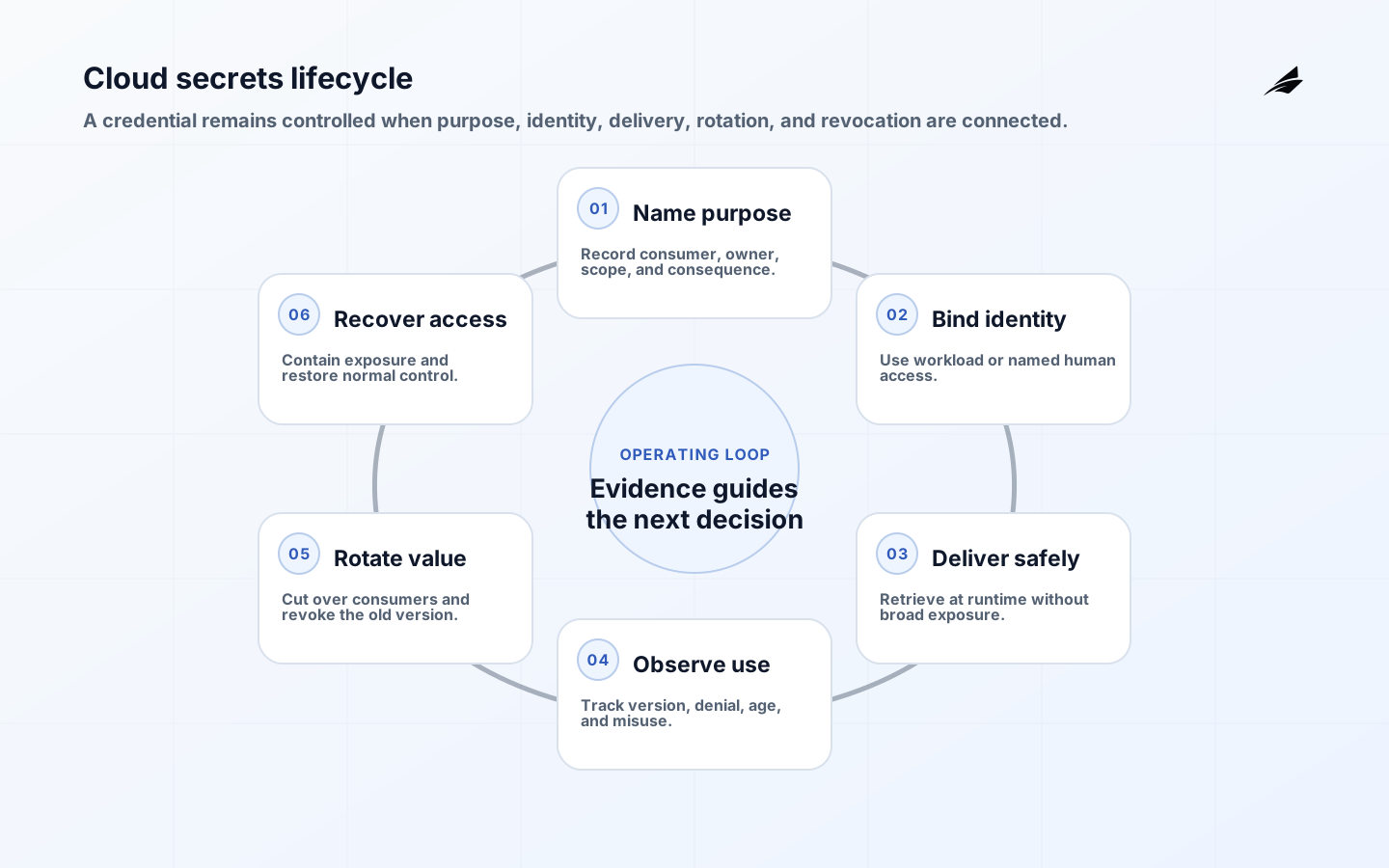
Secrets management is the controlled lifecycle of credentials, keys, tokens, certificates, and other values that grant access. It begins before a secret is created and ends after it is revoked, deleted, or replaced. In cloud and DevOps work, the failure is rarely that a team has no vault; it is that a credential is copied into a build log, granted too broadly, rotated without its consumer, or left active after an incident. The Kubernetes concepts documentation and NIST key management guidance are useful anchors for treating identity, configuration, security, reliability, and operations as one system.
Start with the workflow a secret enables: a deployment reads a database credential, a workload calls a provider, or an operator performs a break-glass action. Edilec’s secrets implementation checklist, container security guide, and platform engineering guide help place the credential in a broader operating boundary. The AWS Secrets Manager best practices keep the discussion grounded in ownership, change, and recovery rather than a tool purchase.
Map the secret lifecycle
For each secret, record purpose, owner, consumer, source, scope, environment, creation path, delivery path, rotation rule, revocation authority, and evidence. Separate human credentials from workload identity wherever possible. Classify secrets by consequence so a short-lived service token, a signing key, and a break-glass administrator credential do not inherit the same policy by accident. Define what happens when the secret is missing, expired, duplicated, or suspected to be exposed.
| Lifecycle point | Decision | Evidence |
|---|---|---|
| Create | Who may issue the credential and for what purpose? | Owner, scope, expiry, and request record. |
| Deliver | How does the consumer receive it without broad exposure? | Identity policy and access audit. |
| Use | What limits the action and detects misuse? | Least-privilege policy and usage signal. |
| Rotate | How can the consumer adopt the replacement safely? | Successful cutover and old-secret revocation. |
| Revoke | Who can stop access and how fast? | Revocation test and incident record. |
Choose storage and delivery deliberately
A managed secret store can protect access, audit, versioning, and rotation, but it does not make every consumer safe. Kubernetes Secret objects are configuration primitives, not automatically a complete secrecy boundary; inspect who can read them, how the API server and storage are protected, and whether values appear in environment dumps, crash reports, or debug output. Prefer workload identity and runtime retrieval to long-lived values embedded in images, source control, manifests, tickets, or shared chat. Keep secret material out of logs and traces while preserving a non-sensitive correlation identifier for investigation.

Apply least privilege at the consumer
Grant access to a workload or person only for the operation and time it requires. Separate read, create, rotate, and revoke rights. Use environment, tenant, service, and resource boundaries instead of a single platform-wide credential. Review inherited permissions, stale service accounts, unused grants, and access from build systems. A secrets manager cannot correct an application that accepts any credential with broad authority. Enforce scopes in the target service as well as in the delivery layer.
| Mistake | Why it persists | Correction |
|---|---|---|
| Secret in repository | It is convenient and copied by automation. | Remove it, rotate it, scan history, and use runtime retrieval. |
| Shared service credential | Ownership is unclear and rotation is risky. | Assign workload identity and separate permissions. |
| Rotation without testing | The new value exists but consumers keep the old state. | Exercise dual-read or overlap, cutover, and revocation. |
| Break-glass never expires | Emergency access becomes the normal path. | Time-limit, log, review, and remove after use. |
Make rotation a production feature
Rotation must include creation of the replacement, consumer adoption, validation, and revocation of the previous value. Coordinate connection pools, caches, replicas, long-running jobs, and external partners. Use an overlap window only when its risk is understood and bounded. Alert before expiry, but also test the path when rotation fails. A credential that rotates successfully in the store but breaks a worker is not a successful rotation. Record the secret version without exposing the secret itself.
Observe use without leaking value
Useful signals include secret age, rotation success, failed retrieval, denied access, unused grants, unusual consumers, exposed-secret findings, revocation time, and downstream authentication failures. Connect these signals to a service owner and an incident path. The OWASP Secrets Management Cheat Sheet is a reminder to preserve trace context across distributed work while scrubbing values and sensitive headers from telemetry. A log that proves which secret version was requested can be valuable; a log that contains the secret is an incident.
Rehearse compromise and recovery
Practice the sequence for suspected exposure: identify the credential and consumers, restrict or revoke access, rotate dependencies, verify service recovery, search for misuse, and document the decision. Include a compromised build runner, leaked support screenshot, stolen workload identity, and an unavailable secret store. Recovery should preserve business continuity without quietly widening access. Review the result with security, platform, service, and incident owners so the runbook reflects actual authority.
A useful bounded exercise is to rotate one non-critical integration credential during normal operations while observing the consumer, deployment path, logs, alerts, and rollback. Ask an operator to identify the current version, owner, expiry, and revocation route from the record alone. If they need private knowledge, improve the inventory or runbook. If the service cannot adopt the new value without a restart, decide whether that limitation is acceptable or requires design work.
Review the credential path with its consumer
A secrets-management review should follow the value from issuance to the consuming process and back to revocation. Inspect the request authority, secret-store policy, runtime identity, process memory or file delivery, connection library, logs, traces, backups, and incident record. Ask where the value could appear accidentally and which controls prevent that exposure. Review the consumer with platform and service owners together because a platform policy that looks least-privileged may still grant a downstream credential far more authority than the workflow needs.
A practical example is a worker that calls a payment provider. The worker should receive an identity or token scoped to the required merchant and operation, not a shared administrator key. Rotation should create the replacement, let the worker adopt it without losing in-flight work, verify a harmless provider call, and revoke the old value. The record should prove which version was active and which operator could stop it. If the provider only supports long-lived credentials, compensate with narrow scope, monitoring, a documented expiry owner, and a tested incident path.
Review secret inventories on a cadence and sample both normal and exceptional paths. Look for credentials with no recent use, multiple owners, unclear expiry, unexpected consumers, or access from build and support systems. Treat repeated exceptions as signals to improve identity, delivery, application configuration, or vendor integration. Avoid measuring success only by the number of secrets migrated; the meaningful outcome is that the service can change or revoke access while remaining attributable and recoverable.
Handle awkward credentials explicitly
Some credentials do not fit a simple rotate-and-restart pattern. A signing key may need overlapping verification keys, a database password may require coordinated connection pools, and a vendor token may be impossible to revoke immediately. Record these constraints as part of the design rather than pretending every secret has the same lifecycle. Add compensating controls such as narrower scope, stronger monitoring, dual validation, shorter exposure windows, or a documented vendor escalation. The exception should have a named owner and a date for reassessment.
Review the places where secret material is transformed or copied. A deployment controller may render a manifest, a sidecar may write a file, a library may cache a token, and a support tool may export configuration. Each boundary can change exposure and lifetime. Trace the value through the system without collecting the value itself. If a team cannot explain where it exists, who can read it, and when it disappears, the inventory is incomplete even if the source store is well protected.
A secrets-management owner does not need to administer every secret store, but must be able to explain the inventory, policy, exception route, and recovery evidence. Service teams own the safety of their consumers; platform teams own delivery and access primitives; security owners help set consequence-based controls. Finance or compliance may need a voice where a credential affects customer commitments or regulated data. This shared model avoids both a central bottleneck and the dangerous assumption that a platform team alone understands downstream use.
Do not overlook the human experience of credential change. An operator who receives an expiry alert needs a clear consumer, owner, action, and fallback; otherwise the alert encourages risky copying or a permanent extension. A developer needs a local and test environment pattern that does not teach them to put production values in a file. A support person needs a safe way to diagnose authentication failure without viewing the secret. Design these experiences alongside the controls. Adoption improves when the secure path is the easiest path to operate and the exception route is explicit rather than improvised.
Key takeaways
- Manage a secret from creation through delivery, use, rotation, and revocation.
- Prefer workload identity and short-lived, narrowly scoped credentials.
- Keep values out of source, images, manifests, tickets, logs, and traces.
- Treat rotation and revocation as tested service behaviour, not a calendar task.
- Measure age, use, failure, exposure, and recovery together with a named owner.
Frequently asked questions
Question: Is putting a credential in a vault enough? Answer: No; scope, delivery, rotation, revocation, access evidence, and consumer behavior also matter. Question: What should happen after suspected exposure? Answer: Contain use, preserve evidence, rotate or revoke the value, inspect access, and confirm that every consumer recovered.
Where should production secrets live?
Answer: Use a managed secret system or protected vault with encryption, access policy, audit history, rotation support, and a clear owner; avoid embedding values in images, source, or ordinary configuration.
How should rotation avoid outages?
Answer: Support overlapping validity where possible, test consumers before revocation, monitor adoption of the new version, and keep a documented recovery path for stale credentials.
What is the right response to suspected secret exposure?
Answer: Contain access, preserve evidence, revoke or rotate the credential, inspect usage, assess affected data, and communicate through the incident process.
Are Kubernetes Secrets encrypted by default everywhere? Do not assume so; inspect the cluster’s storage and access configuration. Is a vault enough? No; consumers, permissions, logs, backups, and recovery still require design. How often should secrets rotate? Match the consequence and technical ability to rotate safely; shorter lifetime is useful only when adoption and revocation work. What is the first improvement? Inventory one critical credential, remove unnecessary exposure, test rotation, and document who can revoke it.
Conclusion
Cloud secrets management is a reliability and security practice. Define the lifecycle, bind access to workload identity, protect delivery and telemetry, rotate with consumer evidence, and rehearse compromise. A team earns confidence when it can replace or revoke a credential without guesswork or an uncontrolled outage.