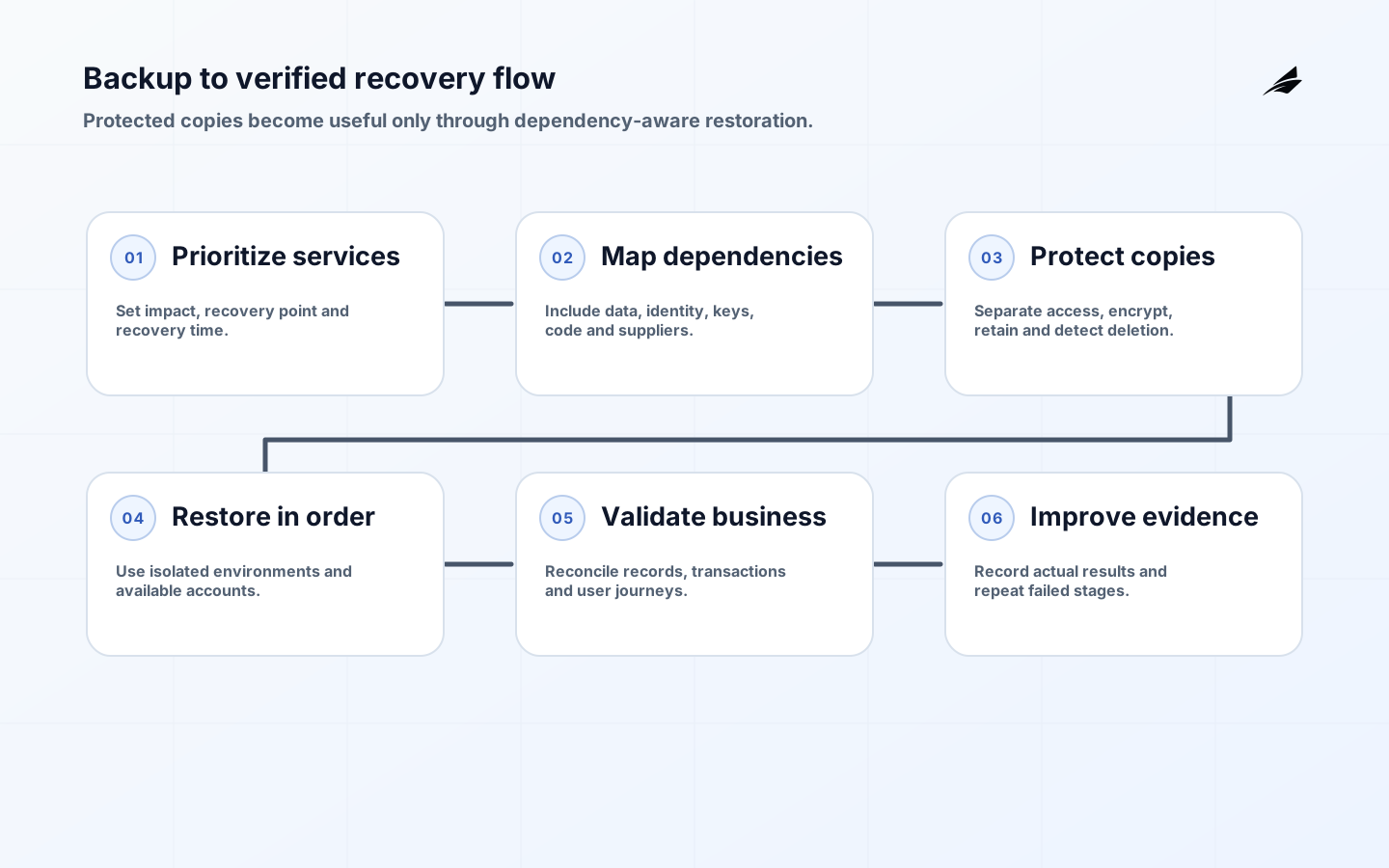
Backup and restore for IT managers is a recovery capability, not a green dashboard showing that copy jobs ran. A usable service begins with business impact and ends when data, applications, identity, configuration, dependencies, and operators can restore an agreed service within its recovery objectives. Use this guide with Edilec’s backup operations playbook, cloud incident response guide, and deployment rollback architecture guide.
Worked example: recover a customer-order service
A customer-order service may depend on a transactional database, object documents, message offsets, encryption keys, identity, network policy, container images, infrastructure definitions, and a payment connection. A database snapshot alone cannot restore the service consistently. Document dependency order and define which data must share a recovery point. Decide how queued or externally accepted transactions will be reconciled after restoration so recovery does not create duplicate charges or missing orders.
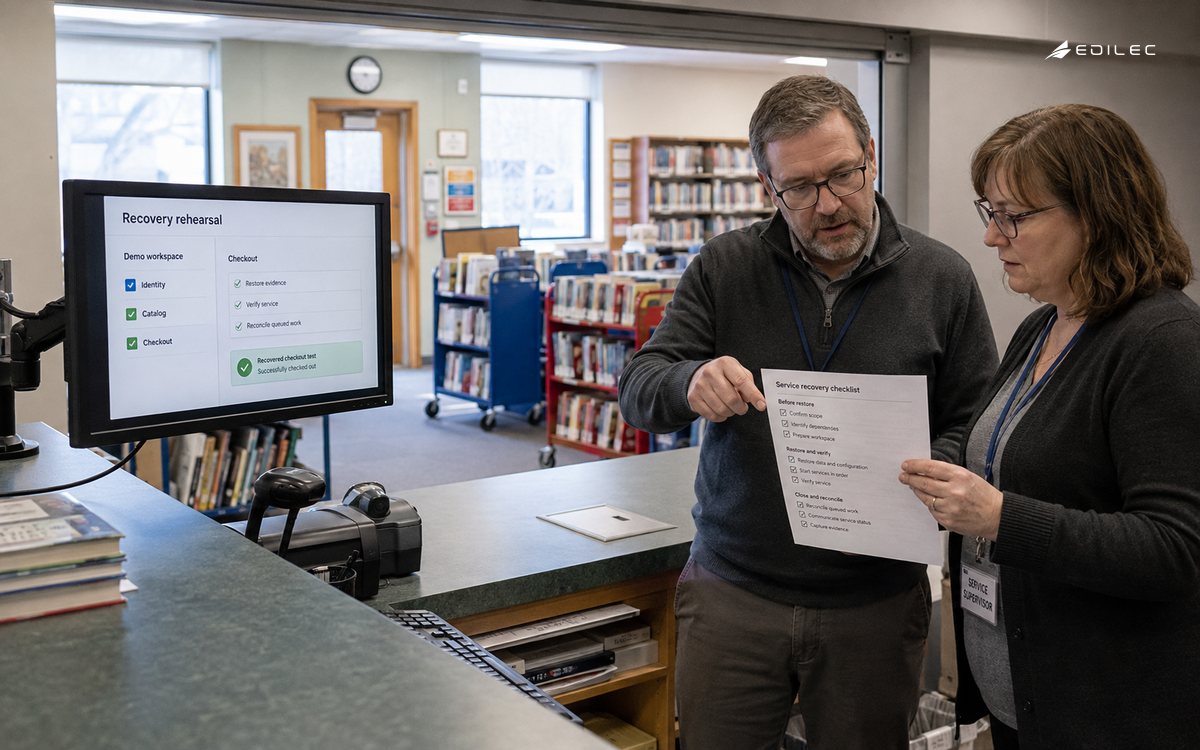
Exercise three scenarios: accidental record deletion, loss of the primary region, and compromise of administrative credentials. Restore into an isolated environment using accounts and documentation available during the scenario. Validate application behavior and business totals, rotate exposed secrets, scan for persistence where relevant, and record actual recovery point, recovery time, operator effort, failures, and decisions. Remediate the runbook and repeat failed stages. A tabletop checks understanding; only a technical restore demonstrates that the copies and procedures work.
Key takeaways
- Make backup and restore for IT managers answer a concrete service decision, not a tool-adoption question.
- Document the boundary, owner, and recovery action before broad production use.
- Use evidence from customer outcomes and technical signals together.
- Start with a bounded implementation, then standardize what survives a real exercise.
Set the purpose and boundary for backup and restore for IT managers
Define recovery around business services and loss tolerances. For an order platform, identify the databases, object storage, configuration, secrets, identity services, queues, DNS, and external integrations needed to accept and fulfil an order. Translate the recovery point objective into the latest transaction the business can afford to reconstruct, and the recovery time objective into the deadline for a tested user journey—not merely for a database process to finish. Rank services by impact and dependency order so teams do not restore an application before its identity or key service. Document exclusions such as third-party SaaS data, endpoint files, or archived records and name the contract or alternative that covers them. This boundary exposes whether snapshots, replication, vendor retention, and exports together protect the stated promise. It also prevents a green backup dashboard from implying that an interconnected service can actually be recovered.
For recovery, state the last acceptable data point and the latest acceptable service restoration time for each priority system. The failure statement should expose missing copies, unusable keys, unavailable dependencies, or an untested procedure before a disruption makes those gaps expensive.
| Recovery element | Business decision | Proof |
|---|---|---|
| Priority | Which service and records return first? | Approved impact assessment |
| Recovery point | How old may restored data be? | Timestamp of recovered data |
| Recovery time | How long may restoration take? | Timed exercise result |
Build an operating model for backup and restore for IT managers
Assign distinct duties for policy, operation, and validation. The service owner sets recovery objectives and prioritizes data; platform teams configure schedules, retention, replication, and restore tooling; security controls privileged access and copy isolation; application owners maintain dependency maps and validation scripts; a business representative confirms that the recovered workflow is usable. Protect at least one copy from the credentials and control plane used for normal production administration when the threat model calls for resilience against compromise. Ensure encryption keys, break-glass accounts, network routes, licenses, infrastructure definitions, and runbooks remain reachable when primary identity or documentation systems are down. Operators need authority for predefined restores, while deviations—shortening retention, deleting protected copies, restoring into production, or bypassing segregation—require explicit approval and a recorded reason. This model turns backup from a storage task into a recoverable service with clear decisions during both routine testing and crisis response.
Use proportionate controls and retained evidence
Design each control against a named failure mode. Separate backup administration from deletion authority to reduce the chance that one compromised account destroys production and recovery copies. Use retention locks or isolated copies where ransomware and insider scenarios warrant them, and monitor unexpected policy changes as closely as failed jobs. Encrypt copies, but prove that key material and recovery credentials survive loss of the primary environment. Record backup policy version, protected resource, completion and verification result, copy location, expiry, and restore-test linkage. During recovery, preserve the selected recovery point, authorizer, integrity checks, transformations, reconciliation findings, and cutover decision. That evidence lets responders distinguish a clean copy from a merely recent one and shows auditors which service promise was tested. The incident response planning guide provides related guidance for containment and coordinated decisions when restoration follows a security event.
| Restore dependency | Test question | Common gap |
|---|---|---|
| Data copy | Can the required point be retrieved? | Incomplete or inaccessible copy |
| Access and keys | Can responders decrypt and authenticate? | Permissions assumed but untested |
| Service validation | Can a real workflow complete? | Database restored but application unusable |
Measure the service outcome and operating health
Report protection and recoverability separately. Protection signals include jobs completed within schedule, latest valid recovery point by service, copy immutability or isolation status, replication lag, verification failures, and resources missing from policy. Recoverability signals come from exercises: percentage of priority services restored end to end, elapsed time by dependency stage, age of recovered data, reconciliation variance, unavailable credentials or keys, failed validation steps, and overdue findings. Compare each service with its stated objectives rather than blending critical databases and low-priority archives into one success percentage. Alert on conditions that consume recovery margin, such as repeated failures or a recovery point approaching its limit. Leaders should see whether customer login, order completion, payroll, or another agreed transaction worked after restoration. A file-level test and a full service rehearsal answer different questions; both are useful only when their scope is labelled clearly.
Adopt backup and restore for IT managers in deliberate increments
Adopt the programme service by service, beginning with one high-impact path whose dependencies are understood. Restore it into an isolated environment from the copy and credentials available to the on-call team. Recreate infrastructure and configuration, reconnect identity and keys, replay or reconcile queued work, and execute a business validation script. Measure elapsed time from declaration through approval, data restore, dependency recovery, validation, and cutover readiness. Convert every missing permission, undocumented manual step, unsupported format, and ownership dispute into a dated remediation item. Repeat until the objective is consistently met, then schedule exercises according to service criticality and change rate. Use the resulting pattern for the next priority service, but allow justified differences in technology and retention. Update coverage whenever a team adds a datastore, changes identity, alters encryption, or adopts a SaaS dependency; architecture change can invalidate an old recovery success even when backup jobs remain green.
Worked operating scenario
Suppose a customer portal’s database copy restores successfully in forty minutes, yet the application remains unavailable. Its infrastructure template references a secret in the failed primary account, the replacement environment lacks access to the encryption key, and DNS change authority belongs to someone outside the exercise. Meanwhile, messages created after the selected recovery point remain in a queue and could duplicate orders if replayed blindly. The backup job was healthy, but the service recovery was not. A corrected plan stores recoverable configuration in a protected location, establishes break-glass key and DNS access, documents dependency order, and defines transaction reconciliation before queue replay. The next drill restores the stack, signs in as a representative customer, submits an order, compares order and payment identifiers, and measures the entire duration against the business objective. This scenario tests coordination among application, platform, security, network, product, and finance teams and produces much stronger evidence than restoring a database in isolation.
Run a readiness review for backup and restore for IT managers
Use a timed exercise as the centre of the readiness review. Select a declared failure and recovery point without giving operators a specially prepared path. Verify that on-duty staff can locate the runbook, obtain emergency credentials, identify the correct protected copy, restore infrastructure and data in dependency order, validate integrity, reconcile transactions, and present the service for business acceptance. Record actual data age and duration at each stage against the approved objectives. The review should also inspect retention coverage, copy isolation, key recovery, monitoring, vendor responsibilities, and outstanding findings from prior drills. For every gap, choose an owner, due date, interim risk decision, and retest condition. Repeat after material changes to storage, identity, encryption, architecture, provider, or support ownership. Readiness exists when the people and tools expected during an incident have demonstrated the whole recovery path, not when a project team can perform a curated restore.
Frequently asked questions about backup and restore for IT managers
What is the difference between recovery point and recovery time objectives?
A recovery point objective describes how much data loss, measured in time, the business can accept. A recovery time objective describes how long restoration may take. Both need validation through an actual recovery exercise, not only a policy statement.
How often should restores be tested?
The cadence should follow business criticality, change rate, threat model, and regulatory duties. Test after material architecture changes as well as on a regular schedule, and include the dependencies that turn a restored copy into a usable service.
What evidence should leaders ask for?
Leaders should request a service-level recovery map, approved recovery point and time objectives, current protection coverage, the latest valid copy, and the result of a recent end-to-end exercise. The evidence should show actual recovered-data age, elapsed restoration time, dependency and access failures, business-transaction validation, unresolved findings, and accountable owners. Backup-job percentages are supporting telemetry; they do not replace proof that a priority service can return.
Conclusion
Backup protects copies; restore exercises prove whether the organization can recover a service. Tie protection to business loss tolerances, include identity, keys, configuration, dependencies, and reconciliation, and measure the complete user journey against recovery objectives. A programme built on repeated service-level drills gives IT managers credible choices during disruption and a funded list of weaknesses to remove before the next event.