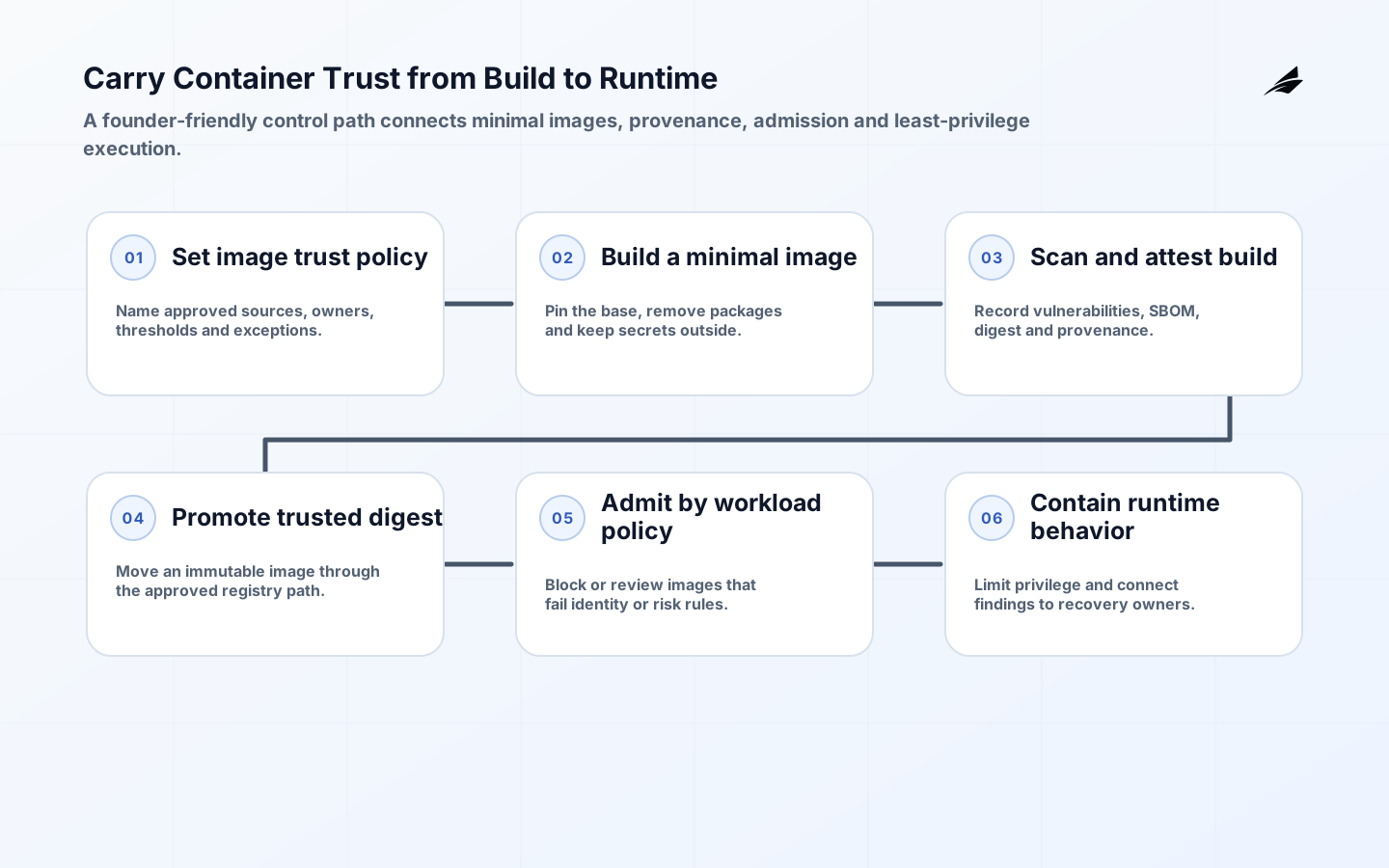
Container security is a product and business risk, not only a scanner configuration. A container packages application code, dependencies, startup behavior, identity assumptions, and a relationship with the host or orchestrator. A founder needs to know whether the organization can explain what it built, where an image came from, what may run in production, and how it will contain a compromised workload. The right standard is evidence across the path from source to build to registry to admission to runtime. A small team can meet that standard with focused controls if ownership and recovery are explicit from the beginning.
Define the container risk boundary
Begin with the workloads that matter to customers, revenue, sensitive data, and operational continuity. Record the images, registries, build systems, base images, deployment identities, namespaces, network paths, and persistent volumes involved. Decide which failures are unacceptable: an untrusted build reaching production, a service running with host-level privilege, credentials appearing in logs, or an image with an unresolved critical issue. This list gives the security program a consequence-based starting point. It also keeps a founder from accepting a long list of findings without knowing which decisions protect the company most.
Make the build process trustworthy
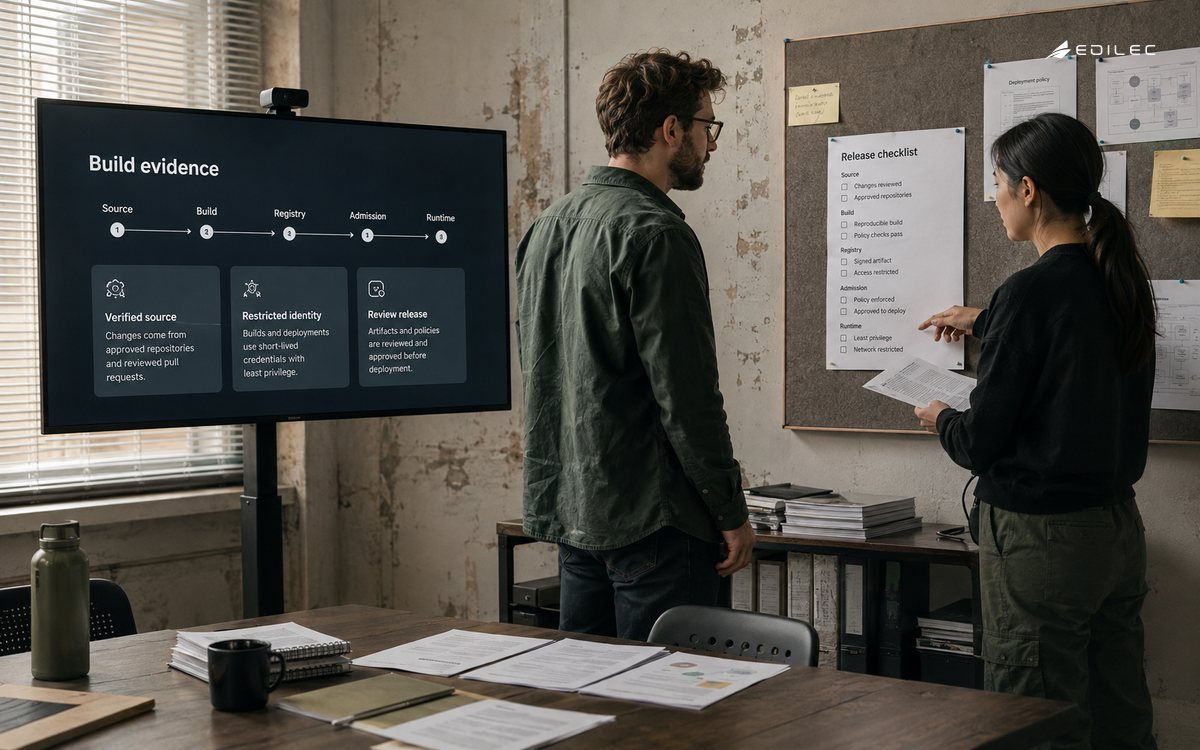
A secure image starts with a controlled build rather than a late scan. Pin important dependencies and base-image versions, keep build credentials separate from runtime credentials, and make the source revision and build environment identifiable. Prefer a small runtime image when it is compatible with the application, but do not remove information needed for safe support. Generate a record that connects source, dependency inputs, builder, image digest, and test result. That record lets the team answer a practical question during an incident: which deployed workload came from which change, and what else used the same vulnerable component?
| Stage | Decision | Evidence |
|---|---|---|
| Source | Build only from an approved revision. | Commit and review identity. |
| Inputs | Use known base and dependency versions. | Resolved dependency record. |
| Artifact | Promote an immutable image digest. | Digest and build provenance. |
| Release | Deploy only after required checks pass. | Admission decision and policy version. |
Control the registry and promotion path
The registry is part of the production trust boundary. Restrict who can push, overwrite, delete, or promote images. Use immutable references or digests for deployed workloads so a tag cannot silently point to a different artifact. Separate build, test, and release authority where the consequence justifies it. Retain scan and provenance results alongside the artifact, then define how a finding is triaged: fix, accept temporarily, block, or replace the dependency. A policy that blocks every unknown condition can encourage bypasses, while a policy that never blocks provides no useful boundary. The exception route needs an owner, reason, expiry, and compensating control.
Use admission policy to stop the right failures
Admission controls should enforce a small set of understandable requirements before a workload runs. Examples include an approved registry, a verified image reference, a non-root user where supported, a read-only root filesystem, limited Linux capabilities, explicit resource requests, and a constrained service account. Tie each rule to a threat or operational failure. Return a reason that a developer can act on, and keep a supported path for a legitimate exception. Test policy changes against representative manifests, including jobs, operators, and workloads with special storage or networking needs. Founders should ask who can change the policy, who can override it, and how the decision is recorded.
Limit runtime privilege and blast radius
A container can be built well and still be dangerous when it runs with broad privilege. Use a dedicated workload identity, avoid host networking and host filesystem access unless a real requirement exists, restrict capabilities, and separate sensitive workloads by namespace or equivalent boundary. Limit egress where the business flow permits it. Keep secrets outside the image and make access specific to the workload. Monitor for unexpected process, file, network, and identity behavior. Runtime controls do not replace build or admission controls; they reduce the impact when an assumption fails or an attacker reaches the application.
| Risk | Practical control | Check during review |
|---|---|---|
| Image tampering | Use digests and restricted promotion. | Trace running digest to source. |
| Credential theft | Use workload-specific secret access. | Inspect identity and expiry. |
| Host escape | Drop privilege and narrow mounts. | Review security context. |
| Lateral movement | Limit network paths and service rights. | Test an unauthorized connection. |
Make vulnerability response executable
Decide in advance how the team handles a vulnerable base image, dependency, or deployed digest. The response should identify affected images and running workloads, establish severity and exposure, choose containment, notify the right owners, and verify closure. Keep the previous known-good artifact available when rollback is safer than an emergency rebuild. Rebuild from current inputs, deploy to a representative environment, and confirm that the replacement has the expected identity and configuration. Record accepted exceptions with a deadline. A vulnerability queue is useful only when somebody can connect a finding to a workload, a decision, and a recovery action.
Test security controls under pressure
Run a controlled exercise that tries to deploy an unapproved image, use an excessive capability, access a forbidden network destination, and revoke a workload credential. Verify that the expected request is blocked, the event reaches an operator, and the application team knows how to recover. Test the registry outage and the policy service outage as well. Ask what existing workloads do when new admission checks cannot be evaluated. The goal is not a perfect demonstration; it is a shared understanding of safe degradation, escalation, and evidence preservation when the normal path is unavailable.
Govern the cost without weakening the boundary
Founders should connect container security investment to the company stage and the consequence of failure. A small team may start with one build path, one registry, immutable deployment references, a narrow runtime baseline, and a clear response owner. As customers, regulatory obligations, or workload diversity grow, add stronger verification, separation of duties, and deeper runtime visibility where those controls reduce meaningful risk. Review false positives and recurring exceptions as product signals. If developers cannot ship through the supported route, fix the route or state the trade-off plainly. Security that is consistently bypassed is a design problem, not a user failure.
Make security ownership visible to the company
A founder does not need to approve every image, but the company does need clear ownership for the build path, registry, deployment policy, workload identity, and incident response. Review those responsibilities when a new team, cloud account, or production environment appears. Ask whether a responder can identify the running digest, contact the application owner, and choose a containment action without waiting for the person who wrote the pipeline. The answer reveals whether the control is part of the company operation or only part of one engineer's memory.
Keep the security baseline short enough to explain to a new team. Each requirement should have a reason, a supported implementation, and a route for a time-bound exception. Revisit the baseline after an incident, a major dependency change, or a shift in customer obligations. This turns container security into a capability that grows with the product while preserving delivery speed and a clear line of accountability.
- Know which workloads and data deserve the strongest boundary.
- Connect source, inputs, image digest, and deployed workload.
- Enforce understandable admission requirements with an expiry-based exception path.
- Reduce runtime privilege, identity scope, mounts, and network reach.
- Rehearse containment and replacement before a real finding arrives.
Key takeaways for founders
- Container security covers build provenance, registry authority, deployment policy, and runtime behavior.
- A vulnerability has meaning only when the team can find affected artifacts and workloads.
- Least privilege reduces blast radius when an application or dependency is compromised.
- Exceptions need a reason, owner, compensating control, and end date.
- Recovery speed depends on practiced replacement and rollback, not on scanning alone.
Frequently asked questions
Is image scanning enough?
No. Scanning identifies one class of signal. The team also needs trustworthy build inputs, artifact provenance, registry controls, admission rules, workload identity, runtime restrictions, and a way to replace or contain a deployed image.
Should every image be minimal or distroless?
Use the smallest practical runtime that supports the application and its support needs. Smaller images can reduce unnecessary packages, but they do not establish provenance, identity, or runtime safety by themselves.
What control should a startup add first?
Start with an accurate inventory and one complete path from source to running digest. Add immutable references, a basic admission baseline, narrow workload identity, and a rehearsed replacement procedure around that path.
Further reading and adjacent practice
Use the Kubernetes documentation, Google SRE Book, AWS Well-Architected Framework, and OpenTelemetry documentation for surrounding platform and operations context. Service-to-service boundaries are covered in the related guide on how CTOs should think about service meshes.
For adjacent decisions, continue with Edilec's How CTOs Should Think About Service Meshes and Serverless Architecture Operations: Events, Reliability and Cost.
Conclusion: make the workload path explainable
Container security becomes manageable when the company can explain how an image was built, why it was admitted, what identity it received, what it can reach, and how it will be replaced when the evidence changes. Set a narrow baseline, make exceptions finite, and practice the uncomfortable cases with the people who will respond. That combination gives founders a security posture that can grow with the product without turning delivery into an opaque approval queue.