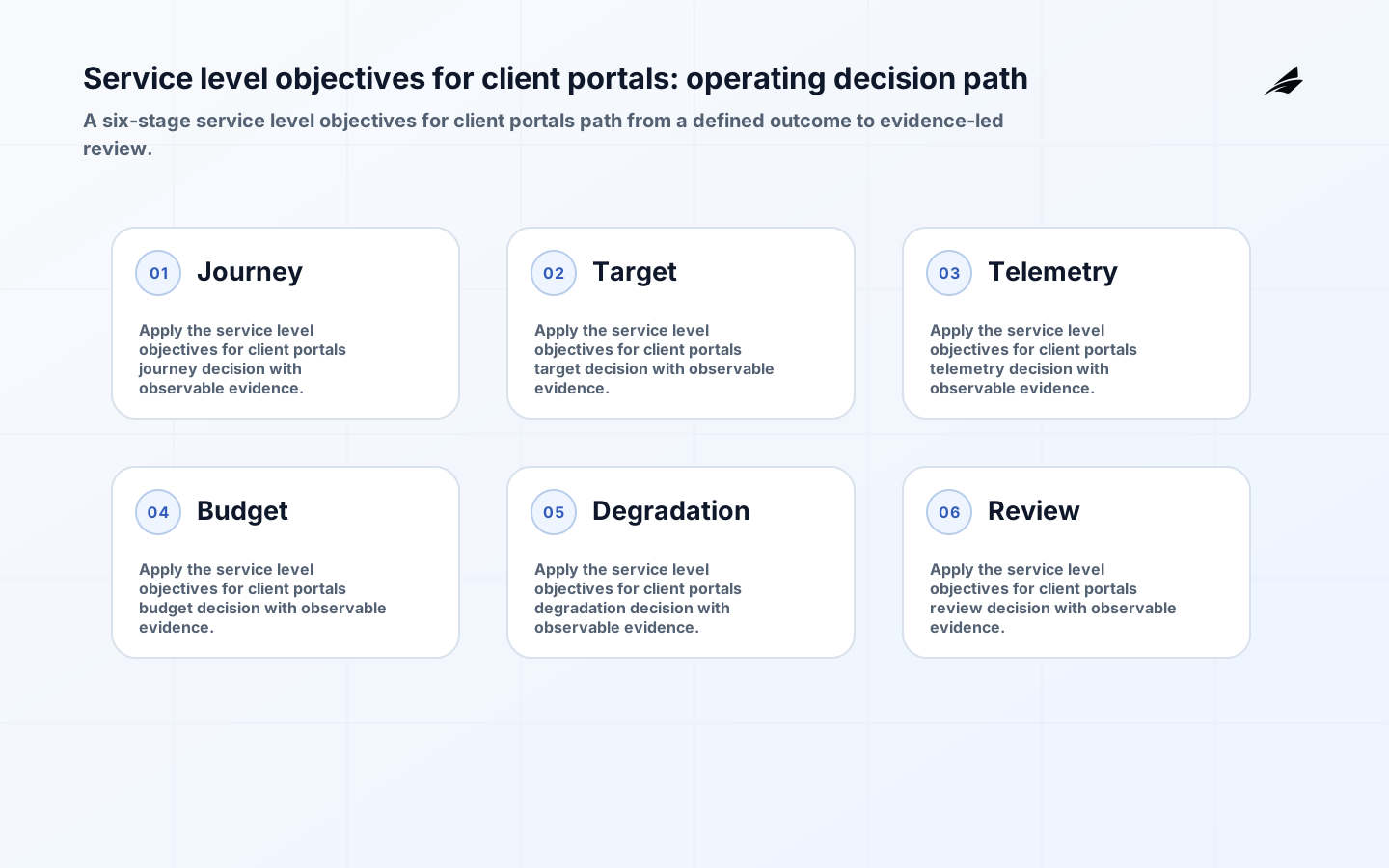
A client portal is reliable when a customer can complete an important journey and understand what happened when a dependency or policy prevents completion. That is a more useful starting point than promising that every endpoint will be fast. The service level objectives (SLOs) in this article connect user-visible outcomes to engineering decisions: what to measure, how to segment tenants, when to pause change, and who owns recovery. This follows the distinction in Google SRE's service level objectives guidance between a service-level indicator, an objective, and a broader customer commitment.
Start with the client journey
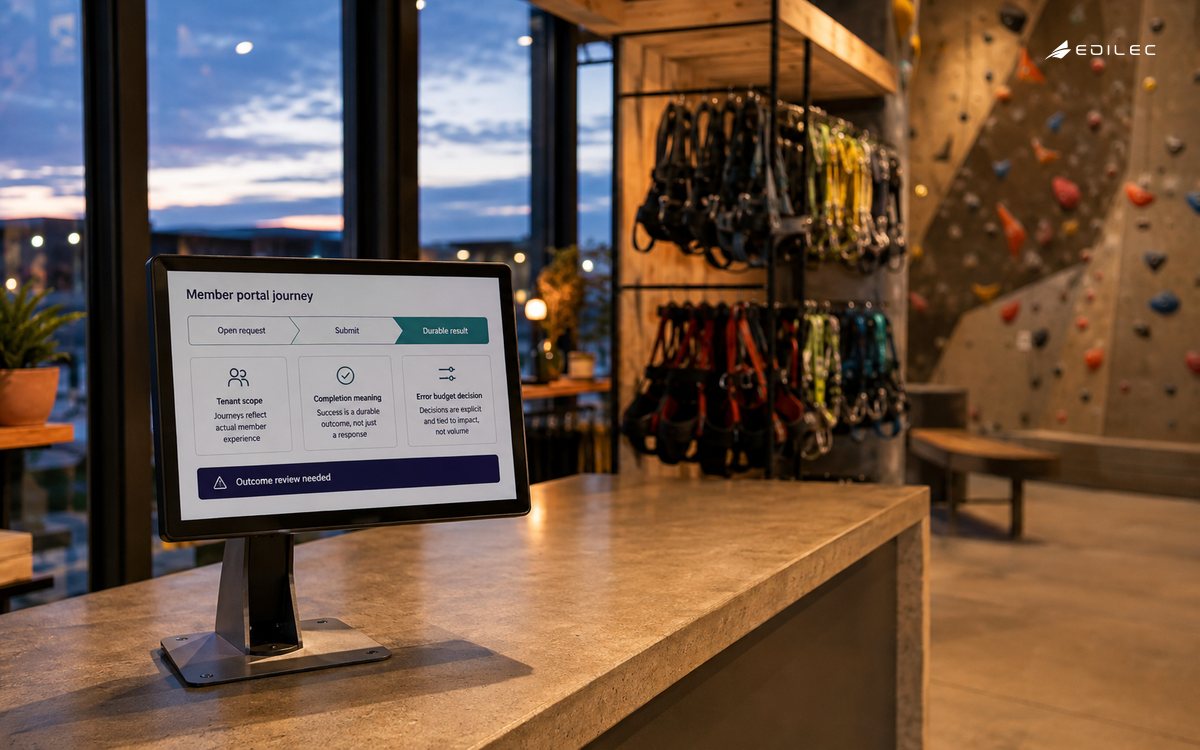
Begin with the decision the portal helps a person make. A customer may sign in to review an account, submit a request, upload evidence, approve a change, or pay an invoice. Each journey has a meaningful start event, a useful end state, and failure modes that should not be collapsed into one server-availability number. A page that renders while the account data is stale is not a successful dashboard load. A payment provider redirect is not a confirmed payment.
Write the journey in plain language before choosing dashboards or alerts. For example: a customer opens an invoice, sees the current balance, submits payment, and receives a durable result they can explain to support. The team can then decide which timing, completion, correctness, and recovery signals belong to the SLO. A useful CI/CD release guide is a companion when the portal's reliability target needs to change release controls.
| Portal journey | Useful indicator | SLO boundary | Keep separate |
|---|---|---|---|
| Sign in and load an account dashboard | Journey completion and time to usable data | From successful authentication to the required account state being visible | Invalid credentials, authorization denial, and stale-data incidents |
| Submit a service request | Durable acknowledgement and completion rate | From valid submission to an accepted request with a trackable identifier | Form validation, duplicate submission, and downstream rejection |
| Upload evidence for review | Upload success and processing completion | From file selection to a document that is available and usable in the case | Unsupported file type, malware quarantine, and processing delay |
| View an invoice and pay | Correct balance and confirmed payment outcome | From invoice open to a durable provider or failure result | Provider redirect, customer cancellation, and reconciliation work |
Turn a business promise into an SLO
An SLO should state the population, journey, indicator, target, measurement window, and owner. Do not hide any of those choices in a dashboard query. A reviewer should be able to explain who was eligible, which events were counted, what target applied, and what action follows a miss.
Make the numerator and denominator inspectable. If the indicator is request completion, define which requests qualify, what counts as completion, and how a retry is treated. If the indicator is latency, define whether the clock includes authentication, queue time, rendering, or only an API call. The Google SRE Workbook guidance on implementing SLOs is useful here because it turns an abstract target into a measurement and review practice.
Keep the objective distinct from an external SLA. An internal SLO can be stricter, narrower, or more experimental than a contract. It should still be concrete enough to drive an action. For example, a portal team might commit internally to a measured request journey completing correctly, while separately promising customers a response timeframe for cases that require manual review. Do not use one blended percentage to hide those different responsibilities.
Make tenant experience visible
Multi-tenant portals create an attribution problem. A shared service may look healthy while one tenant encounters a bad integration, a regional dependency, a noisy workload, or a permission configuration that affects only its users. Tenant-aware reliability does not mean creating a separate alert for every customer. It means preserving enough context to distinguish broad failure from isolated impact and to respond without exposing one tenant's data to another.
Use tenant context in traces, logs, and controlled diagnostic views. Keep high-cardinality tenant identifiers out of dashboards where they create unusable cost or noise; use bounded dimensions such as plan, region, integration class, or workload tier for routine alerting. A support view can then pivot to an authorized tenant without turning the main metric system into a customer directory. The AWS Well-Architected SaaS Lens provides useful context for separating shared platform capabilities from tenant-specific experience.
| Segmentation model | Use it when | Main risk | Decision rule |
|---|---|---|---|
| One shared journey target | Tenants use the same workflow and dependency path | A small group can be hidden by an aggregate | Start here and retain tenant-scoped evidence for investigation |
| Segment by plan or region | Capacity, support promise, or dependency differs materially | Too many slices make ownership unclear | Create a segment only when its alert would trigger a different action |
| Segment by journey | Dashboard, upload, approval, and payment have different failure costs | Teams compare unlike outcomes | Prefer journey boundaries over infrastructure boundaries |
| Per-tenant objective | A contract, regulation, or dedicated dependency requires it | Sparse data creates false precision | Use only when the obligation and response are genuinely tenant-specific |
Instrument the path, not just the service
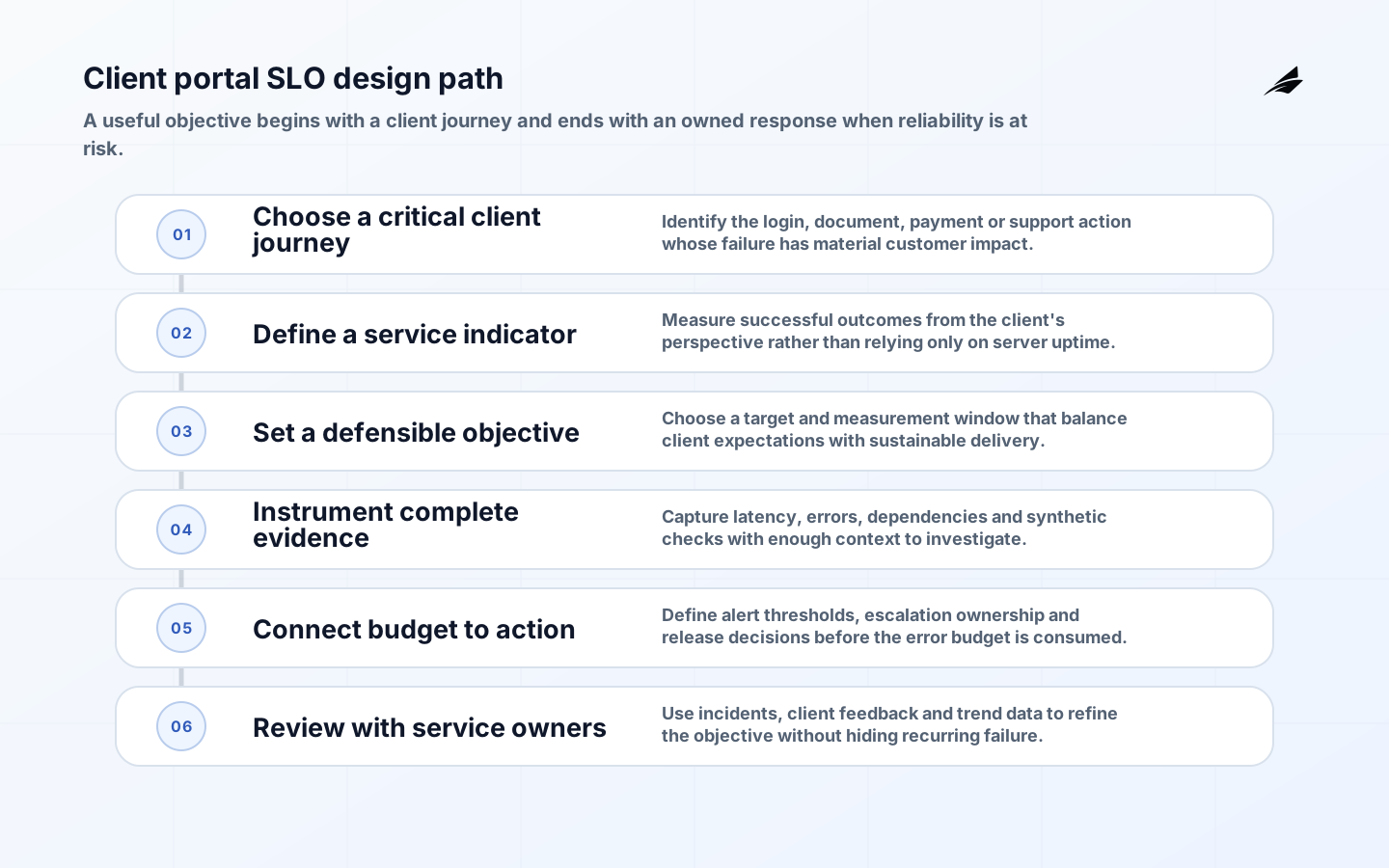
A portal SLO needs more than an uptime probe. Capture the journey's start event, the relevant tenant or workload class, the dependency calls, the terminal outcome, and the reason for failure. Correlate browser, API, queue, and provider activity so an engineer can move from a customer report to the failing boundary without asking the customer to reproduce the entire incident.
Use metrics for stable alerting, traces for path reconstruction, and logs for detailed state or correction evidence. The OpenTelemetry specification is a useful reference for treating those signals as a coherent telemetry model. Protect the model with explicit data rules: do not put sensitive form fields into spans, do not log access tokens, and do not make a tenant identifier visible to an operator who is not authorized to inspect that tenant.
- Record a stable journey name and version when a flow changes.
- Attach a correlation identifier that survives API and asynchronous boundaries.
- Record terminal state, dependency class, retry count, and user-visible recovery action.
- Separate rejected input from service failure so product and operations see different work.
- Sample detailed traces deliberately while retaining enough evidence for a support investigation.
Use the error budget to choose work
An error budget is the portion of measured imperfection the team has accepted for a defined window. Its value is practical: it gives product and engineering a shared way to decide whether the next change should add capability or reduce risk. A budget is not permission to make customers absorb preventable failure, and it is not a score that should be hidden when a target is missed.
Define the burn signal and response before the first incident. A release that changes authentication, tenant routing, payment handoff, or data freshness deserves a stronger review than a copy change. Link the SLO to the deployment path, rollback decision, and incident owner. Teams considering edge or serverless components can use these same boundaries when weighing the edge and serverless architecture tradeoffs.
| Budget state | Release posture | Required response |
|---|---|---|
| Healthy and stable | Continue planned delivery with normal safeguards | Reserve capacity for reliability work and validate that the indicator still reflects user impact |
| Burn accelerating | Reduce exposure from risky or high-blast-radius changes | Find the dominant journey, tenant segment, dependency, and release associated with the burn |
| Budget exhausted | Pause discretionary changes that add similar risk | Prioritize recovery, customer communication, and a corrective change with evidence |
| Recovered after intervention | Resume gradually with explicit guardrails | Record what changed, test the failure mode, and decide whether the target or architecture needs revision |
Design degradation and recovery as product behavior
A dependency failure should leave the user with a truthful next step. That may be a read-only view, a queued request with a reference number, a retry that is safe to repeat, or a clear handoff to support. Avoid a generic error page that makes the customer guess whether an action succeeded. Preserve the attempted action, actor, timestamp, tenant scope, dependency result, and recovery owner so the next person can explain the state. Guidance on audit logs that help investigations is relevant when that explanation must survive a handoff.
Kubernetes health probes can restart or route traffic away from an unhealthy process, but they cannot prove that a customer completed a business journey. The Kubernetes probe guidance helps separate startup, readiness, and liveness decisions. Apply that distinction in the portal: a ready pod may still be unable to load one tenant's data, and a live process may still be returning an unusable payment state.
- Make retries idempotent before exposing a retry button.
- Show whether a request was accepted, queued, rejected, or completed.
- Offer a support reference that does not disclose sensitive payloads.
- Test partial dependency failure, delayed callbacks, duplicate events, and stale reads.
- Practice the customer message before an incident, including what remains safe to do.
Review the promise and key takeaways
Review the portal SLO with product, support, security, and the people who operate its dependencies. Ask whether the measured journey still represents the customer promise, whether the tenant dimensions lead to an actionable response, and whether an exhausted budget changes what the team does next. Revisit the target when the workflow, dependency mix, tenant contract, or data sensitivity changes.
- Name the journey and its durable success state before selecting a target.
- Keep tenant context available for diagnosis without turning routine metrics into uncontrolled high-cardinality data.
- Make the error-budget response part of release and incident practice.
- Treat degradation, recovery, and customer explanation as part of the service design.
- Review user impact and operational evidence together at a regular cadence.
Client portal SLO FAQ
The three questions below are useful decision points for a portal review. The answers belong in the service runbook because they define how the team acts when the target, tenant context, or recovery path is unclear.
Conclusion: make reliability legible
Service level objectives for client portals work when they describe the experience a customer needs, not merely the infrastructure a team happens to run. Start with one journey, define a durable outcome, and make the indicator inspectable. Then add tenant context, telemetry, error-budget policy, and recovery behavior in the places where they change an actual decision.
The result is a reliability practice that can explain both a healthy day and a degraded one: which customers were affected, what they could safely do, what the team changed, and what evidence supports the next decision. That is the level of specificity that lets a portal scale without turning its service promise into generic uptime language.