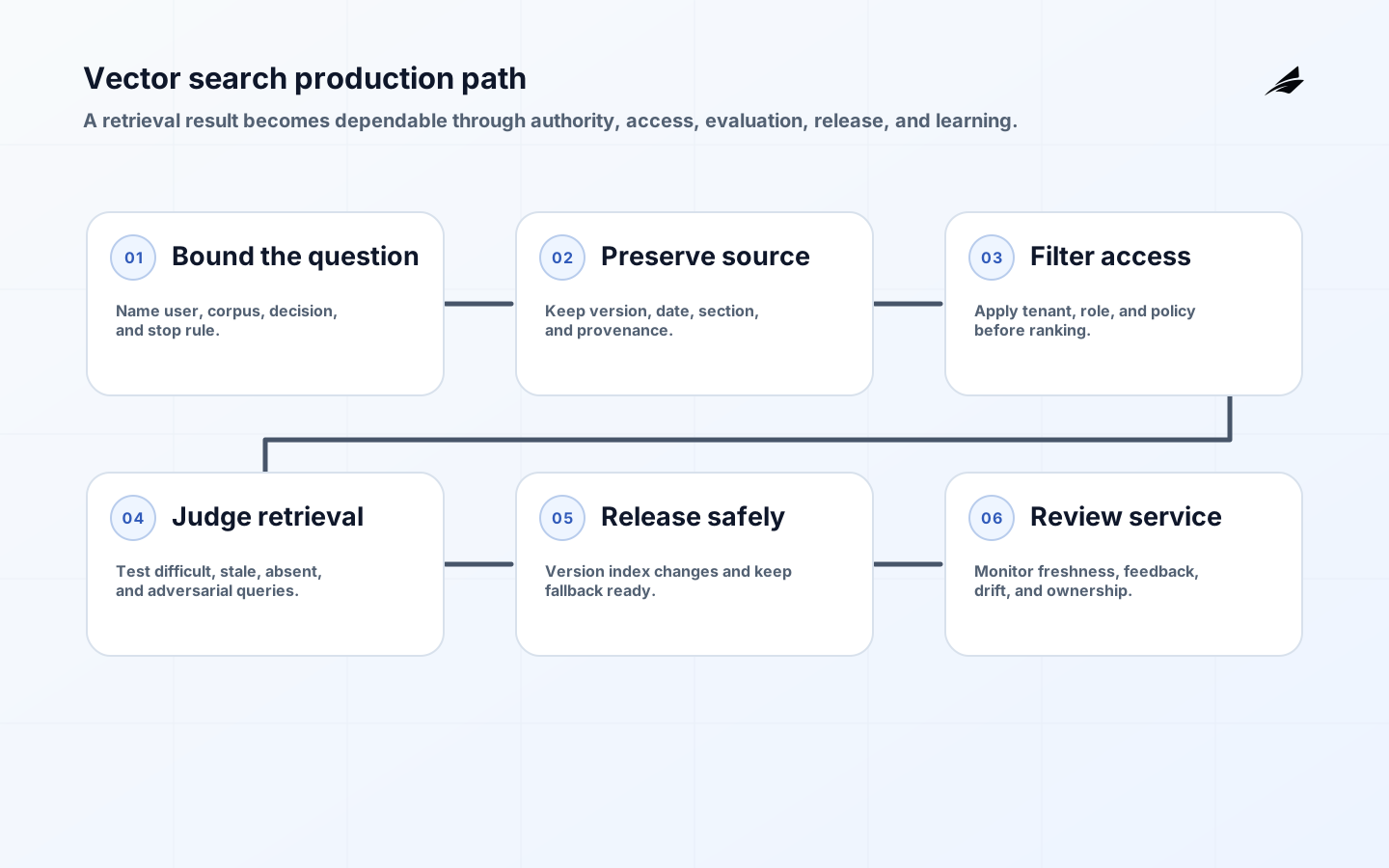
Vector search changes character when it moves from a convincing prototype into production. The prototype asks whether an embedding can find similar text; the service must answer whether the right person can retrieve the right evidence at the right time, understand why it was returned, and recover when the evidence is incomplete. The NIST Generative AI Profile frames this as a lifecycle of governing, mapping, measuring, and managing risk. The RAG research paper is useful for understanding retrieval-augmented generation, but it does not replace decisions about authority, permissions, freshness, or accountability.
A practical production boundary is a named workflow: support staff find the current policy, an analyst locates related cases, or a product team searches internal technical decisions. Keep the source record available beside the result. Three adjacent Edilec guides provide useful context on embeddings, retrieval pipelines, and semantic search. They should sharpen a local decision, not encourage a broad launch without an owner.
Define the retrieval decision
Start by naming the user, decision, corpus, and consequence. A search that supports discovery can tolerate more irrelevant candidates than a workflow that selects a policy clause for a regulated response. State whether exact terms, metadata, recency, language, or a human confirmation is required. Similarity is a ranking signal, not proof of authority. Write a stop rule for no-result, conflicting, stale, or unauthorised evidence before tuning an index. This keeps the team from treating a high score as a substitute for an operational definition of success.
| Design choice | Why it matters | Evidence to retain |
|---|---|---|
| Chunk boundary | A condition or exception can be lost when text is split poorly. | A judged query that tests context continuity. |
| Metadata filter | Permissions and effective dates must constrain candidates before ranking. | Role, tenant, version, and date test results. |
| Hybrid ranking | Exact terminology and semantic similarity solve different failure modes. | Comparison across jargon, synonyms, and misspellings. |
| Result explanation | Users need to inspect source, date, and section rather than trust a score. | Displayed citation and click-through audit sample. |
Design the source and index contract
Preserve the source identifier, document version, section, language, effective date, classification, and authorization attributes with every vector. Establish one authoritative ingestion route and make deletions, corrections, reprocessing, and model changes observable. A rebuild should reconcile source records to indexed records rather than silently producing a different corpus. Keep embedding model and chunking configuration versioned so a relevance change can be explained and rolled back. If the search result feeds generation, pass provenance and boundaries forward; retrieved text should be evidence, not an instruction channel.

Enforce access before retrieval
Tenant, role, classification, and document policy belong at the retrieval boundary. Do not return a broad candidate set and rely on the interface to hide forbidden material. Protect index administration, ingestion credentials, and export paths. The OWASP guidance on vector and embedding weaknesses calls out poisoned data, retrieval manipulation, sensitive information disclosure, and overreliance; each has a vector-search expression. Test poisoned documents, metadata tampering, cross-tenant queries, retrieved instructions, and attempts to make a model call an unauthorised tool. The Google Cloud Vector Search documentation provides an implementation reference for indexing and retrieval that can be checked against these controls.
| Change | Likely failure | Release evidence |
|---|---|---|
| Embedding model | Ranking shifts for some languages or domains. | Segmented judged-query comparison and rollback version. |
| Index rebuild | Records are missing, duplicated, or not deleted. | Source-to-index reconciliation and deletion test. |
| New connector | Untrusted content or incorrect policy enters the corpus. | Provenance, parser, access, and injection tests. |
| Reranker | Latency rises or a high-scoring result becomes opaque. | Quality, latency, and explanation comparison. |
Evaluate retrieval as work quality
Build a judged set from real language: acronyms, old names, negation, multilingual terms, misspellings, stale requests, and queries that should return nothing. Measure recall at a useful cutoff, top-result precision, filter correctness, latency, stale-result rate, and downstream task completion. Review segments after changing chunking, embeddings, filters, or ranking. A benchmark score can improve while the user receives a technically similar but operationally misleading passage. Pair automated measures with domain review and keep failures in the next evaluation set.
Release vector changes in bounded steps
Begin with a permissioned corpus and a result view that shows source, owner, date, and a route to the original record. Compare the new service with the existing search path on representative tasks. Release model and index changes behind a versioned configuration, then define rollback and fallback to the source system. An outage plan should cover delayed ingestion, corrupt vectors, provider failure, and an unsafe result. Small scope is valuable because it makes review and recovery possible, not because it removes the need for them.
Operate the service and its owners
Assign owners for source meaning, platform reliability, access policy, product behavior, and incident response. Monitor indexing lag, query errors, denials, latency, corpus freshness, result feedback, cost, and rebuild status. Keep a change record linking each release to affected workflows, test evidence, owner, rollout date, and rollback condition. Review user feedback with judged queries: a click may indicate usefulness, forced browsing, or lack of trust. The best operating signal combines interaction evidence with the work outcome.
A useful failure exercise is to remove a current policy document, change a user's role, and issue a query whose answer depends on an exception clause. The system should either exclude the old document, deny the unauthorized request, or show uncertainty and route the user to the source owner. If it instead returns a plausible answer without a traceable source, the design has exposed a production gap. Record the correction in the source, filter, interface, evaluation set, or runbook rather than applying an unexplained tuning change.
Keep a change record for retrieval
A retrieval change record should explain the affected corpus, query transformation, embedding model, chunking rule, filter policy, reranker, index version, and user-facing behavior. Include the reason for the change, the expected improvement, the judged-query segments used, the observed regressions, and the rollback condition. This record is especially important when an apparently small change alters what a person can discover. A new chunk boundary can separate a definition from its exception; a new filter can remove a document that a team relies on; a provider change can alter latency and data handling. Recording the decision lets the next reviewer distinguish intended behavior from accidental drift.
Consider a support knowledge base with current policies, archived policies, and customer-specific agreements. A user asks a question containing an old product name. The correct result requires semantic matching, an effective-date filter, tenant authorization, and a link to the current agreement. A prototype may find a similar archived article and produce a fluent answer. A production service should exclude the obsolete record, preserve the customer boundary, show the current source, and make the mismatch visible if no current answer exists. That scenario belongs in the judged set, the access tests, the release record, and the operator runbook.
Review vector search on a cadence that matches source change and consequence. Examine indexing lag, deletion completion, filter-denial rates, no-result queries, top-result changes, and user corrections. Ask a domain owner whether the retrieved evidence remains authoritative, and ask an operator whether the service can be paused without losing the source system. If quality falls, decide whether to correct the source, metadata, query, index, interface, or policy. The most durable improvement is usually the smallest change that removes a repeated ambiguity while keeping evidence and recovery visible.
Use boundary cases to guide the next change
Boundary cases deserve their own review because they often reveal a mismatch between search relevance and operating authority. Test questions that combine a current and obsolete term, ask for an answer outside the corpus, cross a tenant or role boundary, depend on a deleted document, or require an exception clause. Inspect the candidate set before generation, the evidence shown to the user, and the final action that follows. The result may be a legitimate no-result or escalation. That outcome is healthier than forcing a plausible passage into a workflow that needs certainty.
Keep a small set of these cases attached to every material change. A model update, metadata correction, index rebuild, or new connector should be evaluated against them even when the change appears unrelated. If a case fails, identify the layer responsible: source governance, chunking, metadata, authorization, ranking, interface, or user training. This classification keeps teams from repeatedly tuning the model to compensate for a missing source owner or a weak permission contract. It also gives product and platform owners a shared language for deciding whether to expand, hold, or narrow the service.
One useful ownership pattern is to give the source owner authority over meaning and currency, the platform owner authority over index reliability and access enforcement, and the product owner authority over the user experience and decision boundary. Security or risk owners should review threats and high-consequence uses. This division avoids a common production gap in which the search team optimises relevance while no one owns stale policy, access denial, or an unsafe downstream action. Put the names and escalation route in the service record so a result can be challenged and corrected without guesswork.
A production readiness question for vector search is whether a person can challenge a result without leaving the workflow. The result view should show the source title, section, effective date, owner, access decision, and any reason the evidence is incomplete. Operators should be able to locate the source record, pause indexing, compare index versions, and explain an ingestion delay. Product owners should be able to decide whether a no-result is acceptable or whether the workflow needs escalation. These details turn retrieval into a service with a dependable user contract. They also reduce pressure to hide uncertainty with a generated answer, which protects both the user and the source owner when the corpus is incomplete or conflicting.
Key takeaways
- Start with one decision, corpus, and accountable owner.
- Preserve authority, permissions, version, and provenance beside every result.
- Evaluate difficult, stale, absent, and adversarial queries, not only average relevance.
- Keep ranking and index changes versioned, observable, and reversible.
- Treat user feedback as evidence about completed work, not as a single accuracy score.
Frequently asked questions
Question: Does a similarity score prove that a result is authoritative? Answer: No; verify source ownership, permissions, freshness, and the user's task. Question: When should vector search expand? Answer: After judged queries, access tests, source links, and recovery exercises show that users can complete the intended workflow.
What should vector search retrieve first?
Answer: Start with a bounded, permissioned corpus whose records have an owner, version, status, and stable identifier. Relevance ranking is useful only after eligibility and authority are established.
How should vector search handle a low-confidence match?
Answer: Show the strongest permitted evidence with its source context, or abstain and route the user to a review path. A plausible similarity score is not proof that a result answers the task.
When is a vector index ready for broader use?
Answer: Expand after representative and adversarial cases pass, access checks hold, source changes are observable, and an operator can rebuild or roll back the index without losing provenance.
Is vector search the same as semantic search? No. Vector search is one retrieval technique; semantic search can combine vectors with lexical matching, metadata, reranking, and explanations. Does a vector score prove the answer is correct? No, it only ranks candidates. Should a team index everything? No. Start with an owned, permissioned corpus whose source and retention rules are understood. When should the service expand? When users can complete the intended task, reviewers can inspect evidence, access tests pass, and recovery has been exercised.
Conclusion
Production vector search is a governed evidence service. Tie retrieval to authoritative records, enforce access before ranking, evaluate it against real work, and release changes with a recovery path. The durable capability is not the index alone; it is the visible chain from question to evidence, decision, correction, and learning.