Embeddings in production turn inputs into vectors for similarity search, clustering and retrieval. A vector is not meaning, truth or permission. It is a model-dependent representation whose usefulness changes with the task, corpus, query population, chunking and distance rule. Teams get into trouble when they celebrate a plausible demo, retain vectors without policy, or replace a model without rebuilding and comparing the complete index.
Read vector search for product teams, the embeddings automation guide, and AI copilots from first principles. The prompt security review matters when retrieved text enters a generative workflow.
Use primary guidance for the control system: the NIST AI Risk Management Framework, NIST Generative AI Profile, OWASP Top 10 for LLM Applications, and UK NCSC secure AI system development guidelines. Together they cover lifecycle risk, retrieval-assisted systems, injection, disclosure and secure operation.
Set the operating boundary for embeddings
Define the retrieval task before selecting an embedding model. Name the corpus, query population, relevance judgment, latency target, permission boundary, and downstream use of retrieved items. A procurement knowledge search, for example, should specify whether users need exact clauses, conceptually related policy, or candidate documents for review. These are different ranking problems. State which sources may be indexed and what the application must do when no sufficiently relevant, authorized result exists. This boundary keeps a useful similarity service from drifting into unsupported decision-making and gives evaluators a stable description of success.

| Design question | Practical decision | Evidence to retain |
|---|---|---|
| Purpose | Name the specific user task and prohibited autonomous action. | A current workflow map and an accountable owner. |
| Inputs | Limit sources to records that are permitted and maintained. | embedding model, source snapshot, normalization rule, query set, ranking result, and assessor label. |
| Outcome | Define a usable result and an explicit pending state. | A sample of normal, adverse, and incomplete cases. |
| Recovery | Decide who pauses the flow and how work continues. | restore the prior index, preserve the comparison set, and investigate before migration. |
Test embeddings against real work
Build retrieval evaluations from real information needs. Include navigational queries, short identifiers, paraphrases, ambiguous terms, multilingual inputs where relevant, stale documents, permission boundaries, and queries with no acceptable answer. Label relevant items and important negatives rather than treating one clicked result as ground truth. Measure ranking at the depth users inspect, plus abstention and filter correctness. Keep the corpus snapshot, chunking, preprocessing, model, distance metric, and index configuration with each result. Re-run the suite whenever any of those components changes. An easy semantic-query benchmark will not reveal failures on product codes, policy exceptions, or similarly worded records from the wrong business unit.
| Test slice | What to inspect | Decision |
|---|---|---|
| Routine cases | Usefulness, source match, and completion effort. | Release only if the result is consistently actionable. |
| Hard cases | Missing data, ambiguity, conflict, and policy triggers. | Require a safe pending or escalation route. |
| Adversarial input | Attempts to alter instructions or obtain restricted information. | Block the action and record the attempted path. |
| Changed conditions | New source, version, role, or downstream dependency. | Re-evaluate before continuing normal operation. |
Assign controls and ownership for embeddings
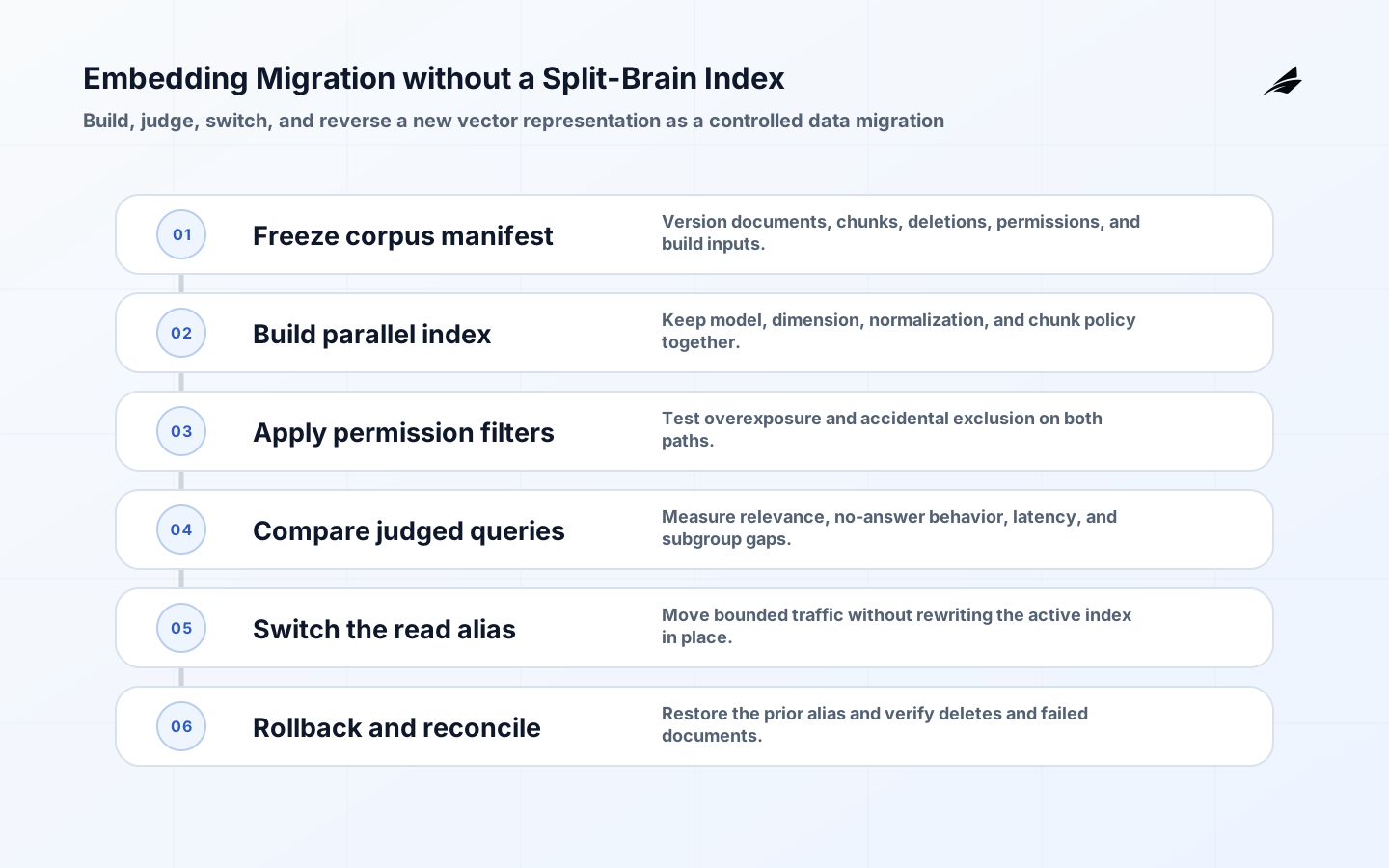
Enforce document authorization before candidates can reach ranking or generation. Metadata filters should use current access policy and be tested for both overexposure and accidental exclusion. Assign ownership separately for source quality, indexing code, model choice, retrieval evaluation, and the consuming workflow. A similarity score is configuration-dependent and should never grant access or authorize a business action. Reviewers need the source item, version, and relevant passage, not a bare numeric score. Use the NIST AI RMF functions to keep governance, context mapping, measurement, and response visible across those owners. Record approved model and corpus combinations so an operator can detect mixed vector spaces or an unplanned reindex.
- Name one owner for the workflow and one owner for each authoritative data source used by embeddings.
- Use least-privilege access for tools, records, and administrative changes.
- Make a pending state normal when evidence, policy, or authority is missing.
- Keep logs useful for investigation without turning protected traces into a new broadly accessible data store.
- Review the control design whenever the workflow scope, vendor, or connected system changes.
Measure live embeddings behavior
Observe the full retrieval path: indexing freshness, failed documents, vector dimension, model version, filter behavior, query latency, empty results, reranking, clicks, citations, and user-reported misses. Segment by corpus and query class because one aggregate relevance score can hide weak exact-match behavior or a neglected language. Store privacy-conscious traces that let an investigator reproduce a bad result without exposing unnecessary content. Pair thresholds with actions: halt an incompatible index build, restore an alias, quarantine a faulty source feed, or route users to keyword search. Compare live samples with a pre-release baseline and a fixed labeled suite so changing traffic does not masquerade as model improvement.
| Signal | Why it matters | Review response |
|---|---|---|
| top-result relevance | Shows whether the bounded task is producing acceptable work. | Sample cases and identify a version or source pattern. |
| hard-negative performance | Shows whether review is catching material problems. | Inspect evidence and adjust the decision boundary. |
| index freshness | Shows whether the fallback path has a real owner. | Escalate capacity or change the route. |
| and migration errors | Shows whether automation shifts burden downstream. | Compare against the manual baseline and recover if needed. |
Run and recover embeddings safely
Design index recovery around immutable builds and a movable read alias. Retain the previous compatible index for a defined window, along with its corpus manifest, embedding configuration, and evaluation result. Rehearse switching traffic back without rebuilding under pressure. If unauthorized material was indexed, stop serving the affected corpus, preserve diagnostic evidence with restricted access, remove the source, rebuild from a known snapshot, and verify deletion in derived stores and caches. Assign one incident owner to classify whether the fault came from source data, permissions, chunking, model configuration, or application logic. Recovery is complete only when retrieval quality and access controls are revalidated, not merely when the endpoint responds.
- Give front-line users a clear route to flag a questionable embeddings result without needing technical access.
- Practice pausing the relevant capability while leaving unrelated work available.
- Reconcile any downstream changes against the system of record after an incident.
- Record the decision, affected scope, correction, and criteria for resuming normal operation.
- Bring repeated exceptions back to the workflow owner rather than asking individual reviewers to absorb the pattern.
Triage retrieval defects before tuning. A wrong result can originate in missing source content, stale ingestion, poor document boundaries, unsuitable chunk size, lost metadata, an access filter, vocabulary mismatch, model behavior, distance settings, or reranking. Reproduce the query against the recorded configuration and inspect candidates before changing anything. Add the failed case and nearby counterexamples to the evaluation set, then test the smallest correction for regressions. The change record should identify corpus snapshot, code and model versions, affected query classes, approval, validation evidence, rollout method, and live confirmation signal. This history prevents teams from repeatedly swapping models when the underlying defect belongs to data or policy.
Release checklist
- The team can state the permitted purpose, prohibited action, owners, and fallback for embeddings in plain language.
- Evaluation includes normal, incomplete, adverse, and changed-condition examples from the real workflow.
- Authorization, output validation, and escalation occur outside untrusted model text.
- Live signals have a baseline, review cadence, accountable owner, and documented action threshold.
- The recovery path has been tested from detection through reconciliation before scope expands.
Review a sample of searches with source stewards, retrieval engineers, application owners, and representative users before adding a corpus or use case. Inspect successful queries, obvious misses, permission-sensitive cases, and empty-result behavior. Ask whether the relevant source existed, whether its version and authority were clear, whether access was correct, and whether the result supported the stated task. Compare the operational gain with indexing, review, and correction effort. Turn unresolved findings into release conditions with owners and dates. Expansion should follow demonstrated retrieval behavior for the new corpus, not the assumption that a model performing well on one document collection will transfer unchanged to another.
Reindex without creating an invisible split brain
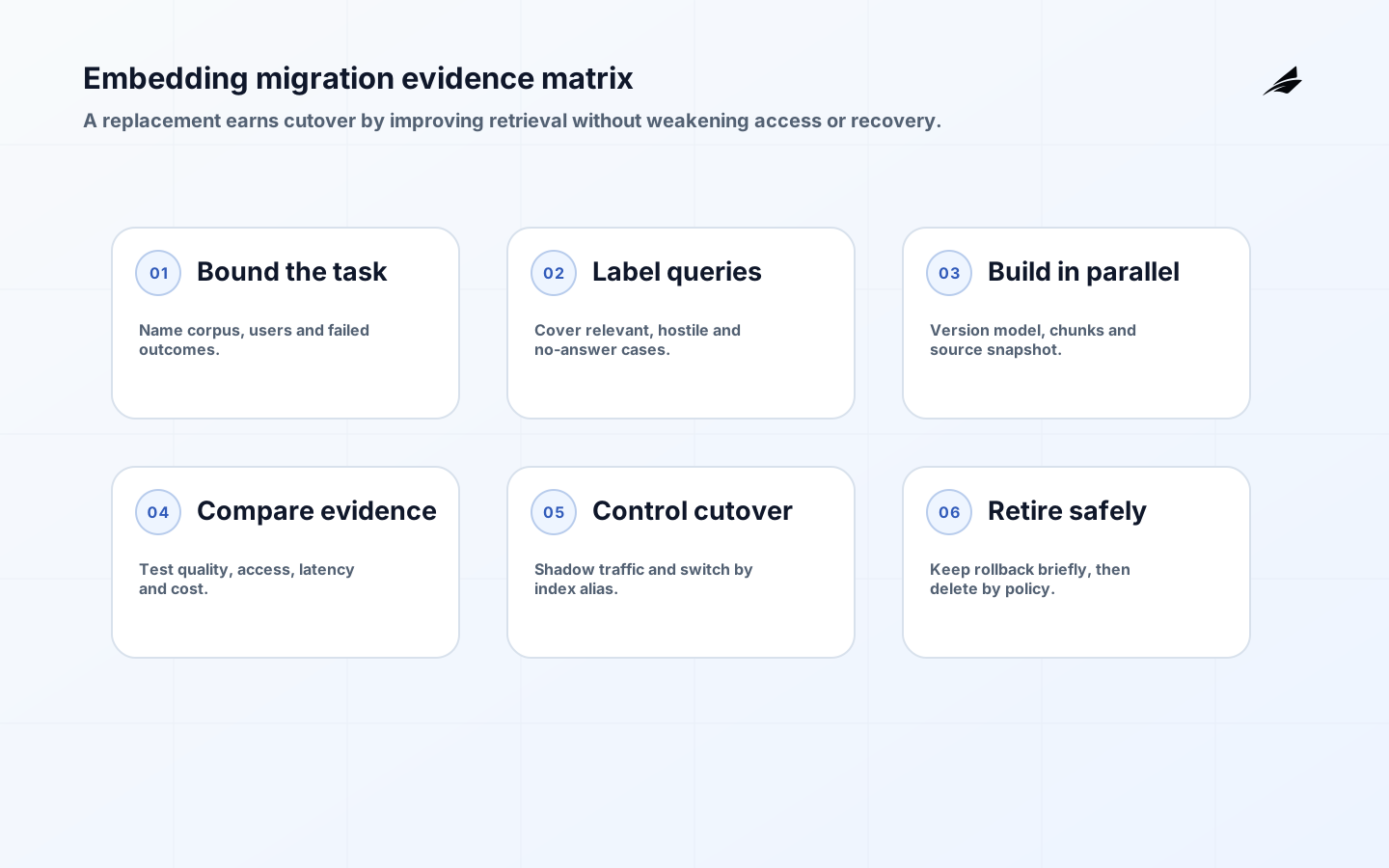
Treat a new model, dimension, normalization method or chunking policy as a data migration. Build a parallel index from a versioned snapshot, run the same labeled query set against both paths, and compare relevance, abstention, latency, cost and subgroup performance. Never mix vectors from incompatible models in one similarity space.
A support knowledge base may improve conceptual queries with a new model while missing short product codes. Keep exact-match retrieval, test permission filters before reranking and shadow the new index on production queries. Cut over by alias only after freshness catches up and rollback is rehearsed; delete the old index after its defined recovery window.
- Define task, corpus, users, permissions and unacceptable retrievals.
- Label relevant, irrelevant, adversarial and no-answer queries.
- Evaluate retrieval separately from generated answers.
- Version source, chunking, model, metric and index settings.
- Test access filtering and cross-tenant isolation.
- Shadow, compare and cut over with rollback.
Key takeaways
- Embeddings should improve a bounded task, not quietly claim broader authority.
- Evidence, permission, and recovery are product requirements alongside model quality.
- Evaluate the cases where the system should stop or seek review, not only the easy successes.
- Use operating signals to decide when to investigate, restrict, or expand the workflow.
Frequently asked questions
Can scores be compared across models?
Not inherently. Calibrate thresholds on representative labeled data for each complete retrieval configuration.
When should an index be rebuilt?
Rebuild when source policy, chunking, preprocessing or model changes require it, and when deletion guarantees cannot be met incrementally.
What is a sensible first embeddings use case? Choose search over a bounded, maintained corpus where users can inspect sources and fall back to an existing method. Does vector similarity replace keyword search? Usually not; hybrid retrieval often protects identifiers and exact phrases that semantic ranking misses. Can one threshold represent confidence? No. Distance values depend on model, normalization, corpus, and query, so calibrate decisions on labeled task data and keep policy checks separate. When should scope expand? Add a corpus only after its ownership, permissions, freshness, evaluation cases, monitoring, and rollback are ready, and after live review shows that the support burden remains acceptable.
Conclusion
Production embeddings are a versioned retrieval dependency, not a permanent representation of meaning. Reliability comes from a defined task, governed corpus, permission checks, representative ranking tests, observable index builds, compatible migrations, and a rehearsed alias rollback. Keep exact-match and manual routes where they remain useful. With those controls, teams can improve retrieval deliberately and explain a result without pretending that vector proximity establishes truth, authority, or permission.