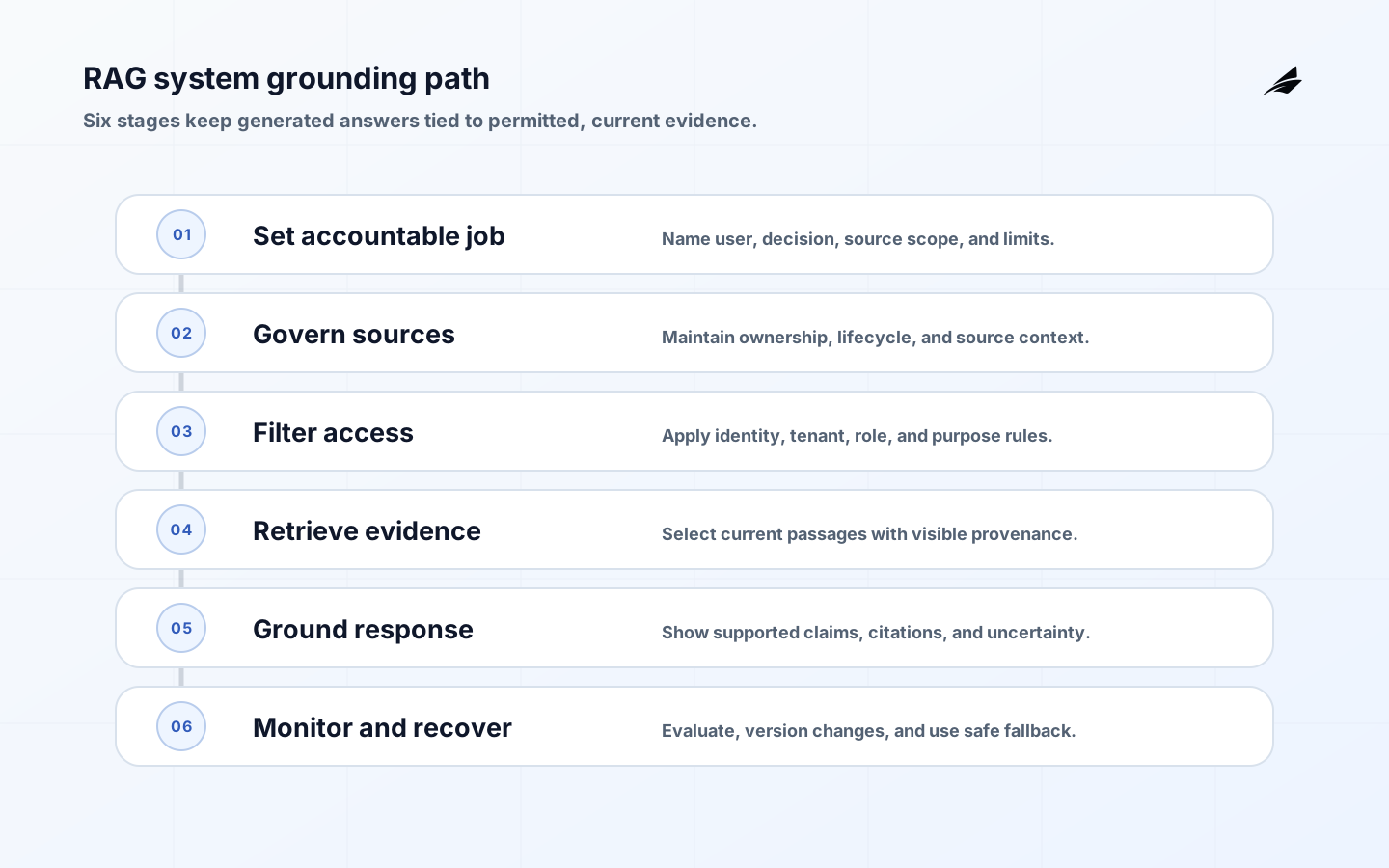
RAG systems combine retrieval with generation so an application can answer using selected external evidence rather than relying only on a model's learned parameters. That can be valuable for changing company procedures, product information, and case context, but it does not make an answer automatically grounded. A RAG system can retrieve the wrong document, retrieve a private document, misread a relevant passage, or generate beyond the evidence it received. Reliable digital operations need a complete path from governed source to displayed answer and human recovery. This checklist helps a team make each link inspectable. Vector search in production is useful further reading for the search layer.
1. Define the RAG system's accountable job
Name the user, decision, approved evidence, permitted output, and forbidden actions. An internal RAG assistant may return a cited explanation of the current deployment procedure to an on-call engineer. It should not claim an unretrieved procedure is authoritative or execute a production change. Identify the source owners and the person who handles an unresolved question. The NIST AI Risk Management Framework helps anchor these decisions in a known governance approach. The boundary provides the basis for access tests, evaluation cases, and meaningful stop conditions.
| Question | RAG system choice | Evidence |
|---|---|---|
| What knowledge counts? | Approved, owned, current records. | Source register and lifecycle state. |
| Who may ask? | Authenticated roles and tenants. | Access decision in request trace. |
| What is shown? | Answer with source citations and limits. | Displayed evidence and response version. |
| What happens on uncertainty? | Decline or route to the owner. | Escalation case and resolution. |
2. Govern sources and their lifecycle
Every RAG source needs an owner, audience, effective date, update route, and retirement state. Preserve document structure and source identifiers through parsing and chunking so a result can be traced to a meaningful section. Exclude drafts and unowned archives by default. When a policy changes, test both the addition of the new instruction and the disappearance of the old one. The original RAG research explains the architecture concept; operational reliability comes from source lifecycle management that the research paper does not provide for a specific business.
- Use a corpus register with source owner, access label, version, and review date.
- Attach title, section, and effective-date context to retrievable chunks.
- Propagate corrections and removals to all indexes and caches.
- Give users a route to flag stale or missing evidence to the source owner.
3. Enforce access before retrieval and generation
Apply requester identity, tenant scope, role, and purpose filters before candidate documents reach the model context. Do not use a generated answer as a place to decide whether information should be revealed. Limit context to the evidence needed for the request and treat retrieved text as untrusted data; a document can contain malicious instructions or misleading content. The OWASP LLM guidance is especially relevant for indirect prompt injection and sensitive-information disclosure. Logs should record the access decision and source IDs without unnecessarily retaining private text.
| Control point | What it protects | Test |
|---|---|---|
| Authentication | Requester identity. | Unauthenticated request is rejected. |
| Metadata filter | Tenant and role boundaries. | Cross-scope query returns no evidence. |
| Context assembly | Minimal disclosure. | Unneeded fields do not enter prompt. |
| Output handling | Unsafe reuse of generated text. | Structured validation before action. |
4. Design answers for evidence review
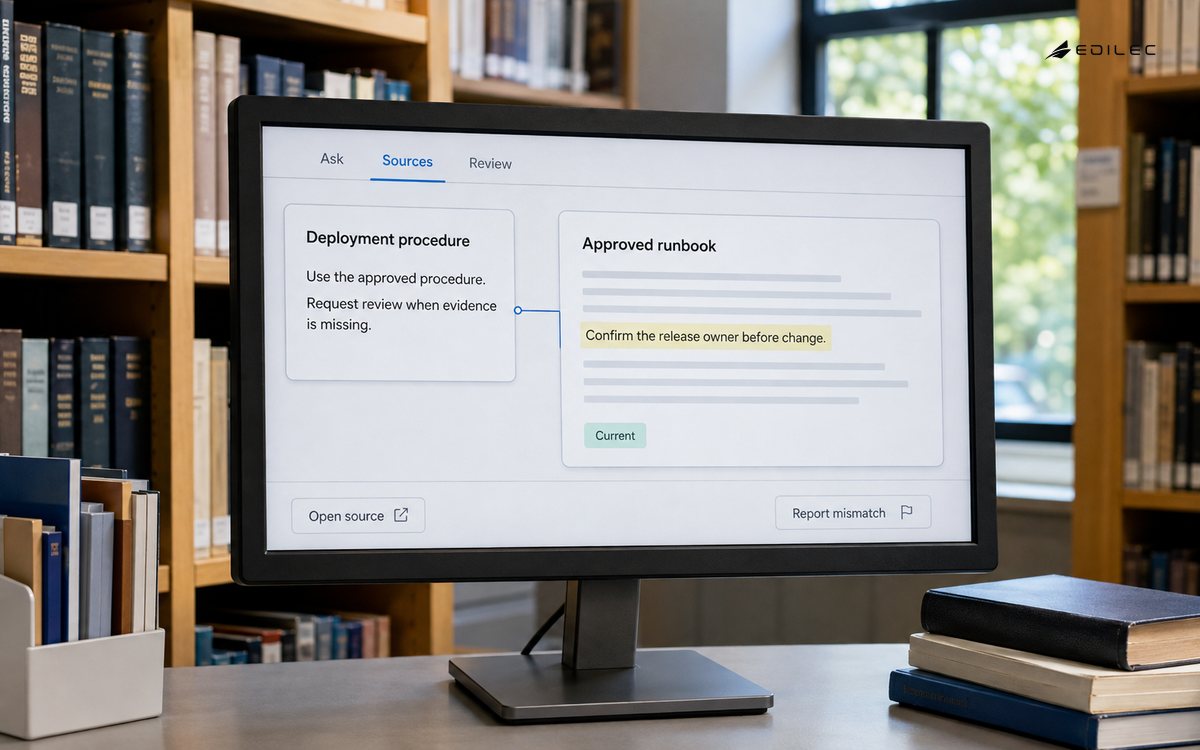
Ask the system to distinguish observed evidence from inference, use direct source references, and state when the retrieved material is incomplete. Keep answer format aligned to the job: a support user may need steps and a cited policy, while an analyst may need a comparison of records and unresolved contradictions. Do not reward verbosity over support. A concise answer with exact citations is usually more useful than an expansive answer that merges several weak passages. Build an interface that lets a reviewer open the evidence and report a mismatch without copying text into another system.
- Show source title, section, effective date, and link near the relevant claim.
- State uncertainty when evidence conflicts, is stale, or does not cover the request.
- Avoid presenting generated conclusions as policy when no approved source says so.
- Let users choose a documented manual route when the answer is insufficient.
5. Evaluate retrieval, grounding, and refusal
Evaluate RAG systems in layers. First check whether the expected, permitted evidence was retrieved; then whether the answer accurately represents it; then whether access and refusal behavior held. Use a versioned set containing routine questions, ambiguous wording, source changes, conflicting policies, out-of-scope requests, and attempts to expose restricted content. Measure citation-supported resolution, retrieval recall, unsupported-claim rate, stale-evidence rate, and reviewer correction. Inspect failures by source family and user role. A strong overall answer score cannot compensate for one serious permission failure.
6. Monitor changes and recover safely
Monitor source freshness, ingestion failures, access denials, retrieval drift, answer feedback, latency, and cost. Release changes to parsing, indexes, prompts, models, and policies as traceable versions, with the judged evaluation set as a release gate. The NIST Generative AI Profile supports ongoing measurement and management of generative-system risk. Operators should be able to pause a source, roll back a configuration, disable answer generation while retaining search, and route users to the established knowledge process.
Maintain RAG quality as knowledge changes
RAG quality depends on the organization continuing to maintain the knowledge it exposes. Assign source owners a practical review cadence and show them feedback that identifies their documents without blaming them for every retrieval issue. A missing-answer report should include the user question category, the evidence that was retrieved, corpus and configuration versions, and whether the failure was access, freshness, retrieval, grounding, or interface. This makes correction specific. Content teams can improve a procedure, search operators can adjust retrieval, and product owners can decide whether the use case is still in scope. Without this separation, every poor response becomes an undifferentiated complaint about the model.
Treat answer feedback carefully. A thumbs-up can signal that the response was convenient, not that it was correct; a thumbs-down may reflect an unavailable policy rather than a retrieval fault. Pair lightweight feedback with sampled expert review and downstream outcomes such as reopened support cases or repeated searches. Schedule an evidence review after important policy, product, or organizational changes. The goal is to discover when the source environment has shifted before users learn to distrust the system. This maintenance work is what turns RAG from a snapshot of documentation into a service that can remain grounded through normal business change.
RAG systems implementation checklist
- Name the user, question class, permitted source scope, answer format, owner, and refusal route for the RAG feature.
- Maintain source ownership, audience, effective date, retirement state, and update route for all admitted records.
- Preserve source title, section, version, and link through parsing, chunking, indexing, and response display.
- Apply identity, tenant, role, purpose, and document-state filters before context is assembled.
- Treat retrieved content as untrusted data and prevent it from overriding application instructions or policy.
- Show citations beside the claims they support, with enough context for a reviewer to inspect evidence.
- Require an explicit uncertainty or escalation state when evidence is missing, stale, conflicting, or out of scope.
- Evaluate expected retrieval, supported claims, access behavior, and valid refusal on a versioned test set.
- Test policy changes and source retirements so replaced evidence disappears as reliably as new evidence appears.
- Measure citation-supported resolution, unsupported claims, stale evidence, reviewer correction, and user bypass behavior.
- Version source corpus, parsing, index, model, prompt, policy, and interface configuration for every release.
- Alert owners about source lag, ingestion failures, unusual denials, retrieval regressions, and answer-quality feedback.
- Give users a manual knowledge route and allow operators to disable generation while retaining safer search.
- Review feedback with content and process owners to distinguish missing policy from technical retrieval failures.
- Expand source scope or action authority only when the current grounded workflow has measurable operational stability.
Conduct a monthly source-health review for the highest-impact RAG collections. Compare their documented owners and review dates with observed freshness, ingestion failures, user feedback, citation corrections, and unresolved questions. Invite the source owner and workflow owner to examine a small sample of real results, including a refusal. The purpose is not to create an editorial burden for every document; it is to make responsibility visible where an answer can influence operational work. This regular contact also catches changes in terminology or process that have not yet reached formal documentation, giving the team a chance to update the source rather than compensating with increasingly complex prompts.
Key takeaways
- A RAG system is reliable only when its source, access, retrieval, and response paths are all governed.
- Citations should lead to current, permitted evidence that supports a specific claim.
- Evaluate retrieval and refusal separately from fluent answer quality.
- Version changes and preserve a manual route so the service can recover safely.
RAG systems FAQ
Does RAG eliminate hallucinations? No. It gives an application evidence to use, but retrieval can be incomplete or wrong and generation can still overstate it. Evaluate support and abstention directly.
Should a RAG system search all company data? Not by default. Start with owned, approved sources for a defined job, then expand only after access, lifecycle, and evaluation practices can handle the new material.
What happens when sources disagree? Show the disagreement, identify the relevant owners, and avoid inventing a reconciliation. A contradiction is an operational signal for policy or content maintenance.
Conclusion
Reliable RAG systems are evidence systems first and language systems second. Define one accountable task, govern source and access lifecycle, make claims reviewable, and test the circumstances where the right result is a refusal. This creates AI assistance that can improve day-to-day operations without hiding its basis for trust.