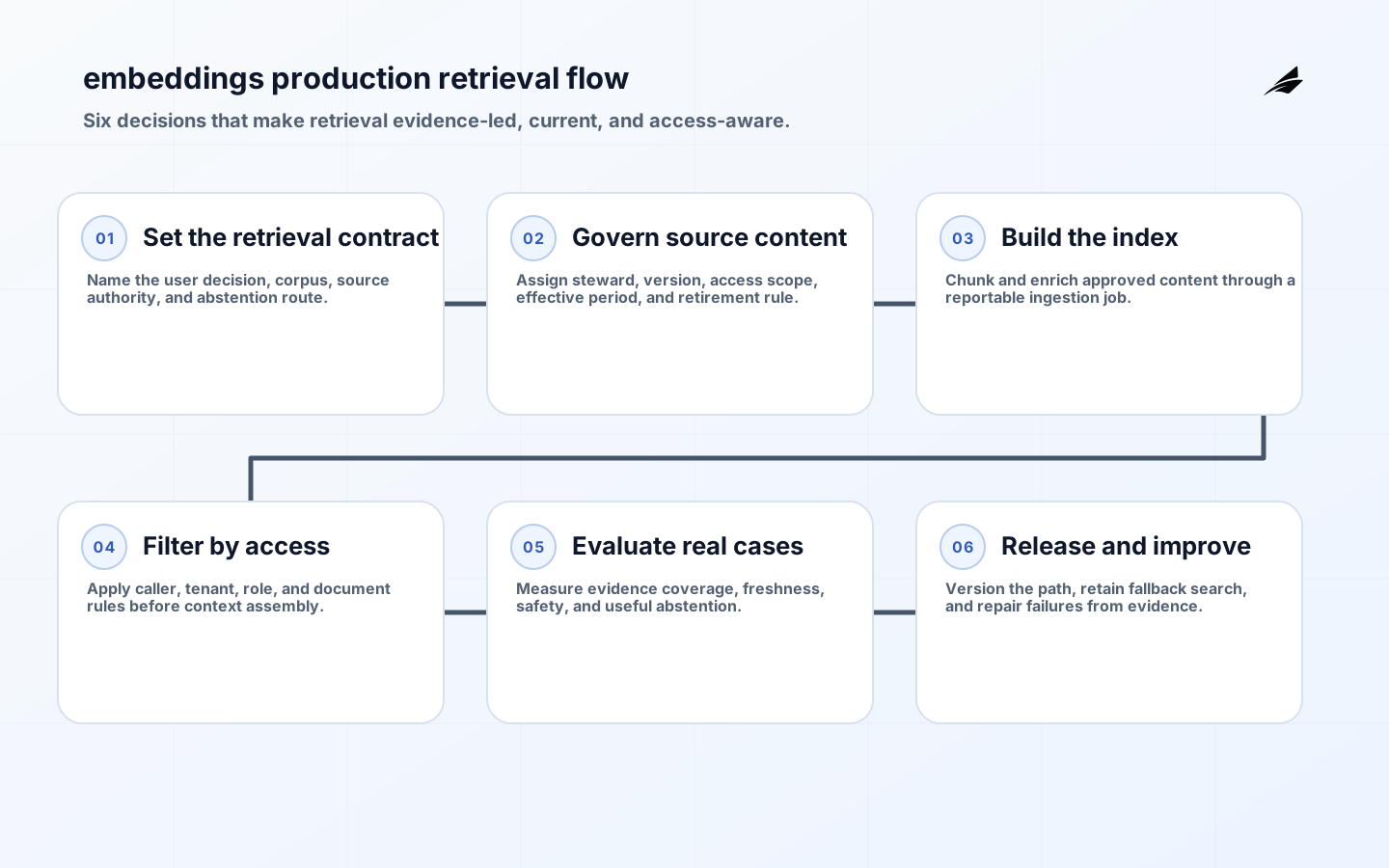
Embeddings become a production concern when a team stops asking whether vectors can retrieve plausible text and starts asking whether a user can rely on the result in a live workflow. The unit of design is not an embedding model; it is an information service with a purpose, an owner, a source boundary, access rules, and a way to correct mistakes. A support assistant that retrieves an expired return policy and a finance assistant that exposes another team's notes can both look technically successful while failing the business. The OpenAI embeddings guide explains how text is represented for similarity work, but production value comes from the surrounding retrieval contract. For a broader planning lens, see Embeddings for AI Automation.
Set The Retrieval Contract
Start with one decision a person already makes: locate the current exception policy, assemble evidence for a case, or route a request to the right procedure. State who is served, what corpus is in scope, which source is authoritative when material conflicts, and what the assistant should do when no evidence clears the threshold. That last condition is essential. A system that offers a concise abstention and routes the case is often more useful than one that fills a gap with fluent invention. The NIST AI RMF frames this kind of work as governing, mapping, measuring, and managing risk across a lifecycle rather than treating deployment as a finish line. Write the contract so an operations owner can test it without reading vector-database documentation.

| Contract element | Production question | Evidence of readiness |
|---|---|---|
| Decision | Which user question or workflow step is supported? | A named owner can explain the expected outcome and abstention path. |
| Corpus | Which records may be indexed and cited? | Each source has a steward, effective date, and retirement rule. |
| Access | Which results may this user see? | Filtering is enforced before content reaches the model context. |
| Freshness | When does a changed record become retrievable? | An ingestion target and a stale-content alert are documented. |
Govern Content Before Indexing
Chunking, metadata, and model choice matter, but they should follow content governance. Give every indexed item a stable identifier, source version, effective period, tenant or audience scope, and deletion behavior. Preserve the canonical record in its system of record; the retrieval index is a derived view that must be rebuildable. This makes incident response tractable: an operator can locate every chunk derived from a withdrawn handbook page instead of hoping a semantic search finds it. It also prevents a familiar failure mode in RAG systems, where a polished answer masks that two differently dated documents were treated as peers. Retrieval pipelines deserve the same change discipline as application data; this retrieval-pipeline guide supplies useful adjacent questions.
- Assign a content steward who can approve inclusion, correction, and retirement.
- Store source, version, timestamp, access scope, and extraction method with every retrievable unit.
- Separate public reference material from internal policies and tenant-specific records.
- Re-index through a controlled job that reports successes, failures, and backlog age.
- Keep a tested path for removing content and invalidating cached answers after a policy change.
Make Retrieval Access-Aware
Authorization belongs in the retrieval service and connected systems, not in a prompt that asks the model to be careful. Resolve the caller's identity and role, apply document and tenant filters, then retrieve only material that the caller is allowed to receive. Treat retrieved text as untrusted input too: documents can contain instructions that attempt to redirect a model or persuade it to disclose unrelated data. The OWASP guidance for LLM applications is a useful reminder that prompt injection and excessive agency require conventional defensive design. Return source references with the answer, and let the interface distinguish a cited policy from a helpful synthesis. Those cues help a user judge whether to act or escalate.
Evaluate The Whole Retrieval Path
Evaluate with real cases, not only generic question-answer pairs. Build a reviewed set containing routine requests, ambiguous wording, outdated vocabulary, similar-but-wrong policies, restricted documents, and questions that should receive no answer. Inspect retrieval separately from answer generation: a poor answer may begin with a missing chunk, a bad access filter, an irrelevant reranker, or an unhelpful instruction. Measure supported-answer rate, source coverage, stale-hit rate, unsafe disclosure attempts, latency, and the share of useful abstentions. The NIST Generative AI Profile is particularly valuable here because it treats testing and monitoring as part of risk management, including risks introduced by data and human interaction.
| Observed signal | Likely cause | Practical response |
|---|---|---|
| Correct answer, weak citation | Answering layer outruns retrieved evidence | Require source display and penalize unsupported claims in evaluation. |
| Old policy appears often | Ingestion or retirement process is lagging | Trace the source version and repair the index lifecycle. |
| Relevant content is absent | Chunking, metadata, or query interpretation is weak | Review failed cases with source owners before changing the model. |
| Restricted result is retrieved | Identity or filtering boundary is incomplete | Block release, audit the query path, and retest permissions. |
Release With Change Controls
Release a bounded corpus and a reversible use case first. A help-desk knowledge assistant that drafts a linked answer is easier to observe than an autonomous system that changes customer records. Version the embedding model, chunking rules, metadata schema, prompts, and index build together so a result can be explained later. Run representative evaluations before a material change, then compare production signals by version after rollout. Cost should be managed as a service characteristic: track ingestion volume, storage, query rate, and the portion of retrieved context that people actually use. A clear disable switch, an ordinary search fallback, and a support runbook turn a promising retrieval feature into something an on-call team can operate.
Operating Checklist
A production embeddings review should finish with named decisions rather than a long technology shopping list. Confirm that the corpus is intentional, source ownership is visible, access is enforced before generation, evaluation represents difficult cases, and removal works in practice. Review the question patterns that force abstention: they often reveal missing data, confused policy language, or a workflow that needs a human decision. Use corrections to improve the source or the contract first; tuning a response style cannot repair an unsupported business rule. This discipline also keeps expansion honest. Add domains only when the existing service meets its support, freshness, and permission obligations.
Review Retrieval Economics
Embeddings also need an operating budget. Costs arise when content is initially processed, when changed material is re-indexed, when queries retrieve context, and when that context increases downstream model use. Treat those costs as a reason to improve corpus discipline, not as an excuse to strip away evidence. Measure documents and chunks ingested per source, re-index backlog, retrieval depth, cited-source use, query latency, and cost per resolved workflow. A source that is rarely retrieved, routinely stale, or duplicated across collections may be a candidate for removal. A frequently retrieved source that produces corrections may need better metadata or ownership. Review capacity alongside quality: a release that improves relevance but makes the index impossible to rebuild within a recovery window is not fully operable. This evidence lets a CTO decide whether to add a domain, change ranking, or invest in source cleanup based on actual service behavior.
- Set a freshness objective for each source class and alert on missed ingestion or retirement jobs.
- Compare the cost and usefulness of retrieved context rather than rewarding larger context windows.
- Exercise an index rebuild from canonical sources and measure recovery time before declaring the service resilient.
- Review source overlap so the same policy does not compete with outdated or translated variants.
- Budget human review for disputed answers, source corrections, and permission incidents as part of the service cost.
- Use a staged corpus expansion plan with explicit quality and support thresholds for each new domain.
Frequently Asked Questions
Do embeddings eliminate the need for search design? No. Embeddings improve semantic matching, but query understanding, metadata filters, ranking, citations, and source quality still determine whether a result is useful. Should every document be indexed? No. Index only material whose owner, audience, retention, and update behavior are known. Is a confidence score enough to automate a response? No. Use evidence quality, consequence, source freshness, and an escalation option alongside any score. When should a team fine-tune instead? If repeated tasks require behavior that retrieval cannot provide, assess the trade-off carefully; fine-tuning decisions is a useful companion.
Key Takeaways
- Production embeddings are a governed retrieval service, not merely a vector index.
- Content provenance, freshness, and access filters are requirements before answer quality.
- Evaluate retrieval, generation, and permissions with difficult cases separately.
- Version the entire retrieval path and keep a conventional fallback for live operations.
Conclusion
Embeddings earn trust in production when they make evidence easier to find without making authority harder to see. Define the decision, govern the corpus, enforce access at the boundary, and learn from observed failures. Those habits create a retrieval service that can improve over time instead of becoming another opaque data store.