Fine-tuning decisions should begin with a measured system failure, not with the availability of a tuning API. Fine-tuning changes a model's parameters using task examples or preference data. It can improve repeated response structure, domain behavior, style, classification, tool selection, or task performance. It does not reliably provide a current knowledge base, enforce authorization, repair a broken workflow, or remove the need for evaluation. IT managers should ask whether a tuned model creates a material and durable advantage over clearer instructions, better context, retrieval, deterministic tools, validation, or a different base model.
Treat the decision as an investment in a new model lifecycle. The NIST AI RMF emphasizes governance, context mapping, measurement, and risk management across the lifecycle, and the NIST Generative AI Profile applies those functions to generative systems. A tuned artifact creates data, versioning, security, deployment, monitoring, rollback, and retirement responsibilities. If no team owns those responsibilities, the apparent one-time quality improvement may become a long-term reliability problem.
Diagnose the failure before choosing fine-tuning
Collect representative failed tasks and classify why they failed. Missing or outdated facts suggest retrieval or an authoritative tool. Ambiguous instructions suggest prompt and interface work. Invalid fields suggest schema-constrained output and validation. A long prompt repeated on every request may create latency and cost that tuning could reduce, but measure that hypothesis. Inconsistent domain style, specialized classification, or repeated tool-routing behavior may be stronger candidates when examples are stable and success can be labeled.
Separate model error from system error. A model cannot retrieve a record it was never given, obey a permission the application did not enforce, or compensate for contradictory policy. Review preprocessing, context assembly, tool results, output parsing, user interface, and reviewer guidance. Use traces to reconstruct a failure. The LLM observability checklist helps create request-level evidence before customization, while prompt library governance improves reusable instructions and release controls.
| Observed problem | Test before tuning | Why |
|---|---|---|
| Answers miss current policy | Permission-aware retrieval with citations | Model weights are a poor current record store |
| Output violates schema | Structured output and deterministic validator | Enforcement belongs outside free text |
| Style varies | Clear examples and prompt template | May solve the issue without a new artifact |
| Task accuracy is weak | Compare stronger base model and better context | Capability or evidence may be missing |
| Prompt is very long | Measure instruction compression and latency | Tuning may reduce repeated context |
| Tool choice is unstable | Improve tool descriptions and constrained routing | Workflow design may be the real cause |
Establish a baseline and required improvement
Build an evaluation set before preparing training data. Sample real task classes, difficult cases, user groups, languages, risk levels, and prohibited behavior. Define scoring rules and qualified reviewers. Keep a holdout that remains independent of prompt and dataset iteration. Measure task quality, unsupported claims, refusal or abstention, structured-output validity, latency, cost, and human correction. Where judgment is subjective, track reviewer agreement and document acceptable variation.
Set a decision threshold in advance. For example, tuning must improve a critical classification slice by a defined margin without reducing safety, increase schema validity while holding factual quality, or reduce median latency and cost enough to justify maintenance. Avoid choosing the tuned model because its demonstrations look better. Compare confidence intervals or repeated samples where output is stochastic, and inspect error types even when the average rises. A critical regression should block the decision despite a stronger headline score.
- Use the same evaluation harness for every alternative.
- Keep training and holdout examples separate by source and near-duplicate.
- Score critical slices rather than relying on one average.
- Record reviewer instructions and disagreement.
- Include security, privacy, refusal, and misuse cases.
- Define how much improvement is worth a new operating burden.
Compare simpler and complementary interventions
Prompting changes how the model interprets a task at runtime and is easy to revise. Retrieval provides current, attributable knowledge and can enforce source permissions. Tools perform deterministic calculations and system actions. Fine-tuning changes learned behavior and may reduce repeated instruction, but updates require another data and release cycle. These are not mutually exclusive. A tuned model may still use retrieval for policy and tools for transactions, while the application validates output and authorizes action.
Run a controlled bake-off: current baseline, improved prompt, retrieval or tool augmentation, a stronger or smaller base model, and a tuning pilot. Keep data, task distribution, and scoring consistent. Include end-to-end latency and cost rather than model invocation alone. Managed-platform documentation such as Google Cloud's supervised fine-tuning guide and OpenAI's fine-tuning guide describes supported methods and data formats, but platform capability is only one selection criterion.
| Intervention | Best fit | Key limitation |
|---|---|---|
| Prompt and examples | Clarify stable instructions quickly | Long prompts and residual variability |
| Retrieval | Current or private knowledge with citations | Retrieval quality and permissions must be operated |
| Deterministic tool | Calculation, validation, and system action | Requires explicit interface and error handling |
| Different base model | Capability, language, latency, or cost shift | May change behavior across many slices |
| Fine-tuning | Repeated behavior supported by quality examples | Creates dataset and model lifecycle |
| Workflow redesign | Failure comes from handoff or policy ambiguity | Requires operational change beyond the model |
Use a fine-tuning decision matrix
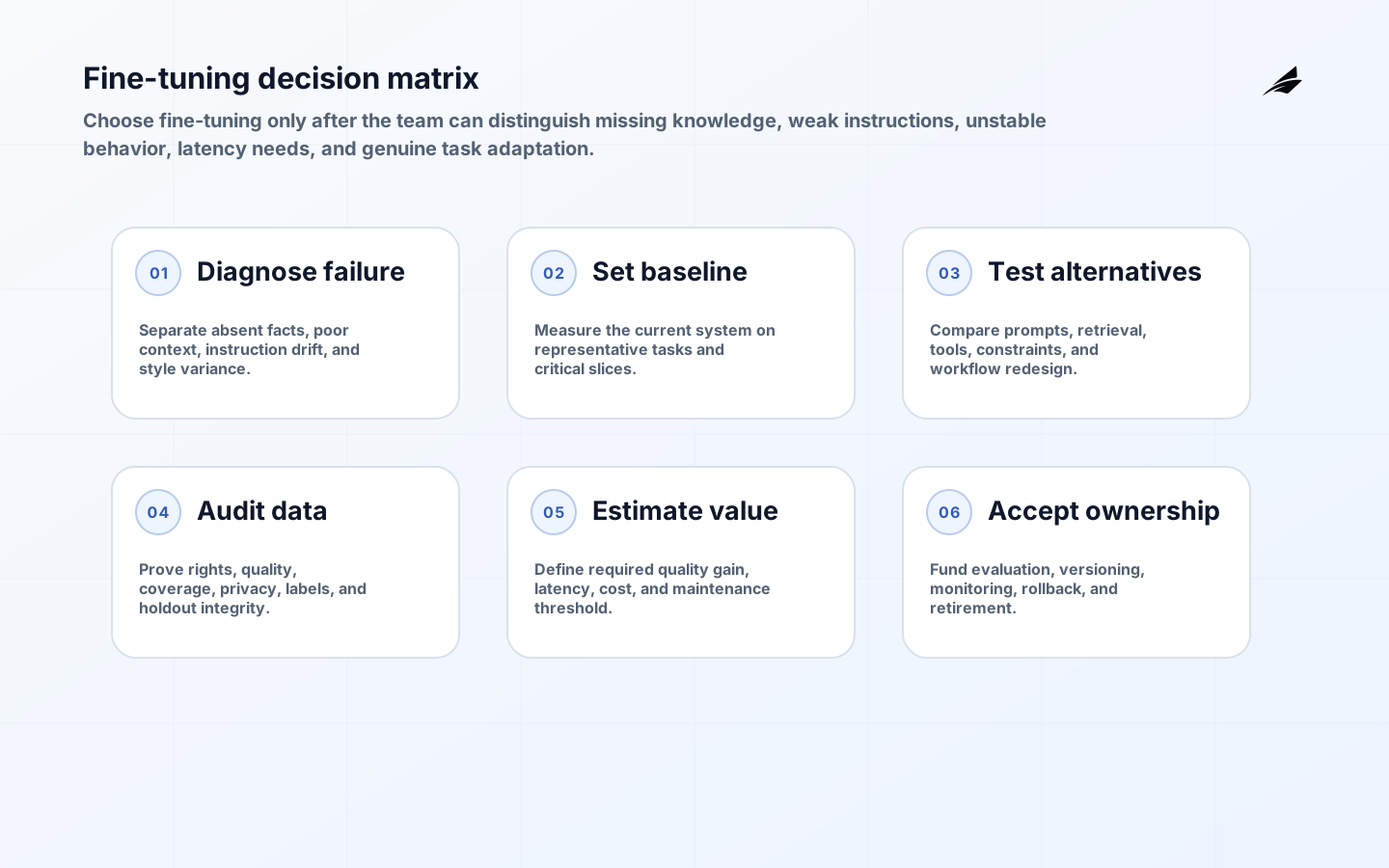
The decision matrix prevents a team from jumping from dissatisfaction to training. It asks whether the failure is understood, a baseline exists, alternatives were tested, data is ready, expected value is material, and operating ownership is funded. A single weak dimension can stop the project: excellent examples without rights cannot be used, and an accurate tuned model without monitoring may become unsafe after the task or provider changes.

Assess training-data rights, quality, and coverage
Inventory source, ownership, license, consent, purpose, personal and confidential data, retention, geography, and deletion obligations. Do not assume that data available to employees is permitted for model training. Remove secrets and unrelated personal data, preserve provenance, and document transformations. Define a schema and labeling guide. Sample labels independently, measure disagreement, and investigate shortcuts such as templates or metadata that leak the answer without representing the real task.
Dataset size alone is not readiness. Look for coverage of important tasks and failure boundaries, balanced examples, realistic inputs, correct outputs, negative and abstention cases, and representation of deployment conditions. Deduplicate near-identical records across training and evaluation. Reserve a clean holdout and test for memorization or unintended regurgitation. The UK NCSC's secure AI system development guidelines emphasize secure design, development, deployment, and operation across the AI lifecycle.
Run a data-readiness review with people who understand the source process. Ask which examples reflect old or disputed policy, which labels were created under time pressure, which populations are missing, and which errors were later corrected outside the dataset. Training on historical decisions can reproduce institutional inconsistency rather than expertise. Preserve effective dates and policy versions, and exclude examples whose target behavior no longer applies. Where a rare high-consequence case lacks enough trustworthy examples, retain deterministic policy or human review instead of manufacturing confidence through synthetic volume.
Define pilot stop conditions before spending on a full dataset. Stop when rights cannot be established, reviewer agreement remains too low, the holdout is contaminated, simpler alternatives meet the target, or critical slices regress. Pause when data preparation cost exceeds expected operational benefit. A disciplined stop is useful evidence: the team tested a hypothesis without creating a production artifact no one can maintain. Retain the diagnosis and evaluation design so a later base-model improvement can be assessed without repeating discovery.
Estimate lifecycle value and exit conditions
Include data preparation, expert labeling, training jobs, evaluation, safety review, registry, serving, observability, incident response, provider or base-model updates, retraining, and retirement. Estimate the cost of false results and human correction alongside token price. Determine whether tuning locks the organization to a model family or region and whether data can be exported or deleted. Write an exit condition: if the tuned version does not meet the threshold, if a new base model surpasses it, or if the task changes materially, return to the simpler architecture.
Approve a pilot only with named owners for task quality, training data, security and privacy, model release, application behavior, and operational response. Separate the decision to train from the decision to deploy. The practical fine-tuning delivery guide covers dataset contracts, reproducible runs, evaluation gates, canary release, rollback, and model retirement once the investment case is sound.
Key takeaways
- Fine-tuning should address a diagnosed and measured behavior gap.
- Current knowledge, authorization, and deterministic validation belong outside model weights.
- Compare prompting, retrieval, tools, base models, and workflow redesign fairly.
- Training-data rights, coverage, provenance, and holdout integrity are decision gates.
- Require a material improvement without unacceptable slice regressions.
- Budget for a model lifecycle and define when to stop or retire it.
Frequently asked questions
Should an organization fine-tune instead of using RAG?
They solve different problems. Retrieval-augmented generation supplies current, attributable knowledge at runtime. Fine-tuning changes behavior. A system may use both: tuning for task format or routing and retrieval for controlled knowledge.
How much training data is enough?
There is no universal number. Quality, consistency, coverage, task complexity, method, and base model matter. Run learning curves and evaluate by critical slice. More duplicated or weak labels can make a dataset larger without making it better.
What happens when the provider updates the base model?
Treat it as a new dependency and model version. Re-run the evaluation suite, verify tuning support and behavior, compare the untuned new baseline, and plan migration or rollback. Do not assume a previous tuned artifact transfers unchanged.
Conclusion
The best fine-tuning decision may be to improve the surrounding system. Diagnose the failure, establish a representative baseline, compare simpler interventions, audit data, and define the value required to justify a new lifecycle. Fine-tune when examples encode stable behavior that model customization can learn and when a team can operate the result. That discipline turns tuning from an experiment driven by novelty into an accountable engineering investment.